Which medical billing resources answer your practice's problem right now?
Pick the line that sounds like your practice this month.
- Claims are piling up past 90 days. How much of your A/R over 90 days you can still collect, and whether to work it in-house or hand it off.
- Denials keep coming back and nobody reworks them. Why your claims are denied and which fixes come first.
- Your biller quit, or your billing company stopped answering. What to do this week so collections keep coming in.
- You are weighing outsourcing. Compare an employed biller against a percentage fee, then check what billing costs beyond the headline rate.
- A new clinician or a new practice is waiting to bill. How practices get in-network with insurers, and the billing setup checklist for a new practice.
- You want to check the billing yourself before deciding anything. A billing audit you can run on your own reports.
How much time do payers give your practice to file a claim?
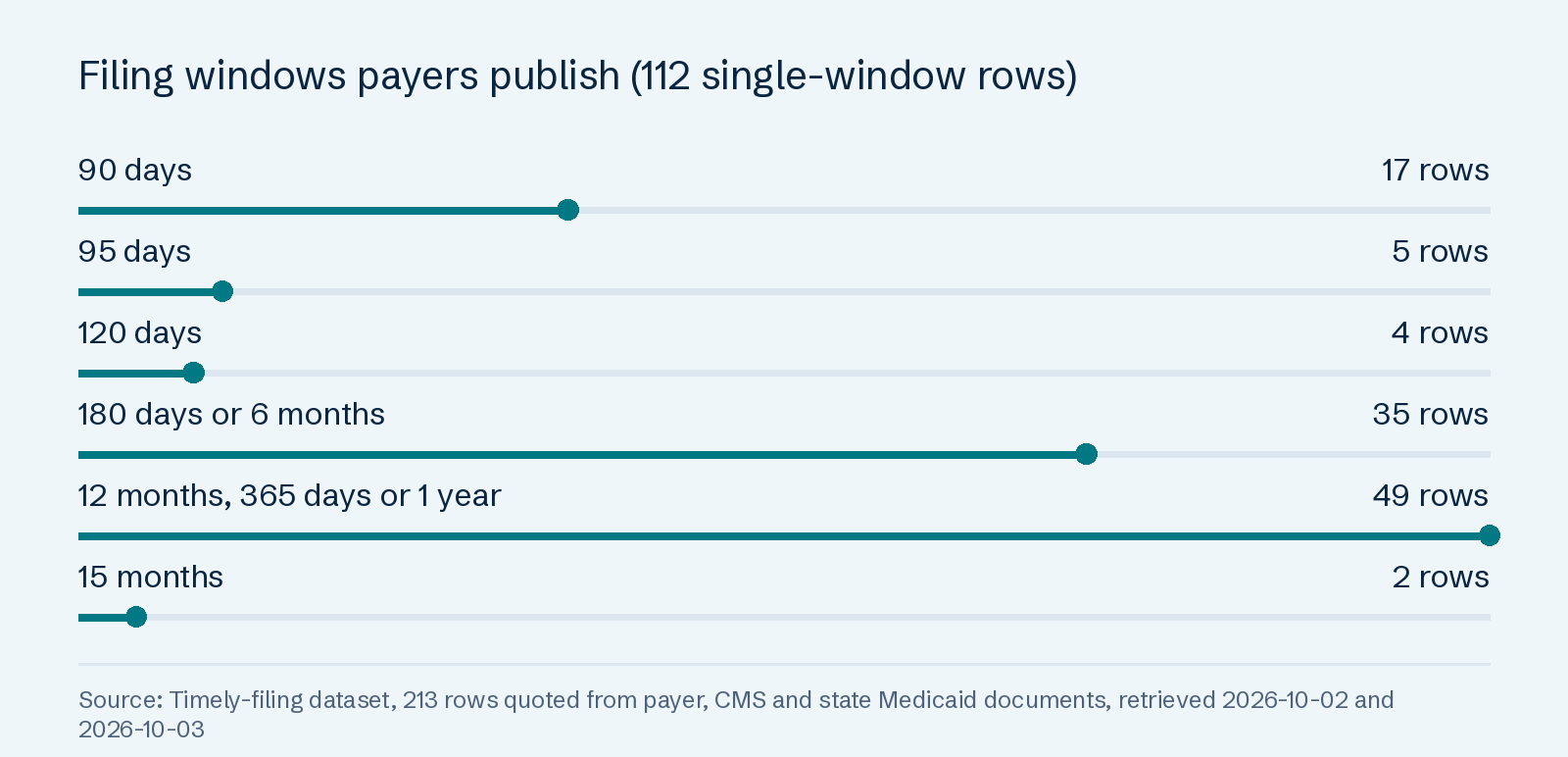
Payer filing windows run from 90 days to 15 months among the rows in our timely-filing dataset that publish a single window, and short windows are common. The dataset has 213 payer rows, each backed by a quote from the payer's or government agency's own document; 112 of them publish one filing window with no split by network status and no exception. Of those 112, 17 allow 90 days and 5 allow 95 days. Another 14 rows publish no number at all and leave the window to the provider contract or the plan.
How short can a payer's window be?
New York's fee-for-service Medicaid program (eMedNY) requires claims to be initially submitted within 90 days of the date of service, unless the delay was outside the provider's control. A New York Medicaid claim that sat unbilled for three months can already be past that window.
What does Medicare allow your practice?
Medicare fee-for-service is longer: a claim must be filed no later than the close of the period ending 1 calendar year after the date of service (42 CFR 424.44), with narrow exceptions listed in the rule. That gap is why aged A/R and filing deadlines are one problem: a claim owed by a 90-day payer can expire while a Medicare claim of the same age still has months left. Deciding who in your practice owns each payer's filing clock matters more than memorizing the numbers.
| Published filing window | Rows in dataset | Share of the 112 single-window rows |
|---|---|---|
| 90 days | 17 | 15.2% |
| 95 days | 5 | 4.5% |
| 120 days | 4 | 3.6% |
| 180 days or 6 months | 35 | 31.3% |
| 12 months, 365 days or 1 year | 49 | 43.8% |
| 15 months | 2 | 1.8% |
Which billing numbers can you check yourself for free?
Two numbers from your monthly billing report are worth checking yourself. A/R days is total accounts receivable divided by average daily charges. Net collection rate is payments divided by charges minus contractual adjustments. The free billing calculators run these on your own figures in the browser, with no sign-up.
What other billing decisions do these guides cover?
Guides publish in stages; the list under this table shows every guide live today, filed under the question it answers. Our editorial policy explains how each one is sourced and dated.
Is our billing losing money?
- A/R Over 90 Days: What Your Practice Can Still CollectWhich old claims your practice can still collect, how to read your 90+ share, and when to work it or hand it off.
- How to Improve Revenue Cycle Management in Your PracticeWhere your practice loses money between visit and payment, which revenue cycle stage to fix first, and what you can hand off.
- How to Prevent Timely Filing Denials in Your PracticeWho watches your payers' filing clocks? Which payers give you the least time, and how to stop claims expiring unpaid.
- How to Reduce Claim Denials at Your Medical PracticeWhy your claims get denied, what it costs, which causes to fix first and when to hand denial work to a billing team.
- Medical Billing Audit Checklist for Practice OwnersTen checks you can run on your own numbers: A/R over 90 days, unworked denials, underpaid claims, filing deadlines and overpayments.
- Revenue Cycle KPIs: The Numbers to Check Every MonthThe five numbers that show whether your billing works, what the monthly report must show, and how to tell a bad month from a real problem.
Are we paid for everything we do?
Should we outsource billing, and to whom?
- How to Choose a Medical Billing Company: A ChecklistEight checks with red flags and nine contract terms to read before you sign with a medical billing company.
- Medical Billing Cost in 2026: What Your Practice PaysWhat 31 billing companies publish, what the percentage is taken on, and a calculator to compare two quotes for your practice.
- Medical Billing Outsourcing vs In-House: 2026 Cost ModelEmploy a biller, buy software or outsource? Compare full costs, a worked break-even model and the contract terms that can change the result.
- Switching Medical Billing Companies Without Losing A/RWho works your old claims, what to get before notice, and how to keep cash arriving while you change billing companies.
- What to Do When Your Medical Biller Quits: First 30 DaysYour biller quit or your billing company went silent: the logins, deposits and deadline checks to run this week.
Getting credentialed and paid by payers
- How to Get Credentialed With Insurance Companies: TimelinesHow long each payer takes, what your practice must supply, and what you can hand off while you wait.
- New Medical Practice: Billing and Credentialing ChecklistThe checks to run before a new practice's first claim: enrollment order, published lead times and when insurance first pays.
Therapy and behavioral health practices
| Group | Questions it is built around |
|---|---|
| Is our billing losing money? | Denials, aged A/R, filing deadlines, patient balances, the monthly numbers and a self-run audit |
| Are we paid for everything we do? | Underpaid and unbilled work: downcoding, Medicare rates, care management, telehealth and therapy units |
| Should we outsource billing, and to whom? | Cost, in-house vs outsourced, choosing or switching a billing company, a biller who left |
| Getting credentialed and paid by payers | How long each payer takes, what it costs, what keeps contracts active, what to hand off |
| Therapy and behavioral health practices | Insurance or private pay, panels, billing options and session rates |
When should you hand the problem to a billing team?
Hand it off when the numbers above show claims aging faster than your team can work them. The Free A/R Deadline Map is the first step, at no cost. A claim-by-claim list of every unpaid insurance claim over 90 days in the aging report you send: payer, amount, the deadline it faces, the denial reason and the next action, sorted by deadline. It takes 5 business days. Clock starts with your claim-level aging export and signed BAA; above 10 requests in a week, we confirm your date within 1 business day. Request the A/R Deadline Map.
For ongoing work, compare the scope of full-service medical billing and credentialing for new providers, and the published rates for each practice size.
Common questions
- Where is my practice most likely losing billing revenue?
- Check four places first: claims older than 90 days, denials nobody has reworked, claims close to a payer's filing deadline, and visits by clinicians whose payer enrollment is not yet effective. The self-run billing audit covers aged A/R, denials and filing-deadline exposure on reports you can pull yourself. For the fourth, see when each payer lets a new clinician bill in-network.
- Should our practice outsource medical billing or keep it in-house?
- Outsourcing makes sense when a percentage fee costs less than an employed biller's pay, benefits and software, or when claims and denials are going unworked because nobody has time for them. The in-house vs outsourced comparison does the break-even math by fee rate and staffing size.
- How long until a new provider can bill insurance?
- For Medicare, a physician's or non-physician practitioner's billing privileges start on the later of the date an approved enrollment application was filed or the date they began seeing patients at the new location (42 CFR 424.520(d)). If circumstances prevented enrolling in advance, they can bill for up to 30 days before that date once all program requirements are met (42 CFR 424.521(a)). Commercial payers set their own timelines, so file early.
- What should our billing company report every month?
- At minimum: A/R days, aged A/R over 90 days, net collection rate and denial rate, each split by payer and defined in the guide to monthly billing numbers.
- What does medical billing cost a practice?
- A percentage-of-collections quote is only part of the cost: the fee base, any monthly minimum and old A/R decide what you actually pay. The billing cost guide shows how to compare two quotes, and our pricing page publishes our rates.
- How long does a payer give our practice to file a claim?
- It depends on the payer and your contract. In our timely-filing dataset, the 112 payer rows that publish one window allow from 90 days to 15 months, and 22 of them allow 95 days or less. New York's fee-for-service Medicaid allows 90 days from the date of service; Medicare fee-for-service allows 1 calendar year. Confirm each payer's current rule before you rely on it.
Sources and review
Page revised October 7, 2026 · Review contact: Hyder Shah (inquiries@claimpillar.com). Chart and table counts come from our timely-filing dataset (payer and agency documents retrieved 2026-10-02 and 2026-10-03); filing windows change, so confirm a payer's current rule before acting on a claim.