When to outsource medical coding
Practices hand off coding when the codes on their claims stop matching the notes behind them, or when nobody has time to keep the two matched:
- Your coder left, or clinicians code their own visits. Charges wait for codes while the payer's filing limit keeps running.
- The same bundling or unit denial returns every month. The fix never reached the charge screen.
- Almost every visit lands on one E/M level. A template may be choosing the level instead of the note.
- A payer asked for records. For a one-time look back at past claims, start with a one-time coding and billing audit; this service codes every new claim going forward.
One team owns code review and billing follow-up for the same claim.
What our medical coding services cover
Our coding team takes every professional claim line from the clinician's signed note to a released or held charge: CPT and HCPCS procedure codes, ICD-10-CM diagnosis codes, modifiers and units.
Coding-related denials stay with the team that assigned the code: we correct, appeal or return the fix and log the cause. To see which step in your practice causes each denial, read our guide to reducing claim denials.
| Task | Deliverable | Timing | What you keep |
|---|---|---|---|
| Code each visit and procedure from the signed note | CPT or HCPCS, ICD-10-CM, modifiers and units on the charge | Claim out within 1 business day of complete charge data | Clinician sign-off on any code change |
| Run NCCI code-pair and unit edits | Each flagged line fixed when the note supports the fix, or held with the reason written down | Before every submission | Your payer contracts and fee schedule |
| Query unclear documentation | A written, non-leading query that quotes the note | Before the claim is released | The clinical answer and any addendum |
| Work coding-related denials | Corrected claim when the note supports it, appeal, or the fix returned to you | Within 2 business days of posting | The final say on any appeal |
| Apply code-set and edit updates | Each claim coded and scrubbed with the code set and NCCI edits in force on its date of service | ICD-10-CM each October 1, NCCI edits each quarter | Your charge screens and favorite lists |
| Report coding results | A coding section in the monthly KPI report, with formulas | By the 10th of each month | The report and its definitions |
Where coding costs practices money, and what we do about it
Five coding failures cost practices money. Our response to each:
- Codes billed below the note. A visit billed a level lower than the note supports simply pays less, and no denial warns you. We code to the note and report each clinician's E/M level mix monthly.
- Codes billed above the note. HHS-OIG treats billing a code that pays more than the code that reflects the service furnished as upcoding. We never raise a level the note does not support.
- Bundled pairs and impossible units. Medicare's NCCI edits exist to stop payment for incorrect code combinations and incorrect units of service. We run them on every line and hold any flagged line with the reason written down.
- Coding from an unclear note. HHS-OIG lists "assumption" coding, coding without supporting documentation, as a risk area for billing companies. We query the clinician instead.
- Old codes after an update. New ICD-10-CM codes apply to encounters from October 1, 2026, and CMS updates NCCI edit files every quarter. We code and scrub each claim with the set in force on its date of service.
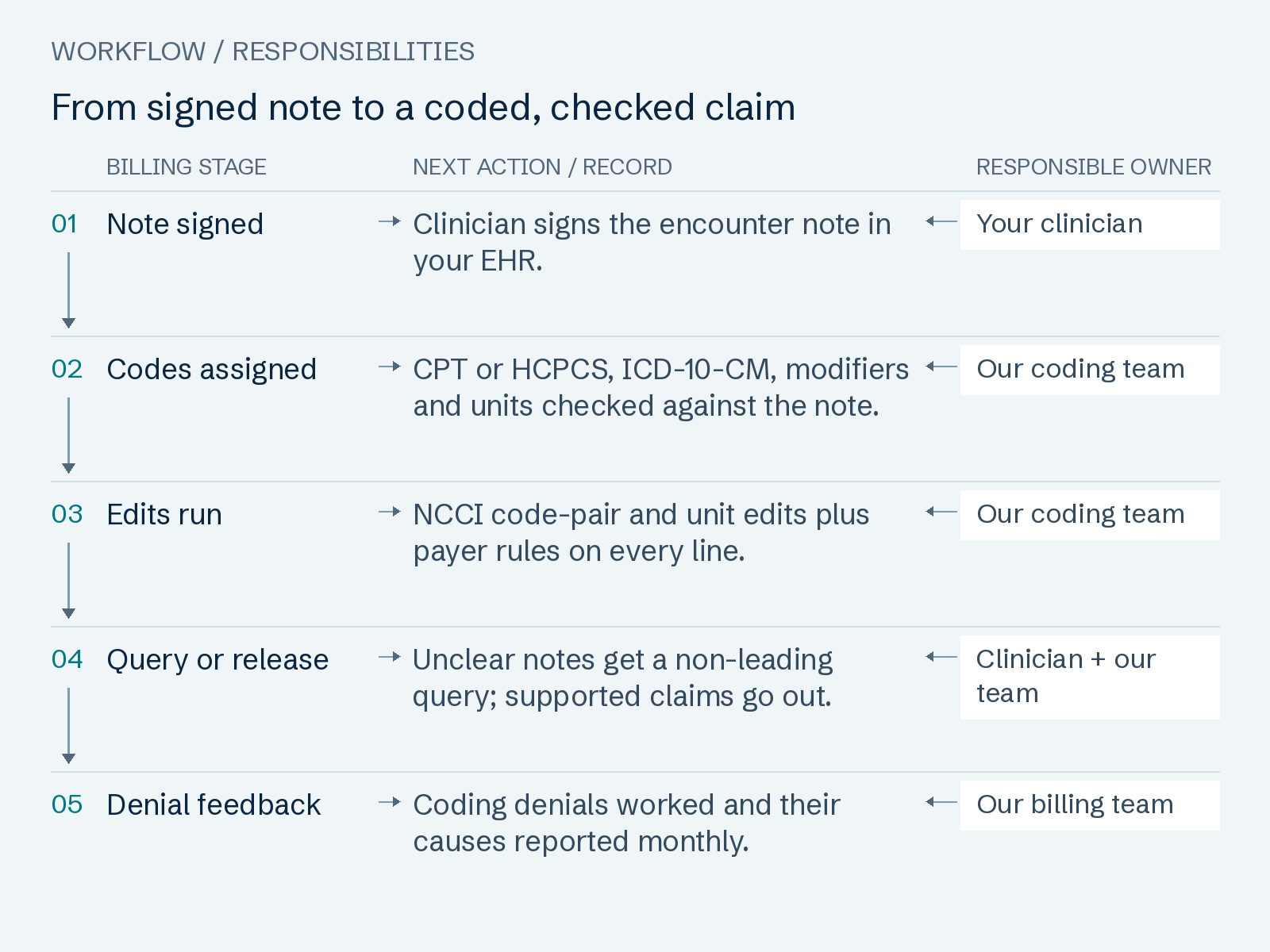
Read the workflow as text
- Note signed — Clinician signs the encounter note in your EHR. Owner: Your clinician.
- Codes assigned — CPT or HCPCS, ICD-10-CM, modifiers and units checked against the note. Owner: Our coding team.
- Edits run — NCCI code-pair and unit edits plus payer rules on every line. Owner: Our coding team.
- Query or release — Unclear notes get a non-leading query; supported claims go out. Owner: Clinician + our team.
- Denial feedback — Coding denials worked and their causes reported monthly. Owner: Our billing team.
How outsourced medical coding works with us
- Access and kickoff. You give us logins to your practice-management system and clearinghouse and join one kickoff call. Go-live comes within 5 business days of access. Clock starts with your signed agreement, signed BAA and working system logins; it extends day for day while we wait on access.
- Specialty setup. We map your top codes, modifiers and payers, and each payer's coding policy.
- Daily coding. We code each signed note and check every code against it.
- Edits. Every line runs through NCCI edits and the payer's own rules.
- Query or release. An unclear note gets a written query; a supported claim goes out within 1 business day of complete charge data.
- Feedback. We work each coding-related denial within 2 business days of posting and report its cause, so the error is fixed at the source.
How do we query your clinicians?
Our query asks the clinician what the note means; it never tells them what to write. Following the ACDIS/AHIMA compliant query practice brief, each query quotes the note and its clinical indicators, offers only options those indicators support, never mentions payment and goes out once. Any change to the note is the clinician's own addendum.
What our medical coding services cost
Coding adds no separate fee: it is part of our full-service medical billing, Full-Service Billing, at 5.0% to 8.5% of insurance payments by specialty and practice size, with $0 setup and no per-chart, per-claim or per-hour coding charge. Your fee is a percentage of insurance payments posted on claims we submitted or worked, net of payer recoupments and refunds. We take 0% of patient payments, copays and anything your front desk collects.
Minimum and cap. Invoices 1–3: only percentage fees on that month's insurance payments, plus any statements or add-ons you order. Percentage fees and mailed statements are capped at 9.0% of that month's insurance payments; from invoice 4, the $400 minimum applies even in a month when the cap comes to less. Larger groups, exclusions and every other term are on the full rate card.
Can we hire you for medical coding only?
Not on today's rate card: there is no coding-only plan and no per-chart price. We keep coding with billing because the team that assigns a code also works its denial, so a coding error comes back to the people who can fix it. If you want coding alone, raise it on a consultation call.
| Specialty group | 1 clinician | 2–5 clinicians | 6–15 clinicians |
|---|---|---|---|
| Mental & behavioral health | 8.0% | 7.5% | 7.0% |
| ABA therapy | 8.5% | 8.0% | 7.5% |
| PT, OT, speech & chiropractic | 7.5% | 7.0% | 6.5% |
| Primary care, pediatrics & urgent care | 6.5% | 6.0% | 5.5% |
| Specialist physician groups | 6.0% | 5.5% | 5.0% |
What we report on your coding every month
Your monthly report arrives by the 10th of each month with a coding section: five defined measures you can recompute from your own system. Rejections, which fail clearinghouse or front-end edits and never reach adjudication, are counted apart from denials. We publish no coding accuracy figure until we have measured one on client work.
| What we report | How we count it | What it tells you |
|---|---|---|
| Coding-related denial rate | Denials for code pairs, modifiers, units or diagnosis support ÷ claims adjudicated | Whether our edits and queries catch problems first |
| Clean claim rate | Claims adjudicated on first submission without correction ÷ claims submitted | How often a coded claim needs no rework |
| Charge lag | Charge posting date − date of service, in days | How long notes wait for sign-off and codes |
| Query turnaround | Days from query sent to clinician answer, averaged per query | Where documentation holds claims back |
| E/M level mix | Established office visits at each level ÷ all established office visits, per clinician | Drift toward one level, checked against the notes |
Coding we handle for your specialty
The code set is national, but each specialty has its own payment-deciding check:
- Primary care. We check every G2211 add-on against modifier 25, because Medicare does not pay G2211 when the visit carries modifier 25, except with an annual wellness visit, vaccine administration or a Part B preventive service. See our primary care billing service.
- Behavioral health. CMS counts behavioral health among its time-based services, so we pick each session's code from the documented minutes. See billing for therapists and psychiatric practices.
- Orthopedics. We run NCCI code-pair edits on same-day procedures and bill a second procedure separately only when the edit and the note allow it. See orthopedic billing and surgical coding.
- PT, OT and speech therapy. We match billed units to documented treatment. See PT, OT and speech therapy billing.
Coding terms and guarantees we put in writing
No coding company can make a payer accept a code; the payer adjudicates the claim. What we put in writing is how codes are chosen, how fast claims and denials move, and what happens if a deadline is missed on our watch:
- Coding policy. We check every code against your clinician's documentation and never change a code without the clinician's sign-off. HHS-OIG has written of "a longstanding concern that percentage billing arrangements may increase the risk of upcoding". This policy is our answer: a percentage fee never changes a code.
- Clock-or-Credit Guarantee. From go-live, every new claim goes out within 1 business day of complete charge data, and every denial is worked within 2 business days of posting — or $25 comes off your invoice for each late one. Mon–Fri ET business days by your system's timestamps; worked: resubmitted, appealed or returned with the fix; auto-credited; capped at monthly fee; clearinghouse outages excluded.
- On-Our-Watch Guarantee. If a claim misses a filing, corrected-claim or appeal deadline while it is on our watch, we pay you what it would have paid. Claims we get complete 10+ business days before the deadline; contracted rate less any copay you collected, paid automatically within 30 days of final denial; capped $10,000/month; your holds excluded.
- Clean-Exit Terms. Leave with 30 days' notice and no termination fee. Want a run-out? We keep working the claims we submitted for 90 days at your plan rate. Decline it and we charge nothing on payments that post after you leave. Notice by email; optional run-out covers claims we submitted before your exit date, at your plan rate; handover file within 10 business days of exit.
We publish client results only with written permission. Until we have them, judge us by the guarantees and the free Deadline Map.
Common questions
- How much do medical coding services cost with you?
- Coding is included in Full-Service Billing: 5.0% to 8.5% of insurance payments, 0% of patient payments and $0 setup, with no per-chart fee. Find your rate in the rate table; our pricing page lists every term.
- Do we have to sign a long-term contract?
- Month to month. Leave with 30 days' written notice. No termination fee. Your codes and notes stay in your own systems of record, because we work inside them.
- How fast can outsourced medical coding start?
- Go-live, when your first claims go out, comes within 5 business days of access; any unbilled backlog follows within 10 business days of access. Clock starts with your signed agreement, signed BAA and working system logins; it extends day for day while we wait on access.
- Can you take over coding from our current billing company?
- Yes. We code new claims from go-live and pick up the open claims your current company leaves. Every inherited claim within 30 days of a filing, corrected-claim or appeal deadline is worked within 5 business days of access. Starts at access; covers up to 250 claims (more gets a day-1 deadline schedule); worked means submitted, corrected, appealed or returned with the fix. For notice, data and run-out, read our guide to switching billing companies.
- Do you code inside our EHR and practice-management system?
- We work inside your existing practice-management system and clearinghouse; tell us which ones and we confirm in writing within 1 business day. We code from the signed note in your system, so your codes, notes and favorite lists stay where they are. See which systems we work in.
- What do you need from our practice?
- Sign the service agreement and BAA, give us logins to your practice-management system and clearinghouse, join one 45-minute kickoff call, sign off encounters so charges are complete, and answer our documentation questions within 5 business days.
- Will you change our codes to get paid more?
- We check every code against your clinician's documentation and never change a code without the clinician's sign-off. When a note supports a higher or lower level than the one chosen, we query the clinician and the clinician decides. Coding to the note is how we guard against undercoding and against the upcoding HHS-OIG warns billing companies about.
- How do you keep our coding current when code sets change?
- We code and scrub every claim with the code set and NCCI edits in force on its date of service. The FY 2027 ICD-10-CM set covers encounters from October 1, 2026 through September 30, 2027, and CMS updates NCCI edit files every quarter.
Sources and review
Page revised October 7, 2026 · Review contact: Hyder Shah (inquiries@claimpillar.com). Medicare and compliance rules are quoted from CMS, HHS-OIG and ACDIS/AHIMA pages retrieved October 2, 2026; CMS updates them quarterly and yearly.
- CMS: NCCI for Medicare
- CMS MLN006764: Evaluation and Management Services (May 2026)
- CMS: ICD-10 code files (FY 2027 ICD-10-CM)
- HHS-OIG: Compliance Program Guidance for Third-Party Medical Billing Companies
- ACDIS/AHIMA: Guidelines for Achieving a Compliant Query Practice (2022 update)
- CMS: CY 2026 Physician Fee Schedule final rule fact sheet (CMS-1832-F)