When to hand your revenue cycle to us
Practices hand off the revenue cycle when claims stall between the front desk, the clinician and the biller, and nobody owns the gap:
- The 90+ day bucket keeps growing. Each aged claim moves closer to its filing or appeal deadline.
- Coverage, coding and claims sit with three different people. When a claim fails, each points at the next, and nobody fixes the cause.
- The same denials return every month. Nobody sends eligibility and authorization causes back to the front desk.
- A new clinician sees patients you cannot bill yet. Enrollment stalled, so the payer's effective date has not arrived.
- Nobody gives you a straight number. A/R days and net collection rate arrive without a formula, or not at all.
Coverage and enrollment already handled in-house? Our billing-only scope, claims to payment may fit better.
Who our RCM service is built for: practices of 1 to 15 clinicians
Our revenue cycle management service is built for practices of 1 to 15 clinicians that bill professional claims for their clinicians' services; our rate card does not price hospital facility billing. The rate card prices three size bands: 1 clinician, 2–5 clinicians and 6–15 clinicians. Quoted work: 16+ clinicians, or anesthesia, radiology, DME, lab and home health: written quote within 1 business day, same fee base, cap and terms. Still deciding? Compare in-house and outsourced billing costs.
What we take over at each stage, and what you keep
Our revenue cycle team takes each stage below with a written deliverable, a clock and a line saying what stays with your practice. We work inside your existing practice-management system and clearinghouse; tell us which ones and we confirm in writing within 1 business day.
Two scopes: Full-Service Billing or Complete RCM
Full-Service Billing runs the claim stages, from eligibility on new and changed coverage to patient statements. Complete RCM adds the stages around the claim: eligibility verification before every visit, prior authorization requests and renewals, credentialing and inherited aged A/R. The table marks which scope carries each stage. We check every code against your clinician's documentation and never change a code without the clinician's sign-off.
| Stage | What we deliver | Timing | What you keep |
|---|---|---|---|
| Eligibility and benefits | Coverage checked and exceptions flagged on the appointment (new patients and changed coverage; every visit in Complete RCM) | Before the visit; ahead of every scheduled visit in Complete RCM | Scheduling and copay collection at check-in |
| Prior authorization | Expiry tracking (Full-Service Billing); requests, tracking and renewals from your documentation (Complete RCM) | Before the authorized service | Orders and clinical documentation |
| Coding check | Every code checked against the clinician's note; questions sent to the clinician | Before the claim goes out | Final code choice and sign-off |
| Claim submission | Claim built, scrubbed and sent through your clearinghouse | Within 1 business day of complete charge data | Signing off encounters so charges are complete |
| Payment posting | Each remittance posted line by line, adjustments included | Within 2 business days of the remittance | Your bank account; every payment lands there |
| Denials and appeals | Each denial corrected, reopened or appealed, with its cause logged | Within 2 business days of posting | Answers to documentation questions |
| Insurance A/R follow-up | Open claims worked in deadline order; inherited aged A/R included in Complete RCM | In deadline order, nearest first | Approval of write-offs |
| Patient balances | Balances calculated from the remittance; statements sent in your practice's name | After the insurance payment posts | Payment plans and any collection-agency decision |
| Credentialing | Applications and re-credentialing for each clinician and payer you choose (Complete RCM) | Filed once your packet is complete; status updates every 14 days | Your CAQH login and signed payer contracts |
| Reporting | KPI report with written definitions; emails answered within 1 business day | By the 10th of each month | Decisions on process changes |
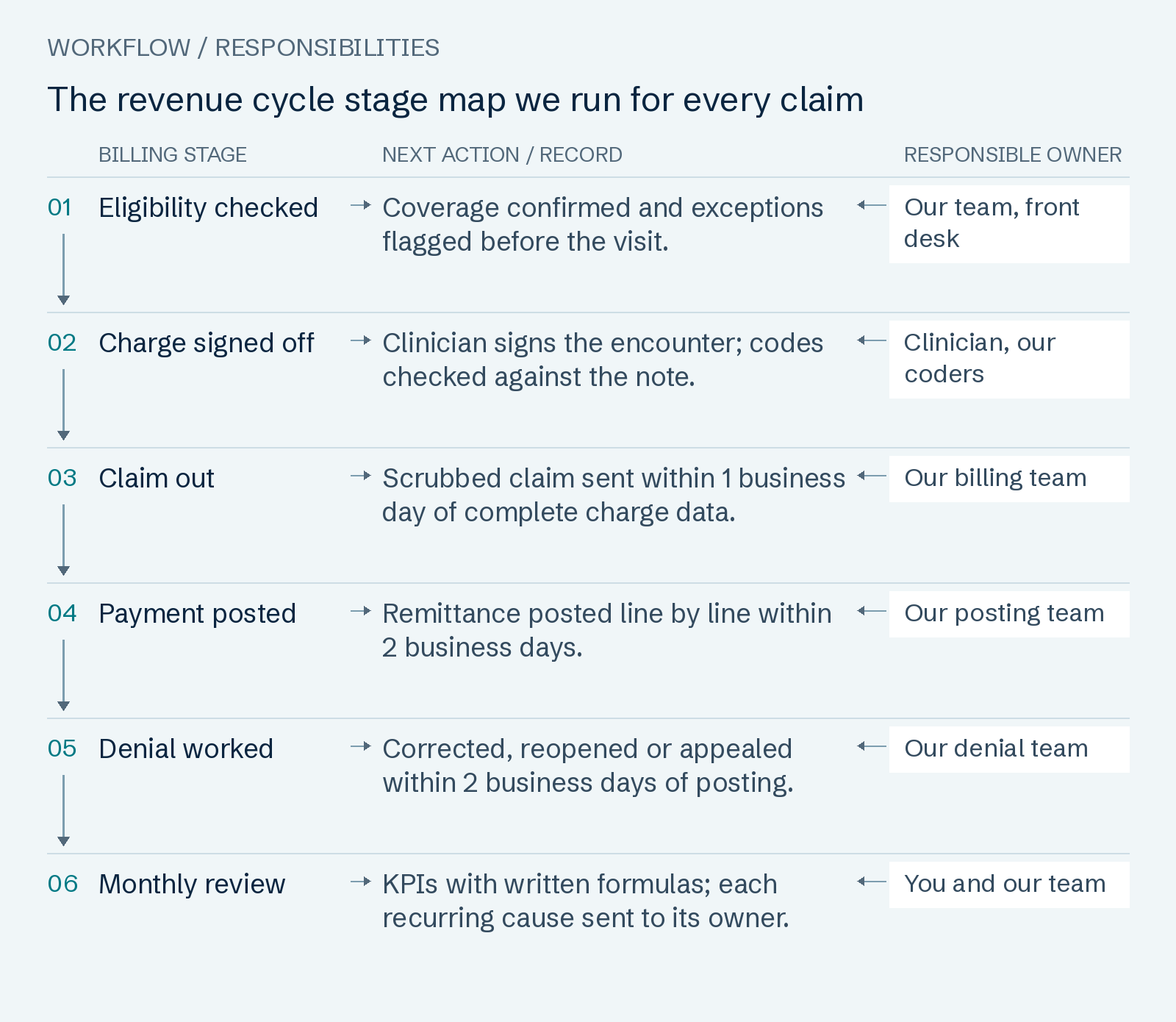
Read the workflow as text
- Eligibility checked — Coverage confirmed and exceptions flagged before the visit. Owner: Our team, front desk.
- Charge signed off — Clinician signs the encounter; codes checked against the note. Owner: Clinician, our coders.
- Claim out — Scrubbed claim sent within 1 business day of complete charge data. Owner: Our billing team.
- Payment posted — Remittance posted line by line within 2 business days. Owner: Our posting team.
- Denial worked — Corrected, reopened or appealed within 2 business days of posting. Owner: Our denial team.
- Monthly review — KPIs with written formulas; each recurring cause sent to its owner. Owner: You and our team.
Where practices lose revenue in the cycle, and what we do about it
Revenue leaks at the handoffs, where one stage finishes late and the next inherits a shorter clock. Our answer to each leak:
- Short filing windows. Cigna gives participating providers 90 days from the date of service; Medicare allows 12 months. We send each claim within 1 business day of complete charge data.
- Late claims become write-offs. Cigna's contract prohibits balance billing your patient for a late-filing denial, and UnitedHealthcare says you cannot bill a member for one. If a claim misses its deadline on our watch, the On-Our-Watch Guarantee covers it. Claims we get complete 10+ business days before the deadline; contracted rate less any copay you collected, paid automatically within 30 days of final denial; capped $10,000/month; your holds excluded.
- Appeal windows close. A Medicare redetermination is due within 120 days of receiving the notice; Cigna allows 180 calendar days. We work every denial within 2 business days of posting and log its cause.
- Unpaid claims wait unnoticed. Medicare must pay or deny a clean claim within 30 days. We check status on any claim past its payer's clock.
- Paper claims cost money. Humana charges a $5 fee for each paper claim reimbursed at $10 or more. We send claims electronically through your clearinghouse wherever the payer accepts them.
- New clinicians see patients before their effective date. Medicare allows retrospective billing for up to 30 days before the effective date when strict conditions are met. In Complete RCM we credential every clinician with every payer you choose; otherwise Credentialing & Payer Enrollment is $149 per payer. Billed only after the payer confirms your effective date; $0 if denied or panel closed; filed within 5 business days of your complete packet.
Our owner guide shows where a practice's revenue cycle leaks and what to fix first.
How we start: from your aging report to the first claims out
Our revenue cycle onboarding starts from your aging report and runs in six steps to the first monthly report:
- BAA first. HHS lists billing and claims processing among the activities a business associate performs for a covered entity, so a signed business associate agreement comes before any patient data reaches us.
- Aging export. Send a claim-level aging export and we return The Free A/R Deadline Map. Every unpaid claim over 90 days, sorted by the date it expires. Clock starts with your claim-level aging export and signed BAA; above 10 requests in a week, we confirm your date within 1 business day.
- Agreement and access. Go-live, when your first claims go out, comes within 5 business days of access; any unbilled backlog follows within 10 business days of access. Clock starts with your signed agreement, signed BAA and working system logins; it extends day for day while we wait on access.
- Inherited claims sorted by deadline. We list every open claim with the deadline it faces and work the nearest first.
- Daily stage work. Each stage in the figure runs on its own clock, and every exception goes to its owner.
- Monthly review. By the 10th of each month you get the KPI report and your top denial causes, each with its front-desk or documentation fix.
What our revenue cycle management services cost
Revenue cycle management with us is priced as a percentage of insurance payments, and the scope you choose sets the rate. Your fee is a percentage of insurance payments posted on claims we submitted or worked, net of payer recoupments and refunds. We take 0% of patient payments, copays and anything your front desk collects.
Example: 3 therapists with $30,000 of insurance payments in a month pay 7.5%, or $2,250. That month's cap would be $2,700. Your exact rate by specialty and practice size is on the full rate card; to set our fee base against other quotes, see how billing fees are quoted.
| Option | Price | What it covers |
|---|---|---|
| Full-Service Billing | 5.0% to 8.5% of insurance payments, by specialty and size | Claim stages: eligibility for new and changed coverage, coding checks, submission, posting, denials, insurance A/R, patient statements, monthly KPI report |
| Complete RCM | 9.0% of insurance payments | Everything above, plus aged A/R, credentialing, eligibility for every visit, prior authorizations, underpayment check, named senior billing lead |
| A/R Recovery (standalone) | 15% | For inherited claims 90+ days past the date of service: 15% of the insurance payments that post after we work them, and $0 on claims that never pay. Fee only on insurance payments posting after our logged action; patient payments 0%; full-service clients stay under the 9.0% fee cap. |
| Credentialing & Payer Enrollment (standalone) | $149 per payer | Billed only after the payer confirms your effective date; $0 if denied or panel closed; filed within 5 business days of your complete packet. |
| Monthly minimum | $400, from your 4th monthly invoice | Invoices 1–3: only percentage fees on that month's insurance payments, plus any statements or add-ons you order; the $400 minimum starts with invoice 4. |
| Fee cap | 9.0% of that month's insurance payments | Percentage fees and mailed statements are capped at 9.0% of that month's insurance payments; the $400 minimum still applies from invoice 4. |
| Setup | $0 | No onboarding or setup charge |
| Where payments go | Your practice's own bank account | Every payment goes straight to your practice's own bank account. We never receive, deposit or endorse your payments; we invoice you once a month. |
| Not included | Paid to others, or billed at the listed price | Your EHR or practice-management subscription and clearinghouse fees (paid to those vendors), any application fee a payer or state charges, mailed patient statements at $0.95 each, and collection-agency, attorney or court costs. |
What we report to you every month
Our monthly report gives each KPI below with its written formula by the 10th of each month, so you can recompute every number from your own system. Rejections and denials are counted apart, so you see whether the claim data or the payer caused a miss. See how we work each denial, and how to read a monthly KPI report.
Do you promise target rates?
No. We publish no target rates, because your payer mix and specialty set what normal looks like. Month one of the report is your baseline, and every later month is compared with it.
| KPI we report | How we calculate it | Who fixes a miss |
|---|---|---|
| Charge lag | Charge posting date − date of service, in days | Clinician |
| Clean claim rate | Claims adjudicated on first submission without correction ÷ claims submitted | Our billing team |
| Rejection rate | Claims rejected at front-end or clearinghouse edits ÷ claims submitted | Our billing team |
| Denial rate | Claims denied ÷ claims adjudicated | Owner of the logged cause |
| Days to post | Posting date − remittance date, in business days | Our posting team |
| A/R days | Total accounts receivable ÷ average daily charges | Our A/R team |
| Aged A/R share | A/R older than 90 days ÷ total A/R | Our A/R team |
| Net collection rate | Payments ÷ (charges − contractual adjustments) | Shared; reviewed monthly |
Which stage we watch first in your specialty
The stage we watch first changes with your specialty. Each range runs from a group to a solo clinician.
- Mental & behavioral health (7.0% to 8.0%). Recurring sessions repeat one eligibility miss on every visit, so we check changed coverage before the next session. See mental health billing.
- ABA therapy (7.5% to 8.5%). We track authorization expiry against the treatment schedule. See ABA therapy billing.
- PT, OT, speech & chiropractic (6.5% to 7.5%). We track visit authorizations against the schedule, so the front end matters as much as the claim. See physical therapy billing.
- Primary care, pediatrics & urgent care (5.5% to 6.5%). High visit volume puts the weight on charge lag and posting speed.
- Specialist physician groups (5.0% to 6.0%). Procedure-heavy days put the weight on the coding check before the claim goes out.
- Multi-specialty groups. Each specialty keeps its own stage owners and KPIs inside one monthly report.
Revenue cycle guarantees and terms we put in writing
No billing company can force a payer to approve a claim; the payer decides. What we guarantee is a payment or credit when we miss our own clock or our own deadlines, each with its terms in the same row. We publish client results only with written permission. Until we have them, judge us by the guarantees and the free Deadline Map. Get my free A/R Deadline Map; it needs your claim-level aging export and a signed BAA.
| Guarantee or term | What we promise | Terms |
|---|---|---|
| On-Our-Watch Guarantee | If a claim misses a filing, corrected-claim or appeal deadline while it is on our watch, we pay you what it would have paid. | Claims we get complete 10+ business days before the deadline; contracted rate less any copay you collected, paid automatically within 30 days of final denial; capped $10,000/month; your holds excluded. |
| Clock-or-Credit Guarantee | From go-live, every new claim goes out within 1 business day of complete charge data, and every denial is worked within 2 business days of posting — or $25 comes off your invoice for each late one. | Mon–Fri ET business days by your system's timestamps; worked: resubmitted, appealed or returned with the fix; auto-credited; capped at monthly fee; clearinghouse outages excluded. |
| The One-Week Deadline Sweep for Specialty Practices | Every inherited claim within 30 days of a filing, corrected-claim or appeal deadline is worked within 5 business days of access. | Starts at access; covers up to 250 claims (more gets a day-1 deadline schedule); worked means submitted, corrected, appealed or returned with the fix. |
| Clean-Exit Terms | Leave with 30 days' notice and no termination fee. Want a run-out? We keep working the claims we submitted for 90 days at your plan rate. Decline it and we charge nothing on payments that post after you leave. | Notice by email; optional run-out covers claims we submitted before your exit date, at your plan rate; handover file within 10 business days of exit. |
| Contract | Month to month. Leave with 30 days' written notice. No termination fee. | Rate lock: Your rate-card rate can't rise for 12 months from your start date; size-band changes still apply; later changes need 60 days' written notice. |
Common questions
- How much do revenue cycle management services cost?
- With us, Full-Service Billing costs 5.0% to 8.5% of insurance payments by specialty and practice size, and Complete RCM costs 9.0% of insurance payments. Patient payments carry 0%, and setup is $0. Every rate is on our pricing page.
- Complete RCM or Full-Service Billing: which should our practice choose?
- Choose Full-Service Billing if your front desk already verifies coverage and your clinicians are enrolled; it runs the claim from creation to posted payment. Choose Complete RCM if the problems start before the claim exists; it covers the whole cycle at one rate. Compare both on the rate card.
- Do we have to sign a long-term contract?
- No. Month to month. Leave with 30 days' written notice. No termination fee. The run-out and handover terms are in our written guarantees and terms.
- How fast can revenue cycle management start?
- Go-live, when your first claims go out, comes within 5 business days of access; any unbilled backlog follows within 10 business days of access. Clock starts with your signed agreement, signed BAA and working system logins; it extends day for day while we wait on access.
- What does our practice need to provide?
- Sign the service agreement and BAA, give us logins to your practice-management system and clearinghouse, join one 45-minute kickoff call, sign off encounters so charges are complete, and answer our documentation questions within 5 business days. Your front desk keeps scheduling and copay collection.
- What happens to our old claims when we switch?
- We list every inherited claim with the deadline it faces and work the nearest first. Inherited claims within 30 days of a deadline when you start are worked at your plan rate, not the 15% A/R Recovery rate. Complete RCM works all inherited and aged A/R at no added percentage; on Full-Service Billing, other aged claims are priced as A/R Recovery in the pricing table. Fee only on insurance payments posting after our logged action; patient payments 0%; full-service clients stay under the 9.0% fee cap.
- Do you work in our practice-management system and clearinghouse?
- We work inside your existing practice-management system and clearinghouse; tell us which ones and we confirm in writing within 1 business day. Your staff keep the screens they already know, and a signed business associate agreement is in place before any patient data reaches us.
- How should we compare RCM companies before we hire one?
- Ask any RCM company, us included: what the percentage applies to; who owns each stage, on what clock; whether missed deadlines are covered in writing; notice and termination fees; and what you get at exit. Our billing company checklist lists each contract term to ask for.
Sources and review
Page revised October 7, 2026 · Review contact: Hyder Shah (inquiries@claimpillar.com). Payer deadlines are quoted from CMS manuals, federal rules and each payer's own provider pages, retrieved October 2, 2026; payers change them without notice.
- CMS Medicare Claims Processing Manual, Chapter 1 (timely filing, payment floor and ceiling)
- CMS Medicare Claims Processing Manual, Chapter 29 (redetermination time limit)
- Cigna Healthcare: Claims Submission, Payments, and Filing
- Cigna Healthcare: Appeals and Disputes Policy and Procedures
- 2026 UnitedHealthcare Care Provider Administrative Guide
- Humana: Claim submissions
- eCFR: 42 CFR 424.521, Request for payment by certain provider and supplier types
- HHS: Business Associates (HIPAA)