Who our anesthesia billing service is for
Our anesthesia billing service is built for independent anesthesiology groups, CRNA-owned practices and mixed care teams, from 1 clinician to groups of 6–15 clinicians and larger. We bill the cases your providers cover in hospital operating rooms, ambulatory surgery centers (ASCs), endoscopy suites and labor and delivery units.
Hand your billing to us when:
- the person who reconciled the OR schedule against the anesthesia records has left, and cases are going unbilled;
- payments arrive on fewer units than the claim reported, and nobody has time to chase the difference;
- the group added a facility or a batch of CRNAs, and the billing office cannot keep up with the case count.
What we take over from your anesthesia group, and what you keep
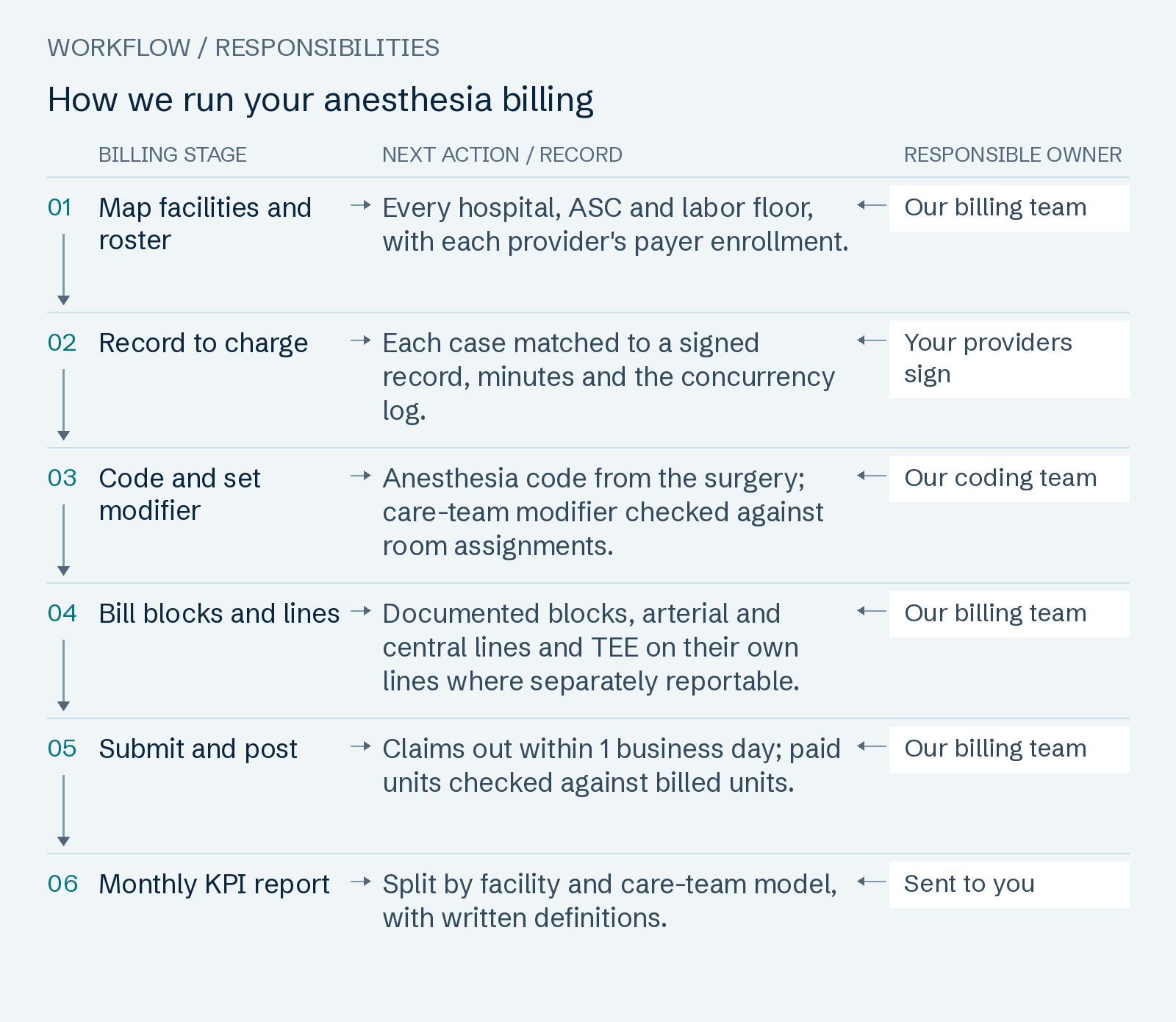
We run the professional side of your anesthesia revenue cycle, from the signed record to the reconciled payment. Every anesthesia code passes our documentation-based coding review, and no code changes without the provider's sign-off. The figure shows a month of anesthesia billing with us.
| Task | What we do | What you keep |
|---|---|---|
| Anesthesia record intake | Match every case on each facility's OR schedule to a signed record with start and stop minutes; ask the named provider about gaps. | Complete, signed anesthesia records |
| Surgery-to-anesthesia crosswalk | Pick the anesthesia code for each surgery from the signed record; when one anesthetic covers several procedures, apply that payer's multiple-procedure rule. | Final say on every code |
| Care-team modifiers | Assign the personally performed, medically directed or CRNA modifier from your concurrency log, plus the monitored anesthesia care flags the record supports. | Room assignments and staffing ratios |
| Blocks, lines and TEE | Bill documented nerve blocks, arterial and central lines and TEE interpretation on their own claim lines where each is separately reportable. | A procedure note for each block or line |
| Labor epidurals | Bill labor analgesia and a cesarean that follows it as each payer requires. | Labor start and stop times |
| Enrollment check | Confirm each anesthesiologist, CRNA and anesthesiologist assistant is enrolled with the payer before their claims go out. | A current provider roster per facility |
| Claims and denials | Send each claim within 1 business day once the record and charge are complete; work each denial within 2 business days of posting. | Answers when we query a record |
| Posting and short-paid units | Post remittances within 2 business days; flag each line paid on fewer units than billed or below that payer's care-team percentage, and work it like a denial. | Every payment lands in your own account |
Read the workflow as text
- Map facilities and roster — Every hospital, ASC and labor floor, with each provider's payer enrollment. Owner: Our billing team.
- Record to charge — Each case matched to a signed record, minutes and the concurrency log. Owner: Your providers sign.
- Code and set modifier — Anesthesia code from the surgery; care-team modifier checked against room assignments. Owner: Our coding team.
- Bill blocks and lines — Documented blocks, arterial and central lines and TEE on their own lines where separately reportable. Owner: Our billing team.
- Submit and post — Claims out within 1 business day; paid units checked against billed units. Owner: Our billing team.
- Monthly KPI report — Split by facility and care-team model, with written definitions. Owner: Sent to you.
Where anesthesia groups lose revenue, and what we do about it
Anesthesia revenue leaks through the formula, not the fee: Medicare pays base units plus time units, multiplied by a locality conversion factor, so every input comes from the record.
Minutes and care-team ratios we check on every case
- Minutes that do not match the record. Time units come from the reported minutes, so a missing stop time is lost payment. We check start and stop times against the signed record and the OR log before release.
- A modifier that does not match the ratio. Under Medicare, medical direction pays each side 50% of the personally performed allowance and counts concurrency across every patient, Medicare or not. We reconcile each day's concurrency log to the modifiers and query the anesthesiologist when an induction or emergence note is missing.
- Days over four rooms. Above four concurrent cases, the Medicare contractor may allow only three base units per procedure. We flag those days before claims go out, so your group sees the exposure first.
- Block time inside anesthesia time. UnitedHealthcare's commercial anesthesia policy keeps block placement before induction or after emergence out of anesthesia time. We bill the documented block on its own line and keep its minutes off the anesthesia line.
Payer differences we load before your first claim
- One modifier, different percentages. Noridian's Jurisdiction F Medicare Part B anesthesia page lists a CRNA without medical direction at 100%; UnitedHealthcare's commercial policy pays 85%. We post every line against that payer's percentage, so a short payment stands out.
- State Medicaid modifiers. UnitedHealthcare Community Plan's Medicaid anesthesia policy denies Texas Medicaid anesthesia claims that lack a U1 or U2 modifier. We set each Medicaid plan's state modifiers from the anesthesia record before submission.
- Units that no longer pay. Medicare does not recognize physical status modifiers P1–P6, per the same Noridian page. We never count those units in what a Medicare claim should pay, and report them only where a payer asks for them and the record documents the physical status.
What our anesthesia billing costs
Anesthesia groups are priced by written quote rather than a row on the rate card, at every size. Your fee applies only to payments on the professional claims we submit or work; the facility's own payment for a case is not in it. The full rate card and fee terms list every add-on.
| Term | Anesthesia groups |
|---|---|
| Rate | 16+ clinicians, or anesthesia, radiology, DME, lab and home health: written quote within 1 business day, same fee base, cap and terms. |
| Fee base | Percentage of insurance payments; 0% of patient payments |
| Setup fee | $0 |
| Monthly minimum | $400. Invoices 1–3: only percentage fees on that month's insurance payments, plus any statements or add-ons you order; the $400 minimum starts with invoice 4. |
| Fee cap | Percentage fees and mailed statements are capped at 9.0% of that month's insurance payments; the $400 minimum still applies from invoice 4. |
| Contract | Month to month. Leave with 30 days' written notice. No termination fee. |
| Rate lock | Your rate-card rate can't rise for 12 months from your start date; size-band changes still apply; later changes need 60 days' written notice. |
How we start: switching from in-house or another billing company
An anesthesia handover puts open claims at every facility you cover in play at once, so week one goes to the claims nearest a deadline. What your group sends us:
- The signed service agreement and BAA.
- Billing system and clearinghouse logins, plus read access to wherever your anesthesia records and their start and stop times live.
- A claim-level aging export split by facility, so the cases nearest a deadline are worked first.
- A roster of anesthesiologists, CRNAs and anesthesiologist assistants with NPIs and the facilities each covers.
- Your commercial payer contracts, so each payer's conversion factor and care-team percentages are on file.
Go-live, when your first claims go out, comes within 5 business days of access; any unbilled backlog follows within 10 business days of access. Clock starts with your signed agreement, signed BAA and working system logins; it extends day for day while we wait on access. Every inherited claim within 30 days of a filing, corrected-claim or appeal deadline is worked within 5 business days of access. Starts at access; covers up to 250 claims (more gets a day-1 deadline schedule); worked means submitted, corrected, appealed or returned with the fix.
Our guide to changing billing companies lists what to request from your current company. Want to see your exposure first? Request The Free A/R Deadline Map: A claim-by-claim list of every unpaid insurance claim over 90 days in the aging report you send: payer, amount, the deadline it faces, the denial reason and the next action, sorted by deadline. Clock starts with your claim-level aging export and signed BAA; above 10 requests in a week, we confirm your date within 1 business day.
What we report each month, and the guarantees behind it
Your anesthesia claims carry two guarantees, with the terms beside each one:
- On-Our-Watch Guarantee: If a claim misses a filing, corrected-claim or appeal deadline while it is on our watch, we pay you what it would have paid. Claims we get complete 10+ business days before the deadline; contracted rate less any copay you collected, paid automatically within 30 days of final denial; capped $10,000/month; your holds excluded.
- Clock-or-Credit Guarantee: From go-live, every new claim goes out within 1 business day of complete charge data, and every denial is worked within 2 business days of posting — or $25 comes off your invoice for each late one. Mon–Fri ET business days by your system's timestamps; worked: resubmitted, appealed or returned with the fix; auto-credited; capped at monthly fee; clearinghouse outages excluded.
A record held for a missing signature or stop time is the usual anesthesia hold, and the filing limit keeps running: Medicare allows 12 months after the date of service, and Cigna lists 90 days for participating providers and may ask for anesthesia notes and time with a claim. We chase each incomplete record with the provider by name.
Anesthesia service standards, timed in your own system
The timings below are measured by timestamps in your system; they are service commitments, not results. Each monthly report defines clean claims, A/R days and net collection rate in writing, split by facility and care-team model, plus a count of lines paid on fewer units than billed. Our denial management team works anesthesia denials on the same schedule.
We publish client results only with written permission. Until we have them, judge us by the guarantees and the free Deadline Map.
| Service | Timing | What it means for an anesthesia case |
|---|---|---|
| Claim out | 1 business day from a complete record | A case is complete once the record is signed with start and stop minutes |
| Denial worked | 2 business days from the denial posting | Enrollment, missing-modifier and documentation denials on anesthesia lines |
| Remittance posted | 2 business days from remittance receipt | Paid units and percentage compared with what we billed |
| Email reply | 1 business day | Questions about a record, a room assignment or a facility |
| KPI report | By the 10th of each month | Split by facility and by care-team model |
Your systems, new CRNAs and data access
We bill in the practice-management system and clearinghouse your group already uses; the EHR compatibility page shows how we confirm yours. No patient data moves before a signed BAA.
For a new CRNA or anesthesiologist, we confirm payer enrollment and effective dates and start payer enrollment as soon as you know the start date. Our New-Clinician Enrollment bonus applies: Clinicians who join while you're a client get enrollment filed with up to 5 payers each (the payer decides), with no per-payer fee. Each further payer through Credentialing & Payer Enrollment is $149. Billed only after the payer confirms your effective date; $0 if denied or panel closed; filed within 5 business days of your complete packet.
Common questions
- How much do your anesthesia billing services cost?
- Anesthesia is priced by written quote: 16+ clinicians, or anesthesia, radiology, DME, lab and home health: written quote within 1 business day, same fee base, cap and terms. The fee is a percentage of insurance payments, with 0% taken from patient payments and a $0 setup fee. See the minimum and cap on our pricing page.
- How should we choose an anesthesia billing company?
- Put four anesthesia questions to every candidate and get the answers in writing: how care-team modifiers are checked against your concurrency log, how lines paid on fewer units get caught, the total fee, and who pays when a filing deadline is missed. Ours are above, and our guarantees answer the last one; for contract terms, use our billing company comparison checklist.
- Is there a long-term contract or a cancellation fee?
- No. Month to month. Leave with 30 days' written notice. No termination fee. Our Clean-Exit Terms make the run-out your choice: Notice by email; optional run-out covers claims we submitted before your exit date, at your plan rate; handover file within 10 business days of exit.
- How fast can you take over our anesthesia claims?
- Your first anesthesia claims go out within 5 business days. Clock starts with your signed agreement, signed BAA and working system logins; it extends day for day while we wait on access. Inherited claims nearest a deadline come first; the sweep, its terms and our start list are under how we start.
- Do you bill for CRNAs working without medical direction?
- Yes. We bill CRNA-only cases with the non-directed CRNA modifier and post each payment against that payer's percentage, which differs between Medicare and commercial plans. We also bill CRNAs who work under medical direction, matched to the anesthesiologist's claim.
- Can you handle our nerve blocks, arterial lines and TEE reads?
- Yes. We bill each documented block, arterial or central line and TEE interpretation on its own claim line where it is separately reportable, keep block placement minutes off the anesthesia line where the payer requires it, and work any that deny. On endoscopy and joint cases we take the anesthesia code from the surgeon's documented procedure; see our gastroenterology billing and orthopedic billing services.
- Will you bill inside our current systems?
- Yes. We work inside your existing practice-management system and clearinghouse; tell us which ones and we confirm in writing within 1 business day.
- Do you enroll a new CRNA or anesthesiologist before their first case?
- We file as soon as you tell us the start date; each payer sets the effective date. New-Clinician Enrollment: Clinicians who join while you're a client get enrollment filed with up to 5 payers each (the payer decides), with no per-payer fee. Each further payer is $149. Billed only after the payer confirms your effective date; $0 if denied or panel closed; filed within 5 business days of your complete packet.
Sources and review
Page revised October 7, 2026 · Review contact: Hyder Shah (inquiries@claimpillar.com). The workflow checklists are editorial recommendations; payer requirements depend on the program and current policy.
- CMS: Medicare Claims Processing Manual, Chapter 12, sections 50 and 140 (anesthesia)
- Noridian JF Part B: Anesthesia and Pain Management
- UnitedHealthcare Commercial: Anesthesia Policy, Professional (2026R0032A)
- UnitedHealthcare Community Plan: Anesthesia Policy, Professional (2026R0032C)
- CMS: Medicare Claims Processing Manual, Chapter 1, section 70 (timely filing)
- Cigna Healthcare: Claims submission, payments and filing