ABA billing services we handle, from intake to payment posting
Our ABA billing service is built for autism treatment agencies, solo BCBAs and multi-site ABA groups. Agencies hand it off when 97153 sessions sit unbilled after a biller leaves, when clients run past their authorized units, or when RBT hours outgrow the billing desk. Denials go through our denial work and appeals process, and the full scope of the plan is on our medical billing services page.
| Task | What we do | What your agency keeps |
|---|---|---|
| Intake and eligibility | Check coverage for each new client and each change of plan before sessions are billed. | Collecting the family's insurance card and consent |
| Authorization ledger | Record approved units and dates per client and code; subtract units with every claim; flag low balances and end dates. | Requesting and renewing authorizations, unless you choose Complete RCM |
| Unit counting | Turn documented face-to-face minutes into 15-minute units per code; return notes missing times. | Session notes with start and stop times |
| Claim submission | Send each claim within 1 business day once the session's charges are complete. | Signing off notes promptly |
| Payment posting | Post each remittance within 2 business days and compare units paid with units billed. | Payments, which go straight to your own bank account |
| Denials and appeals | Work each denial within 2 business days of posting: correct, resubmit or appeal with the note and authorization. | Final say on any clinical appeal |
| Family balances | Calculate copays and coinsurance from the remittance; send statements in your agency's name. | Collecting copays from families |
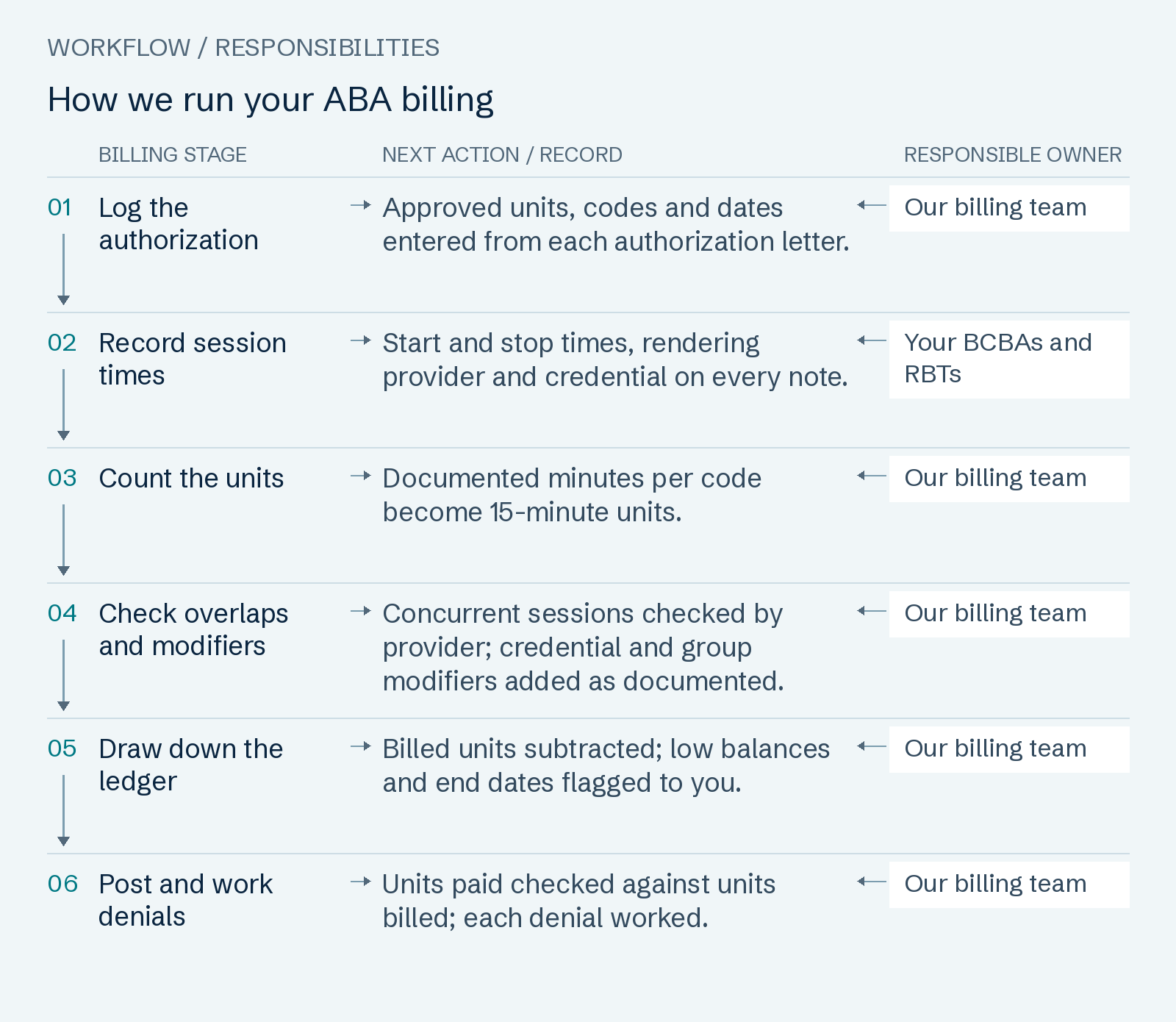
Read the workflow as text
- Log the authorization — Approved units, codes and dates entered from each letter. Owner: Our billing team.
- Record session times — Start and stop times, rendering provider and credential on every note. Owner: Your BCBAs and RBTs.
- Count and check — Minutes become 15-minute units; overlaps and modifiers checked. Owner: Our billing team.
- Draw down the ledger — Billed units subtracted; low balances and end dates flagged. Owner: Our billing team.
- Post and work denials — Units paid checked against units billed; each denial worked. Owner: Our billing team.
ABA insurance billing for your Medicaid, TRICARE and commercial clients
The same 97153 session can need a different modifier or authorization format for Medicaid, TRICARE and each commercial plan, so we set up each payer's requirements before the first claim goes out.
Medicaid ABA claims in your state
Medicaid programs and their managed care plans set their own ABA requirements. Superior HealthPlan, a Texas Medicaid plan, for example, has required prior authorization for all ABA services before delivery since the benefit began on February 1, 2022 (restated in September 2023), and its May 2022 notice listed which credential modifier went with each ABA code: HO only on 97151 and 97153, HO or HN on 97155, 97156 and 97158. We add the modifiers your state and plans ask for when the session note supports them. Where a state Medicaid program does not let a billing company charge a percentage, we bill your Medicaid claims at a flat fee per claim, agreed in writing before we start.
TRICARE and commercial plans
For TRICARE and commercial clients, we bill each plan from that client's own authorization letter and the plan's published billing requirements and tell your BCBAs in writing what each note must show. Payer enrollment for the agency and each BCBA is a separate step; our ABA insurance credentialing page sets out how we get you in-network.
ABA denial management: units, rendering IDs and concurrent billing
Our ABA denial management works each denial within 2 business days of posting, and the monthly report names the top causes so the fix reaches the session note, not only the claim.
ABA denial reasons we prevent and fix
The time rules in the table come from the ABA Coding Coalition's FAQ: adaptive behavior codes bill in 15-minute units, work lasting 8 to 22 minutes counts as one unit, under 8 minutes is not reportable, and only face-to-face time counts: with the patient, or with caregivers for family treatment guidance.
| Denial reason | What usually sits behind it | What we do |
|---|---|---|
| Units over the authorization | Sessions kept running after the approved balance ran out. | Check every line against the ledger before it goes out; flag low balances early. |
| No authorization on file | A new client, new code or new period started before the approval arrived. | Hold the claim, tell you which approval is missing, bill once it is on file. |
| Concurrent 97153 and 97155 | One clinician's time reported under both codes for the same minutes. | Compare overlaps by rendering provider; correct the line when the note shows who did what. |
| Units do not match the minutes | Units guessed from session blocks instead of documented times. | Count units from documented minutes per code; return notes without start and stop times. |
| Missing or wrong credential modifier | The claim line does not show the rendering clinician's credential level. | Add the modifier each payer's manual asks for when the session note supports it. |
| Rendering provider not enrolled | A new BCBA billed before the payer confirmed enrollment. | Hold those claims and file the enrollment; bill from the effective date the payer confirms. |
Your ABA rate card: 8.5% solo, 8.0% for 2–5, 7.5% for 6–15 clinicians
ABA agencies pay the ABA row of our rate card, set by agency size. The fee is a percentage of insurance payments; family copays and balances carry 0%. Clinicians are counted on the 1st of each month from the rendering NPIs we billed the month before (for ABA, BCBAs and BCaBAs, not RBTs). Your rate moves with your size band the next month, in either direction.
Worked example: which ABA rate applies to your agency
Illustrative example, not client data: an agency whose last month's claims named 3 BCBAs, 1 BCaBA and 14 RBTs as rendering providers counts 4 clinicians, because RBTs do not count. That puts it in the 2–5 clinicians band, so its rate is 8.0% of insurance payments. If it adds two BCBAs, it moves to the 6–15 clinicians band and 7.5% the following month.
Setup is $0. Percentage fees and mailed statements are capped at 9.0% of that month's insurance payments; the $400 minimum still applies from invoice 4. Compare every segment on our medical billing rate card.
| Agency size (BCBAs and BCaBAs) | Your ABA rate |
|---|---|
| 1 clinician | 8.5% of insurance payments |
| 2–5 clinicians | 8.0% of insurance payments |
| 6–15 clinicians | 7.5% of insurance payments |
| Larger groups | 16+ clinicians, or anesthesia, radiology, DME, lab and home health: written quote within 1 business day, same fee base, cap and terms. |
Working from your ABA practice management system
Your agency keeps its practice management, data-collection and scheduling tools. We work inside your existing practice-management system and clearinghouse; tell us which ones and we confirm in writing within 1 business day. We work under a signed BAA, and our EHR compatibility page sets out the access we need. Whatever the system, the unit ledger is built from what your session notes record: start and stop times, the code, the rendering provider and the credential. If your group also employs counselors or psychologists, their claims run through our mental and behavioral health billing service at that segment's rate.
Outsourced ABA billing with deadline guarantees
Taking over ABA billing puts two kinds of dates at risk: filing limits on open claims and end dates on client authorizations. Go-live, when your first claims go out, comes within 5 business days of access; any unbilled backlog follows within 10 business days of access. Clock starts with your signed agreement, signed BAA and working system logins; it extends day for day while we wait on access. Every inherited claim within 30 days of a filing, corrected-claim or appeal deadline is worked within 5 business days of access. Starts at access; covers up to 250 claims (more gets a day-1 deadline schedule); worked means submitted, corrected, appealed or returned with the fix.
To start, your agency sends five things:
- The signed agreement and BAA (business associate agreement).
- Logins to your practice management system, clearinghouse and the system that holds session notes.
- Current authorization letters with approved units, codes and dates for every client.
- A roster of BCBAs, BCaBAs and RBTs with NPIs and any payer certifications.
- A claim-level aging export, so we work inherited claims in deadline order.
On-Our-Watch Guarantee. If a claim misses a filing, corrected-claim or appeal deadline while it is on our watch, we pay you what it would have paid. Claims we get complete 10+ business days before the deadline; contracted rate less any copay you collected, paid automatically within 30 days of final denial; capped $10,000/month; your holds excluded.
Clock-or-Credit Guarantee. From go-live, every new claim goes out within 1 business day of complete charge data, and every denial is worked within 2 business days of posting — or $25 comes off your invoice for each late one. Mon–Fri ET business days by your system's timestamps; worked: resubmitted, appealed or returned with the fix; auto-credited; capped at monthly fee; clearinghouse outages excluded.
Your KPI report arrives by the 10th of each month, with a written definition for every metric. We publish client results only with written permission. Until we have them, judge us by the guarantees and the free Deadline Map.
When an outside ABA billing specialist pays for your agency
A billing and posting clerk's median wage is $48,500 a year (BLS, May 2025): about $4,042 a month before benefits, software and the clearinghouse, or about $5,774 at the private-industry benefit share (BLS, June 2026). A billing clerk is paid whether claims pay or not. Your first three invoices are only a share of insurance payments that already reached your account, plus any statements or add-ons you order. In-house still makes sense when your volume keeps a trained ABA biller fully busy and someone covers authorizations when they are out. Our comparison of ABA billing software and a billing service weighs the third option.
Not ready to switch? Start with Get my free A/R Deadline Map: A claim-by-claim list of every unpaid insurance claim over 90 days in the aging report you send: payer, amount, the deadline it faces, the denial reason and the next action, sorted by deadline. Clock starts with your claim-level aging export and signed BAA; above 10 requests in a week, we confirm your date within 1 business day.
Common questions
- How much do your ABA billing services cost?
- 8.5% for 1 clinician, 8.0% for 2–5 clinicians and 7.5% for 6–15 clinicians, of insurance payments. RBTs do not count toward your size band, and setup is $0. The minimum and fee cap are on our pricing page.
- Which ABA codes do you bill for our agency?
- The adaptive behavior codes your clinicians perform, 97151 through 97158, with the credential and telehealth modifiers each payer asks for when the note supports them. The ABA Coding Coalition lists a revised code set taking effect January 1, 2027; we bill the new codes from that date and flag any authorization still written in the old ones. Our ABA billing codes guide explains each one.
- Do you track our clients' authorization hours?
- Yes, on every ABA plan: approved units and end dates are logged per client and code, drawn down with each claim and flagged before they run out. Requesting and renewing authorizations is included with Complete RCM at 9.0% of insurance payments.
- Which ABA practice management systems do you work with?
- We work inside your existing practice-management system and clearinghouse; tell us which ones and we confirm in writing within 1 business day.
- Can you bill Medicaid ABA claims in our state?
- Yes. We bill Medicaid ABA claims by following your state's manual and each managed care plan's notices for authorization and credential modifiers.
- Do we have to sign a long-term contract?
- No. Leave with 30 days' notice and no termination fee. Want a run-out? We keep working the claims we submitted for 90 days at your plan rate. Decline it and we charge nothing on payments that post after you leave. Notice by email; optional run-out covers claims we submitted before your exit date, at your plan rate; handover file within 10 business days of exit.
- How long does it take to switch our ABA billing?
- First claims go out within 5 business days of access, after the authorization ledger is loaded; the clock and the deadline sweep are set out in the guarantees section above.
- Can you credential a new BCBA joining our agency?
- Yes. New-Clinician Enrollment: Clinicians who join while you're a client get enrollment filed with up to 5 payers each (the payer decides), with no per-payer fee. Any other enrollment through Credentialing & Payer Enrollment is $149 per payer. Billed only after the payer confirms your effective date; $0 if denied or panel closed; filed within 5 business days of your complete packet.
Sources and review
Page revised November 4, 2026 · Review contact: Hyder Shah (inquiries@claimpillar.com). The workflow checklists are editorial recommendations; payer requirements depend on the program and current policy.
- ABA Coding Coalition: Frequently Asked Questions (15-minute units, 8-22 minute rule, face-to-face time, concurrent 97153/97155), retrieved 2026-11-04
- ABA Coding Coalition: Billing Codes (code set effective January 1, 2027), retrieved 2026-11-04
- Superior HealthPlan (Texas Medicaid): New Medicaid Benefit for ABA Services, Prior Authorization Required (dated 05/24/22), retrieved 2026-11-04
- Superior HealthPlan (Texas Medicaid): Clarification for Providers of ABA Services (dated 09/25/23), retrieved 2026-11-05