97153 CPT code description
In plain words, 97153 is one-to-one ABA treatment carried out by a technician from a written protocol, under the direction of a qualified health care professional (QHP), billed per 15 minutes. It is the code for most of the hours in an ABA treatment plan. The official descriptor belongs to the AMA's CPT code set; this page uses only the code number and our own summary.
The ABA Coding Coalition FAQ describes a protocol as a written description of the procedures for delivering a service to address a treatment target. The technician runs the protocol as written; when the protocol has to change, that work belongs to a QHP under 97155. Time billed must be face-to-face time with the patient. Day-to-day treatment planning by the QHP has no separate CPT code; it is bundled into the treatment codes unless the payer allows a HCPCS code for it.
Unlike session-based psychotherapy codes such as the 90837 CPT code, which is picked from a range of session minutes, 97153 is counted unit by unit, so an all-day session can carry many lines' worth of units. The rest of the set (assessment, group, caregiver and harmful-behavior codes) is on our page of ABA billing codes.
Does 97153 change in 2027?
The number stays. The Coalition's 2027 coding crosswalk (September 11, 2026) says the AMA revised the descriptors of 97151 to 97158 from January 1, 2027 and added six new codes. In the crosswalk, 97153 keeps its 15-minute unit and is attended by the client and a technician, while QHP one-to-one treatment, previously billed as 97155, moves to the new code 97173.
Who delivers 97153: RBTs, technicians and supervision requirements
The technician is the expected rendering person, but who counts as a technician is set by each payer and state.
- Indiana Medicaid defines the technician as an RBT from January 1, 2024, and lets a QHP substitute for the technician (IHCP bulletin BT2023169).
- Montana Medicaid lists 97153 as treatment by a technician and says all services are billed under the BCBA's NPI, with the BCBA taking full professional responsibility for RBT work (July 2025 fee schedule).
- Louisiana Medicaid uses a registered line technician (RLT) and requires a licensed behavior analyst's supervision in the treatment plan whenever technician services are provided (ABA provider manual, chapter 4).
- Blue Cross and Blue Shield of Oklahoma says 97153 must be billed by an appropriately trained technician and is not payable when a caregiver performs it (policy CPCP011, effective March 20, 2026).
When a BCBA bills 97153
If a QHP simply stands in for the technician and changes no protocol, the Coalition says to report 97153 with a modifier showing the higher-level provider. BCBSOK says the same in its own words: a QHP who performs technician activities reports that time as technician time.
Supervision requirements
Payers set supervision levels, not CPT. Louisiana Medicaid approves supervision on a 2:10 basis, two hours of supervision for every ten hours of therapy, and will not approve supervision when the licensed professional is the one delivering the therapy. BCBSOK cites the CASP guideline of 10 to 20% of direct hours for case supervision and may authorize at least 1 hour per week of direct supervision when fewer than 10 direct hours are authorized. Supervision without the patient present has no billable CPT code in the current set, according to the Coalition.
97153 units: 15 minutes and the CPT midpoint rule
The Coalition applies the CPT time rule to ABA: a unit may be reported once half of the 15-minute increment is met, so 8 to 22 minutes is one unit and less than 8 minutes is not reportable. BCBSOK publishes the full minute-to-unit ladder below for 15-minute timed codes, and says pre- and post-session work and time the patient is not being treated do not count.
Worked example (illustration only): an RBT session runs from 9:00 to 11:40 a.m. with no break, which is 160 minutes. Ten units cover 150 minutes; the 10 minutes left pass the 8-minute midpoint, so the line is 11 units of 97153.
Building a 97153 claim line
- Take the start and stop times from the session note for each 97153 block.
- Subtract breaks and any time the technician was not treating the patient.
- Convert the total with the table below: full 15-minute units, plus one more if 8 or more minutes remain.
- Check the result against the authorization balance and the payer's daily limit before the claim goes out.
Record the clock times, not only the total. Louisiana Medicaid requires start and stop times for every code billed, at the start of the session, after any break of 12 minutes or longer, and whenever the billing code changes.
| Face-to-face minutes of 97153 | Units to bill |
|---|---|
| Fewer than 8 | 0 (not reportable) |
| 8 to 22 | 1 |
| 23 to 37 | 2 |
| 38 to 52 | 3 |
| 53 to 67 | 4 |
| 68 to 82 | 5 |
| 83 to 97 | 6 |
| 98 to 112 | 7 |
| 113 to 127 | 8 |
Billing 97153 with 97155 at the same time
Yes, two people can bill overlapping minutes when each does the work their code requires. The Coalition says 97153 and 97155 may be reported concurrently when the criteria in both descriptors are met, and that a single QHP may not report both at once. The typical case is a BCBA who joins the RBT and the patient to direct the RBT in a new or changed protocol: the BCBA bills 97155 and the RBT's time stays on 97153. A BCBA who only watches, without changing a protocol or directing the technician, has no 97155 time to bill.
Payers then add their own conditions, so check the policy before the first overlapping claim:
| Payer or source | 97153 with 97155 at the same time | Condition stated |
|---|---|---|
| ABA Coding Coalition (guidance, not a payer) | Allowed | Both code descriptors met; never the same QHP for both |
| Indiana Medicaid (DOS from Jan 1, 2024) | Allowed | Patient present, one or more protocols modified, QHP directing the technician; one QHP cannot bill both |
| Louisiana Medicaid | Allowed | One-on-one supervision may be billed concurrently with one-on-one treatment, only when a non-licensed person provides the treatment |
| BCBS of Oklahoma (CPCP011) | Allowed for the technician plus one QHP | No payment for more than one BCBA or QHP providing the same or similar services on the same date |
Modifiers on 97153 claims (HM, HN, HO, HP and telehealth)
The Coalition's 2027 crosswalk lists the modifiers commonly used with the ABA codes: HM (high-school education), HN (four-year degree), HO (master's degree) and HP (PhD). The code is the same; the modifier tells the payer which level of provider rendered it. Each payer decides which modifier, if any, it wants on 97153, and some use state-specific modifiers instead.
| Payer (sample) | Modifier rule for 97153 | Source date |
|---|---|---|
| BCBS of Oklahoma (commercial) | Use a single modifier, HM, HN or HO, for the rendering provider's level | Effective March 20, 2026 |
| Indiana Medicaid | U1 = delivered by an RBT; billed as 97153 U1 | DOS from January 1, 2024 |
| Louisiana Medicaid | 97153 has one technician rate on the schedule, listed with no modifier | Fee schedule for DOS from July 1, 2022 |
| Montana Medicaid | No modifier on 97153; TC marks a BCaBA on QHP codes such as 97155 | Fee schedule July 1, 2025 |
97153 reimbursement ranges by payer type
Medicare. There is no national Medicare amount for 97153. In the CMS CY 2026 PFS relative value file (RVU26D), 97153 carries status C with zero RVUs, so the Medicare contractor prices the service and the 2026 national Medicare amount (unadjusted) is blank in both settings. 97153 is on the CMS list of Medicare telehealth services for 2026.
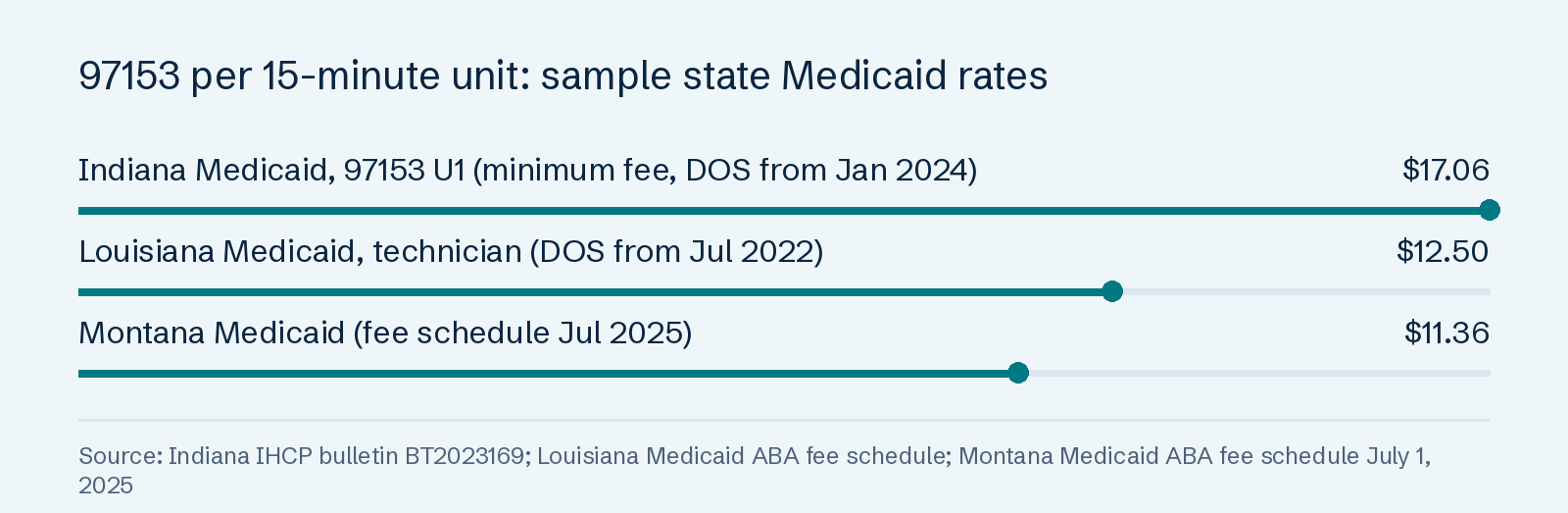
Medicaid. Each state publishes its own rate per 15-minute unit. The three below come from each program's own schedule: Indiana's is a minimum fee that its managed care plans must pay at or above, Louisiana's applies to dates of service from July 1, 2022, and Montana's took effect July 1, 2025. Check the current schedule before you quote a rate; these are samples, not a national range.
Commercial plans and TRICARE. Rates are set in each contract or fee schedule, and a plan that asks for a level modifier on 97153 (as BCBSOK does) may price the line by it. Compare your contracted 97153 rate per unit with your RBT cost per hour before you accept a renewal.
Common 97153 denials and fixes
Match the denial on the remittance to the cause below. Each rule comes from the Coalition guidance or the payer sources cited on this page; the fix column is the matching correction.
Reading a denial is easier when you know where ABA billing starts; our primer on what ABA billing is walks through the claim from intake to payment. Practices that would rather hand the authorization tracking, unit checks and denial work to someone else can see our ABA therapy billing service. To see which unpaid ABA claims are closest to a filing or appeal deadline first, Get my free A/R Deadline Map: Clock starts with your claim-level aging export and signed BAA; above 10 requests in a week, we confirm your date within 1 business day.
| Problem | Why the line fails | Fix |
|---|---|---|
| Units rounded up | A remainder under 8 minutes was billed as a unit | Recount from start and stop times; send a corrected claim |
| Units over 32 on one date | Above the Medicare practitioner MUE for 97153 | Recheck the minutes and bill only the units documented for that date |
| Units past the authorization | The approved units or period ran out | Request more units before the period ends; hold the line until approved |
| Same BCBA on 97153 and 97155 | One QHP cannot bill both for the same minutes | Keep 97155 for the BCBA; bill 97153 only for the technician's time |
| Missing or wrong level modifier | The payer prices 97153 by provider tier (for example HM, HN, HO or U1) | Load each payer's modifier map into the claim template by rendering credential |
| Indirect time billed as 97153 | Only face-to-face time with the patient counts | Remove note-writing and planning time from the units |
| Telehealth line not covered | Telehealth coverage for ABA varies by state law and payer policy | Confirm the payer allows it and has authorized it before the session |
Common questions
- What is CPT code 97153?
- It is the ABA code for one-to-one treatment that a technician delivers from a protocol written by a BCBA or other qualified professional, billed per 15 minutes of face-to-face time. It covers most of the direct hours in an ABA treatment plan.
- How many units of 97153 can be billed per day?
- As many as the face-to-face minutes and the authorization support, within each payer's edits. Medicare's practitioner MUE table (October 1, 2026) sets 32 units per day for 97153, and the payer's authorization can be lower.
- Can 97153 be billed by an RBT?
- Yes. The RBT is usually the rendering technician, though some payers have the claim billed under the supervising BCBA's NPI. Indiana Medicaid defines the technician as an RBT and Montana bills RBT services under the BCBA's NPI. A BCBA who stands in for the technician bills 97153 with a modifier.
- Can 97153 and 97155 be billed together?
- Yes, when a QHP directs the technician during the session and both code criteria are met. One person can never bill both for the same minutes, and payers such as Indiana Medicaid also require the patient present and a protocol modified.
- Is 97153 covered by Medicaid?
- Every state program sets its own ABA coverage, but for children the federal rule is broad. CMS's July 7, 2014 bulletin on autism services says states must cover services for children consistent with EPSDT, and states such as Indiana, Louisiana and Montana publish 97153 rates. Prior authorization is usually required.
Sources and review
Page revised November 5, 2026 · Review contact: Hyder Shah (inquiries@claimpillar.com). Every source below was retrieved and checked on November 5, 2026. Payer rules apply only to the payer and program named; Medicaid rates are the published fee for the dates shown, and actual payment depends on the program and plan.
- ABA Coding Coalition: Frequently Asked Questions
- ABA Coding Coalition: 2027 CPT Code Crosswalk (September 11, 2026)
- CMS: Medicare NCCI Medically Unlikely Edits (practitioner services table, effective 10/1/2026)
- CMS: PFS Relative Value Files (CY 2026, RVU26D)
- CMS: List of Medicare Telehealth Services, CY 2026
- CMS Informational Bulletin: Clarification of Medicaid Coverage of Services to Children with Autism (July 7, 2014)
- Indiana Health Coverage Programs bulletin BT2023169: ABA therapy fee schedule effective Jan. 1, 2024
- Louisiana Medicaid Applied Behavioral Analysis Fee Schedule (DOS on or after July 1, 2022)
- Louisiana Medicaid Services Manual, Chapter 4: Applied Behavior Analysis (issued 08/22/25)
- Montana Medicaid Applied Behavior Analysis Services Manual (updated 09/01/2025)
- Montana Medicaid Applied Behavior Analysis Services Fee Schedule (July 1, 2025)
- Blue Cross and Blue Shield of Oklahoma: Applied Behavior Analysis, policy CPCP011 (effective March 20, 2026)