90837 CPT code description: a 60-minute therapy session in plain words
In plain words, 90837 is one individual psychotherapy session of 53 minutes or more, with no E/M visit by the same clinician that day. It is the longest of the three time-based individual psychotherapy codes; 90832 and 90834 cover shorter sessions. The code number and our own summary are all this page uses: the official descriptor belongs to the AMA's CPT code set.
Three points from Medicare contractor guidance shape what the code covers. Palmetto GBA, the Medicare Part B contractor for Jurisdiction M, says psychotherapy times are for face-to-face services with the patient, that the patient must be present for all or some of the service, and that informants such as a parent or partner may take part. The same page says codes 90832 to 90838 include ongoing assessment and adjustment of the therapy itself, so reassessing progress inside the session is not billed separately.
Is 90837 a 60-minute code?
Payers and clinicians call 90837 the 60-minute code, but the billable line is 53 minutes. Palmetto attributes the time ranges to CPT and places 53 minutes or longer on 90837. Some payer material still prints the shorthand: Optum Provider Express lists 90837 as "60+ minutes" in its October 2025 record-review article. When a commercial plan's own policy sets a different rule, that plan's policy governs its claims.
90837 or 90838?
The CMS NCCI policy manual, chapter XI (revised January 1, 2026) splits individual psychotherapy into codes without an E/M service (90832, 90834, 90837) and add-on codes reported with an E/M code (90833, 90836, 90838). A psychiatrist or psychiatric nurse practitioner who manages medication and then provides 53 or more minutes of therapy reports the E/M code plus 90838, never E/M plus 90837.
90837 time rules: the 53-minute threshold
The code follows the minutes of psychotherapy, not the appointment slot. Palmetto tells providers to select the code that most closely matches the actual time spent performing psychotherapy, and lists the CPT time ranges below. It also says not to bill a psychotherapy code for a session under 16 minutes.
What counts toward the minutes
Only psychotherapy time counts. Palmetto states that time spent on an E/M service is separate from psychotherapy time and cannot be used to meet it, and asks providers to document the psychotherapy time on its own rather than one time period that includes the E/M service. Time spent writing the note after the patient leaves is not face-to-face time with the patient.
Is a 50-minute session 90837?
No. Fifty minutes sits inside the 38 to 52 minute range, so it is 90834. A clinic that books 50-minute hours and bills 90837 by habit is billing a longer code than the time supports on every one of those claims.
| Psychotherapy minutes | Code without E/M | Add-on code with E/M | What to bill |
|---|---|---|---|
| Under 16 | None | None | No psychotherapy code |
| 16 to 37 | 90832 | 90833 | The short session code |
| 38 to 52 | 90834 | 90836 | The mid-length code, including a 50-minute hour |
| 53 or more | 90837 | 90838 | The long session code |
Who can bill 90837: psychologists, LCSWs, LPCs, LMFTs, psychiatric NPs
For Medicare Part B, the CMS booklet Medicare & Mental Health Coverage (MLN1986542, March 2026) lists the eligible professionals: physicians (particularly psychiatrists), clinical psychologists, clinical social workers, clinical nurse specialists, nurse practitioners, physician assistants, certified nurse-midwives, marriage and family therapists, and mental health counselors, including certified alcohol and drug counselors who meet the counselor requirements. A counselor licensed as a professional counselor, clinical professional counselor or mental health counselor qualifies as a Medicare mental health counselor when they meet the booklet's degree and supervised-experience requirements. The booklet says marriage and family therapists and mental health counselors may enroll and bill Medicare independently since January 1, 2024.
The license decides how much Medicare pays, not which code is used. Each clinician reports 90837 for the same 53-minute session, and Medicare applies the percentage in the table to the fee-schedule amount.
| Clinician | Medicare category | What Medicare pays on 90837 (MLN1986542) |
|---|---|---|
| Psychiatrist (MD or DO) | Physician | 100% of the PFS amount |
| Psychologist (PhD or PsyD) | Clinical psychologist | 100% of the PFS amount, with assignment |
| Psychiatric nurse practitioner | Nurse practitioner | 85% of the physician PFS amount |
| LCSW | Clinical social worker | 75% of the clinical psychologist amount |
| LMFT | Marriage and family therapist | 75% of the clinical psychologist amount |
| LPC or LMHC | Mental health counselor | 75% of the clinical psychologist amount |
90837 reimbursement in 2026: Medicare and commercial ranges
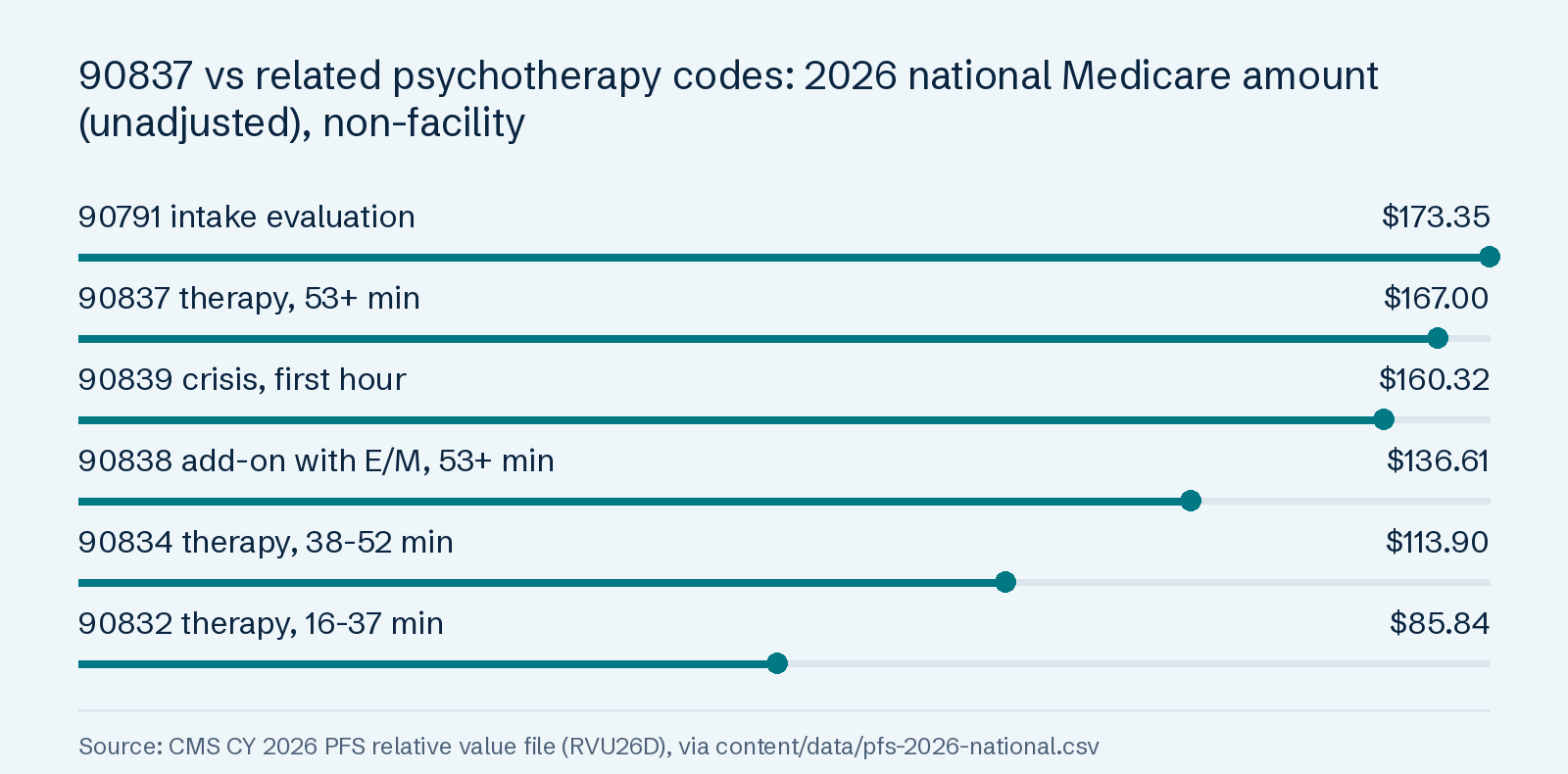
The 2026 national Medicare amount (unadjusted) for 90837 is $167.00 non-facility and $135.27 facility, from the CMS CY 2026 PFS relative value file (RVU26D). Actual payment varies by locality, setting and payer. The non-facility amount applies in an office, and Medicare also pays it for telehealth to a patient at home (see the telehealth section). The facility amount applies when the session takes place in a facility setting such as a hospital.
Illustrative calculation, not client data: for a marriage and family therapist, 75% of the $167.00 non-facility amount is $125.25 before the locality adjustment and before the patient's deductible and coinsurance. The same session by a clinical psychologist is calculated on the full $167.00.
2026 rate by locality
Medicare adjusts the national amount by geographic locality, so the same 90837 claim pays a different amount from one locality to the next. The CMS Physician Fee Schedule Look-Up Tool returns the amount for each locality. This page prints national amounts only.
Commercial 90837 rates
Commercial plans pay their own contracted rates for 90837, and those rates differ by plan, network, state and license. We publish no commercial range here because no plan-neutral, sourced range exists for every market; your own remittances and contracts are the record that counts. What 90837 and 90834 pay a therapy practice compares what each payer and license pays per session and how to read your own payment data.
| Code | Use it when | 2026 national Medicare, non-facility | Facility |
|---|---|---|---|
| 90837 | Therapy alone, 53+ minutes | $167.00 | $135.27 |
| 90834 | Therapy alone, 38 to 52 minutes | $113.90 | $91.85 |
| 90832 | Therapy alone, 16 to 37 minutes | $85.84 | $69.47 |
| 90838 | 53+ minutes added to an E/M visit | $136.61 | $110.22 |
| 90839 | Crisis psychotherapy, first hour | $160.32 | $129.60 |
| 90785 | Interactive complexity add-on | $14.70 | $11.69 |
90837 billing code with add-ons: 90785, 90840 and prolonged time
Only one add-on regularly travels with 90837. The other two codes people expect to stack on a long session belong to different services.
90785: interactive complexity
The NCCI manual says interactive complexity in psychiatric services is reported with add-on 90785, for patients who have lost, or have not yet developed, the expressive language skills to explain their symptoms and response to treatment. Add 90785 to 90837 only when the note supports it: name the communication factor and how it affected the session. In 2026 its national Medicare amount (unadjusted) is $14.70 non-facility.
90840: the crisis add-on, not a 90837 extension
Palmetto lists 90840 as each additional 30 minutes of psychotherapy for crisis, billed in addition to 90839, the code for the first 60 minutes of crisis psychotherapy. Palmetto describes the crisis service as using an urgent assessment, a mental status exam and a disposition. A long routine session stays 90837; a documented crisis session is 90839, plus 90840 when the time supports it.
Prolonged time
The CMS CY 2026 relative value file has no rows for 99354 to 99357, the former prolonged-service codes. The prolonged codes that remain describe extra time on office E/M visits: Medicare pays G2212, whose HCPCS short descriptor reads "Prolong outpt/office vis", and lists CPT 99417 with status I, which Medicare does not pay. Neither code describes psychotherapy alone, so a session that runs past an hour is still one unit of 90837. The NCCI manual's one exception is psychotherapy in a Medicare partial hospitalization or intensive outpatient setting, which may be reported with more than one unit for the day.
Before the claim goes out, check these same-day pairings against the NCCI manual:
- No intake on the same date. 90791 and 90792 are not separately reportable with individual, group, family or crisis psychotherapy on the same date.
- Family therapy needs its own interval. 90846 or 90847 may be reported with 90837 on the same date only when performed as a separate and distinct service in a separate time interval; family members who join as informants are already included in 90837.
- E/M changes the code. With an E/M visit, bill the E/M code plus 90838 instead of 90837.
- 90785 needs its own documentation. Record the communication factor in the note.
Telehealth 90837: POS 02 vs 10 and modifiers 95 and 93
90837 is on the CMS list of Medicare telehealth services for calendar year 2026, so a video session is billed with the same code and the same 53-minute rule. The CMS telehealth FAQ (updated October 8, 2026) sets the place of service: POS 02 when the patient is not at home and POS 10 when the patient is at home. Since January 1, 2024, Medicare pays telehealth to a patient at home at the non-facility rate, so a home session is calculated on $167.00 national, not $135.27. The Medicare Claims Processing Manual, ch. 26 §10.5 (Rev. 14466) requires POS 02 or POS 10 to be paired with a telehealth modifier: 95 for audio and video, 93 for audio-only. The modifier does not change the payment rate; only the POS does.
For audio-only sessions, 42 CFR 410.78 allows audio-only telehealth to a patient at home when the clinician is able to use video but the patient cannot use, or does not consent to, video, and requires CPT modifier 93 on the claim to show those conditions were met, plus Medicare modifier FQ for rural health clinics and federally qualified health centers. CMS's FAQ says patients may keep receiving audio-only telehealth at home through December 31, 2027, and that from January 1, 2028 audio-only behavioral health at home remains available under those same video and consent conditions. The FAQ also says modifiers BB and BC become required for certain telehealth claims from January 1, 2027, with no payment effect.
The in-person visit rule
The same FAQ says Medicare's in-person, non-telehealth visit requirement for mental health telehealth takes effect after December 31, 2027: an in-person visit within 6 months before the first mental health telehealth service. Patients who began services on or before that date are treated as established and need at least one in-person visit every 12 months after it.
Commercial plans write their own telehealth rules, and the two policies below disagree on POS 10 and on modifiers.
| Payer | Place of service | Video sessions | Audio-only sessions |
|---|---|---|---|
| Medicare (CMS FAQ, MLN901705, 42 CFR 410.78, Claims Processing Manual ch. 26 §10.5) | POS 02 not at home; POS 10 at home | POS 02 or 10 with modifier 95; 93 for audio-only (ch. 26 §10.5, Rev. 14466); home sessions paid at the non-facility rate | Modifier 93 (FQ for RHCs and FQHCs); patient at home |
| UnitedHealthcare commercial (policy 2026R0046A) | POS 02 or 10 in box 24B | Modifiers 95, GT, GQ and G0 not required; accepted as informational | Modifier 93 with POS 02 or 10, for codes on its audio-only list |
| Cigna behavioral health (policy R31, updated 02/17/2026) | POS 02, per the policy's behavioral health section | One of modifiers 93, 95, FQ, GQ or GT required | Modifier 93 accepted; record must show the delivery method |
| Medicaid and other plans | Set by each state or plan | Check the plan's telehealth policy | Check the plan's telehealth policy |
Why payers audit 90837 and how to document for it
90837 is the highest-paying of the three individual therapy codes, and its whole case rests on a time record. HHS-OIG audit A-09-21-03021 found that Medicare paid $1 billion for psychotherapy services in the first year of the COVID-19 public health emergency; for 128 of 216 sampled enrollee days, providers did not meet Medicare requirements, for example because psychotherapy time was not documented. OIG estimated $580 million of improper payments, $348 million for telehealth and $232 million for non-telehealth services.
Commercial reviewers look for the same gaps. Optum Provider Express tells clinicians submitting records to verify the signature, credentials and start and stop times, to check that session time matches the code, and to consider a family therapy code when family members took part. It also asks for psychotherapy to be documented distinctly from any E/M service.
90837 audit documentation checklist
Each item below comes from the Palmetto, Optum, Cigna or NCCI sources on this page:
- Start and stop times, or total psychotherapy minutes, showing 53 or more.
- Psychotherapy time kept separate from any E/M time, never one combined period.
- Who attended: the patient for all or part of the session, plus any informants.
- Clinician signature and credentials on the note.
- Delivery method for telehealth: video or audio-only, matching the POS and modifier.
- The 90785 factor, named and described, whenever the add-on is billed.
- A separate interval for any same-day family therapy billed as 90846 or 90847.
When most of a clinician's sessions bill as 90837, the minutes in each note are what a reviewer reads first. A template that prompts for start and stop times prevents more denials than any appeal letter.
90837 vs 90834 vs 90832: picking the right code
Pick the code from the psychotherapy minutes in the note, then check for an E/M visit. The table puts the three codes side by side with their 2026 national Medicare amounts (unadjusted, non-facility). Between 90834 and 90837 the line is one minute, and the national amount differs by $53.10.
90837 vs 90834 goes deeper on that choice, and the full set of cpt codes for mental health places all of them next to intake, family and group codes. If your practice also delivers applied behavior analysis, those sessions use a separate code family; start with the aba billing codes overview and code 97153.
If 90837 claims keep coming back short-paid or with record requests, the pattern usually sits in the note template or the schedule, not in single claims. Our mental health billing services code from the minutes in each note and query the clinician when the time is missing, before the claim goes out. To see which unpaid therapy claims are closest to their filing deadlines, get my free A/R Deadline Map: The Free A/R Deadline Map (Clock starts with your claim-level aging export and signed BAA; above 10 requests in a week, we confirm your date within 1 business day.).
| Code | Psychotherapy minutes | With an E/M visit, bill instead | 2026 national Medicare, non-facility |
|---|---|---|---|
| 90832 | 16 to 37 | E/M + 90833 | $85.84 |
| 90834 | 38 to 52 | E/M + 90836 | $113.90 |
| 90837 | 53 or more | E/M + 90838 | $167.00 |
Common questions
- What is the 90837 CPT code?
- 90837 is the CPT code for one individual psychotherapy session of 53 minutes or more, billed when the same clinician reports no E/M visit that day. With an E/M visit, the therapy is reported as add-on 90838 instead. Its 2026 national Medicare amount (unadjusted) is $167.00 non-facility.
- How many minutes is 90837?
- 53 minutes or more of psychotherapy. Palmetto GBA lists the CPT ranges as 16 to 37 minutes for 90832, 38 to 52 for 90834 and 53 or longer for 90837. Count only psychotherapy minutes, not E/M time or note writing.
- Does insurance cover 90837?
- Medicare Part B covers it when furnished by an eligible professional such as a psychologist, clinical social worker, marriage and family therapist or mental health counselor (CMS MLN1986542). Commercial and Medicaid coverage depends on the plan, the patient's benefits and whether the clinician is in network, so verify benefits before the first session.
- Can 90837 be billed via telehealth?
- Yes for Medicare: 90837 is on the CY 2026 telehealth list. Use POS 10 when the patient is at home and POS 02 elsewhere, and add modifier 93 for an audio-only session (42 CFR 410.78). Commercial plans differ: Cigna's behavioral health policy asks for POS 02 and a telehealth modifier, while UnitedHealthcare accepts POS 02 or 10.
- Why do insurers audit 90837 claims?
- Because 90837 pays more than the shorter codes and depends entirely on documented time. HHS-OIG found that providers failed Medicare requirements on 128 of 216 sampled enrollee days, for example by not documenting psychotherapy time. Start and stop times, separate E/M time and a signed note answer most record requests.
- What is the difference between 90837 and 90834?
- Psychotherapy minutes: 90834 covers 38 to 52 minutes and 90837 covers 53 or more. In 2026 the national Medicare amount (unadjusted, non-facility) is $113.90 for 90834 and $167.00 for 90837; actual payment varies by locality, setting and payer.
Sources and review
Page revised November 4, 2026 · Review contact: Hyder Shah (inquiries@claimpillar.com). Every source below was retrieved and checked on November 4, 2026. Medicare amounts are 2026 national Medicare amounts (unadjusted) from our dataset built on the CMS CY 2026 PFS relative value file (RVU26D); actual payment varies by locality, setting and payer. Payer rules apply only to the payer and program named.
- Palmetto GBA JM Part B: Psychotherapy Services (published 02/23/2026)
- CMS NCCI Policy Manual for Medicare Services, Chapter XI (revised 1/1/2026)
- CMS MLN1986542: Medicare & Mental Health Coverage (March 2026)
- CMS: PFS Relative Value Files (CY 2026, RVU26D)
- CMS: Medicare Claims Processing Manual, Chapter 26, section 10.5 (Rev. 14466, May 27, 2026)
- CMS: List of Medicare Telehealth Services, CY 2026
- CMS Telehealth FAQ (updated 10/8/2026)
- CMS MLN901705: Telehealth & Remote Patient Monitoring (December 2025)
- eCFR: 42 CFR 410.78, Telehealth services
- UnitedHealthcare Commercial Reimbursement Policy 2026R0046A, Telehealth/Virtual Health
- Cigna Reimbursement Policy R31, Virtual Care (updated 02/17/2026)
- HHS-OIG A-09-21-03021: Medicare improperly paid providers for some psychotherapy services
- Optum Provider Express: top 3 errors in psychotherapy and E/M records (October 2025)