When to outsource credentialing
Practices hand off credentialing when a payer gate stands between a clinician and a paid claim:
- A new clinician starts in a few weeks. Visits before a payer's effective date put claims at risk: for clinicians contracted only for Humana's Medicare products who join non-delegated groups, members seen earlier “generally will have claims paid at an out-of-network level”.
- You are opening a practice or a new group. We file the group's payer requests alongside each clinician's application.
- An application went quiet. Cigna closes an application and notifies you by email when requested items never arrive. We take over the file and chase the missing item.
- The person who ran credentialing left. Our first status report rebuilds the list of pending and approved payers.
What our medical credentialing services cover, and what you keep
Our provider credentialing team runs each clinician-and-payer pair as its own line, from the first document to the effective date your billing depends on.
Which filings this service covers
Credentialing verifies a provider's qualifications; enrollment registers the provider with a payer so claims can be paid; contracting sets the rates and terms. This service covers credentialing with commercial payers. Medicare and Medicaid enrollment runs through our Medicare, Medicaid and PECOS enrollment service under the same tracker. State licensing, DEA registration and hospital privileging are not part of this service.
| Task | Deliverable | Timing | What you keep |
|---|---|---|---|
| Packet check | Missing-item list per clinician, naming who supplies each item | Before anything is filed | Your original documents |
| CAQH ProView profile | Profile built or corrected, attested by the clinician, released to the payers you chose | Before payer applications; re-attested every 90 days, UnitedHealthcare's cadence, which also meets DataSpring's 120-day cycle | Your CAQH login and profile |
| Payer applications | Application filed with each payer, with the payer's reference number logged | After your packet is complete | A copy of every application |
| Payer follow-up | Status report per clinician and payer: stage, payer reference, next owner | every 14 days | Every payer letter and email |
| Contract routing | Participation agreement sent to you for signature | When the payer issues it | Signature authority and the decision to accept rates |
| Effective-date confirmation | Payer's written effective date and provider ID, passed to your billing setup | When the payer confirms | The confirmation letter |
| Recredentialing calendar | Due dates for CAQH re-attestation, payer recredentialing and Medicare revalidation | Kept from the first day | The calendar file |
Where credentialing stalls, and what we do about each
A credentialing file stalls at five points. Here is what we do at each:
- An incomplete packet. UnitedHealthcare counts its up to 45 calendar days or more only from a completed application and all required information. We check the packet before anything is filed, so the payer receives a complete application.
- A closed panel. Aetna reviews each request against its current network in your geographic area, and UnitedHealthcare sends a letter when a market is closed to your specialty. We check each payer's panel status at kickoff and tell you about a closed panel before the packet is built for it.
- A lapsed CAQH attestation. DataSpring, the new name for CAQH, keeps profiles on a 120-day attestation cycle, and Aetna gets its credentialing application from CAQH ProView. We build or correct the profile, the clinician attests it, and each re-attestation date goes on the calendar.
- Approval without a loaded contract. UnitedHealthcare asks you to allow up to 60 days to load the contract after approval and a signed contract, so a claim is not denied or paid out of network. We pass the payer's written effective date and provider ID to whoever runs your billing, so claims for that payer go out from the confirmed date.
- A clinician joining a group already in network. UnitedHealthcare says a clinician joining a practice with a UHC agreement still completes onboarding before seeing members in-network. We file every joining clinician as a new line, never as an add-on to the group.
Each payer's published clock, and what restarts it, is in our insurance credentialing guide.
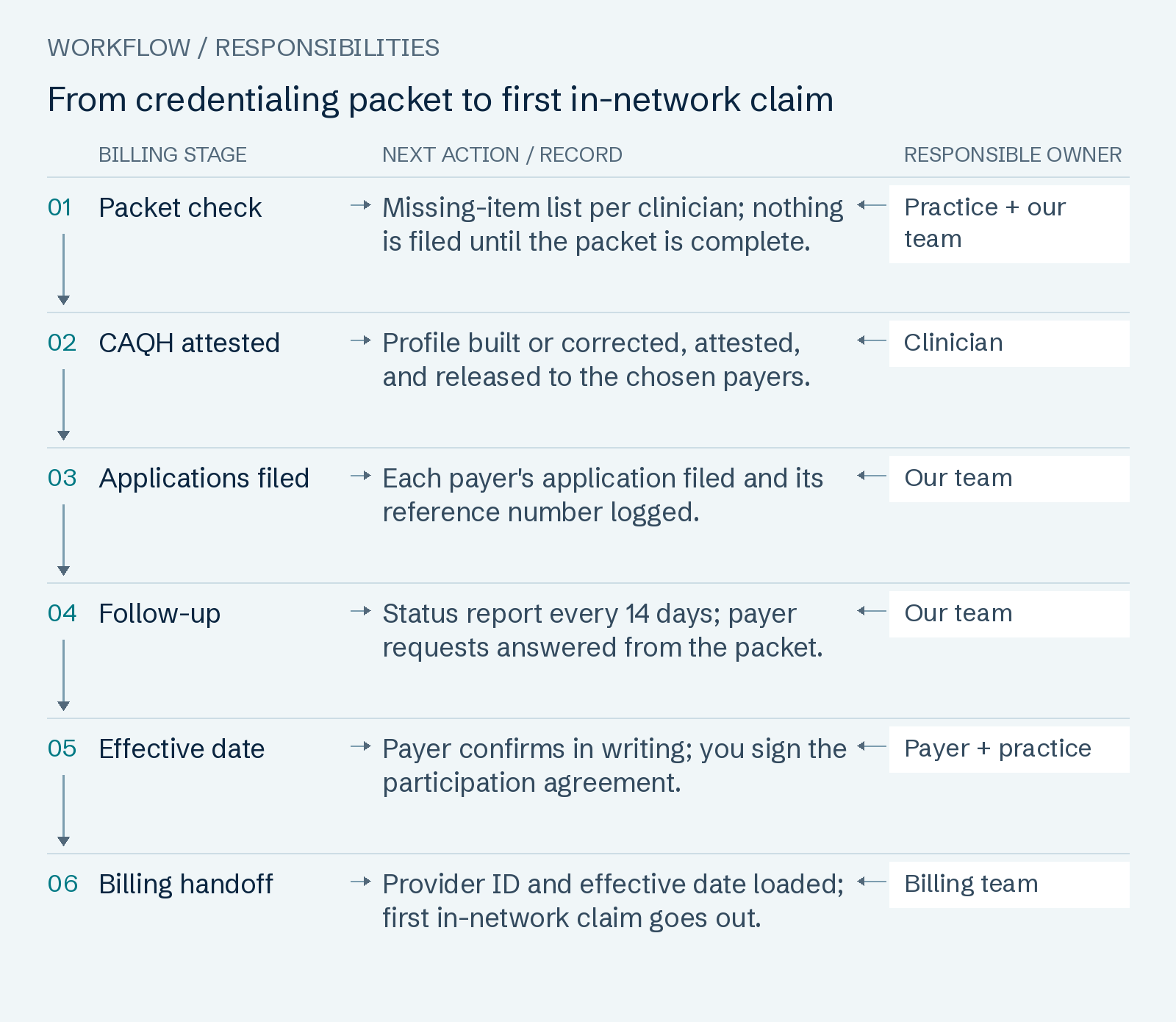
Read the workflow as text
- Packet check — Missing-item list per clinician; nothing is filed until the packet is complete. Owner: Practice + our team.
- CAQH attested — Profile built or corrected, attested, and released to the chosen payers. Owner: Clinician.
- Applications filed — Each payer's application filed and its reference number logged. Owner: Our team.
- Follow-up — Status report every 14 days; payer requests answered from the packet. Owner: Our team.
- Effective date — Payer confirms in writing; you sign the participation agreement. Owner: Payer + practice.
- Billing handoff — Provider ID and effective date loaded; first in-network claim goes out. Owner: Billing team.
Who we credential: physicians, NPs, PAs, therapists and telehealth clinicians
We credential physicians and the clinicians who bill beside them; the file changes with the clinician type:
- Physicians who admit patients. Cigna asks for clinical privileges in good standing at a Cigna-participating hospital or a coverage arrangement, so we confirm the named hospital is in network before filing.
- Nurse practitioners and PAs. AANP lists reduced-practice states that require a career-long regulated collaborative agreement; where the state requires one, the signed agreement goes into the packet before we file. Their Medicare enrollment runs through our provider enrollment service.
- Telehealth clinicians licensed in several states. UnitedHealthcare lets a clinician submit multiple state requests at one time and issues a reference number for each state; we report each state as its own line.
- Therapists, counselors and psychologists. Behavioral networks run their own join process, and UnitedHealthcare points behavioral clinicians to Optum Behavioral Health.
- PT, OT and speech therapists. We file each therapist who joins a therapy group as their own line with each payer, and our therapy billing team bills each one from their own effective date.
- Multi-location practices. Humana asks for all prior and current practice locations; we match each service address across CAQH and every payer record.
How long a new NP or PA waits before billing, and what it changes per visit, is in our guide to adding an NP or PA.
What our insurance credentialing services cost
Our medical credentialing services cost $149 per payer for each clinician (Credentialing & Payer Enrollment). Billed only after the payer confirms your effective date; $0 if denied or panel closed; filed within 5 business days of your complete packet.
Example (an illustration, not a quote): one new clinician applies to five payers; four confirm an effective date and one panel is closed. You pay 4 × $149, one invoice per confirmed payer.
Payer or state application fees are not included. Compare every tier and term on the full rate card, and see what to check before paying for credentialing.
| Option | Price | When you pay | What it covers |
|---|---|---|---|
| Credentialing only | $149 per payer | After the payer confirms the effective date | Packet check, CAQH ProView, application, follow-up, effective-date confirmation |
| Full-Service Billing client adding a clinician | Included (New-Clinician Enrollment) | Included while you are a billing client | Clinicians who join while you're a client get enrollment filed with up to 5 payers each (the payer decides), with no per-payer fee. |
| Complete RCM | 9.0% of insurance payments | Monthly invoice | Billing plus credentialing and re-credentialing for every clinician and payer you choose |
How we start: from kickoff to your first in-network claim
- Kickoff. You name the clinicians, locations and payers in priority order, and we check which panels are open first.
- Packet. We send one checklist per clinician and return a missing-item list until the packet is complete.
- CAQH ProView. We build or correct the profile and the clinician attests it; Humana requires a current and complete CAQH ProView application for first-time credentialing.
- File. We file each payer's application and log its reference number.
- Follow up. You get a status report every 14 days. We answer payer requests from the packet; anything only you can supply goes to you with the payer's deadline attached.
- Confirm and hand off. You sign the participation agreement, the payer confirms the effective date in writing, and that date goes to whoever runs your billing from the effective date forward.
What we need from your practice
For each clinician: license, DEA and state controlled-substance certificates where they apply, education and training, board status, five years of work history, malpractice coverage and claims history, hospital privileges or a coverage arrangement, NPI, W-9 and CAQH ProView access. For the practice: tax ID, service locations and a signer for participation agreements. We send the checklist at kickoff.
What we report, and how we keep clinicians credentialed after approval
You get a status report every 14 days on every open application, per clinician and payer. After approval the same file becomes a recredentialing calendar: each CAQH re-attestation, payer recredentialing and Medicare revalidation date sits on it with the clinician who has to sign, because a clinician who does not re-sign at Cigna recredentialing is terminated from the Cigna network.
Re-credentialing work itself is included in Complete RCM at 9.0% of insurance payments.
| What we report | When | What it tells you |
|---|---|---|
| Status per clinician and payer: stage, payer reference, next owner | every 14 days | Which payer is waiting on whom |
| Items only your practice can supply | As the payer asks | What to send, with the payer's deadline attached |
| Payer decision or closed panel | When the payer tells us | Where to schedule the clinician next |
| Effective date and provider ID | When the payer confirms in writing | The date claims for that payer can go out |
| Recredentialing calendar | Kept from the first day | Due dates for CAQH re-attestation, payer recredentialing and Medicare revalidation |
Credentialing terms we put in writing
No credentialing company can make a payer approve an application or open a closed panel; the payer decides. What we commit to is the work, the reporting and when you pay. Put these answers beside any credentialing company you are considering.
- New-Clinician Enrollment (billing clients): Clinicians who join while you're a client get enrollment filed with up to 5 payers each (the payer decides), with no per-payer fee.
- Clean-Exit Terms (billing clients): Notice by email; optional run-out covers claims we submitted before your exit date, at your plan rate; handover file within 10 business days of exit. Every open claim with its status and next action, the denial log, payer correspondence and credentialing files, in CSV and PDF.
We publish client results only with written permission. Until we have them, judge us by the guarantees and the free Deadline Map.
To start, send us the clinician list and the payers you want; kickoff begins with the packet checklist. If your practice also bills insurance, Get my free A/R Deadline Map: 5 business days from your aging export and BAA. Yours to keep.
| Question to ask | Our answer |
|---|---|
| When is the fee charged? | $149 per payer. Billed only after the payer confirms your effective date; $0 if denied or panel closed; filed within 5 business days of your complete packet. |
| Denied application or closed panel | Nothing for that payer, as the terms line above states |
| CAQH ProView login | You keep it, along with every payer letter and email |
| Status report | every 14 days, per clinician and payer: stage, payer reference, next owner |
| Timelines | Quoted from each payer's own published page, never one range for every payer |
| Renewal dates | Recredentialing calendar kept from the first day; re-credentialing work is included in Complete RCM |
| Medicare and Medicaid enrollment | A separate filing, run by our provider enrollment service under the same tracker |
| When the engagement ends | You hold a copy of every application, every payer letter and the calendar file |
Common questions
- How much do your credentialing services cost?
- $149 per payer for each clinician, unless your billing plan includes it. Billed only after the payer confirms your effective date; $0 if denied or panel closed; filed within 5 business days of your complete packet. Any application fee a payer or state charges is not included. See our pricing page for every tier.
- Do you charge if a payer denies the application or the panel is closed?
- No. Billed only after the payer confirms your effective date; $0 if denied or panel closed; filed within 5 business days of your complete packet. We report each payer's decision so you can redirect the clinician's schedule.
- How fast do you file, and how long until our clinician is in-network?
- We file once your packet is complete. Billed only after the payer confirms your effective date; $0 if denied or panel closed; filed within 5 business days of your complete packet. Then the payer's own clock runs: UnitedHealthcare, for example, states up to 45 calendar days or more from a complete application, plus up to 60 days to load the contract. We quote each payer's own published time, never one range for every payer.
- Can our new clinician see patients while you credential them?
- Yes, but schedule them with payers that have confirmed an effective date. UnitedHealthcare says credentialing and contracting must both be complete before a clinician sees its members in-network. Our status report shows which payers have confirmed.
- Is credentialing included if we use your billing service?
- Full-Service Billing clients get New-Clinician Enrollment: Clinicians who join while you're a client get enrollment filed with up to 5 payers each (the payer decides), with no per-payer fee. Complete RCM includes credentialing and re-credentialing for every clinician and payer you choose. Standalone credentialing stays at $149 per payer.
- Does our practice keep the CAQH login and files if we stop working with you?
- Yes. You keep your CAQH ProView login, every payer letter and a copy of every application, and DataSpring states that health plans do not own or control clinician profiles.
- How should we compare credentialing companies?
- Compare terms, not rankings: when the fee is billed, what a denial costs, who keeps the CAQH login, how often you hear about each application and whether Medicare enrollment is included. Our credentialing terms table answers each question for us.
Sources and review
Page revised October 7, 2026 · Review contact: Hyder Shah (inquiries@claimpillar.com). Payer timelines are quoted from each payer's own provider page, retrieved October 2, 2026; payers change them without notice.
- UnitedHealthcare: Join our network - Medical providers
- Aetna: Join the Aetna network
- Aetna: Joining the provider network FAQs
- Cigna Healthcare: Health care provider credentialing
- Humana: Credentialing and CAQH for healthcare professionals
- DataSpring (formerly CAQH): For clinicians
- AANP: State Practice Environment
- Humana: 2026 Provider Manual (non-delegated)