Who our gastroenterology billing service is for
Our GI billing service is built for independent gastroenterology practices, from a single endoscopist to groups of 6–15 clinicians. We bill the cases your endoscopists perform in office procedure suites, ASCs and hospital endoscopy units, plus the clinic visits around them.
Hand your billing to us when:
- screening colonoscopies that found a polyp keep coming back with the wrong patient balance, and patients are calling the front desk about it;
- the anesthesia group or the pathology lab bills the same case differently from you, and nobody owns the mismatch;
- the biller who knew which site each endoscopist worked at has left, and endoscopy claims older than 90 days are piling up.
What we take over from your GI team, and what stays with you
We run the professional side of your GI revenue cycle, from the signed endoscopy report to the posted payment. No code is changed without your endoscopist's sign-off, and every colonoscopy, EGD and ERCP claim passes our documentation-based coding review before release. The figure shows a month of GI billing with us.
| Task | What we do | What you keep |
|---|---|---|
| Charge capture from endoscopy reports | Match every scheduled colonoscopy, EGD, ERCP, EUS and capsule study to a signed report and a charge; chase missing reports by name. | Signing reports promptly |
| Screening versus diagnostic status | Check each colonoscopy's screening intent, risk level and findings against the report and the patient's screening history before coding. | Final say on every code |
| Sedation and anesthesia linkage | Bill the sedation line with the scope's date, diagnosis and screening status, and send the same details to whoever bills the anesthesia. | Choice of anesthesia provider |
| Pathology linkage | Match the specimen count in the report to the pathology claim and send the screening status to whoever bills it. | Labeling each specimen container |
| Site of service | Set the place-of-service code for each case by where the endoscopist scoped: office suite, ASC or hospital. | Your endoscopists' site schedule |
| Authorization tracking | Record authorization numbers and expiry dates against each scheduled EGD, colonoscopy and ERCP. | Clinical notes the plan asks for |
| Claim submission | Send every claim with complete charge data within 1 business day. | Encounter sign-off |
| Denials and appeals | Every GI denial is corrected, appealed or sent back to you with the fix, inside 2 business days. | Replies when we query a report |
| Payment posting and A/R | Remittances posted inside 2 business days; each unpaid insurance balance chased until paid or closed. | Payments in your own bank account |
| Patient balances | Calculate the patient share after any payer's screening cost-sharing waiver; send statements in your practice's name. | Copay collection at check-in |
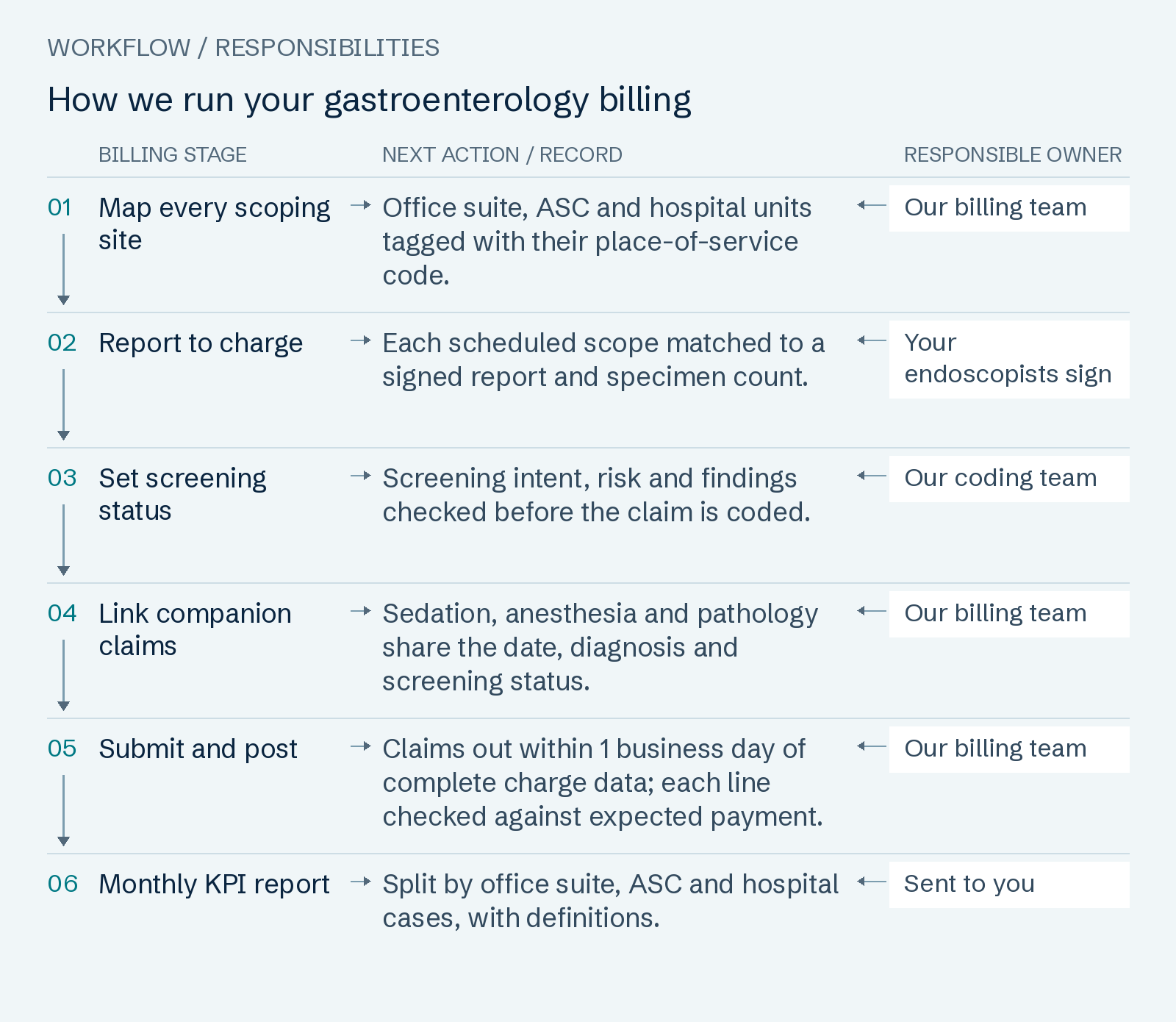
Read the workflow as text
- Map every scoping site — Office suite, ASC and hospital units tagged with their place-of-service code. Owner: Our billing team.
- Report to charge — Each scheduled scope matched to a signed report and specimen count. Owner: Your endoscopists sign.
- Set screening status — Screening intent, risk and findings checked before the claim is coded. Owner: Our coding team.
- Link companion claims — Sedation, anesthesia and pathology share the date, diagnosis and screening status. Owner: Our billing team.
- Submit and post — Claims out within 1 business day of complete charge data; each line checked against expected payment. Owner: Our billing team.
- Monthly KPI report — Split by office suite, ASC and hospital cases, with definitions. Owner: Sent to you.
Where GI claims lose money, and what we do about it
GI revenue leaks where one procedure day produces several claims from several billers, and where a screening changes status halfway through the scope. We check each point below on every endoscopy case.
Screening colonoscopies that turn diagnostic
- The screening flag is lost. We retain the documented screening purpose through the claim review and check how a finding changes the payer's required coding.
- The patient is billed the wrong share. We post each payer line before calculating the patient balance, and query a screening claim whose cost sharing does not match the remittance and applicable policy.
- Commercial plans apply cost sharing to a screening. We check the plan's preventive coverage instructions and coordinate the procedure date with companion anesthesia and pathology billers when their claims need matching.
Multi-lesion, multi-site and companion claims
- Biopsy and snare removal billed together without support. We compare the report's lesions, specimen sites and procedures before a separate line or modifier is released; the endoscopist approves any code change.
- Short payments on same-session scopes go unnoticed. We post each scope line with its adjustment reason and investigate denial or coding mismatches. 60-Day Underpayment Check: In month 3 we compare every payment from your first 60 days against your contracted rates and appeal each underpaid line. Needs your fee schedules.
- The wrong rate for the site. We match the endoscopist's site schedule to each professional claim so office, ASC and hospital cases use the correct setting.
What our gastroenterology billing costs
GI practices sit on the specialist physician row of our rate card. Your fee applies only to insurance payments on claims we submitted or worked; copays and other patient payments carry 0%. The ASC's or hospital's facility payment for a case goes to that facility, so it never enters your fee. Setup is $0. Invoices 1–3: only percentage fees on that month's insurance payments, plus any statements or add-ons you order. Percentage fees and mailed statements are capped at 9.0% of that month's insurance payments; from invoice 4, the $400 minimum applies even in a month when the cap comes to less.
Claims for anesthesia providers your group employs, or for a pathology lab your group owns, are quoted on the custom row. Our anesthesia billing team handles the anesthesia claims. Add-ons and exclusions are on the full rate card.
| GI practice size | Your percentage of insurance payments |
|---|---|
| Solo endoscopist (1 clinician) | 6.0% |
| Small group (2–5 clinicians) | 5.5% |
| Larger group (6–15 clinicians) | 5.0% |
| Larger groups, employed anesthesia providers or a group-owned lab | Pricing is by written quote. |
How we start, whether you bill in-house or with another company
A GI handover puts the oldest endoscopy claims and their companion anesthesia and pathology claims at risk first, so week one goes to deadlines. To start, we need:
- Your signature on our agreement and BAA.
- Practice-management and clearinghouse logins, plus read access to signed endoscopy reports.
- A claim-level aging export, which we sort by filing deadline on day one.
- Each endoscopist's site schedule: which days at the office suite, which ASC and which hospital.
- Billing contacts for the anesthesia group and pathology lab that cover your cases.
Go-live, when your first claims go out, comes within 5 business days of access; any unbilled backlog follows within 10 business days of access. Clock starts with your signed agreement, signed BAA and working system logins; it extends day for day while we wait on access. Every inherited claim within 30 days of a filing, corrected-claim or appeal deadline is worked within 5 business days of access. Starts at access; covers up to 250 claims (more gets a day-1 deadline schedule); worked means submitted, corrected, appealed or returned with the fix.
Before you give notice, our billing handoff plan shows what to collect from your current company. Not ready to switch? Start with The Free A/R Deadline Map. Clock starts with your claim-level aging export and signed BAA; above 10 requests in a week, we confirm your date within 1 business day.
Monthly reporting, service standards and guarantees for GI claims
Two guarantees cover your GI claims, each with its terms:
- On-Our-Watch Guarantee: If a claim misses a filing, corrected-claim or appeal deadline while it is on our watch, we pay you what it would have paid. Claims we get complete 10+ business days before the deadline; contracted rate less any copay you collected, paid automatically within 30 days of final denial; capped $10,000/month; your holds excluded.
- Clock-or-Credit Guarantee: From go-live, every new claim goes out within 1 business day of complete charge data, and every denial is worked within 2 business days of posting — or $25 comes off your invoice for each late one. Mon–Fri ET business days by your system's timestamps; worked: resubmitted, appealed or returned with the fix; auto-credited; capped at monthly fee; clearinghouse outages excluded.
Unsigned reports and missing specimen details stay on a hold list with the responsible clinician named. We track the filing deadline for the actual plan and release the claim once all required charge data is complete.
GI service standards on your own system's clock
Each timing below is a timestamp in your own system, not a results claim. Your monthly report carries written definitions of clean claims, A/R days and net collection rate, plus two GI counts: converted screenings with the patient balances billed on them, and companion claims still waiting on a pathology or anesthesia match. Our denial management team works GI denials to the same timetable.
We publish client results only with written permission. Until we have them, judge us by the guarantees and the free Deadline Map.
| Service | Timing | What it means for a GI claim |
|---|---|---|
| Claims submitted | 1 business day after complete charge data | A signed report and specimen count are required alongside all other complete charge data |
| Denials worked | 2 business days after a denial posts | Authorization and screening-status denials on colonoscopy and EGD claims |
| Payments posted | 2 business days after the remittance arrives | Each endoscopy line posted on its own, with the site rate it was paid at |
| Your emails answered | 1 business day | Questions about a report, a specimen count or an endoscopist's site |
| KPI report | Delivered by the 10th of each month | Split by office suite, ASC and hospital cases |
Your systems, new gastroenterologists and data access
Your GI billing stays in the practice-management system and clearinghouse you already run (our EHR compatibility page explains how we confirm yours), and a signed BAA comes before any patient data moves.
We check payer enrollment status and effective dates for each new clinician before releasing their claims. New-Clinician Enrollment: Clinicians who join while you're a client get enrollment filed with up to 5 payers each (the payer decides), with no per-payer fee. Past that, Credentialing & Payer Enrollment costs $149 per payer. Billed only after the payer confirms your effective date; $0 if denied or panel closed; filed within 5 business days of your complete packet.
Common questions
- How much do your gastroenterology billing services cost?
- A solo endoscopist pays 6.0%, a group of 2–5 clinicians pays 5.5%, and a group of 6–15 clinicians pays 5.0%, each of insurance payments. Patient payments carry 0% and setup is $0; the minimum and fee cap are on our pricing page.
- How should we choose a gastroenterology billing company?
- Get written answers to four GI questions from each candidate: how a converted screening is billed, how anesthesia and pathology claims stay matched to the scope, the full fee, and who absorbs a missed filing deadline. Ours sit on this page, with our guarantees; our checklist for comparing billing companies covers the contract side.
- Do we sign a long-term contract to outsource GI billing?
- No. Month to month. Under our Clean-Exit Terms: Leave with 30 days' notice and no termination fee. Want a run-out? We keep working the claims we submitted for 90 days at your plan rate. Decline it and we charge nothing on payments that post after you leave. Notice by email; optional run-out covers claims we submitted before your exit date, at your plan rate; handover file within 10 business days of exit.
- How fast can you take over our GI claims?
- GI claims start flowing within 5 business days of your signed agreement, BAA and working logins, and we sort inherited claims by filing deadline on day one. What we need from you is under how we start.
- Do you bill screening colonoscopies that turn diagnostic?
- Yes. We code the conversion from the signed report, carry the screening status to the sedation and anesthesia claims, and check the patient balance against the remittance before a statement goes out.
- Can you handle anesthesia and pathology claims for our endoscopy cases?
- Yes. When an outside anesthesia group or lab bills them, we share the date, diagnosis, specimen count and screening status so their claims match yours. When your group employs the anesthesia providers or owns the lab, we bill those claims too, quoted on the custom row of our rate card.
- Will you bill inside our current EHR and practice-management system?
- Yes. We work inside your existing practice-management system and clearinghouse; tell us which ones and we confirm in writing within 1 business day.
- Can you credential a new gastroenterologist joining our group?
- Yes. New-Clinician Enrollment covers gastroenterologists who join while you are a client; the payer count, fee and terms are under systems and credentialing.
Sources and review
Page revised October 7, 2026 · Review contact: Hyder Shah (inquiries@claimpillar.com). The workflow checklists are editorial recommendations; payer requirements depend on the program and current policy.
- CMS: Medicare Claims Processing Manual, Chapter 18, section 60 (colorectal cancer screening)
- CMS: Medicare Claims Processing Manual, Chapter 12 (endoscopy, place of service, anesthesia)
- CMS: Medicare NCCI Policy Manual 2026, Chapter VI (digestive system)
- DOL, HHS and Treasury: FAQs about ACA Implementation Part 51
- Cigna Healthcare: Submit claims and timely filing