Who our orthopedic billing service is for
Our orthopedic billing service is built for independent orthopedic practices, from one surgeon to groups of 6–15 clinicians. Some operate mostly in hospitals; others book their joint replacements and scopes into a surgery center and run joint injection and fracture clinics in the office. We bill sports medicine, spine, hand and general orthopedic groups surgeon by surgeon, case by case.
Hand your billing to us when:
- the biller who tracked post-op periods has left, and follow-up visits are billed when they should not be, or never billed when they should;
- returns to the OR and split post-op care pay less than expected and nobody has time to check why;
- work-injury and accident cases sit unpaid because the claim went to the wrong payer first;
- surgical A/R is aging past 90 days while the surgeons are in the OR.
What we take over and what your practice keeps
We take over orthopedic billing from the signed operative note to the posted payment: the surgeon's professional claim for every case, the office visits and injections around it, and the follow-up on all of them. We check every code against your clinician's documentation and never change a code without the clinician's sign-off. Every surgical claim passes our documentation-based code review before release.
Two related services bill separately: anesthesia for your cases goes to our anesthesia billing team, and post-op therapy by your own therapists to our physical therapy billing team.
| Task | What we do | What you keep |
|---|---|---|
| Surgical charge capture | Match every scheduled case, hospital or surgery center, to a signed op note and a charge; chase missing notes by surgeon. | Signing op notes promptly |
| Post-op period tracking | Keep each patient's 0-, 10- or 90-day window on file and check every later visit and procedure against it. | Telling us when post-op care is handed to another physician |
| Arthroscopy and multi-procedure cases | Code each knee and shoulder scope family and same-day second procedure against the op note, then check what paid. | Op notes that list every procedure performed |
| Assistant and co-surgeon claims | Check whether the payer pays an assistant or co-surgeon on the code before billing, and attach the op note where asked. | Choosing who assists |
| Joint injections and office visits | Bill injections, the drug and any separately documented same-day visit; keep routine follow-up out of the claim. | Visit notes that separate the decision from the procedure |
| Work-injury and accident cases | Flag job and accident injuries at intake and bill the carrier first, with claim number and adjuster. | Asking the intake questions |
| Authorization tracking | Record authorization numbers and expiry dates against scheduled surgeries, spine cases and injections. | Clinical notes the plan asks for |
| Claim submission | Every claim with complete charge data goes to the payer within 1 business day. | Closing encounters in your EHR |
| Denials and posting | Remittances posted within 2 business days; each denial resubmitted, appealed or sent back with the fix within 2 business days. | Payments land in your own bank account |
| Monthly reporting | KPIs split by surgery, office visits, injections and work-injury claims, with written definitions, by the 10th of each month. | Ownership of all billing data |
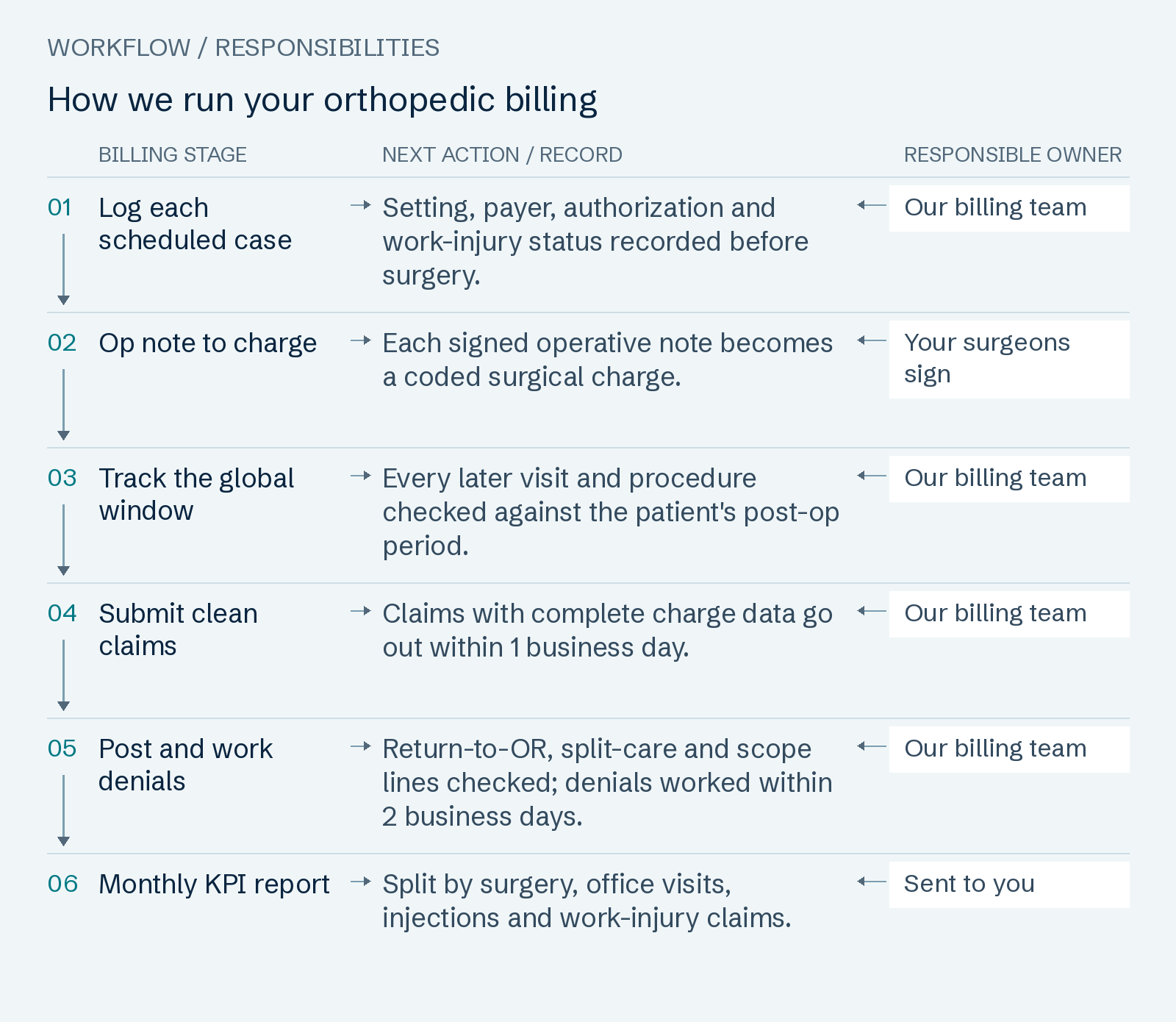
Read the workflow as text
- Log each scheduled case — Setting, payer, authorization and work-injury status recorded before surgery. Owner: Our billing team.
- Op note to charge — Each signed operative note becomes a coded surgical charge. Owner: Your surgeons sign.
- Track the global window — Every later visit and procedure checked against the patient's post-op period. Owner: Our billing team.
- Submit clean claims — Claims with complete charge data go out within 1 business day. Owner: Our billing team.
- Post and work denials — Return-to-OR, split-care and scope lines checked; denials worked within 2 business days. Owner: Our billing team.
- Monthly KPI report — Split by surgery, office visits, injections and work-injury claims. Owner: Sent to you.
Where orthopedic practices lose revenue, and what we do about it
Orthopedic revenue leaks less on the surgery line than on the services around it, on claims sent to the wrong payer and on claims missing paperwork.
Surgery and the 90-day post-op period
- Follow-up billed, or exceptions missed. We keep the patient's surgical window on file and compare each later visit or procedure with it, returning uncertain exceptions to the surgeon.
- Return-to-OR payments read wrong. We post the return-to-OR line with its adjustment reason and investigate coding or denial mismatches. 60-Day Underpayment Check: In month 3 we compare every payment from your first 60 days against your contracted rates and appeal each underpaid line. Needs your fee schedules.
- Split post-op care with no paper trail. We retain the transfer agreement and care dates so postoperative claims match the part of care your surgeon supplied.
Work injuries, spine authorizations and braces
- Work injuries billed to Medicare first. We record the injury carrier, claim number and adjuster before routing the claim and following the balance.
- A fusion claim that falls with the hospital's. We match the hospital's approval information to the scheduled case where required. Commercial authorization requests are part of prior authorization services in Complete RCM; Full-Service Billing tracks approvals.
- Documentation missing on assisted cases. We attach the op-note support the payer requests for assistant and co-surgeon claims and return missing documentation before release.
- Braces billed without supplier enrollment. We confirm supplier enrollment and documentation for separately quoted brace claims handled by our DME billing team.
To see which open orthopedic claims sit closest to a filing deadline, ask for The Free A/R Deadline Map, delivered in 5 business days. Clock starts with your claim-level aging export and signed BAA; above 10 requests in a week, we confirm your date within 1 business day.
What our orthopedic billing costs
Orthopedic groups pay the specialist physician rate on our card, and it drops as the number of clinicians we bill for grows. The fee applies only to insurance payments on claims we submitted or worked, so your patients' deductible and coinsurance after a joint replacement never carry it. Setup costs $0. Invoices 1–3: only percentage fees on that month's insurance payments, plus any statements or add-ons you order. Percentage fees and mailed statements are capped at 9.0% of that month's insurance payments; from invoice 4, the $400 minimum applies even in a month when the cap comes to less.
The rate covers your surgeons' professional claims. A surgery center bills Medicare for its facility costs on its own claim, so facility claims for a center your group owns are not part of this rate; the FAQ below covers them. Add-ons and exclusions are on the full rate card.
| Clinicians we bill for | Rate of insurance payments |
|---|---|
| 1 clinician | 6.0% |
| 2–5 clinicians | 5.5% |
| 6–15 clinicians | 5.0% |
| 16 or more clinicians | Pricing is by written quote. |
How we start: switching from in-house or another billing company
A handover puts two kinds of orthopedic claims at risk first: surgeries near their filing limit, and post-op claims whose clock started on the surgery date. We start with five things from you:
- Your signature on our service agreement and business associate agreement (BAA).
- Practice-management and clearinghouse logins, plus read access to operative notes.
- A claim-level aging report, which we sort by filing deadline.
- A list of patients now inside a post-op period, with surgery dates, if your system cannot report one.
- Copies of any written transfer-of-care agreements, and the carrier and claim number for each open work-injury case.
Go-live, when your first claims go out, comes within 5 business days of access; any unbilled backlog follows within 10 business days of access. Clock starts with your signed agreement, signed BAA and working system logins; it extends day for day while we wait on access.
Leaving another billing company? Our switching guide lists the files and access to request, or book a call with our billing team.
What we report each month and the guarantee behind it
On-Our-Watch Guarantee. If a claim misses a filing, corrected-claim or appeal deadline while it is on our watch, we pay you what it would have paid. Claims we get complete 10+ business days before the deadline; contracted rate less any copay you collected, paid automatically within 30 days of final denial; capped $10,000/month; your holds excluded.
Unsigned op notes stay on a named surgeon hold list. We track each claim against the actual plan's filing deadline and release it once all required charge data is complete.
Service standards for your orthopedic claims
Every clock in the table runs on timestamps in your own system. Your report arrives with clean claims, A/R days and net collection rate defined in writing, plus two orthopedic counts: post-op visits held back as inside the surgical package, and return-to-OR or split-care lines paid below the expected share. Denials follow our denial management workflow.
We publish client results only with written permission. Until we have them, judge us by the guarantees and the free Deadline Map.
| Standard | Our commitment | Where orthopedic claims test it |
|---|---|---|
| Claim submission | Within 1 business day of complete charge data | A signed op note is required alongside all other complete charge data |
| Denial work | Within 2 business days of posting | Post-op visit, missing-authorization and assistant-surgeon denials |
| Payment posting | Within 2 business days of the remittance | Return-to-OR, split-care and multi-scope lines checked against the expected share |
| Email replies | Within 1 business day | Questions about an op note, a transfer of care or a work-injury carrier |
| Monthly report | By the 10th of each month, with written definitions | Split by surgery, office visits, injections and work-injury claims |
Your systems, new surgeons and data access
Your surgeons keep the practice-management system and clearinghouse they already use; we log in and bill there (see EHR and practice-management compatibility). A signed BAA comes before any access to patient data.
We check payer enrollment status and effective dates for each new clinician before releasing their claims. New-Clinician Enrollment: Clinicians who join while you're a client get enrollment filed with up to 5 payers each (the payer decides), with no per-payer fee. Beyond that, Credentialing & Payer Enrollment costs $149 per payer. Billed only after the payer confirms your effective date; $0 if denied or panel closed; filed within 5 business days of your complete packet.
Common questions
- How much do your orthopedic billing services cost?
- The specialist physician rate: 5.0% of insurance payments for a group of 6–15 clinicians, rising to 5.5% at 2–5 clinicians and 6.0% for a solo surgeon. Patient payments carry 0%. Minimum, cap and add-ons are on our pricing page.
- How should we choose an orthopedic billing company?
- Ask each candidate, in writing, how it tracks post-op periods, who checks a return-to-OR payment against the expected share, what it charges and who pays when a claim misses its filing limit. This page answers all four for us, including the written guarantee. Our billing company checklist covers contract terms.
- Is there a long-term contract or a cancellation fee?
- No. Month to month. Leave with 30 days' written notice. No termination fee. Clean-Exit Terms: Leave with 30 days' notice and no termination fee. Want a run-out? We keep working the claims we submitted for 90 days at your plan rate. Decline it and we charge nothing on payments that post after you leave. Notice by email; optional run-out covers claims we submitted before your exit date, at your plan rate; handover file within 10 business days of exit.
- How fast can you take over our orthopedic claims?
- Go-live, when your first claims go out, comes within 5 business days of access; any unbilled backlog follows within 10 business days of access. The five things we need from you are listed under switching to us.
- Do you bill our surgery center's facility claims too?
- Our specialist rate covers your surgeons' professional claims. Facility claims for a surgery center your group owns, implant lines included, are not part of that rate. Raise them on a call with our billing team and we tell you plainly whether and how we take them on.
- Can you handle workers' compensation and accident cases?
- Yes. We flag job and accident injuries at intake, record the carrier, claim number and adjuster, and bill the workers' comp carrier first. Under Medicare Secondary Payer rules the carrier pays first, so we bill Medicare only after the carrier's denial.
- Which EHR and practice-management systems do you work in?
- The ones you already run. We bill inside your practice-management system and clearinghouse, and confirm in writing within 1 business day once you name them. See systems we work in.
- Can you credential a new surgeon joining our group?
- Yes. Under New-Clinician Enrollment: Clinicians who join while you're a client get enrollment filed with up to 5 payers each (the payer decides), with no per-payer fee. Per-payer fees and terms beyond that are under systems and credentialing.
Sources and review
Page revised October 7, 2026 · Review contact: Hyder Shah (inquiries@claimpillar.com). The workflow checklists are editorial recommendations; payer requirements depend on the program and current policy.
- CMS: Medicare Claims Processing Manual, Chapter 12 (global surgery; modifiers 22, 50, 51, 54, 55, 57, 58, 62, 78, 79; assistant at surgery)
- CMS: Medicare Claims Processing Manual, Chapter 1, section 70 (timely filing)
- CMS: Medicare Secondary Payer
- CMS: Prior Authorization for Certain Hospital Outpatient Department (OPD) Services
- CMS: OPD Prior Authorization Frequently Asked Questions
- Cigna Healthcare: Claims Submission, Payments, and Filing
- CMS: Enroll as a DMEPOS Supplier
- CMS: Medicare Claims Processing Manual, Chapter 14 (ambulatory surgical centers: professional vs facility payment, implants, braces)