What does A/R over 90 days cost your practice?
The 90+ A/R bucket contains balances your practice is owed that are older than 90 days: insurance claims, patient balances and anything else still open on the aging report. The cost is not the age itself. Each unpaid insurance claim faces a deadline, and the older it gets, the fewer claims are still inside one. A claim that misses a filing limit can be lost outright: Cigna gives participating providers 90 days after the date of service, and its contract prohibits balance billing your patient when a claim is denied for late filing.
Old A/R also hides where the money leaks. In MGMA's Jan. 6 Stat poll, 48% of medical group leaders named denials and appeals their largest source of revenue leakage, and MGMA notes that each denied claim pushes the balance into older aging buckets while staff rework it. When the 90+ bucket grows, check two causes first: denials nobody reworks, and old claims nobody is assigned to.
Credit balances are not money owed to you
A credit balance is a negative line on the aging report: a duplicate payment, a payer overpayment or a patient payment that was never applied. It is not collectible A/R, and some of it may be money you owe back. For Medicare, an identified overpayment must be reported and returned by 60 days after it is identified (or the cost report due date, if later). Netting credits against old debits makes the 90+ bucket look smaller than it is, so ask for credits on their own list.
Is your practice's A/R over 90 days too high?
Your aged A/R share is A/R older than 90 days ÷ total A/R. It is one of the five numbers to check every month, and it only compares fairly with your own past months on the same aging basis (date of service or claim date) and payer mix.
The most quoted target comes from a vendor-sponsored article on HFMA's website, not from HFMA's own guidance: A/R over 90 days below 10%, and self-pay A/R over 90 days below 30%. Its author adds that these are general guidelines that vary by specialty, geography and payer mix. The American Academy of Family Physicians warns that good overall days in A/R can hide large balances in older receivables, so it points practices to an A/R greater than 120 days measure as well.
Signs your practice has a real aged-A/R problem, not a slow month:
- The 90+ share rises two months in a row while charges stay flat.
- One payer holds most of the aged dollars. MGMA advises running aging by payer, not only in total, before contract talks.
- The share fell, but write-offs or adjustments rose by the same amount.
- A/R days look fine while the 120+ bucket grows. Work out your A/R days from the same report to compare the two.
Worked example: split the bucket before you judge it
Example only, with round numbers. A practice has $180,000 in total A/R, of which $45,000 is older than 90 days: $45,000 ÷ $180,000 = 25%. Of that $45,000, $12,000 is patient balances. Insurance A/R over 90 days is $45,000 − $12,000 = $33,000, or $33,000 ÷ $180,000 = 18.3% of total A/R. The two parts need different work: the $33,000 sits on payer clocks, while the $12,000 follows your statement cycle and the sponsored article's separate self-pay guideline.
How much of your old A/R can you still collect?
What you can still collect depends on where each claim stopped, not on how old it is. A claim the payer never received is governed by the filing limit, counted from the visit. A claim the payer denied is governed by the appeal or reconsideration window, counted from the denial notice. Two claims from the same week can sit in the same aging bucket while one is lost and the other has months left.
The table shows what that means on day 100 after the visit for eight payer lines, from our timely-filing dataset. Your contract or state law can set different limits, so check the payer agreement before you write anything off. Limits for more payers are in our filing limits by payer.
When a claim is past its deadline
A claim past its filing limit is collectible only with proof it was filed on time or with an exception the payer recognises. Medicare extends its one-year limit in narrow cases, such as a miss caused by error or misrepresentation of a Medicare contractor or HHS agent, or retroactive Medicare entitlement. A denied Cigna claim keeps a separate clock: an appeal is due within 180 calendar days of the initial payment or denial notice. Claims with no proof and no exception are write-offs. Record the reason for each one so the same failure does not repeat.
| Payer (scope) | Filing limit | Appeal window if denied | Never-received claim on day 100 |
|---|---|---|---|
| Original Medicare (national) | 12 months (1 calendar year) after the date of service | Redetermination: 120 days from receipt of the initial determination | Inside the limit: file it now |
| Medicare Advantage (CMS rule, all plans) | No CMS-set limit found; the plan contract sets it | Reconsideration (42 CFR 422.582): 60 calendar days after receipt of the organization determination | Depends on the plan contract |
| Cigna commercial (national) | 90 days participating; 180 days out-of-network | 180 calendar days from the initial payment or denial notice | Participating: past the 90-day limit unless you have proof of timely filing or your agreement, state law or a Cigna exception allows more; out-of-network: inside 180 days |
| UnitedHealthcare commercial (national; varies by state) | Per agreement; at least 90 days participating | 12 months from the original EOB or PRA | Depends on your agreement |
| Humana commercial (national; state law and contracts override) | 90 days from the date of service | Per the member's policy or state law | Past the limit unless your contract allows more |
| Optum Behavioral Health (national network) | 90 calendar days from the date of service | 12 months total for reconsideration plus appeal (not Medicaid plans) | Past the limit unless state law or the plan allows more |
| Texas Medicaid fee-for-service (in-state providers) | 95 days from each date of service | 120 days from the disposition date | Past the 95-day limit |
| New York Medicaid fee-for-service | 90 days from the date of service | Not stated in the source reviewed | Past the limit; late claims only for delays outside your control |
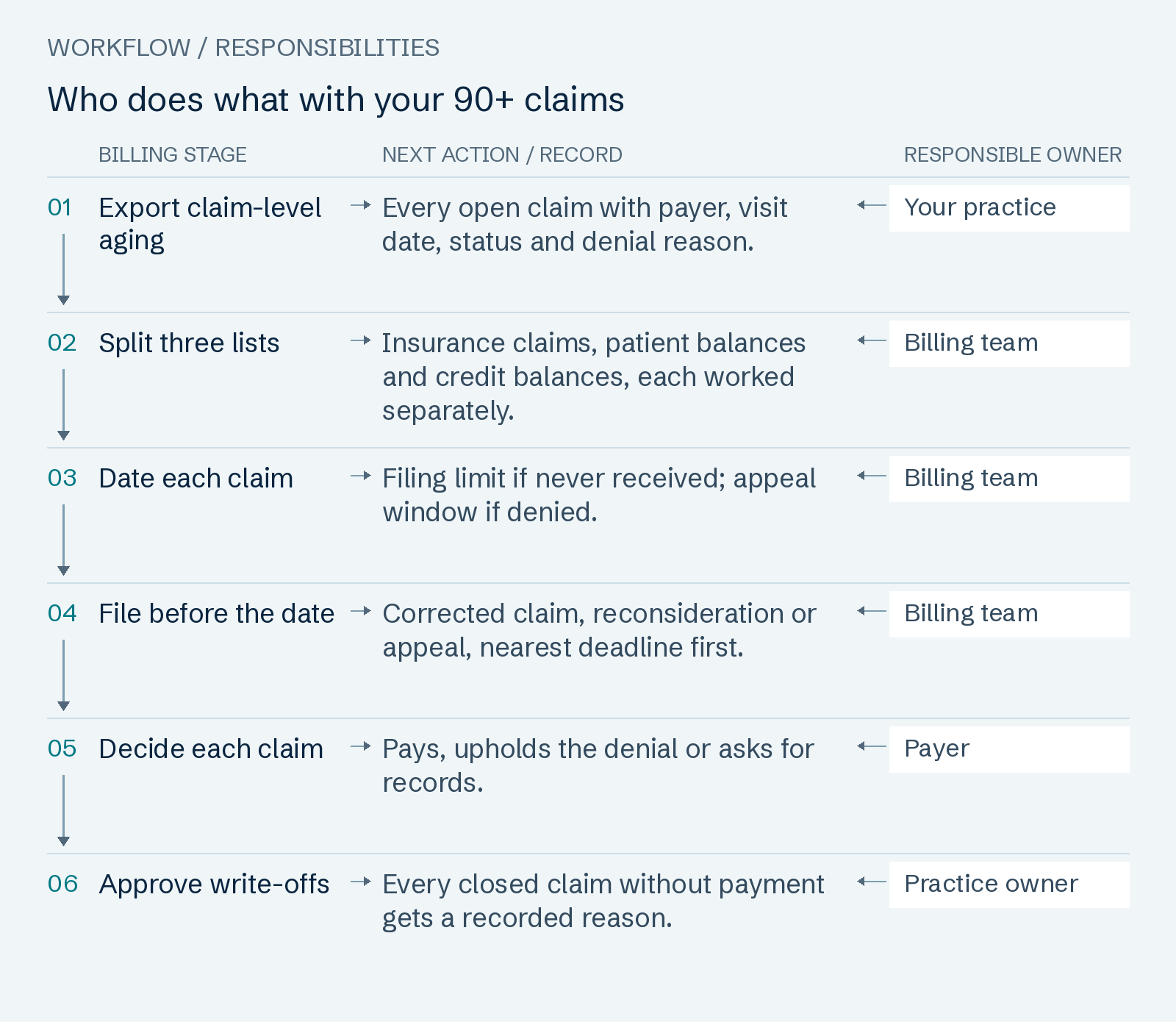
Read the workflow as text
- Export claim-level aging — Every open claim with payer, visit date, status and denial reason. Owner: Your practice.
- Split three lists — Insurance claims, patient balances and credit balances, each worked separately. Owner: Billing team.
- Date each claim — Filing limit if never received; appeal window if denied. Owner: Billing team.
- File before the date — Corrected claim, reconsideration or appeal, nearest deadline first. Owner: Billing team.
- Decide each claim — Pays, upholds the denial or asks for records. Owner: Payer.
- Approve write-offs — Every closed claim without payment gets a recorded reason. Owner: Practice owner.
Should your staff work old A/R, or should you hand it off?
Each old claim needs its own work: a status check, a reason, and a corrected claim, reconsideration or appeal before its date. The question for your practice is who has the hours to do that without letting new claims age into the same bucket. AAFP notes that accounts sent to a collection agency are written off the current receivables, so moving balances out of A/R is not the same as collecting them.
| Option | What it costs | Who does the work | What can go wrong |
|---|---|---|---|
| Your own staff work the 90+ list | Staff hours taken from new claims | Your biller or office manager | New claims wait, so the bucket refills |
| Your current billing company works it | Depends on your contract; check whether old claims are in scope | The billing company | Claims it did not submit may fall outside its contract |
| An A/R recovery service on contingency | A percentage of what posts; nothing on claims that never pay | An outside A/R team | Fee on money that would have arrived anyway, unless the fee base is defined |
| A collection agency (patient balances only) | The agency's fee on what it collects | The agency | Balances leave your A/R; patients deal with an outside collector |
| Write it off | The full balance | Your practice manager signs off | The cause repeats unless each write-off records why |
What should you prepare before anyone works your old claims?
Whoever works the list, in-house or outside, needs the same inputs. Prepare these and the first week goes to filing claims, not chasing data:
- A claim-level aging export. One line per claim with payer, date of service, claim date, amount open, last action and denial reason. A summary by bucket hides which claims face a deadline this month.
- The aging basis. Write down whether your report ages from the date of service or the claim date, and keep it. Filing limits count from the visit.
- Three separate lists. Insurance claims, patient balances and credit balances.
- Proof of submission. Clearinghouse acceptance reports and payer acknowledgments, which are your evidence when a payer says it never got the claim.
- Your payer agreements. Several payers set the filing limit "per agreement", so the contract decides.
- A write-off rule. Who approves a write-off, and which reasons are allowed.
- A business associate agreement. An outside team sees patient data on the aging report; under HIPAA your practice may share it with a business associate only after it obtains satisfactory assurance that the data will be safeguarded.
MGMA's advice on denials applies to the 90+ list too: work them starting with high-dollar claims and the nearest appeal deadlines. The workflow figure above shows who does what once the list is ready.
What does working old A/R cost?
In-house, the cost is staff time. A billing and posting clerk's median wage is $48,500 a year (BLS, May 2025): about $4,042 a month before benefits, software and the clearinghouse, or about $5,774 at the private-industry benefit share (BLS, June 2026). The hidden cost is the new claims that wait while that person works old ones.
Outside, ask how the fee is calculated and what it is charged on. Ours is A/R Recovery. For inherited claims 90+ days past the date of service: 15% of the insurance payments that post after we work them, and $0 on claims that never pay. Fee only on insurance payments posting after our logged action; patient payments 0%; full-service clients stay under the 9.0% fee cap. Full rates and terms are on our pricing page.
Whatever you choose, compare it with the cost of doing nothing: a never-received claim past its filing limit pays nothing, and under a participating Cigna contract it cannot be moved to the patient either.
When should you hand off your 90+ claims?
Hand off the 90+ list when nobody in your practice owns it, when it grows every month while new claims take all the staff time, or when claims were left behind in a switch or your biller has left. Our A/R recovery service takes over insurance claims 90 or more days past the date of service, dates each one against the deadline it faces and works the nearest first, through to a posted payment or a write-off you approve. The Free A/R Deadline Map lets you see your own list before you decide. A claim-by-claim list of every unpaid insurance claim over 90 days in the aging report you send: payer, amount, the deadline it faces, the denial reason and the next action, sorted by deadline. Clock starts with your claim-level aging export and signed BAA; above 10 requests in a week, we confirm your date within 1 business day.
If the bucket keeps refilling, the cause is upstream: cut denials at the source so fewer claims age past 90 days.
Common questions
- How much A/R over 90 days is normal for a practice?
- The most quoted figure is less than 10% of A/R over 90 days, and less than 30% for self-pay A/R, from a vendor-sponsored article on HFMA's website. Its author calls these general guidelines that vary by specialty, geography and payer mix, so your own trend on the same aging basis is the better test.
- Can we still collect claims older than 90 days?
- Yes, if each claim is still inside its filing limit or appeal window. A denied claim can still be inside its appeal window, and Original Medicare allows 12 months from the date of service to file. A never-received claim past a 90-day limit, such as Cigna's for participating providers, needs proof of timely filing or an exception.
- Which old claims should our practice work first?
- The ones nearest their filing or appeal deadline, then the highest dollar. A claim at 200 days with a live appeal window can be worth more today than one at 95 days that is already past its limit.
- Should we hand old A/R to a recovery team?
- Hand it off when no one in your practice owns the 90+ list or new claims take all the staff time. Before you sign, ask what the fee is charged on, whether claims that never pay cost anything, and who approves write-offs. Our rates are on the pricing page.
- How do we stop A/R from aging past 90 days?
- Send claims quickly, work denials as they arrive and give old claims a named owner. MGMA suggests closing encounters within 72 hours, posting charges within two days and working denials daily. Our guide to payer filing clocks covers the deadline side.
- Are credit balances part of our A/R?
- They appear on the aging report but are not money owed to you. Work them as a separate list: a Medicare overpayment must be reported and returned within 60 days of being identified, or by the cost report due date if later.
- Can we bill the patient for a claim the payer denied as late?
- Not when your payer contract forbids it. Cigna's participating-provider contract prohibits balance billing the patient for a late-filing denial. Bill a patient only when the remittance assigns the amount to the patient with the PR group code, a valid ABN covers it, or the payer's rule allows it.
- Does an outside team need a BAA before it sees our aging report?
- Yes. The aging report holds patient data, and HIPAA lets your practice share it with a business associate only with satisfactory assurance that it will be safeguarded, and the rule requires that assurance in a written agreement: the business associate agreement.
Sources and review
Page revised October 7, 2026 · Review contact: Hyder Shah (inquiries@claimpillar.com). The payer table comes from our timely-filing dataset, built from each payer's own manual or provider page (rows retrieved 2026-10-02 and 2026-10-03); every source below was retrieved and checked on 2026-10-07.
- HFMA website, vendor-sponsored article: 7 KPIs providers should be tracking
- MGMA Stat: Days in A/R holds steady for most practices, but payer pressure persists in 2026
- AAFP: Practice Finances and Revenue Cycle Management
- 42 CFR 424.44: Time limits for filing claims (Medicare), eCFR
- Cigna Healthcare: Claims submission, payments and filing
- Cigna Healthcare: Appeals and disputes policy and procedures
- 42 CFR 401.305: Reporting and returning of overpayments, eCFR
- 45 CFR 164.502: Uses and disclosures of protected health information (business associates), eCFR