When to outsource patient statements
Practices hand off patient statements when the front desk spends more time explaining bills than checking patients in. The usual triggers:
- Patients receive statements for balances an insurer still owes or has already adjusted off.
- A corrected account keeps getting the old statement.
- The person who ran statements left, and nobody owns the billing questions.
- Patient questions reach whoever answers the phone and are never recorded.
We run patient statements inside the same billing we do for your insurance claims, so one team sees the remittance, the secondary claim and the open question on each account. That holds for primary care practices, behavioral health practices and every other specialty we bill.
Patient billing here means statements and billing questions, not collection-agency work. We do not pursue debts, report patients to credit bureaus or take legal action.
What our patient statement service covers and what you keep
We take over six statement tasks. Each row names when the task happens and the decision your team keeps.
What stays with your practice?
Your practice keeps every decision that changes what a patient owes: write-offs, discounts, refunds, hardship requests and payment arrangements. We never waive or discount a balance on our own. HHS-OIG's Special Fraud Alert on routine copayment waivers warns that charge-based practitioners who routinely waive Medicare Part B copayments and deductibles risk false-claims and anti-kickback liability, so we route each hardship request to the reviewer you name.
| Task | What we do | When | What you keep |
|---|---|---|---|
| Balance check | Confirm every payer has posted and the remittance assigns the balance to the patient | Before each statement | Telling us about corrections you already know of |
| Secondary insurance | Bill the secondary payer and wait for its answer | After the primary pays | Collecting updated insurance cards at the desk |
| Self-pay check | Compare a self-pay bill with the good faith estimate given before the visit | Before release | Your response to any patient dispute |
| Statements | Send statements in your practice's name with your approved wording | On the cycle you set | Wording, channels and statement cycle |
| Billing questions | Log each question against the account and route it to its owner | As questions arrive | Decisions on refunds, hardship and disputes |
| Patient payments | Post them so the next statement is right | As payments post | Your bank account and front-desk collections |
How we start and run your patient statements
Statements start with the rest of your billing. Go-live, when your first claims go out, comes within 5 business days of access; any unbilled backlog follows within 10 business days of access. Clock starts with your signed agreement, signed BAA and working system logins; it extends day for day while we wait on access.
- Kickoff call: we agree statement wording, channels, cycle and the person who decides exceptions.
- Access: you sign the BAA and give us logins to your practice-management system and clearinghouse.
- Open balances: we check current patient balances against their remittances and hold any that a payer still owes.
- First cycle: only balances that pass the check go out, in your practice's name.
- Questions and holds: every billing question and held account is logged with its reason and owner from day one.
What we need from your practice
Sign the service agreement and BAA, give us logins to your practice-management system and clearinghouse, join one 45-minute kickoff call, sign off encounters so charges are complete, and answer our documentation questions within 5 business days. For statements, add your approved wording, your statement channels and the name of the person who approves refunds and hardship requests.
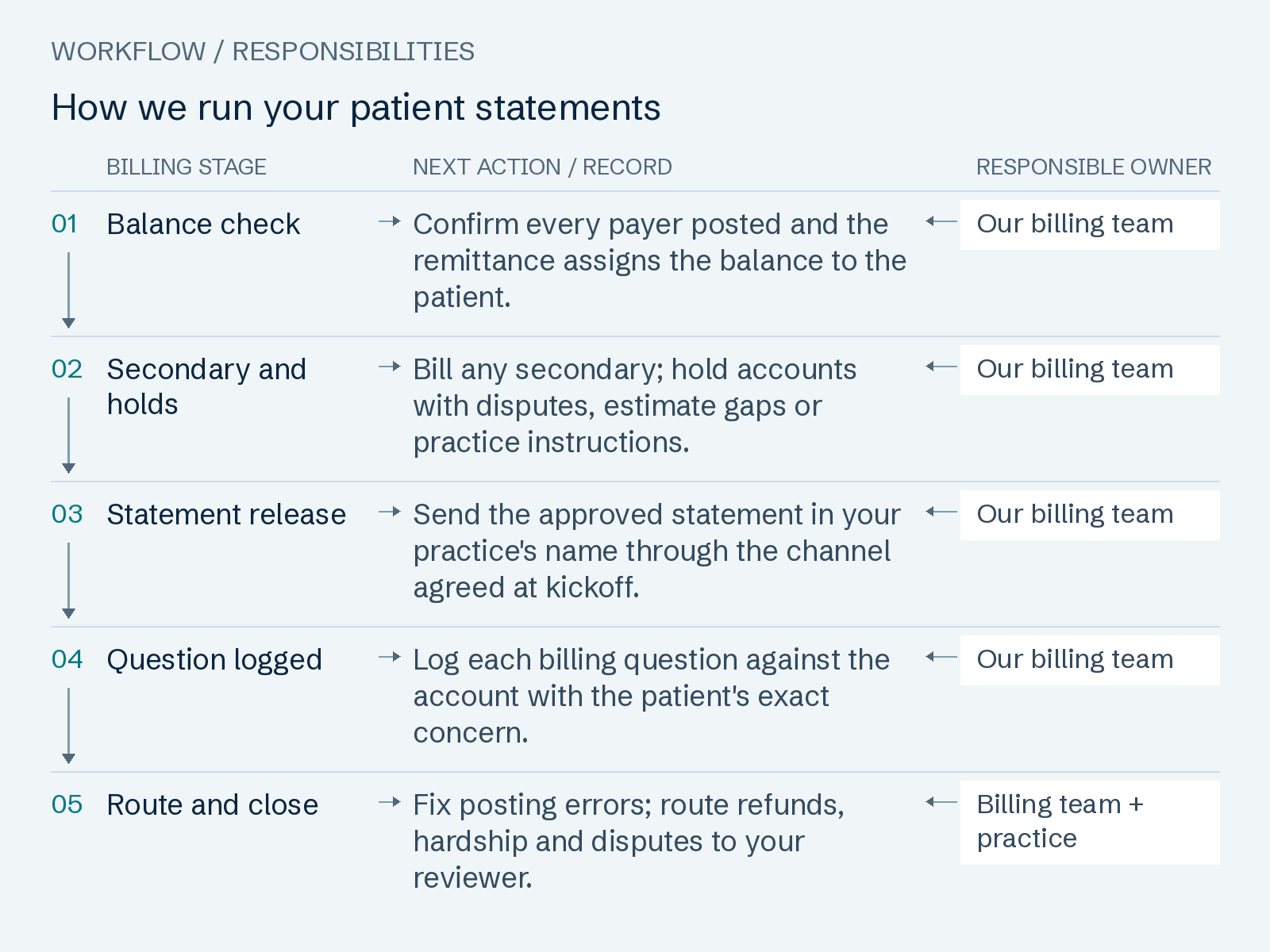
Read the workflow as text
- Balance check — Confirm every payer posted and the remittance assigns the balance to the patient. Owner: Our billing team.
- Secondary and holds — Bill any secondary; hold accounts with disputes, estimate gaps or practice instructions. Owner: Our billing team.
- Statement release — Send the approved statement in your practice's name through the channel agreed at kickoff. Owner: Our billing team.
- Question logged — Log each billing question against the account with the patient's exact concern. Owner: Our billing team.
- Route and close — Fix posting errors; route refunds, hardship and disputes to your reviewer. Owner: Billing team + practice.
Where patient statements cost a practice money, and what we do about each
Five failures turn a patient statement into a refund, a complaint or a compliance problem. We check every account for each one before release.
- Billing the patient for the practice's share. CMS explains that the group code on each remittance line assigns who owes the unpaid part: PR the patient, CO the provider, and Medicare patients may be billed only on PR. We release a balance only when the remittance assigns it to the patient.
- Billing before the secondary answers. A statement sent while a secondary claim is open asks the patient for money another insurer may pay. We hold the account until the secondary pays or denies.
- A self-pay bill above its estimate. A bill at least $400 above the patient's good faith estimate can open CMS patient-provider dispute resolution, which bars collections and late fees while it is open. We flag those bills before release and hold any account with a dispute notice.
- A payment the patient says they made. Resending the same statement turns a posting error into a complaint. We trace the payment in your posting history first and correct the ledger through payment posting.
- The same coverage question every month. Repeated "my insurance should have paid" calls point back to check-in. We report the pattern to your front desk, and our eligibility checks cover new patients and changed coverage.
What patient statement services cost
Patient statements carry no separate percentage. They are part of Full-Service Billing, priced as a percentage of insurance payments by specialty and practice size. Your fee is a percentage of insurance payments posted on claims we submitted or worked, net of payer recoupments and refunds. We take 0% of patient payments, copays and anything your front desk collects. Every payment goes straight to your practice's own bank account. We never receive, deposit or endorse your payments; we invoice you once a month.
Not included: Your EHR or practice-management subscription and clearinghouse fees (paid to those vendors), any application fee a payer or state charges, mailed patient statements at $0.95 each, and collection-agency, attorney or court costs. Find your exact rate on the rate card by specialty and size, or see how percentage pricing compares in the medical billing cost guide. Tell us your statement volume and channels; send no patient details until a BAA is signed.
| Item | Price | Terms |
|---|---|---|
| Full-Service Billing, statements included (mailed statements priced below) | 5.0%–8.5% of insurance payments | Set by specialty and practice size |
| Patient payments and copays | 0% | Nothing taken from what patients or your front desk collect |
| Mailed statements | $0.95 each | Percentage fees and mailed statements are capped at 9.0% of that month's insurance payments; the $400 minimum still applies from invoice 4. |
| Setup | $0 | No onboarding charge |
| Monthly minimum | $400 | Invoices 1–3: only percentage fees on that month's insurance payments, plus any statements or add-ons you order; the $400 minimum starts with invoice 4. |
| Contract | 30 days notice | Month to month. Leave with 30 days' written notice. No termination fee. |
What we report on your statements every month
Your KPI report arrives by the 10th of each month with written definitions. For patient billing it shows:
- Statements released in each cycle.
- Accounts held, by reason (payer still open, secondary pending, dispute, practice instruction) and by age.
- Billing questions logged and how each closed: explained, corrected or decided by your practice.
- Repeat questions traced to their cause upstream, such as posting or check-in.
Payments posted within 2 business days of the remittance, emails answered within 1 business day, and the KPI report with written definitions by the 10th. A sent statement and a resolved question are reported separately, so you can see which patients still need an answer.
Terms, guarantees and systems behind our patient billing
We work inside your existing practice-management system and clearinghouse; tell us which ones and we confirm in writing within 1 business day. Our EHR compatibility page explains how we confirm your systems. HHS lists billing among the activities a business associate performs for a covered entity, so we sign a BAA before we see any patient record.
When a patient balance follows an insurance claim, that claim can be covered by our deadline guarantee, on its terms. On-Our-Watch Guarantee: If a claim misses a filing, corrected-claim or appeal deadline while it is on our watch, we pay you what it would have paid. Claims we get complete 10+ business days before the deadline; contracted rate less any copay you collected, paid automatically within 30 days of final denial; capped $10,000/month; your holds excluded.
Clean-Exit Terms: Leave with 30 days' notice and no termination fee. Want a run-out? We keep working the claims we submitted for 90 days at your plan rate. Decline it and we charge nothing on payments that post after you leave. Notice by email; optional run-out covers claims we submitted before your exit date, at your plan rate; handover file within 10 business days of exit. Your rate-card rate can't rise for 12 months from your start date; size-band changes still apply; later changes need 60 days' written notice. Moving from another company? Our guide to switching billing companies covers the handover. We publish client results only with written permission. Until we have them, judge us by the guarantees and the free Deadline Map.
Common questions
- What do patient statement services cost?
- Statements are part of Full-Service Billing: 5.0% to 8.5% of insurance payments by specialty and size, 0% of patient payments, $0 setup and mailed statements at $0.95 each. See the full rate card.
- Do you take a percentage of patient payments?
- No. We charge 0% on patient payments, copays and anything your front desk collects. Every payment goes straight to your practice's own bank account. We never receive, deposit or endorse your payments; we invoice you once a month.
- Will you write off balances or set payment plans for our patients?
- No. Your practice approves write-offs, discounts, refunds, hardship requests and payment arrangements. We prepare the account history and route each request to the person you name.
- Do you act as a collection agency or report patients to credit bureaus?
- No. We send statements and handle routine billing questions. We do not pursue debts, report to credit bureaus or take legal action. Sending an account to a collection agency stays your practice's decision.
- Can you send statements in our practice's name and wording?
- Yes. Statements go out in your practice's name, with the wording and service references you approve and the statement channels we agree at kickoff.
- How fast can you start sending our statements?
- Go-live, when your first claims go out, comes within 5 business days of access; any unbilled backlog follows within 10 business days of access. Clock starts with your signed agreement, signed BAA and working system logins; it extends day for day while we wait on access. The first statement cycle runs once we have checked open patient balances against their remittances.
- How does your team handle a patient who disputes a statement?
- We put the account on hold, log the patient's exact question and route it to your reviewer with the account history. The hold stays until your practice records a decision. A federal dispute notice on a self-pay bill gets the same hold.
Sources and review
Page revised October 7, 2026 · Review contact: Hyder Shah (inquiries@claimpillar.com). The workflow checklists are editorial recommendations; payer requirements depend on the program and current policy.