What does credentialing mean for your practice's revenue?
Credentialing decides when a clinician's visits start paying at in-network rates. Until a payer has verified the clinician and loaded a signed contract, claims for its members are at risk: UnitedHealthcare warns that a contract not yet in its systems can leave a claim denied or paid at an out-of-network level. For an owner, the number that matters is the effective date: the first date of service each payer will pay in-network.
Credentialing, enrollment and contracting are three different steps
Credentialing verifies a provider's qualifications. Enrollment registers the provider with a payer so claims can be paid. Contracting sets the rates and terms. Commercial plans pair credentialing with contracting: UnitedHealthcare says you must complete both before you see its members as an in-network provider, and that receiving a contract to review is not confirmation of an approved application. Medicare runs enrollment instead, under federal rules, so a clinician needs both tracks before every patient on the schedule is billable.
What does your practice need to supply for each clinician?
Payers ask for the same core file, so build it once per clinician and reuse it. The table shows what each payer's own page asks for and who in a typical practice holds it. Cigna adds detail that trips up files: work history must cover the previous five years, with any gap over six months explained, and it recommends malpractice limits of $1,000,000 per occurrence and $3,000,000 aggregate. CAQH, now named DataSpring, lets a clinician enter information once and share it with all plans they authorize, at no cost to clinicians, groups or practices.
| What the payer asks for | Who asks (on its own page) | Who in your practice supplies it |
|---|---|---|
| Licensing and certification details | UnitedHealthcare | Clinician |
| NPI and W-9 | UnitedHealthcare | Practice manager |
| Work and education history (Cigna: five years, gaps over six months explained) | UnitedHealthcare; Cigna | Clinician |
| Liability insurance face sheet (Cigna recommends $1M per occurrence, $3M aggregate) | UnitedHealthcare; Cigna | Practice manager |
| CAQH registration ID, with the payer authorized to view the profile | UnitedHealthcare | Clinician attests; manager checks |
| Medicare CMS-855I, with reassignment of benefits to your group | CMS (Medicare) | Practice manager or credentialing service |
How to get credentialed with insurance companies: what are the steps, and who does each?
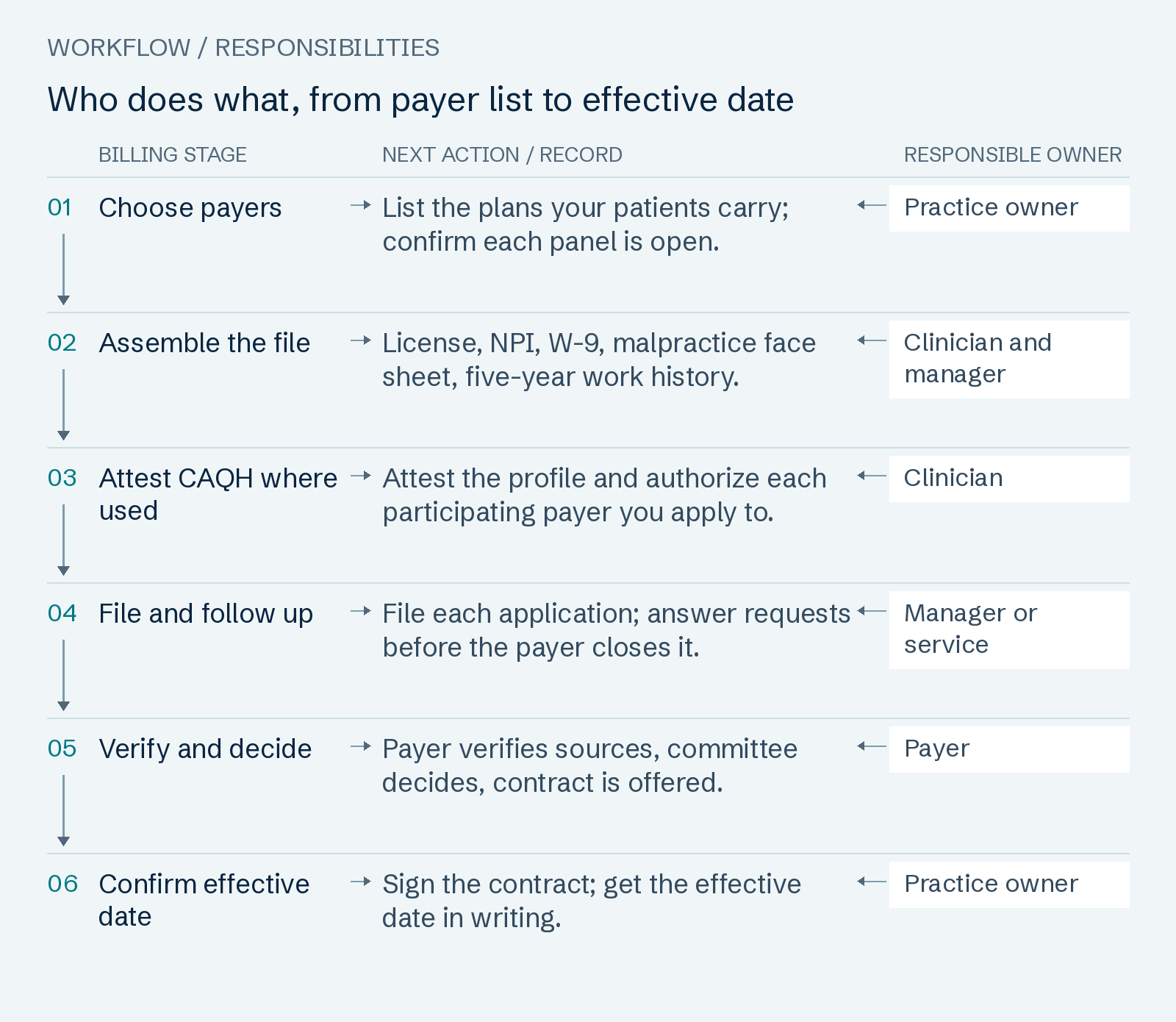
Use this framework for each clinician and payer, adapting it to that payer's enrollment and credentialing requirements; an approval with one plan does not establish participation with another. Each step below names who usually owns it when you run credentialing in-house; a credentialing service takes over steps 2 to 4 and reports to you on step 5.
- Choose the payers (owner). Start from the plans your patients carry, and check that each panel is open to your specialty in your area.
- Assemble the file (clinician and manager). Use the table above; a missing item stalls the file before the payer's clock starts.
- Attest the CAQH profile where used (clinician). Attest it and authorize each participating payer you apply to; UnitedHealthcare asks you to confirm DataSpring has authorized it to see the profile.
- File each application and answer requests (manager or service). Cigna closes an application when missing information never arrives, and a Medicare contractor can reject one when requested information is not furnished within 30 calendar days.
- Sign the contract and get the effective date in writing (owner). Cigna's approval notice states the effective date; book the clinician as in-network with each payer only from that date.
Read the workflow as text
- Choose payers — List the plans your patients carry; confirm each panel is open. Owner: Practice owner.
- Assemble the file — License, NPI, W-9, malpractice face sheet, five-year work history. Owner: Clinician and manager.
- Attest CAQH where used — Attest the profile and authorize each participating payer you apply to. Owner: Clinician.
- File and follow up — File each application; answer requests before the payer closes it. Owner: Manager or service.
- Verify and decide — Payer verifies sources, committee decides, contract is offered. Owner: Payer.
- Confirm effective date — Sign the contract; get the effective date in writing. Owner: Practice owner.
How long until each payer lets your practice bill in-network?
Each payer sets its own clock, and only some publish one. The table quotes what UnitedHealthcare, Cigna and the Medicare regulations say, with the scope each statement covers. Ranges you see on vendor blogs are not payer rules, so they are not repeated here.
Two clocks run back to back
Approval ends only the first clock. UnitedHealthcare says credentialing generally takes up to 45 calendar days or more once it has a completed application, and that the timeline depends on responses from medical schools, residencies, specialty boards and hospitals. It then asks you to allow up to 60 days to load the contract. Cigna's credentialing typically takes 45 to 60 days, and loading an approved provider into its directories and claim systems typically happens within 10 business days. Plan a new clinician's commercial schedule around both clocks, not the first.
How you will know where each application stands
Ask whoever runs credentialing for one line per clinician per payer: date filed, reference number, last payer request, and effective date. The payers give you the signals to fill it: Cigna emails when it closes an incomplete application and confirms each approval with its effective date; UnitedHealthcare tells you a contract in the mail is not an approval; and Medicare's online system shows which contractor is processing your application and its tracking number. A line with no change for weeks is the one to ask about.
| Payer or program | What it says credentialing takes | When the clock starts | Before claims pay in-network | Scope |
|---|---|---|---|---|
| UnitedHealthcare | Up to 45 calendar days or more | A completed application and all required information | Allow up to 60 days to load the contract after approval and a signed contract | Medical network; Optum Behavioral Health has its own application |
| Cigna Healthcare | Typically 45 to 60 days | Not stated; missing items close the application | Upload to directories and claim systems typically within 10 business days | Medical network; behavioral health credentialing runs through Evernorth Behavioral Health |
| Medicare | No processing time on the pages cited here | Filing an application the Medicare contractor approves | Effective date: later of filing date or first service at a new location | Physicians, non-physician practitioners such as NPs and PAs, physical and occupational therapists, speech-language pathologists, and physician and practitioner organizations |
Can your practice bill for visits while credentialing is pending?
A clinician can see patients while applications are pending, but the claims are only as good as each payer's effective date. The answer differs by payer type.
- Commercial plans. UnitedHealthcare requires both credentialing and contracting before in-network visits, and Cigna confirms approval with an effective date. Ask each plan in writing whether it will pay any visit before that date; do not assume it will.
- Medicare. Physicians, non-physician practitioners, physical and occupational therapists and speech-language pathologists may bill up to 30 days before their effective date (42 CFR 424.521), but only for services at the enrolled location, once all program requirements including state licensure were met, and when circumstances precluded enrolling in advance. Because the effective date is the later of the filing date of an application the contractor approves or first service at a new location (42 CFR 424.520), file before the clinician's first Medicare visit.
- Filing deadlines keep running. Holding claims does not stop each payer's timely filing limit. Cigna's limit for participating providers on commercial claims, from our filing-limit dataset, is 90 days after the date of service, unless applicable law or your provider agreement allows longer.
Before you hold claims, check how close they sit to each payer's claim filing deadline.
Adding an NP, PA or physician: how long until they can bill?
A new hire starts their own clocks, even inside a group that already has contracts. UnitedHealthcare says a clinician joining a practice with an existing UnitedHealthcare agreement still needs to complete the onboarding process before seeing patients as an in-network provider. For Medicare, the new clinician enrolls on the CMS-855I and reassigns benefits to your group so the group is paid for their services. Physicians and non-physician practitioners pay no Medicare enrollment application fee.
Nurse practitioners and physician assistants also change the revenue per visit. Medicare pays their services, outside a hospital or skilled nursing facility, at 80% of the lesser of the actual charge or 85% of the physician amount; the PA rule uses the same 85% basis. Start NP and PA files at the same time as the offer letter, not on their first day.
Worked example: one Medicare office visit at 85%
This is an example, not a payment estimate. The 2026 national Medicare amount (unadjusted), non-facility, for 99213 (established patient visit, low complexity) is $95.19 in the CMS CY 2026 PFS relative value file (RVU26D). At 85%: $95.19 × 0.85 = $80.91. If your charge is higher, Medicare pays 80% of that: $80.91 × 0.80 = $64.73. Actual payment varies by locality, setting and payer.
What goes wrong, and what does it cost your practice?
The delays below follow rules the payers publish, giving your practice specific checks to run before filing. The table pairs each failure with what it costs the practice and the habit that prevents it.
| What goes wrong | The payer's or CMS's rule | What it costs your practice | How to prevent it |
|---|---|---|---|
| Panel closed to your specialty | UnitedHealthcare sends a closed-market letter; reassessment on the grounds it lists | The clinician cannot see that plan's members in-network | Check panel status before you set a start date |
| Application closed for missing items | Cigna closes the file and emails you | You reapply and lose the weeks already spent | Complete the file before filing; answer requests the day they arrive |
| Medicare request unanswered | The contractor may reject it after 30 calendar days; no appeal rights | A new application, so a later effective date | Track every contractor request with its due date |
| Visits booked before the contract loads | UnitedHealthcare allows up to 60 days to load after approval | Claims denied or paid out-of-network | Book in-network visits only from the confirmed effective date |
| Recredentialing email ignored | Cigna sends up to three reminders, then terminates | The clinician drops out of the network | Send payer email to a shared inbox someone owns |
| Office move not reported to Medicare | Physicians and practitioners report a location change within 30 days | An enrollment record that no longer matches where you bill from | Update Medicare and every payer before the move |
Which payers should your practice credential with first?
Start with the plans that cover most of the patients already asking for appointments, and with Medicare if you see Medicare patients, because its effective date is tied to the filing date of an approved application. Then check how each plan routes your specialty. Behavioral health clinicians check the behavioral network first: UnitedHealthcare sends clinicians joining its Optum Behavioral Health network to providerexpress.com, and Cigna runs behavioral health credentialing through Evernorth Behavioral Health, apart from its medical credentialing. If you are buying a practice already in UnitedHealthcare's network, that purchase is one of the grounds it lists for reassessing a closed market.
Getting credentialed and paid by payers
What can your practice hand off?
Credentialing is mostly tracking: one line per clinician per payer, kept moving until each effective date is confirmed. Practices hand it off when a new clinician starts in weeks, when an application has gone quiet, or when the person who tracked it has left. Our credentialing service for practices adding clinicians builds the CAQH profile, files the applications, answers payer requests and sends you a status report every 14 days; our Medicare and Medicaid enrollment service files the government side. Credentialing & Payer Enrollment: $149 per payer. Billed only after the payer confirms your effective date; $0 if denied or panel closed; filed within 5 business days of your complete packet. You keep your CAQH login, signature authority and the decision to accept each contract. Compare it with our published billing prices or ask about your clinicians and payers.
If you are weighing doing it yourself, start with what credentialing costs your practice in fees and unbilled visits. Opening a new practice? Use the new practice billing checklist for the full setup order.
Common questions
- How long does credentialing take for our practice?
- It depends on the payer, and the clock starts only when the file is complete. UnitedHealthcare states up to 45 calendar days or more plus up to 60 days to load the contract; Cigna states typically 45 to 60 days plus typically 10 business days to load. Medicare sets the effective date by rule: the later of the filing date of an application the contractor approves or first service at a new location.
- Why does credentialing take so long?
- The payer verifies each item at its source before a committee decides. UnitedHealthcare performs primary source verification, presents the request to its credentialing committee, and says the timeline depends on responses from medical schools, residencies, specialty boards and hospitals. A second clock follows approval while the contract loads.
- Can a new clinician see patients before the effective date?
- Yes, but the claims are at risk: UnitedHealthcare warns that a claim before its contract loads can be denied or paid at an out-of-network level, so ask each commercial plan in writing. Medicare allows up to 30 days of retrospective billing under 42 CFR 424.521 when its conditions are met. See billing while credentialing is pending.
- Does our practice pay an application fee to get credentialed?
- Not to Medicare for individual clinicians: physicians and non-physician practitioners pay no Medicare enrollment application fee; the 2026 fee of $750 generally applies to institutional providers and suppliers, such as DMEPOS suppliers. DataSpring provides the CAQH profile at no cost to clinicians, groups and practices. Vendor fees and the cost of waiting are in what credentialing costs your practice.
- How do we add a newly hired NP or PA without unbilled visits?
- Start their files when the offer is signed. UnitedHealthcare requires onboarding even when your group already has its agreement, and Medicare needs a CMS-855I with reassignment to your group. Book their in-network visits with each payer from that payer's confirmed effective date.
- How often do our clinicians need to be recredentialed?
- UnitedHealthcare starts recredentialing near its 3-year cycle and needs nothing more if you keep a complete and current data attestation every 90 days. Cigna emails a request to re-sign the CAQH profile and terminates network participation if three reminders go unanswered. Medicare requires physicians and practitioners to revalidate their enrollment every 5 years.
- How will we know if an application has stalled?
- Watch for payer requests and silence. Cigna emails when it closes an incomplete application, a Medicare contractor can reject an application when requested information is not furnished within 30 calendar days, and Medicare's online system shows the contractor and tracking number. Ask for a status line per clinician per payer.
Sources and review
Page revised October 7, 2026 · Review contact: Hyder Shah (inquiries@claimpillar.com). Payer and CMS rules come from the pages listed below, all re-checked on October 7, 2026. The worked example uses our dataset of 2026 national Medicare amounts, built from the CMS RVU26D file, and the filing-limit line uses our sourced timely filing dataset.
- UnitedHealthcare: Join our network - Medical providers
- Cigna Healthcare: Health care provider credentialing
- eCFR: 42 CFR part 424 subpart P, Medicare provider and supplier enrollment
- CMS MLN9658742: Medicare Provider Enrollment
- CMS: Advanced Practice Registered Nurses (APRNs)
- CMS: Physician Assistants (PAs)
- DataSpring, powered by CAQH: For clinicians
- CMS CY 2026 PFS relative value file (RVU26D)