Urology billing we handle for your practice
Our urology billing service is built for independent urology practices, from one urologist to groups of 6–15 clinicians, advanced practice providers included. Your urologists scope in the office, operate at ASCs and hospitals, and give hormone injections in-house. We bill the professional claim for all of it; the ASC or hospital bills its own facility claim.
Practices hand off urology billing when:
- the biller has left and stone, biopsy and BPH claims are aging while you hire;
- same-session scope lines or injection lines keep coming back denied;
- prostate biopsies are still going out on codes that changed for 2026.
The table shows where our work starts and what stays with you. We check every code against your clinician's documentation and never change a code without the clinician's sign-off.
| Task | What we do | What you keep |
|---|---|---|
| Charge capture | Match every scheduled scope, stone case, BPH procedure, biopsy and injection visit to a signed note. | Signing notes promptly |
| Procedure coding | Check units, laterality and same-session combinations against the operative note. | Final say on every code |
| In-office imaging and urodynamics | Bill the global or professional-only line by who owns the equipment and where the study ran. | Equipment and lease records |
| Drug lines | Convert milligrams to billing units and pair each drug with its administration line. | Drug purchasing and stock |
| Urinalysis | Bill under your CLIA certificate, adding QW only for tests CMS lists as waived. | Your CLIA certificate |
| Claims, denials and posting | Claims out within 1 business day of complete charge data; denials worked within 2 business days; payments posted within 2 business days. | Payments into your own bank account |
| Reporting | KPI report by the 10th of each month, with office, ASC and hospital on separate lines. | Ownership of all claim data |
How we code your cystoscopy, biopsy and lithotripsy claims
Every procedure passes our documentation-based coding review before it goes out. We check these points on every urology procedure claim.
Cystoscopy and stone cases
- Several scopes in one session. Medicare pays the highest-valued endoscopy in full plus only the difference between each further code and its base, under Medicare Claims Processing Manual chapter 12. The 2026 CMS relative value file lists 52000 as the base for the cystoscopy family and 52351 for ureteroscopy, so we post the expected reduction instead of appealing it.
- Bladder biopsies. The 2026 NCCI policy manual, chapter VII says 52204 covers all biopsies in the procedure and takes one unit. We bill it that way.
- Ureteroscopic lithotripsy. The same chapter sets 52353 at one unit per ureter however many stones are treated, with modifier 50 for both sides. We count ureters from the op note, not stones.
The 2026 prostate biopsy codes
The CY 2026 physician fee schedule final rule records that CPT deleted 55700, revised 55705 and 76872, and added nine codes, 55707 to 55714 plus add-on 55715, that sit beside the existing 55706 and separate the approach, the imaging and whether only targeted lesions are sampled. We match each biopsy to one code from the note's approach and targeting. When a code's descriptor includes imaging guidance, NCCI bars a separate guidance line, so a 76942 beside it is the first line we query. Denials that still come back go to our denial management service.
Your in-office ultrasound and urodynamics, billed to match the equipment
Transrectal and renal ultrasound and the urodynamic studies split into a professional and a technical component in the 2026 CMS relative value file. A post-void bladder scan (51798) is a technical-only code with no professional line. Who owns the machine and where the patient was decides which line we bill:
- Your machine, your office. We bill the global line, professional and technical together, at the office (non-facility) rate.
- A hospital outpatient study your urologist reads. Chapter 12, section 20.4.2 pays the facility rate for hospital outpatients (POS 19 or 22) and pays the professional component of a diagnostic test the same in every setting, so we bill modifier 26 only.
- Ultrasound on a biopsy day. Guidance built into a 2026 biopsy code is not billed again; a separate study is billed only when the note supports it.
Our cardiology billing services apply the same check to echo.
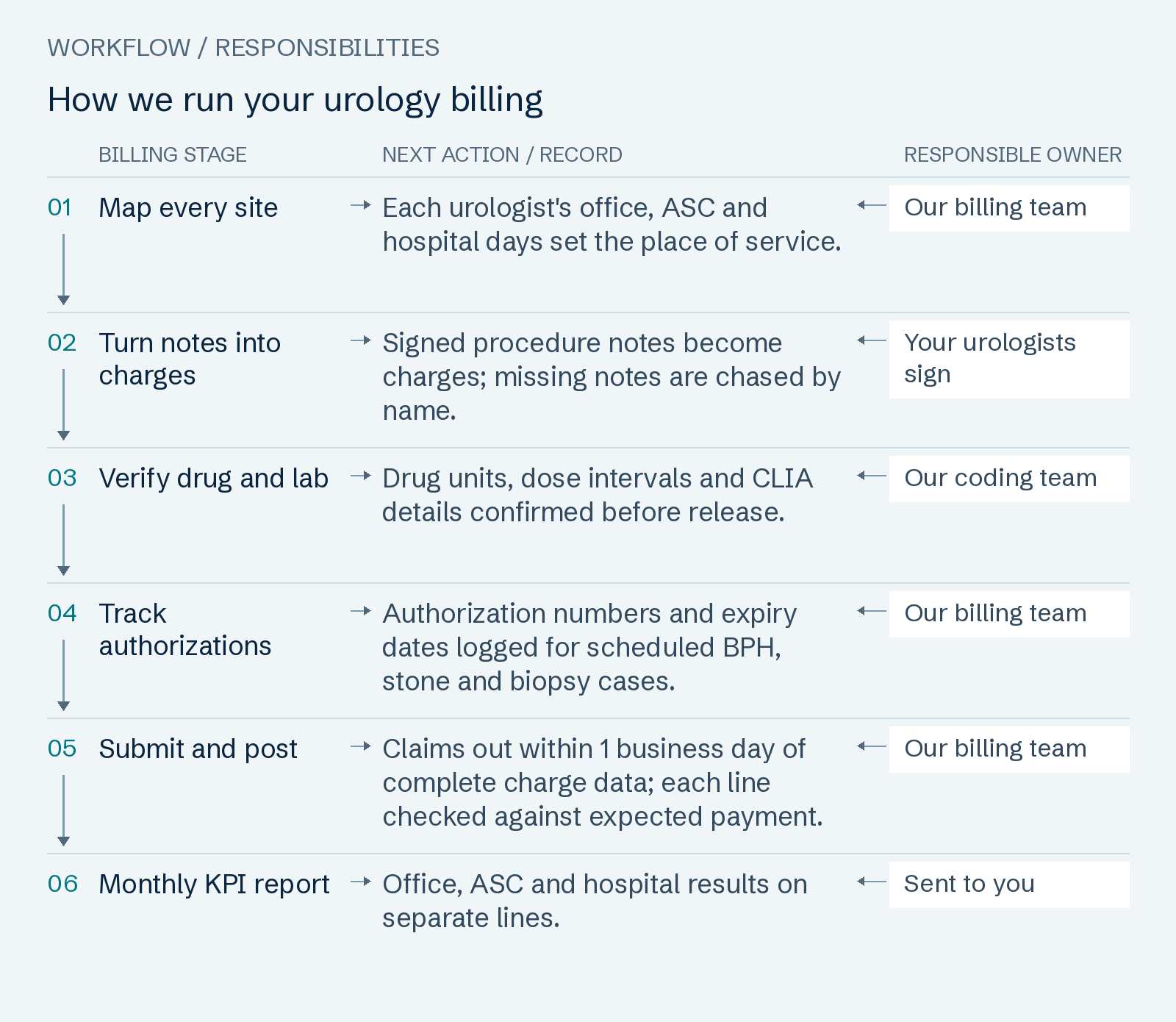
Read the workflow as text
- Map every site — Each urologist's office, ASC and hospital days set the place of service. Owner: Our billing team.
- Turn notes into charges — Signed procedure notes become charges; missing notes are chased by name. Owner: Your urologists sign.
- Check units and globals — Drug units, biopsy codes and open global periods checked before release. Owner: Our billing team.
- Submit and post — Claims out within 1 business day of complete charge data; each line posted. Owner: Our billing team.
- Work denials — Denied lines corrected, resubmitted or appealed within 2 business days of posting. Owner: Our billing team.
- Monthly KPI report — Office, ASC and hospital results on separate lines, definitions included. Owner: Sent to you.
Drug administration and J-code units we check on your injection claims
Leuprolide and goserelin injections bill as chemotherapy administration, not as a routine shot: chapter 12, section 30.5 names leuprolide acetate and goserelin acetate among the hormonal antineoplastics. We pair each drug line with 96402, unless your Medicare contractor's guidance says otherwise, and bill a same-day visit with modifier 25 only when the note supports a separate service.
We divide each dose by the code's unit size. Worked examples, using the units in Wellpoint Federal's LHRH analog billing article A52453:
- J9217, leuprolide depot per 7.5 mg. A 22.5 mg dose is 3 units; a 45 mg dose is 6 units.
- J1950, leuprolide depot per 3.75 mg. An 11.25 mg dose is 3 units.
- J9202, goserelin implant per 3.6 mg. A 10.8 mg implant is 3 units.
Timing matters too. In Wellpoint's states (Illinois, Minnesota, Wisconsin, New York and New England), the article ties frequency to the duration of action of the previous dose and denies drugs given outside that frequency together with their administration. We check each last dose date before release, and follow your own contractor's article elsewhere. For infusion-heavy practices, see our oncology billing service.
How we track your global periods and modifiers
A related visit inside a global period is paid in the procedure, so we read global days from the 2026 CMS file and hold related visits before they become denials. Chapter 12, section 40 sets the rules we apply:
- A 90-day global covers the day before surgery, the day of surgery and the 90 days after it.
- A visit on the day of a 0-day procedure is included unless a significant, separately identifiable service is also performed; that visit takes modifier 25 when the note supports it.
- Inside a global, we add 24 to an unrelated visit, 79 to an unrelated procedure, 78 to a related return to the operating room and 58 to a staged procedure, each when the documentation supports it. Modifier 57 marks the decision for surgery on the day of or the day before a 90-day procedure.
The AUA's CodingToday also lists global days and modifier usage; the table uses the CMS file.
| Procedure (example code) | Global days in the 2026 CMS file | What we do with visits around it |
|---|---|---|
| Diagnostic cystoscopy (52000) | 0 | Same-day visit billed only for separate, documented work |
| Cystoscopy with bladder biopsy (52204) | 0 | Next-day visits billed normally |
| Ureteroscopy with lithotripsy (52353) | 0 | Stent removal visits checked against the op note |
| Prostate biopsy (55705 to 55714) | 0 | Pathology review visit billed as a new date of service |
| Prostatic urethral lift (52441) | 0 | Add-on implants (52442) counted from the note |
| Shock wave lithotripsy (50590) | 90 | Related follow-ups held from the day before to day 90 |
| Water vapor therapy (53854), TURP (52601), laser vaporization (52648) | 90 | Unrelated visits sent with 24 when documented |
Our rate card for urology groups, with a worked example
Urology practices pay the specialist physician rate for their size. The rate applies to insurance payments on claims we submit or work, drug lines included. Setup is $0. Percentage fees and mailed statements are capped at 9.0% of that month's insurance payments; the $400 minimum still applies from invoice 4.
Illustrative example, not client data: a practice of 2–5 clinicians posts $40,000 of insurance payments in a month, $8,000 of it on leuprolide and goserelin drug lines. The fee is 5.5% of the full $40,000. The $3,000 its patients pay in copays and coinsurance that month carries 0%.
Multi-specialty practices: each clinician's claims are billed at that clinician's segment rate; the size band counts every clinician. A group that also employs a chiropractor or physical therapist pays the rehab rate on those claims, as our chiropractic billing services page sets out. See what our billing services cost by specialty and size for every add-on.
| Practice size | Your rate (specialist physician groups) |
|---|---|
| 1 clinician | 6.0% of insurance payments |
| 2–5 clinicians | 5.5% of insurance payments |
| 6–15 clinicians | 5.0% of insurance payments |
| Larger groups and urology labs | Pricing is by written quote. |
Deadline protection for your procedure claims
A stone or BPH case past its filing limit is a procedure fee lost. Medicare allows 12 months from the date of service under chapter 1, section 70, and commercial plans often allow less; our timely filing limits guide lists them by payer. Two guarantees back our clocks:
- On-Our-Watch Guarantee. If a claim misses a filing, corrected-claim or appeal deadline while it is on our watch, we pay you what it would have paid. Claims we get complete 10+ business days before the deadline; contracted rate less any copay you collected, paid automatically within 30 days of final denial; capped $10,000/month; your holds excluded.
- Clock-or-Credit Guarantee. From go-live, every new claim goes out within 1 business day of complete charge data, and every denial is worked within 2 business days of posting — or $25 comes off your invoice for each late one. Mon–Fri ET business days by your system's timestamps; worked: resubmitted, appealed or returned with the fix; auto-credited; capped at monthly fee; clearinghouse outages excluded.
Both apply on the terms above. We publish client results only with written permission. Until we have them, judge us by the guarantees and the free Deadline Map.
How we start
Go-live, when your first claims go out, comes within 5 business days of access; any unbilled backlog follows within 10 business days of access. Clock starts with your signed agreement, signed BAA and working system logins; it extends day for day while we wait on access. Our billing handoff plan lists the files to request from your outgoing biller.
Want to see your exposure first? Request The Free A/R Deadline Map (Get my free A/R Deadline Map). Clock starts with your claim-level aging export and signed BAA; above 10 requests in a week, we confirm your date within 1 business day.
New urologists are enrolled before their claims go out through Credentialing & Payer Enrollment, at $149 per payer. Billed only after the payer confirms your effective date; $0 if denied or panel closed; filed within 5 business days of your complete packet.
Common questions
- How much do your urology billing services cost?
- 6.0% for 1 clinician, 5.5% for 2–5 clinicians or 5.0% for 6–15 clinicians, of insurance payments, drug lines included. Patient payments carry 0%, and setup is $0. The rate card lists the minimum, the cap and add-ons.
- Can our urologists bill in-office ultrasound, and do you handle it?
- Yes. When your practice owns the machine and the study is done in your office, we bill the global line at the office rate. When your urologist reads a hospital outpatient study, we bill the professional component with modifier 26, under CMS chapter 12, section 20.4.2. Guidance included in a 2026 biopsy code is not billed again.
- How are injectable drugs billed on our claims?
- Each injection goes out as two lines: the drug, in billing units from the milligrams given (a 22.5 mg leuprolide depot is 3 units of J9217, per 7.5 mg), and the administration, 96402 for hormonal antineoplastics under chapter 12, section 30.5. We check the last dose date against your contractor's frequency rules before release.
- What modifiers are common in urology, and do you add them to our claims?
- Yes, from the note: 50 for bilateral stone procedures, 25 for a separate same-day visit, 26 for reading a hospital study, and 24, 57, 58, 78 or 79 inside a global period, each only when the documentation supports it. We check every code against your clinician's documentation and never change a code without the clinician's sign-off.
- Do you bill our ASC and hospital cases as well as office procedures?
- Yes. We bill the professional claim for every case your urologists perform in the office, an ASC or a hospital, coded to the site where it happened. The ASC or hospital bills its own facility claim.
- Are we locked into a contract if we hire you?
- No. Month to month. Leave with 30 days' written notice. No termination fee. Notice by email; optional run-out covers claims we submitted before your exit date, at your plan rate; handover file within 10 business days of exit.
- How fast can you take over our urology claims?
- Go-live, when your first claims go out, comes within 5 business days of access; any unbilled backlog follows within 10 business days of access. Clock starts with your signed agreement, signed BAA and working system logins; it extends day for day while we wait on access. See how we start.
Sources and review
Page revised November 4, 2026 · Review contact: Hyder Shah (inquiries@claimpillar.com). The workflow checklists are editorial recommendations; payer requirements depend on the program and current policy.
- CMS: Medicare Claims Processing Manual, Chapter 12 (sections 20.4.2, 30.5, 40), retrieved 2026-11-04
- CMS: Medicare NCCI 2026 Policy Manual, Chapter VII (urinary and male genital systems), retrieved 2026-11-04
- CMS: CY 2026 PFS relative value files (RVU26D: global days, PC/TC, endoscopic base codes), retrieved 2026-11-04
- Federal Register: CY 2026 Physician Fee Schedule final rule (prostate biopsy services), retrieved 2026-11-04
- Wellpoint Federal: Billing and Coding: LHRH Analogs (A52453), retrieved 2026-11-04
- CMS: MLN Matters MM12581, New Waived Tests (CLIA certificate edits, QW), retrieved 2026-11-04
- CMS: Medicare Claims Processing Manual, Chapter 1, section 70 (timely filing), retrieved 2026-11-04
- American Urological Association: AUA CodingToday (global days, CCI edits, modifier usage), retrieved 2026-11-04