How we bill your TMS therapy: 90867, 90868, 90869
A TMS course is one initial treatment followed by weeks of repeat sessions, so a wrong unit on the first claim repeats on every claim after it. The CMS National Correct Coding Initiative manual allows 90867 once per course and one unit of 90868 or 90869 per day, because these are not timed codes. We hold every TMS claim to those counts before it goes out.
Medicare sets no national amount for these three codes: the 2026 CMS relative value file gives them status C, meaning each Medicare contractor prices them. We post every TMS payment, and on Complete RCM the monthly underpayment check compares each session's payment with what your contractor and your commercial contracts allow. The rest of your code set is listed in CPT codes for mental health.
| TMS code | What it covers, in plain words | What we check before the claim goes out | What your clinic documents |
|---|---|---|---|
| 90867 | First treatment, with mapping and motor threshold | Billed once per course; a second 90867 in the same course is stopped before it bills. | The mapping and threshold result in the first session note |
| 90868 | Each later treatment session | One per treatment day, checked against the authorization's dates. | A dated session record naming the supervising physician |
| 90869 | A later session with the threshold measured again | One per day, billed only on a day the note shows the new threshold. | Why the threshold was rechecked, and the new value |
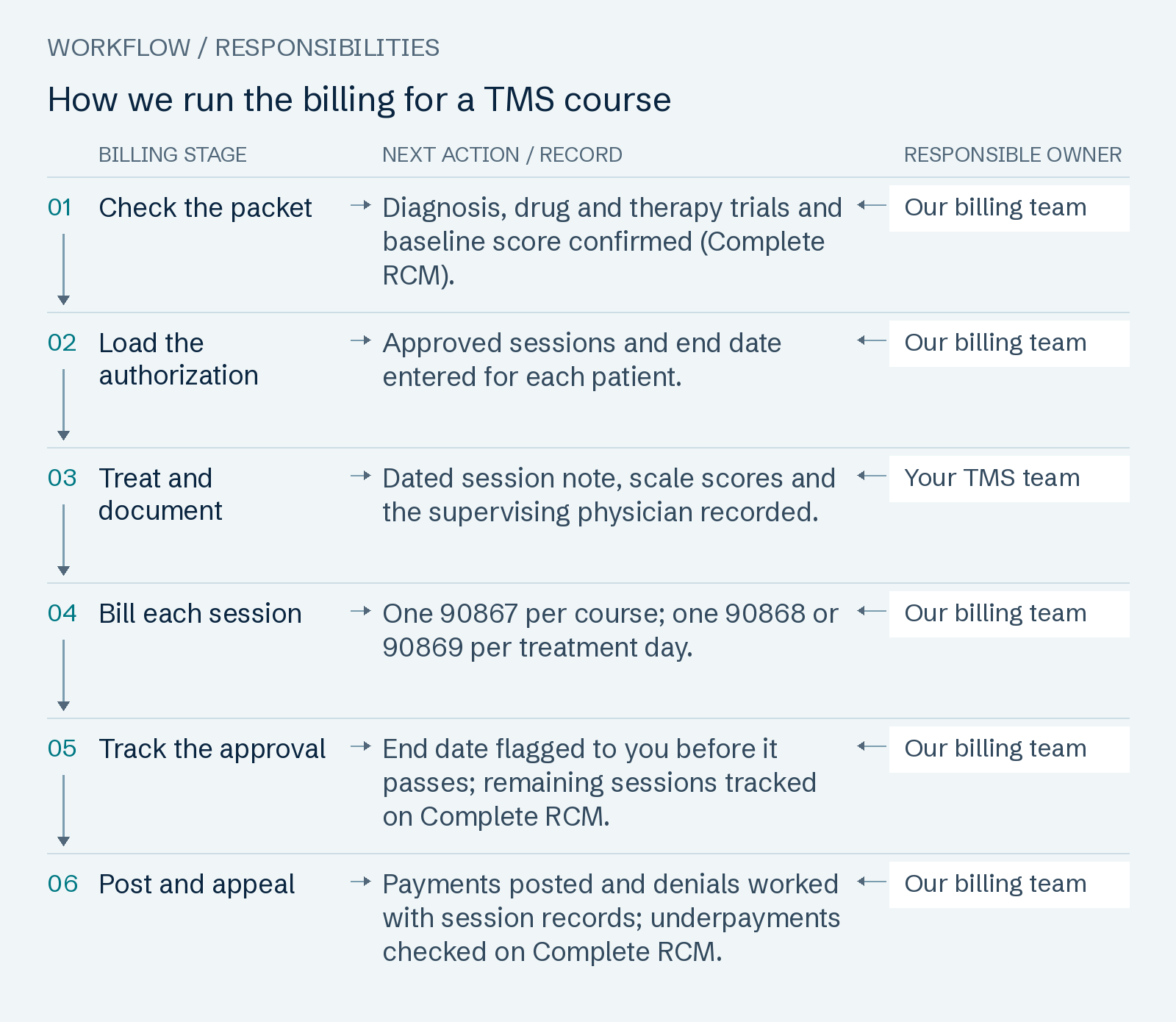
Read the workflow as text
- Check the packet — Diagnosis, drug and therapy trials and baseline score confirmed (Complete RCM). Owner: Our billing team.
- Load the authorization — Approved sessions and end date entered for each patient. Owner: Our billing team.
- Treat and document — Dated session note, scale scores and the supervising physician recorded. Owner: Your TMS team.
- Bill each session — One 90867 per course; one 90868 or 90869 per treatment day. Owner: Our billing team.
- Track the approval — End date flagged to you before it passes; remaining sessions tracked on Complete RCM. Owner: Our billing team.
- Post and appeal — Payments posted and denials worked with session records; underpayments checked on Complete RCM. Owner: Our billing team.
Course limits, maintenance TMS and the denials we work
Where a TMS course loses payment, and what we do about it:
Sessions past the authorization
On Complete RCM, each session is drawn down from the approved total and we flag the last authorized sessions to you before they are delivered, so an extension request or a coverage conversation with the patient comes first.
Maintenance TMS and retreatment
Wellpoint's billing article A57528 states that maintenance therapy is not covered. A session claim after the acute course is held so your team can confirm coverage. The same article allows retreatment for a patient who met the initial criteria and relapsed, after responding to the prior course with more than 50% improvement on a rating scale or reaching remission. On Complete RCM we pull the prior course's scores into the new request.
Sessions beyond established parameters may be reviewed for medical necessity. Every TMS denial goes to our denial management team within 2 business days of posting, with the session record and score history attached to any appeal.
Your psychiatry visits: E/M plus psychotherapy add-ons
The NCCI manual has separate psychotherapy codes for visits without an E/M service (90832, 90834, 90837) and add-on codes (90833, 90836, 90838) reported with an E/M code. It also bars two pairings on the same date: 90791 or 90792 with a psychotherapy code, and an E/M code with 90791 or 90792.
- We code the E/M level and the psychotherapy add-on from the note, adding the add-on only when the documentation supports psychotherapy time.
- We hold any claim that pairs an intake evaluation with psychotherapy on the same date and return it with the fix.
- We check every code against your clinician's documentation and never change a code without the clinician's sign-off.
How E/M levels are chosen is explained in our guide to E/M codes for independent practices. If your group also employs therapists or psychologists, their claims run through our mental health billing services at the same behavioral-health rate.
Our rate card for psychiatric practices
Psychiatric practices and TMS clinics pay the mental and behavioral health row of our rate card, set by practice size. Clinicians are counted on the 1st of each month from the rendering NPIs we billed the month before (for ABA, BCBAs and BCaBAs, not RBTs). Your rate moves with your size band the next month, in either direction. Multi-specialty practices: each clinician's claims are billed at that clinician's segment rate; the size band counts every clinician.
Setup is $0. Invoices 1–3: only percentage fees on that month's insurance payments, plus any statements or add-ons you order. Percentage fees and mailed statements are capped at 9.0% of that month's insurance payments; from invoice 4, the $400 minimum applies even in a month when the cap comes to less. Every segment is on our medical billing pricing page, and the measures we report each month are defined in our guide to behavioral health revenue cycle management.
| Practice size (billing clinicians) | Rate for psychiatry and TMS |
|---|---|
| 1 clinician | 8.0% of insurance payments |
| 2–5 clinicians | 7.5% of insurance payments |
| 6–15 clinicians | 7.0% of insurance payments |
| Larger groups | 16+ clinicians, or anesthesia, radiology, DME, lab and home health: written quote within 1 business day, same fee base, cap and terms. |
Our deadline guarantees on high-dollar TMS courses
A TMS course puts many session claims on one payer's filing clock.
On-Our-Watch Guarantee. If a claim misses a filing, corrected-claim or appeal deadline while it is on our watch, we pay you what it would have paid. Claims we get complete 10+ business days before the deadline; contracted rate less any copay you collected, paid automatically within 30 days of final denial; capped $10,000/month; your holds excluded.
Clock-or-Credit Guarantee. From go-live, every new claim goes out within 1 business day of complete charge data, and every denial is worked within 2 business days of posting — or $25 comes off your invoice for each late one. Mon–Fri ET business days by your system's timestamps; worked: resubmitted, appealed or returned with the fix; auto-credited; capped at monthly fee; clearinghouse outages excluded.
Both apply on the terms above. Switching mid-course? Go-live, when your first claims go out, comes within 5 business days of access; any unbilled backlog follows within 10 business days of access. Clock starts with your signed agreement, signed BAA and working system logins; it extends day for day while we wait on access. Send the authorization letters and sessions used for every patient in an active course first, so no session bills past its approval.
Not ready to switch? Get my free A/R Deadline Map: A claim-by-claim list of every unpaid insurance claim over 90 days in the aging report you send: payer, amount, the deadline it faces, the denial reason and the next action, sorted by deadline. Clock starts with your claim-level aging export and signed BAA; above 10 requests in a week, we confirm your date within 1 business day. We publish client results only with written permission. Until we have them, judge us by the guarantees and the free Deadline Map.
Common questions
- How is TMS therapy billed when you handle our claims?
- One 90867 for the first treatment of a course, then one 90868 for each later treatment day, or 90869 on a day the motor threshold is measured again, as the CMS coding manual allows. We check every session against the authorization's dates before the claim goes out.
- Does insurance cover TMS, and do you check coverage before a course starts?
- Under Wellpoint Federal's LCD L33398, TMS is covered for major depressive disorder when the patient meets its criteria, including medication trials from at least two drug classes (or an earlier response to TMS) and a psychotherapy trial; maintenance TMS is not covered. Other contractors and commercial plans set their own policies. We check eligibility for new patients before the first session.
- What documentation does our practice need for TMS prior auth?
- The confirmed diagnosis, each antidepressant trial with dose, duration and response, the psychotherapy trial, a baseline depression-scale score, the order from the physician or qualified practitioner who examined the patient, and the session count requested. On Complete RCM we assemble and submit the request from that documentation; on Full-Service Billing we track the approval's end date.
- Can our psychiatrists bill E/M with psychotherapy, and do you handle both?
- Yes, when the note supports both: the E/M code plus add-on 90833, 90836 or 90838 by documented psychotherapy time. We check the documentation for both before the claim goes out. We check every code against your clinician's documentation and never change a code without the clinician's sign-off.
- What do your psychiatric billing services cost?
- From 7.0% to 8.0% of insurance payments by practice size, with 0% of patient payments and $0 setup. The minimum and fee cap are on our pricing page.
- Do we have to sign a long-term contract?
- No. Leave with 30 days' notice and no termination fee. Want a run-out? We keep working the claims we submitted for 90 days at your plan rate. Decline it and we charge nothing on payments that post after you leave. Notice by email; optional run-out covers claims we submitted before your exit date, at your plan rate; handover file within 10 business days of exit.
- How fast can you take over our TMS and psychiatry billing?
- First claims go out within 5 business days of access. Clock starts with your signed agreement, signed BAA and working system logins; it extends day for day while we wait on access. Patients in an active TMS course come first: we load their authorizations and sessions used before the first claim goes out.
Sources and review
Page revised November 5, 2026 · Review contact: Hyder Shah (inquiries@claimpillar.com). The workflow checklists are editorial recommendations; payer requirements depend on the program and current policy.
- CMS Medicare Coverage Database: LCD L33398, Transcranial Magnetic Stimulation, Wellpoint Federal (J6 and JK) (current version effective 08/09/2026; retrieved 2026-11-05)
- CMS Medicare Coverage Database: Billing and Coding Article A57528, Transcranial Magnetic Stimulation (retrieved 2026-11-05)
- CMS: Medicare NCCI Policy Manual 2026, Chapter XI, Medicine and Evaluation and Management Services (retrieved 2026-11-05)
- CMS: PFS Relative Value Files, RVU26D (status C for 90867-90869) (retrieved 2026-11-05)
- UnitedHealthcare Medical Policy 2026T0536W: Transcranial Magnetic Stimulation for Treating Physical Health Conditions, effective February 1, 2026 (retrieved 2026-11-05)