Therapist insurance credentialing with us: how it works
We treat each therapist and each payer as one line of work. For every line we confirm the license qualifies, prepare the profile the payer reads, file the application, answer the payer's questions and send you the effective date in writing. It is the same insurance credentialing service we run for medical practices, set up around behavioral health networks and therapist license types. Our guide to the insurance credentialing process lays out each step if you want to see it before you hand it off.
Your CAQH setup checklist before we file
Most commercial behavioral networks read the clinician's CAQH ProView profile, which DataSpring (powered by CAQH) offers at no cost to clinicians. Optum says CAQH participation is required in the majority of states to join its network. We work through this list with each therapist:
- Profile complete and not expired. Optum names an incomplete or expired profile among the most common issues that slow down or cancel an application.
- Locations match. Practice and primary locations on CAQH must match what goes on the Optum participation form.
- Network authorized. In the profile's Authorization section, the clinician authorizes each network to view it, including United Behavioral Health for Optum.
- License and liability dates current. Both effective and expiration dates updated after every renewal.
- Attestation on schedule. Evernorth requires re-attestation every 120 days, or every 180 days in Illinois.
- Five years of work history. Evernorth asks for consecutive history with any gap over six months explained.
- A signed W-9 that matches the tax ID on the application, and a current liability certificate attached.
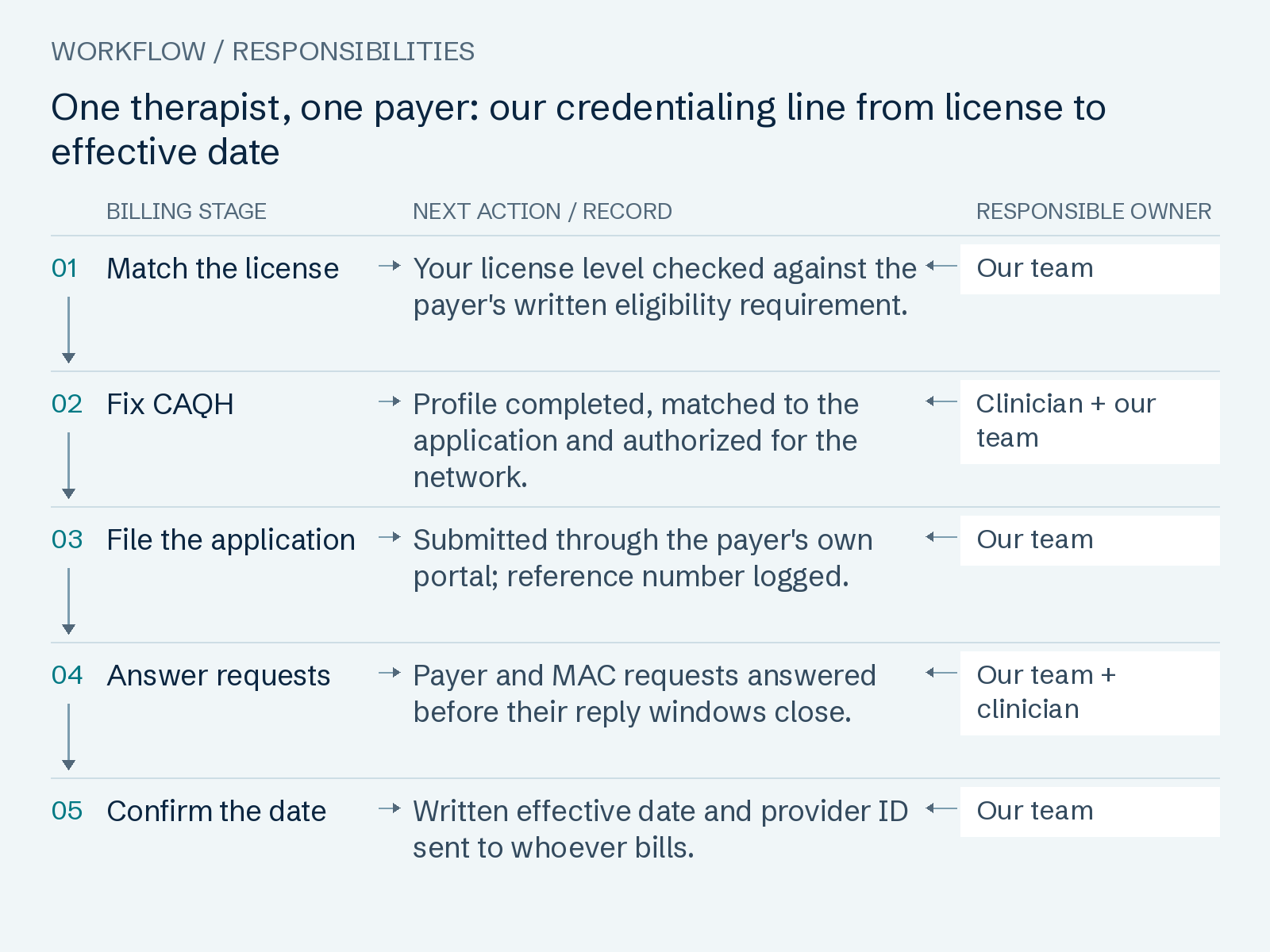
Read the workflow as text
- Match the license — Your license level checked against the payer's written eligibility requirement. Owner: Our team.
- Fix CAQH — Profile completed, matched to the application and authorized for the network. Owner: Clinician + our team.
- File the application — Submitted through the payer's own portal; reference number logged. Owner: Our team.
- Answer requests — Payer and MAC requests answered before their reply windows close. Owner: Our team + clinician.
- Confirm the date — Written effective date and provider ID sent to whoever bills. Owner: Our team.
LCSW insurance credentialing and the other licenses we credential (LPC, LMFT, psychologist)
Medicare applies federal definitions written into regulation for clinical social workers, clinical psychologists, and the marriage and family therapist and mental health counselor categories CMS added for 2024. Evernorth credentials only clinicians holding a license to practice independently (without supervision) in the state where they see clients. The matrix below is what we confirm for each therapist on your roster before a single application goes in.
| License on your roster | Medicare category | Evernorth (Cigna behavioral) | What we confirm before filing |
|---|---|---|---|
| LCSW | Clinical social worker: master's or doctorate in social work and at least 2 years of supervised clinical social work after the degree | Independent license in the state of service | A clinical-level license, or the state's highest practice level where it has no clinical social work license |
| LPC, LMHC or LCPC | Mental health counselor (MHC), billable from January 1, 2024 | Independent license in the state of service | 2 years or 3,000 hours of post-master's supervised experience, with signed proof if the license did not require it |
| LMFT | Marriage and family therapist (MFT), billable from January 1, 2024 | Independent license in the state of service | The same supervised-experience proof as a counselor |
| Licensed addiction or alcohol and drug counselor | May enroll as an MHC when every MHC qualification is met | Independent license in the state of service | Master's or doctoral degree and supervised hours documented |
| Psychologist | Clinical psychologist: doctoral degree in psychology, licensed at the independent practice level | Independent license in the state of service | The license level shown on the state board's record |
| Associate or pre-licensed clinician | Not until the state license and supervised-experience requirements are met | Not accepted while practicing under supervision | We file on the day the independent license posts |
Medicare enrollment for your LPCs and LMFTs since 2024
Since January 1, 2024, MFTs and mental health counselors can bill Medicare independently, and Medicare Part B pays them 75% of what it pays a clinical psychologist under the Physician Fee Schedule. CMS will not grant either category an effective date earlier than January 1, 2024. We prepare the enrollment in PECOS or on the paper CMS-855I, where counselors and MFTs pick the undefined non-physician practitioner specialty in section 2H and name MFT or MHC. Your clinician must sign it personally; CMS does not let a practitioner delegate that signature.
What we track on each Medicare application
- Processing time. CMS says clean web applications are generally processed within 15 calendar days of receipt and clean paper ones within 30, and either can take longer when something is missing.
- Development letters. The contractor gives 30 calendar days to answer and rejects the application if no reply arrives. We own that deadline.
- Supervised-experience proof. If the state license did not already require the 2 years, CMS wants a signed statement on letterhead from the setting where the hours were worked and one from the licensing or a national credentialing body. Email is not accepted.
- Each state separately. A therapist who sees Medicare clients in two states needs a separate CMS-855I and a license in each, and gets a separate PTAN for each.
- No application fee. CMS charges MFTs and MHCs none.
Mental health credentialing with insurance companies: our payer-by-payer plan
Each payer runs its own application, so your plan is a list of lines, not one form. The table shows where we file for therapists and what each payer publishes about timing and open panels. Medicaid managed-care plans need the state to enroll the clinician too; federal rules let a plan sign a network agreement for up to 120 days while state enrollment is pending, and end it when the state says it cannot enroll the provider or the 120 days pass without enrollment.
| Payer or network | Where we file | What the payer publishes on timing | Panel status where known |
|---|---|---|---|
| Original Medicare | PECOS or CMS-855I, one per state | Clean web applications generally 15 calendar days; paper 30 | Open to clinicians who meet the federal definitions |
| Evernorth Behavioral Health (Cigna) | Provider Information Form in the Evernorth Provider Portal | Up to 90 calendar days, or as law requires | Texas: Cigna took applications February 1 to 28, 2026. Provisional credentialing in certain circumstances, decided case by case |
| Optum Behavioral Health (UnitedHealthcare) | Join Our Network on Provider Express | No time stated on its join pages | Arizona Medicaid additions limited since a notice dated April 13, 2023 |
| Medicaid and Medicaid managed-care plans | The state Medicaid agency, then each plan | Set by each state and plan | Plans may contract for up to 120 days while state enrollment is pending |
| Other commercial plans in your state | Each plan's own route, confirmed at kickoff | Only what the plan states in writing | Checked for your state and product line before we file |
Behavioral health carve-outs and EAP panels we route your therapists to
The insurer on a client's card often hands behavioral health to a separate network. UnitedHealthcare tells behavioral clinicians who want its behavioral network to apply through Optum Behavioral Health on Provider Express. Cigna's behavioral network is Evernorth, and a therapist who sees clients in their own private practice applies with the Evernorth Behavioral Health Provider Information Form. We map every plan your clients carry to the network that actually credentials it before we file. Each network sets its own timely filing limits.
EAP panels and regional exceptions we check
Evernorth publishes exceptions that change where your application goes:
- Minnesota, North Dakota and western Wisconsin. Evernorth has an alliance with HealthPartners for managed care there and contracts for Employee Assistance Program (EAP) services only. Managed-care participation goes through the HealthPartners Behavioral Health Contract Application; the EAP contract goes through the Evernorth Provider Portal.
- Therapists inside a participating Cigna medical practice. One who takes no direct referrals from the community joins under the practice's medical contract by phone; one who takes community referrals, or also sees clients in private practice, applies to Evernorth Behavioral Health.
Group vs individual credentialing for your therapists
Whether your therapists join as individuals or under a group agreement depends on each payer's criteria, not on how your practice is organized internally. We check the route your practice qualifies for before filing:
- Optum. A clinician applies individually only as a solo clinician or within a group that has no Optum group agreement. Optum offers group contracts under limited circumstances: every eligible clinician agrees to participate, claims go under the practice TIN with the clinician identified, central intake and billing, cross coverage and triage for urgent appointments, and a minimum of 5 providers who will be credentialed.
- Evernorth. A clinic is four or more independently licensed behavioral providers sharing a TIN, location and administrative staff. A practice that does not fit applies clinician by clinician.
- Medicare. A therapist billing through your group reassigns benefits to it; CMS requires both the clinician and the group to be enrolled or enrolling at the same time, with the group on the CMS-855B. A group already billing Medicare for LCSWs keeps its PTAN when it adds MFTs or counselors.
Your therapists' own NPIs
Every therapist enrolls with their own Type 1 NPI, even inside a group. CMS states that a practitioner may have only one Type 1 NPI and should use an existing one, such as the number already on file with Medicaid, to enroll in Medicare. The NPI's taxonomy should match the license: CMS lists 106H00000X for MFTs and 101YM0800X for mental health counselors.
Pricing: $149 per payer for each therapist
Credentialing & Payer Enrollment costs $149 per payer for each clinician. Billed only after the payer confirms your effective date; $0 if denied or panel closed; filed within 5 business days of your complete packet. You get status by clinician and payer every 14 days.
Illustrative example, not client data: a solo LCSW joining Evernorth, Optum Behavioral Health and Medicare is three lines, invoiced as 3 × $149, each only when its effective date is confirmed in writing. Our guide to credentialing services pricing and the cost of waiting compares fees across the market, and every price we charge is on our rate card.
| Item | What you pay | Who charges it |
|---|---|---|
| Our credentialing, per clinician per payer | $149, billed on the confirmed effective date | Us |
| A line the payer denies or a closed panel | Nothing | Not applicable |
| CAQH ProView profile (DataSpring) | No cost to clinicians | Not applicable |
| Medicare enrollment for MFTs and MHCs | No application fee | Not applicable |
| Fees a state or plan charges | Not part of our fee | The state or plan |
Mental health billing and credentialing services together
When we bill for your practice too, the effective date and provider ID go straight to the team posting your sessions, so no claim leaves before the date a payer confirmed. Practices that bill with us also get New-Clinician Enrollment: Clinicians who join while you're a client get enrollment filed with up to 5 payers each (the payer decides), with no per-payer fee.
Session billing has its own terms on our mental health billing services page. If you are weighing several providers first, our comparison of the best credentialing services for therapists and clinicians lists what each one states about its price and process, including us. When you are ready, send us your clinician list and the plans your clients carry.
Common questions
- How long does it take to get credentialed as a therapist?
- It depends on the payer. Evernorth says joining can take up to 90 calendar days, or as law requires. CMS says clean web Medicare applications from MFTs and counselors are generally processed within 15 calendar days, and paper ones within 30. Optum states no time on its join pages. Missing CAQH items add time.
- Which insurance panels should a new therapist join first?
- The networks behind the plans your current clients and recent inquiries carry, that are open in your state for your license type. Map each card to its behavioral network first: UnitedHealthcare routes therapists to Optum Behavioral Health, and Cigna to Evernorth. We build that payer plan with you at kickoff.
- Can LPCs bill Medicare, and can you enroll ours?
- Yes. Since January 1, 2024, licensed counselors who meet the federal mental health counselor definition can bill Medicare independently. We prepare the PECOS or CMS-855I application and any supervised-experience proof; the counselor signs it, because CMS allows no one else to.
- Do I need my own NPI as a therapist in a group?
- Yes. Each practitioner has one Type 1 NPI and uses it for every payer, including when benefits are reassigned to a group. When a group bills Medicare for the therapist's sessions, the therapist reassigns benefits to the group, and both must be enrolled or enrolling.
- How much does therapist credentialing cost?
- With us, $149 per payer for each clinician. Billed only after the payer confirms your effective date; $0 if denied or panel closed; filed within 5 business days of your complete packet. The CAQH profile costs clinicians nothing, and CMS charges MFTs and MHCs no Medicare application fee.
- What do you need from our therapists to start credentialing?
- Each therapist's state license, NPI, CAQH login access, a current liability certificate and five years of work history, plus your W-9 and the plans your clients carry. You get one missing-item list per therapist, and the filing window in our terms starts when the packet is complete.
- Do you credential associates before their independent license posts?
- Not with networks that require an independent license, such as Evernorth, and not with Medicare until the federal definitions are met. We file those lines on the day the independent license appears on the state board's record and credential the supervising clinician and group in the meantime.
Sources and review
Page revised November 5, 2026 · Review contact: Hyder Shah (inquiries@claimpillar.com). Every source below was retrieved on November 5, 2026. Payer statements are scoped to the network named; plan routes and panel status change, so we reconfirm them at kickoff.
- CMS: MFT and MHC Provider Enrollment FAQs (May 2024)
- CMS: Marriage and Family Therapists & Mental Health Counselors
- eCFR: 42 CFR 410.73, clinical social worker services
- eCFR: 42 CFR 410.71, clinical psychologist services
- eCFR: 42 CFR 438.602, Medicaid managed-care provider enrollment
- Evernorth Behavioral Health: Join the network
- Optum Provider Express: Our Network
- Optum Provider Express: Individually Credentialed Clinicians
- Optum Provider Express: Join Our Network
- UnitedHealthcare: Join our network
- DataSpring: For clinicians