What is insurance credentialing?
Insurance credentialing is an insurer's review of a clinician's qualifications before it lets that clinician treat its members as an in-network provider. The insurer checks the license, education, training, work history and liability coverage, often against the original sources. UnitedHealthcare, for example, says its timeline depends on responses from schools, residencies, boards and hospitals. For your practice, the result that matters is one date per payer: the effective date from which that payer's claims pay at in-network rates.
Credentialing, enrollment and contracting are three steps
Credentialing verifies a provider's qualifications. Enrollment registers the provider with a payer so claims can be paid. Contracting sets the rates and terms. Commercial insurers usually run credentialing and contracting together; Medicare runs enrollment under federal rules. A clinician who sees both commercial and Medicare patients needs both tracks before every visit on the schedule is billable.
What an NPI does not do
The National Provider Identifier is the 10-digit identifier that Medicare, Medicaid and private plans require in their administrative and financial transactions, but the CMS NPI fact sheet says having one does not ensure a provider is licensed or credentialed, guarantee payment or enroll a provider in a health plan. It is the first step of the process, not proof that the process is done.
Credentialing with insurance companies: the 9-step process
Run these nine steps once for each clinician and each payer. An approval from one plan does not carry over to another, and a new clinician joining a group that already has a contract still goes through the process: UnitedHealthcare says that clinician still needs to complete onboarding before seeing its members in-network.
- Choose the payers. Start from the plans your current patients and recent inquiries carry, then ask each plan whether its network is open to your specialty where you practice. This is the owner's decision.
- Confirm the NPIs. Each clinician needs one Type 1 NPI; a group can hold Type 2 NPIs for the organization. CMS lists three routes to get one, including the online NPPES application.
- Gather the document file. Use the checklist in the next section. A missing item holds the application before the payer's clock starts.
- Complete and attest the CAQH profile. Many commercial payers, including UnitedHealthcare, Cigna and Evernorth, read the clinician's CAQH profile. Attest it and authorize each payer you apply to.
- Enroll in Medicare if you see Medicare patients. File in PECOS or on the paper CMS-855I. CMS has merged the CMS-855R into the CMS-855I, so reassigning a clinician's benefits to your group now happens on the same application.
- Submit each commercial application. Each payer has its own route: a portal, an online form or a request to join.
- Follow up and answer every request. Payers close or reject files that go unanswered (details below).
- Review and sign the contract. Read the rates and terms before you sign. A contract in the mail is not an approval: UnitedHealthcare says receiving one for review is not confirmation of an approved application.
- Confirm the effective date and the system load. Get the effective date in writing, and allow for the payer to load the contract into its claim system before you bill in-network.
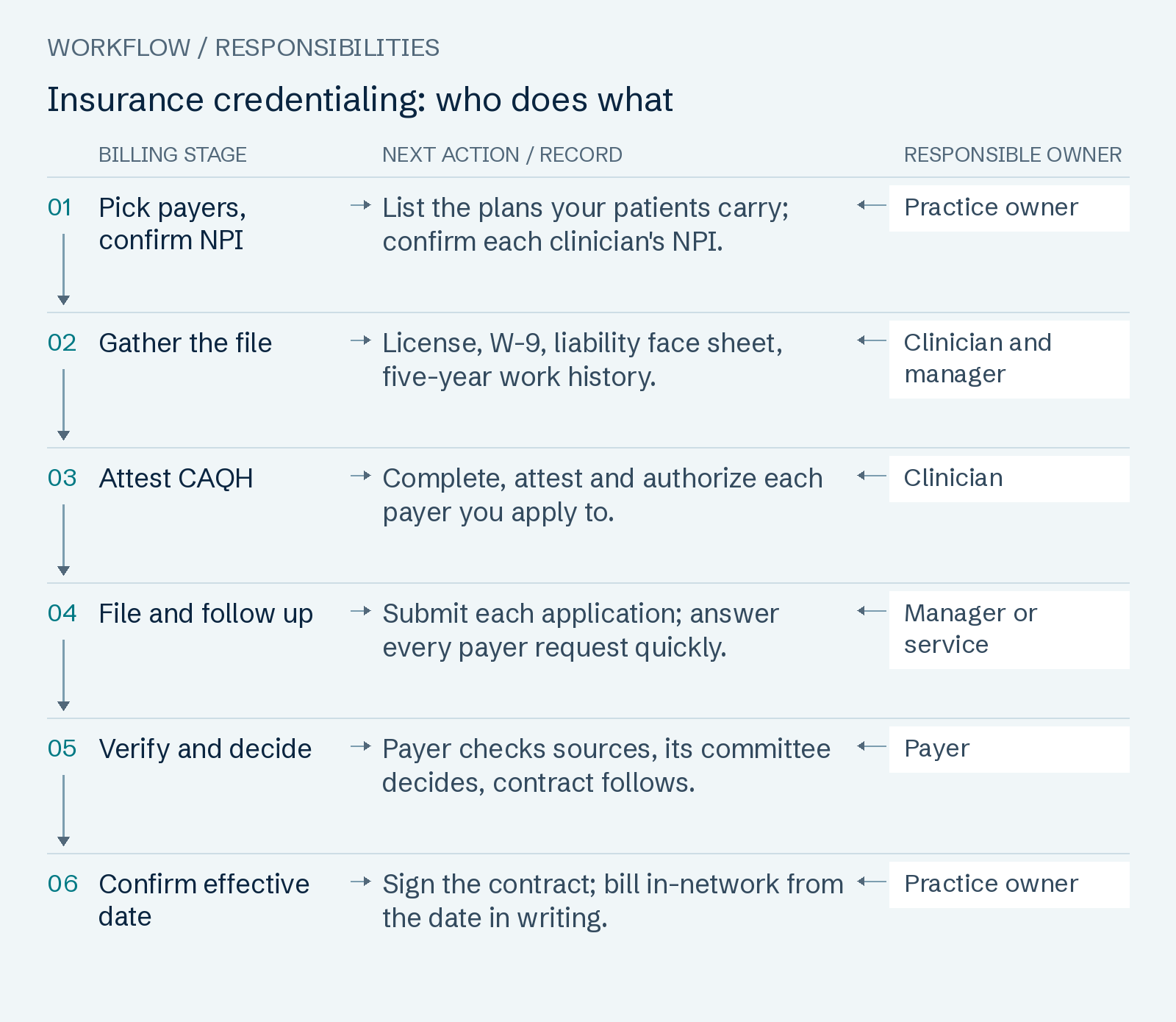
Read the workflow as text
- Pick payers, confirm NPI — List the plans your patients carry; confirm each clinician's NPI. Owner: Practice owner.
- Gather the file — License, W-9, liability face sheet, five-year work history. Owner: Clinician and manager.
- Attest CAQH — Complete, attest and authorize each payer you apply to. Owner: Clinician.
- File and follow up — Submit each application; answer every payer request quickly. Owner: Manager or service.
- Verify and decide — Payer checks sources, its committee decides, contract follows. Owner: Payer.
- Confirm effective date — Sign the contract; bill in-network from the date in writing. Owner: Practice owner.
Documents you need before you start
Payers ask for the same core file, so build it once per clinician and reuse it for every application. The checklist below lists what each payer names on its own page and who in a typical practice holds the item. Cigna adds two details that stall files: work history must cover the previous five years, with any gap over six months explained, and it recommends malpractice limits of $1,000,000 per occurrence and $3,000,000 aggregate, while noting coverage must meet state and specialty requirements. Evernorth asks non-prescribing behavioral clinicians for $1 million/$1 million.
Copy or print the table and tick each item off per clinician before the first application goes in.
| Item to have ready | Who holds it | Who asks for it (on its own page) |
|---|---|---|
| State license and certification details | Clinician | UnitedHealthcare; Evernorth requires a license to practice without supervision |
| Type 1 NPI (and the group's Type 2 NPI) | Clinician; practice | UnitedHealthcare; CMS for Medicare enrollment |
| W-9 matching the tax ID you bill under | Practice manager | UnitedHealthcare |
| Work and education history, five years, gaps over six months explained | Clinician | UnitedHealthcare; Cigna |
| Liability insurance face sheet | Practice or clinician | UnitedHealthcare; Cigna; Evernorth |
| CAQH registration ID, profile attested, payer authorized | Clinician attests; manager checks | UnitedHealthcare (if applicable); Cigna; Evernorth |
| One Healthcare ID | Practice manager | UnitedHealthcare |
| Medicare application (PECOS or CMS-855I) with reassignment to your group | Practice manager or credentialing service | CMS |
CAQH ProView setup and attestation
CAQH ProView is the shared profile that many commercial payers pull instead of collecting the same data on their own forms. CAQH has since rebranded as DataSpring, and the profile is now called the CAQH Provider Data Portal; registration still runs at proview.caqh.org. DataSpring describes it as a platform where clinicians enter, update and verify their information and share it with the organizations they authorize, and providers pay nothing to use it.
- Register the clinician and record the CAQH ID; payers ask for it on their applications.
- Complete every section, uploading the license, liability face sheet and work history from your checklist.
- Authorize each payer you apply to. UnitedHealthcare asks you to confirm DataSpring has authorized it to see the profile.
- Attest, then check the status. Cigna requires the profile to show Initial Profile Complete or Re-attestation.
Keeping the profile from expiring
Attestation is a recurring job, not a one-time one. DataSpring requires providers to attest every 120 days (every 180 days for Illinois providers); a profile that misses the date changes to Expired, and DataSpring follows up by email and then phone. A lapsed profile slows both new applications and recredentialing reviews, so put each clinician's next attestation date on the same list as their license and liability renewals.
Payer applications, follow-up cadence and contracting
Filing is the short part; keeping each file moving is where the weeks go. Each payer runs its own route and its own rules for incomplete files, so whoever files should also own the follow-up.
- Evernorth Behavioral Health. Its application must be completed in a single session; you cannot save it and return, so every document must be ready first.
- Cigna. If requested information never arrives, Cigna emails to say it has closed the application.
- Medicare. The Medicare Administrative Contractor (MAC) sends a development letter for anything missing. CMS says to respond within 30 days or the MAC may reject the application. PECOS shows each application's status under View Enrollments.
A follow-up cadence that keeps files open
Keep one line per clinician per payer: date filed, reference number, last payer request with its due date, and effective date. Answer payer requests the day they arrive, and review every open line at least every two weeks; a line with no change since the last review is the one to call about. A credentialing service should send you that status line on a set schedule. Ours arrives every 14 days.
The contracting step
Credentialing approval and a signed contract are both needed before in-network billing. UnitedHealthcare says the contract it sends for review is not confirmation of an approved credentialing application. Read the fee schedule and terms before signing; once credentialing is approved and the signed contract is received, UnitedHealthcare asks you to allow up to 60 days to load it into its systems.
Typical timelines by payer
Only some payers publish a clock, and every published clock starts with a complete file. The table quotes what each payer or CMS states, with its scope; ranges found on vendor blogs are not payer rules and are not repeated here.
For therapists, the two behavioral numbers are the ones to plan around: Evernorth says joining its network can take up to 90 calendar days (or as otherwise required by law) and may grant provisional credentialing in certain circumstances, and CMS says clean web Medicare applications from marriage and family therapists and mental health counselors are generally processed within 15 calendar days, paper ones within 30. Humana's credentialing policy says the process should be completed within 30 calendar days of a complete application, or as state or federal regulations require.
What the published clocks leave out
Approval ends the first clock only. UnitedHealthcare credentialing generally takes up to 45 calendar days or more, then up to 60 days to load the contract; Cigna's typical 45 to 60 days is followed by loading into its directories and claim systems, typically within 10 business days. Plan a new clinician's schedule around both clocks, plus the days your practice needs to assemble the file.
| Payer or program | What it publishes | When the clock starts | Before in-network claims pay | Scope |
|---|---|---|---|---|
| UnitedHealthcare | Up to 45 calendar days or more | A completed application with all required information | Allow up to 60 days to load the signed contract | Medical network |
| Cigna Healthcare | Typically 45 to 60 days | Not stated; missing items close the application | Directory and claim-system load typically within 10 business days | Cigna Healthcare network |
| Humana | Should be completed within 30 calendar days, or as regulations require | Receipt of a complete application | Practitioner notified within 30 calendar days of approval or denial | Practitioners under Humana medical and vision benefits (policy last reviewed May 12, 2025) |
| Evernorth Behavioral Health | Up to 90 calendar days, or as required by law | Not stated | Provisional credentialing possible case by case | Evernorth behavioral health network |
| Medicare (MFTs and mental health counselors) | Clean web applications generally 15 calendar days; paper 30 | Receipt of the application | Effective date set by 42 CFR 424.520(d) | CMS FAQ for MFTs and MHCs, May 2024 |
Effective dates and billing during the wait
A clinician can see patients while applications are pending; what changes is how each visit gets paid. The answer differs between Medicare and commercial plans.
- Medicare. For physicians, non-physician practitioners, their organizations and physical therapists, occupational therapists and speech-language pathologists, the effective date of billing privileges is the later of the filing date of an application the contractor approves, or the date services began at a new practice location (42 CFR 424.520(d)). Under 42 CFR 424.521, they may bill retrospectively for up to 30 days before that date, but only for services at the enrolled location, once all program requirements including state licensure were met, and when circumstances precluded enrolling in advance. File before the first Medicare visit.
- Commercial plans. UnitedHealthcare warns that a claim sent before its contract is loaded can be denied or paid at an out-of-network level. Cigna's approval email states the effective date. Ask each plan in writing whether it will pay any visit before that date; do not assume it will.
- Filing deadlines keep running. Holding claims while you wait does not pause any payer's timely filing limit. From our filing-limit dataset: Original Medicare allows 12 months from the date of service, and UnitedHealthcare commercial allows participating providers the time set in their Agreement, at least 90 days. Check each payer's claim filing deadline before you decide to hold claims.
Whether to see a pending clinician's patients out-of-network, reschedule them or move them to an already credentialed colleague is a business decision for your practice; the effective date is the fact it rests on.
Re-credentialing every 3 years, and Medicare revalidation every 5
Credentialing is not finished at approval. Each payer re-verifies its clinicians on its own cycle, and a missed request can end network participation. These are the clocks the payers and CMS publish:
- UnitedHealthcare starts recredentialing automatically as a clinician approaches the 3-year credentialing cycle, and says that with a complete and current data attestation every 90 days, there is nothing more you need to do.
- Humana formally recredentials its practitioners at least every 36 months, per its credentialing policy.
- Medicare Advantage plans must recredential physicians and other health care professionals at least every 3 years under 42 CFR 422.204, with an attestation that the new information is correct and complete.
- Cigna names no interval on its page. It sends up to three reminder emails asking the provider to verify and re-sign the CAQH information, and failing to respond results in termination from the Cigna Healthcare network.
- Original Medicare uses revalidation instead: CMS says providers and suppliers generally revalidate every 5 years (DMEPOS suppliers every 3). Physicians, non-physician practitioners and their organizations must report a practice location change within 30 days and most other changes within 90.
Send payer email to a shared inbox someone owns, and keep each clinician's CAQH attestation, recredentialing and revalidation dates on one list. An NPI record has its own rule: CMS says changes must be reported within 30 days, and updating NPPES does not update the Medicare enrollment.
When to hand the credentialing process off
Every step above can be done in-house. The cost is staff time and attention: one tracking line per clinician per payer, answered within each payer's deadline, for as long as the clinician is in network. Practices hand it off when a new clinician starts in weeks, when an application has gone quiet, or when the person who tracked the dates has left. What credentialing costs a practice, in fees and waiting time, sets out both options side by side.
Our insurance credentialing service builds the CAQH profile, files the payer applications, answers payer requests and confirms each effective date. Credentialing & Payer Enrollment: $149 per payer. Billed only after the payer confirms your effective date; $0 if denied or panel closed; filed within 5 business days of your complete packet. You keep your CAQH login, signature authority and the decision to accept each contract. If you also want claims handled from the first effective date, our medical billing and credentialing services run both under one team. Therapy practices can start with insurance credentialing for therapists. For per-payer detail and what goes wrong, read how to get credentialed with insurance companies. Then compare our published prices or send us your clinicians and the payers you want.
Common questions
- What is insurance credentialing?
- It is an insurer's verification of a clinician's license, education, training, work history and liability coverage before the insurer adds that clinician to its network. It runs separately for each clinician and each payer, and it ends with an effective date: the first date of service that payer pays at in-network rates. Credentialing is distinct from enrollment (registering so claims can be paid) and contracting (setting rates and terms).
- How long does credentialing with insurance take?
- It depends on the payer, and every clock starts with a complete file. UnitedHealthcare says up to 45 calendar days or more, then up to 60 days to load the contract; Cigna says typically 45 to 60 days; Humana's policy targets 30 calendar days from a complete application. For therapists, Evernorth says up to 90 calendar days, and CMS says clean web Medicare applications from MFTs and counselors are generally processed within 15 calendar days. See the payer timeline table.
- What is CAQH?
- CAQH, now operating as DataSpring, runs the shared clinician profile (formerly CAQH ProView, now the CAQH Provider Data Portal) that many payers read instead of collecting the same data on their own forms. Providers pay nothing to use it. Each clinician completes the profile, authorizes the payers they apply to and attests every 120 days (180 in Illinois); a missed attestation changes the status to Expired.
- Can I credential with insurance myself?
- Yes. Payers accept applications directly from clinicians and practices, CAQH charges providers nothing, and CMS charges physicians and non-physician practitioners no Medicare enrollment application fee. The cost is time: assembling the file, answering every payer request before the payer closes or rejects the application, and tracking effective dates and recredentialing for each clinician and payer. Use the nine steps and the checklist above.
- How much does insurance credentialing cost our practice?
- Medicare charges physicians and non-physician practitioners no enrollment application fee, and the CAQH profile is free for providers. The real costs are staff time or a service fee, plus visits you cannot bill in-network while you wait. Our credentialing service is $149 per payer. Billed only after the payer confirms your effective date; $0 if denied or panel closed; filed within 5 business days of your complete packet. The full comparison is in what credentialing costs, fees and waiting time included.
- Can our new clinician bill before credentialing is complete?
- Not in-network with a commercial plan unless that plan agrees in writing: UnitedHealthcare warns that claims before its contract loads can be denied or paid out-of-network. Medicare allows up to 30 days of retrospective billing under 42 CFR 424.521 when its conditions are met, and Evernorth may grant provisional credentialing case by case. See effective dates and billing during the wait.
Sources and review
Page revised November 4, 2026 · Review contact: Hyder Shah (inquiries@claimpillar.com). Every payer, CMS and eCFR source below was retrieved on November 4, 2026; each payer statement is scoped to the network named, and filing limits come from our timely-filing dataset.
- UnitedHealthcare: Join our network, medical providers
- Cigna Healthcare: Health care provider credentialing
- Evernorth Behavioral Health: Join the network
- Humana: Policy, Credentialing and Recredentialing (28th ed., last reviewed May 12, 2025)
- DataSpring, powered by CAQH: Provider Data Portal resources and FAQs
- CMS MLN9658742: Medicare Provider Enrollment
- CMS: MFT and MHC Provider Enrollment FAQs (May 2024)
- CMS: National Provider Identifier (NPI) fact sheet (December 2024)
- eCFR: 42 CFR 424.520, Effective date of Medicare billing privileges
- eCFR: 42 CFR 424.521, Request for payment by certain provider and supplier types
- eCFR: 42 CFR 422.204, Provider selection and credentialing (Medicare Advantage)