How much does credentialing cost my practice?
Credentialing costs a practice in three ways: fees a government program or payer charges to apply, the labor of preparing and chasing each application (your staff's hours or a credentialing company's fee), and the revenue you cannot bill in-network until each payer sets an effective date. Only the first is fixed by regulation, and for most clinician-owned practices it is zero. The labor and the wait are the costs you control.
Three terms keep the budget straight. Credentialing verifies a clinician's qualifications, enrollment registers the clinician with a payer so claims can be paid, and contracting sets the rates and terms. Medicare and Medicaid enroll clinicians; commercial plans credential and contract with them. The insurance credentialing guide shows where each step sits.
Does my practice owe the $750 application fee?
CMS set the 2026 provider enrollment application fee at $750 for applications submitted from January 1 through December 31, 2026. It applies only to institutional providers, which Medicare defines by the form they file: the CMS-855A, the CMS-855S, or the CMS-855B except physician and non-physician practitioner (NPP) organizations. A physician or NPP filing the CMS-855I owes nothing, and neither does a physician or NPP group.
State Medicaid programs apply the same fee. Each state must collect it before it signs a provider agreement, except from individual physicians and NPPs, from providers already enrolled in Medicare or another state's Medicaid or CHIP, and from providers that already paid it to a Medicare contractor or another state. If your practice runs a facility or supplier that files the 855A, the 855S or a non-physician 855B, budget $750 for each 2026 application, including revalidation and each new Medicare location.
| Cost | Who charges it | What your practice pays (per its source) | When it applies |
|---|---|---|---|
| CAQH profile (Provider Data Portal) | DataSpring, formerly CAQH | $0: providers are not charged | Whenever a health plan pulls the profile |
| Medicare enrollment, clinician on the CMS-855I | CMS, through the Medicare contractor | $0: no application fee | Initial enrollment and revalidation |
| Medicare enrollment, physician or NPP group | CMS, through the Medicare contractor | $0: not an institutional provider | Initial enrollment and revalidation |
| Medicare or Medicaid enrollment, institutional provider | CMS or the state Medicaid agency | $750 per 2026 application | Enrollment, revalidation, new Medicare location |
| Medicaid enrollment, individual physician or NPP | State Medicaid agency | $0: exempt from the federal fee | Enrollment and re-enrollment |
| Commercial payer application | The health plan | No fee listed on UnitedHealthcare's join-the-network page | Each plan, for each clinician |
| Preparing and following up each application | Your staff, or the credentialing company you hire | Staff hours, or the fee in your vendor contract | Per payer, per clinician |
| Visits before the effective date | No one invoices it | The visits you cannot bill in-network | From the clinician's first visit to each effective date |
What does my practice have to supply, and what does it cost us?
Most of what a payer asks for already exists in your practice; the cost is the time to gather it and keep it current. UnitedHealthcare's list of what to have ready is typical of a commercial application. A credentialing company can assemble and submit these items, but only your practice and the clinician can produce them.
| Item the payer asks for | Who in your practice holds it | What it costs you |
|---|---|---|
| License and certification details | The clinician | Already held; the cost is keeping copies current |
| National Provider Identifier (NPI) | The clinician (and the group, if billing as one) | Already held for most clinicians |
| W-9 | The owner or office manager | One form per tax ID |
| Work and education histories | The clinician | The clinician's time to compile them |
| Liability insurance face sheet | The owner, from your malpractice carrier | Your existing policy |
| CAQH (DataSpring) registration ID, if the payer uses it | The clinician, or someone you delegate | $0 to providers; time to complete and re-attest |
Which steps cost our staff time, and which can someone else do?
Credentialing a new clinician runs in six steps. Two of them stay with your practice whoever does the paperwork: deciding which payers to join and signing each contract. The rest a staff member or a credentialing service can run for you.
- Choose the payers. Your practice decides, from your patient mix and each plan's rates. No vendor should make this call.
- Complete and attest the CAQH profile. The clinician attests; staff or a credentialing service can fill in and maintain the data.
- Enroll in Medicare and Medicaid. Staff or a service files the enrollment; file Medicare before the clinician's first Medicare visit, because the filing date sets the effective date.
- Apply to each commercial payer. Staff or a service submits each application and answers the payer's requests.
- Sign the contract. Your practice reviews the rates and signs; the payer then loads the contract.
- Confirm the effective date in writing. Staff or a service gets it; your front desk books that payer's members as in-network only from that date.
For a practice that is opening, credentialing is one line in a longer list; the new-practice billing checklist puts it in order with the rest.
How long until we can bill, and how will I know where each application stands?
Each payer runs its own clock, and the waiting cost is set by the slowest payer your patients use. UnitedHealthcare says credentialing generally takes up to 45 calendar days or more once it has a complete application, then asks you to allow up to 60 days for the contract to load after it approves credentialing and receives the signed contract. Until the contract loads, it warns, a claim can be denied or paid at the out-of-network level. Other payers' published times are compared in the payer-by-payer credentialing timelines.
Medicare ties the date to your filing. For physicians, NPPs, their groups, physical and occupational therapists and speech-language pathologists, the effective date is the later of the filing date of an application the contractor approves or the date the clinician started at the location. The same providers may bill back up to 30 days before the effective date when circumstances kept them from enrolling earlier, or 90 days when a presidentially declared disaster prevented it.
You will know where each application stands only if someone reports it payer by payer. Ask whoever runs the work, staff or vendor, for a regular report that names each clinician and payer, the stage, the payer's reference number and who holds the next step. A single date range for every payer hides the one that is late.
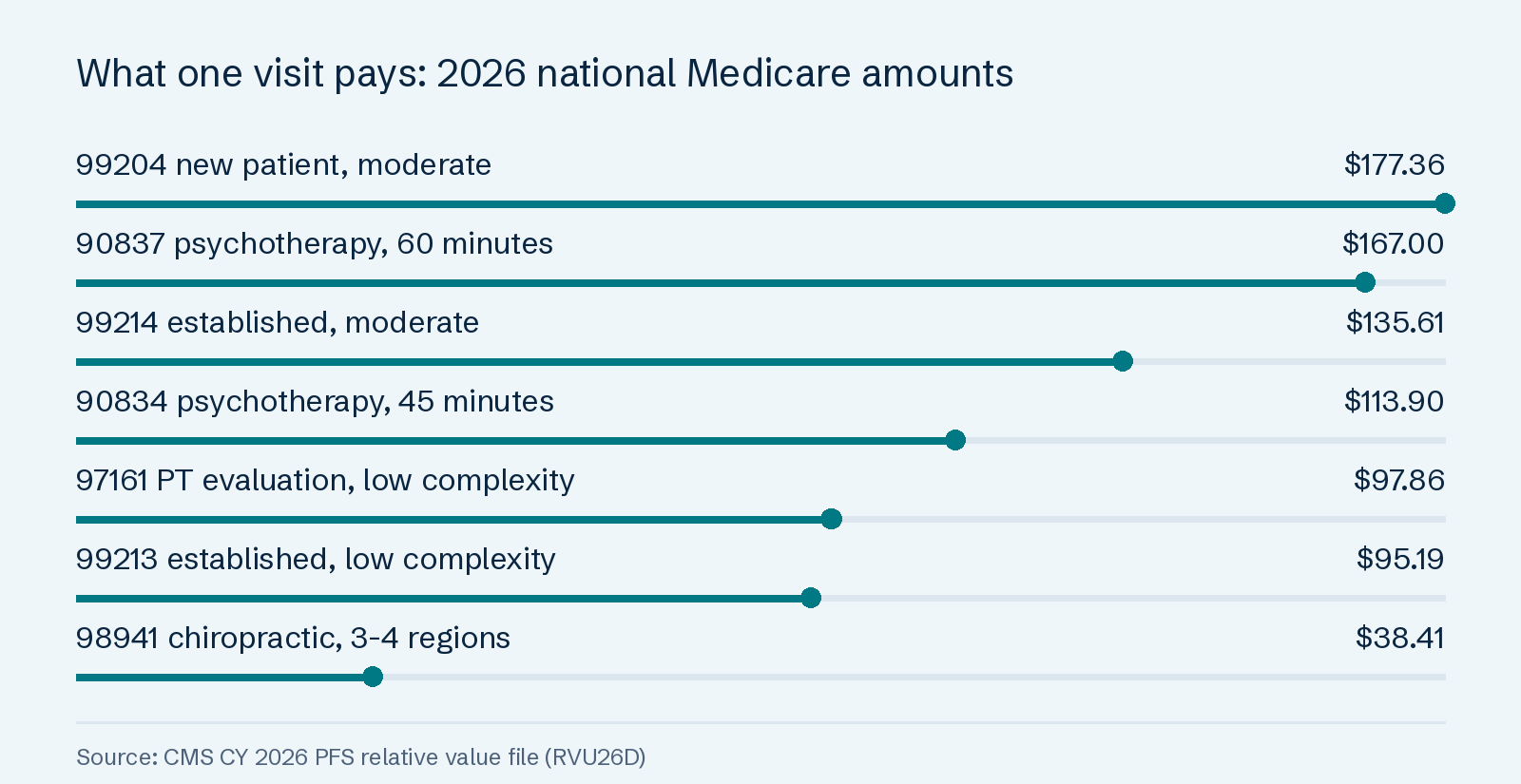
The chart shows what one visit is worth: the 2026 national Medicare amount (unadjusted), non-facility, for common visit types in medical, psychotherapy, physical therapy and chiropractic practices, from the CMS CY 2026 PFS relative value file (RVU26D). Actual payment varies by locality, setting and payer.
What does the wait cost us? A worked example
Your own waiting cost is visits per week, times weeks until the effective date, times what each visit pays. Example, for illustration only: a therapist-owner's new clinician sees 15 Medicare patients for 60-minute psychotherapy (CPT 90837) on dates that fall before the 30-day retrospective window.
- 2026 national Medicare amount (unadjusted), non-facility: $167.00 per session.
- 15 × $167.00 = $2,505.00 that Medicare will not pay.
- $2,505.00 is more than three times the $750 institutional fee (3 × $750 = $2,250), a fee this practice does not owe.
Which credentialing mistakes cost my practice the most?
Timing mistakes can add costs beyond application fees. Each row names the rule from its source and what it means for your revenue. Claims held while you wait also run against each payer's timely filing limit, the deadline for submitting a claim.
| What goes wrong | What the payer or CMS says | What it costs your practice |
|---|---|---|
| Booking a payer's members as in-network before its contract loads | UnitedHealthcare: a claim can be denied or paid at the out-of-network level | Denied or out-of-network payment on those visits |
| Filing Medicare after the clinician starts seeing Medicare patients | The effective date follows the filing date; billing back reaches 30 days (90 after a presidentially declared disaster) | Visits before the 30-day window are not payable |
| Letting the CAQH attestation lapse | UnitedHealthcare recredentials on a 3-year cycle and asks nothing more if attestation stays current every 90 days | Recredentialing stops being automatic and becomes staff or vendor work |
| Sending an institutional application without the fee | A Medicare contractor may reject a new institutional provider's application without the fee or a hardship request | Refiling, and a later filing date |
| Holding claims past a payer's filing deadline | Each payer sets its own timely filing limit | Claims the payer can deny as late |
Is it cheaper to credential in-house or hire a credentialing company?
Application fees are the same whoever files, so the choice comes down to labor and speed. In-house credentialing costs staff hours you already pay for and works when one person can keep a payer-by-payer tracker current and answer payer requests quickly. A credentialing company costs a fee and makes sense when that tracker has outgrown the person keeping it, or when several clinicians start at once. Compare each vendor's pricing basis: a set fee per payer application, an hourly rate or a recurring monthly charge.
What should I ask a credentialing company before I sign?
- When is the fee charged? At signing, at filing, monthly, or only after the payer confirms an effective date.
- What do we pay if a payer denies the application or the panel is closed?
- Are payer and state application fees passed through? A clinician on the CMS-855I owes Medicare no fee, so a Medicare fee line for one needs an explanation.
- Is the CAQH line labor? DataSpring says providers will not be charged to use the portal, so any CAQH charge pays for the vendor's time.
- Who keeps the logins and payer letters when the engagement ends?
The same make-or-buy logic applies to billing as a whole; the in-house versus outsourced billing comparison weighs it for claims, and the billing company contract checklist covers the contract terms.
| Question | In-house | Credentialing company |
|---|---|---|
| Payer and government application fees | Same either way | Same either way; ask whether they are passed through |
| Labor cost | Staff hours per payer, per clinician | The vendor's fee: per application, hourly or monthly |
| CAQH | $0 to providers; staff time to attest | $0 to providers; any CAQH line is vendor labor |
| Denied application or closed panel | The staff hours are spent | Depends on your contract terms |
| Recredentialing and re-attestation dates | Your tracker | Ask whether tracking is included and priced |
| Choosing payers and signing contracts | Your practice | Still your practice |
What can my practice hand off, and at what price?
Practices hand off the CAQH upkeep, the Medicare and Medicaid filings, each commercial application and the follow-up to the effective date; choosing payers and signing contracts stay with you either way. Our credentialing and payer enrollment service charges $149 per payer for each clinician, unless your billing plan includes it. Billed only after the payer confirms your effective date; $0 if denied or panel closed; filed within 5 business days of your complete packet. Payer and state application fees are not included. The full rate card is on our pricing page.
Common questions
- How much does credentialing cost per provider?
- For a clinician enrolling on the CMS-855I, Medicare, Medicaid and CAQH charge nothing. The cost per provider is the labor (your staff's hours or a credentialing company's fee for each payer) plus the visits you cannot bill in-network before each payer's effective date. Institutional providers add a $750 application fee in 2026.
- Do insurance companies charge an application fee?
- Medicare and Medicaid charge one only to institutional providers: $750 for 2026 applications, which state Medicaid programs waive when the provider is already enrolled in, or already paid the fee to, Medicare or another state. UnitedHealthcare's join-the-network page lists no application fee. Check each commercial plan's own provider page before you budget.
- Is CAQH free for providers?
- Yes. DataSpring, which now runs CAQH's provider portal, says providers will not be charged to use the portal. A CAQH line on a vendor's quote pays for that vendor's time, not a CAQH fee.
- Should I hire a credentialing company or do it myself?
- Do it in-house when one person can track every payer and answer requests quickly; the application fees are the same either way. Hire a company when several clinicians start at once or the tracker has outgrown the person keeping it, and compare quotes on when the fee is charged and what you pay if a payer says no.
- How much revenue do we lose while credentialing is pending?
- Multiply the visits you expect per week by the weeks until each payer's effective date, then by what each visit pays. Medicare lets physicians, NPPs, physical and occupational therapists and speech-language pathologists bill back up to 30 days before the effective date when circumstances kept them from enrolling earlier, so file before the clinician's first Medicare visit.
- What do credentialing companies charge?
- No agency sets the price. Compare per-application, hourly and recurring monthly quotes by total cost over the engagement, including when the fee is charged and what you pay if a payer denies the application or closes its panel.
Sources and review
Page revised October 7, 2026 · Review contact: Hyder Shah (inquiries@claimpillar.com). Every source below was retrieved and checked on October 7, 2026. Visit amounts are 2026 national Medicare amounts (unadjusted) from our dataset built from the CMS CY 2026 PFS relative value file (RVU26D).
- Federal Register 90 FR 55738: Provider Enrollment Application Fee Amount for Calendar Year 2026 (CMS-6096-N)
- 42 CFR 424.514, Medicare application fee (eCFR)
- 42 CFR 455.460, Medicaid application fee (eCFR)
- 42 CFR 424.520, Effective date of Medicare billing privileges (eCFR)
- 42 CFR 424.521, Request for payment by certain provider and supplier types (eCFR)
- DataSpring, powered by CAQH: Clinician Q&A
- UnitedHealthcare: Join our network, medical health care professionals
- CMS: PFS Relative Value Files (CY 2026, RVU26D)