What is a claim denial, and what does it cost your practice?
A claim denial is a claim the payer has adjudicated and will not pay as billed. The denied amount remains unresolved until someone corrects the claim, asks for reconsideration, appeals it or confirms that it is not payable. Each payer limits how long you have to challenge its decision. Denials are common: insurers selling plans on HealthCare.gov denied 19% of in-network claims in 2024, and the rate ranged from 3% to 36% by insurer, according to KFF's analysis of federal transparency data. That figure covers one market, not Medicare, Medicaid or employer plans; it combines medical and prescription drug claims, and it leaves out claims that were resubmitted and paid.
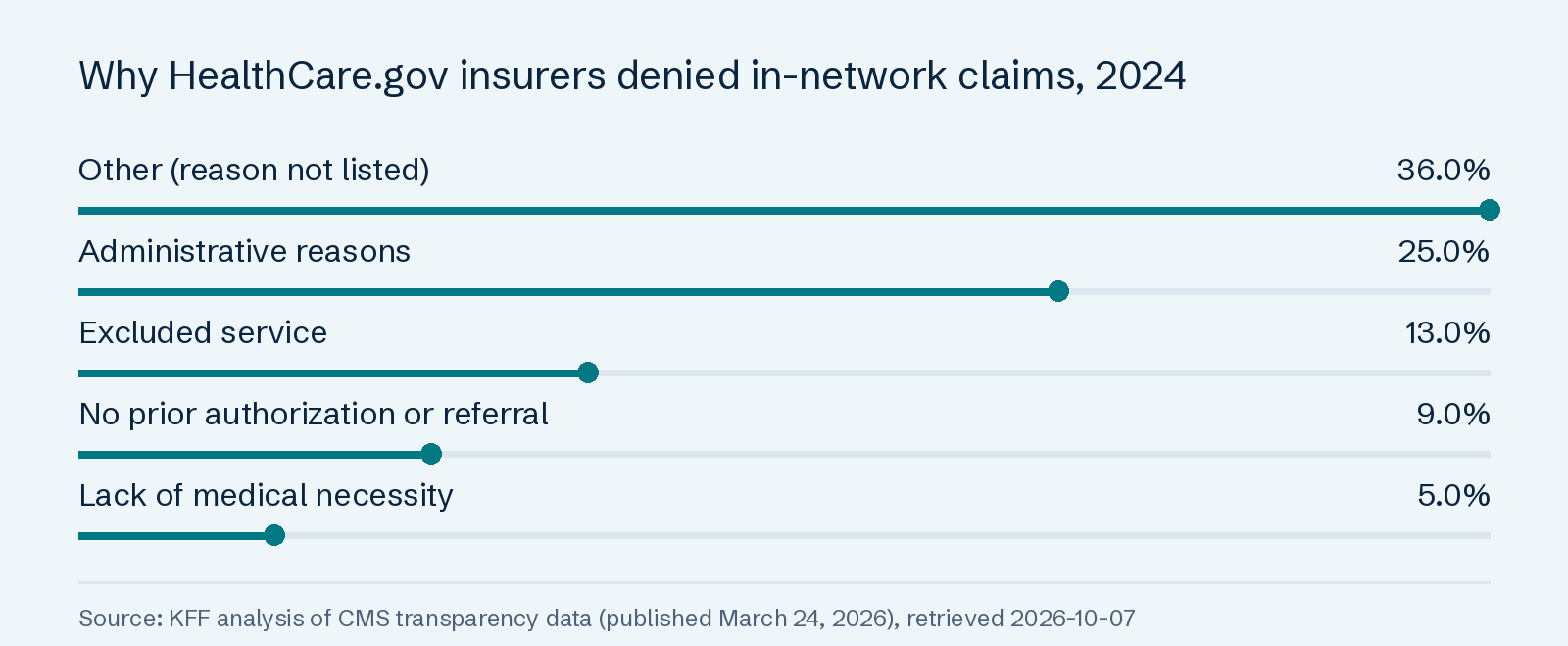
The reasons insurers reported point to work a practice controls. Administrative reasons, which KFF says include duplicate claims, missing information, untimely claims and claims for an unapproved provider, made up 25% of in-network denial reasons, and missing prior authorization or referral made up 9%. The chart shows the split. Insurers tally each reason separately, so one claim can count more than once.
Is the claim rejected or denied? The answer sets your deadline
A rejection fails front-end or clearinghouse edits and never enters adjudication: fix it and resubmit. A denial is an adjudicated claim: correct it, ask for reconsideration or appeal it. For Original Medicare the difference decides whether you have any appeal at all. CMS lists claims returned or rejected as incomplete or invalid, and determinations that a claim was filed late, among actions that are not initial determinations and cannot be appealed (Medicare Claims Processing Manual, chapter 29, §200). A rejection left sitting in a queue can become a late claim with no appeal path.
The remittance also tells you who carries the unpaid balance. CMS explains that the group code assigns it: CO to the provider and PR to the patient, and Medicare patients may be billed only when the adjustment carries PR (CMS remittance advice guidance). A balance assigned under CO stays your practice's loss until it is corrected or appealed.
How can you tell where your practice stands on denials?
Your practice has a denial problem worth fixing when any of these is true:
- Nobody can say which payer denies you most, or why.
- The same denial reason comes back month after month.
- Denials wait weeks before anyone opens them.
- Balances are written off as denied with no record of an appeal decision.
- Rejections and denials are counted together, so neither number means anything.
Two numbers tell you more than the signs. The first is the initial denial rate. HFMA's Claim Integrity Task Force defines it as initial denial claims divided by claims submitted, counting only a claim's first denial, leaving out rebills such as corrected claims, and using the average of the three months before the reporting month as the denominator (HFMA denial metrics). Ask for it by payer. The second is the share of initial denials overturned, which shows whether denials are being worked to payment or only touched. The rest of a useful report is in our guide to the monthly numbers your billing report should show.
Which step in your practice causes each denial?
The preventable causes below start at a step before the claim reaches the payer. Sort last quarter's denials by the causes in the table, rank the causes by dollars, and the table shows who has to change what. Three of the causes start at scheduling or check-in, before the visit is billed, which is why eligibility verification and authorization tracking belong before claim submission.
| Cause of the denial | Where it starts | Who prevents it | What prevents it |
|---|---|---|---|
| Patient not covered, or wrong member ID | Scheduling and check-in | Front desk | Check active coverage and the card details before each visit |
| Another plan should pay first | Patient intake | Front desk | Ask about other coverage at every visit; bill the primary plan first |
| No prior authorization or referral | Scheduling | Authorization staff | Match the approved service, dates and clinician to the claim |
| Missing or wrong claim data | Charge entry | Biller | Run claim edits before sending; fix rejections the same week |
| Coding or bundling edit | Coding | Coder | Code from the signed note; check the payer's edits before sending |
| Medical necessity or coverage policy | Visit and documentation | Clinician and coder | Check the documented diagnosis and record against the payer's coverage policy before billing |
| Filed after the payer's limit | Claim submission | Biller | Track each payer's filing limit and send claims within days of the visit |
| Duplicate claim | Resubmission | Biller | Check claim history before resending; never resend a true duplicate |
What are your options for preventing and working denials?
Any option has to cover two jobs: preventing the next denial at the front end, and working the denials you already have before their windows close. The table compares four setups by what each costs your practice, who does the work and what can go wrong.
Choose by where your denials start. If most start at the front desk, training and a pre-visit coverage check change more than extra appeal effort. If they start in coding or follow-up, the work needs someone whose day is built around payer deadlines. Our comparison of in-house and outsourced billing costs works through the decision for your whole billing operation.
| Option | What it costs | Who does the work | What can go wrong |
|---|---|---|---|
| Current staff fit it in | No new invoice; hours come out of other billing work | Front desk and your biller, between daily tasks | New claims come first, so denials wait and appeal windows close |
| Hire a dedicated denial biller | BLS median pay for medical records specialists: $51,140 a year (May 2025), before benefits | One employee you hire, train and supervise | One person holds every deadline; a resignation stops the queue |
| Claim-edit software or clearinghouse edits | A software fee quoted by each vendor | Your biller, who still works whatever the edits flag | Catches data errors before sending; the edits do not obtain authorizations or confirm coverage |
| Hand denial work to a billing company | A percentage of what is collected; see the cost section below | The billing team; your staff keep the front-desk and clinical steps | A percentage fee on payments; vague reporting can hide unworked denials |
What should you check first to reduce claim denials?
- Get three months of denials on one list. Ask your biller or billing company for every denied claim with its payer, amount, reason and the date the remittance posted it.
- Have rejections counted separately. Rejected claims never reached adjudication; they should be fixed and resubmitted within days, before a filing limit passes.
- Rank the causes by dollars. Sort the list by payer and by the causes in the table above, ranked by dollars, not by count.
- Check each open denial's deadline. The claims closest to the end of their appeal window get worked first.
- Name one owner per cause. The fix belongs at the step where the cause starts, with a date to check that it held.
- Ask for the same numbers every month. Initial denial rate by payer, overturn rate and dollars written off as denied.
Bring your payer contracts to step 4: a contract can set a different window from the payer's manual.
Which denials can you still appeal, and by when?
A denial can be worked only while its window is open, and windows differ by payer, product and contract. The table shows the first-level windows six payer programs publish, taken from our timely-filing dataset, which records each payer's own wording (rows retrieved October 2, 2026). For Original Medicare, the redetermination request is due within 120 days of receiving the notice, which CMS presumes arrives 5 days after its date, and minor errors go to the contractor's reopening process instead (CMS appeals chapter). Contracts and state law can change any of these windows.
Original Medicare gives a claim filed more than 12 months after the date of service no appeal rights; our dataset records only narrow exceptions under 42 CFR 424.44(b), such as Medicare's own administrative error or retroactive entitlement. For that payer the filing calendar matters more than the appeal queue. Our guide on keeping claims inside each payer's filing limit covers that side. Denials left past their window age into old A/R; what your practice can still collect from A/R over 90 days sorts which of those claims can still be paid.
| Payer and scope | First-level window | Counted from |
|---|---|---|
| Original Medicare (Parts A and B) | Redetermination: 120 days | Receipt of the initial determination notice |
| Aetna (national dispute process) | Reconsideration: 180 calendar days; appeal: 60 calendar days after that decision | The initial claim decision |
| Cigna Healthcare (commercial) | Appeal: 180 calendar days | The initial payment or denial notice |
| UnitedHealthcare (commercial) | Reconsideration and appeal: 12 months | The original claim EOB or PRA |
| Humana Medicare Advantage (non-participating providers) | Appeal: 65 calendar days | The date of the denial |
| TRICARE West Region | Claim reconsideration: 90 days | The date of the remittance |
What do unworked denials cost, and what does fixing them cost?
The amount at risk is the supported payment denied, which may be one line or the whole claim. Example: the 2026 national Medicare amount (unadjusted) for an established-patient office visit billed as 99214 is $135.61 at the non-facility (office) rate, from the CMS physician fee schedule relative value file (RVU26D). If 10 payable visits of this kind a month are fully denied and the payments are never recovered, your practice forgoes 10 × $135.61 = $1,356.10 a month, or 12 × $1,356.10 = $16,273.20 a year. Actual payment varies by locality, setting and payer.
Fixing denials costs staff time or a fee. A dedicated hire costs the wage in the options table plus benefits (BLS pay data for medical records specialists). With our team, denial work and appeals are part of Full-Service Billing, priced from 5.0% to 8.5% of insurance payments depending on specialty and practice size. Invoices 1–3: only percentage fees on that month's insurance payments, plus any statements or add-ons you order. Percentage fees and mailed statements are capped at 9.0% of that month's insurance payments; from invoice 4, the $400 minimum applies even in a month when the cap comes to less. The full rate card is on our pricing page.
When should you hand denial work to a billing team?
Practices hand off denial work when denials wait weeks before anyone opens them, when the biller who knew the payers has left, when the same causes return every month, or when nobody can produce the initial denial rate by payer. Some work stays with your practice whoever works the denials: collecting insurance details at the front desk and documenting care in the record.
Our denial management service is built for that handoff: each denial is corrected, reconsidered, appealed or returned to you with the fix, and its cause goes back to the person at the step where it starts. To see first which unpaid claims over 90 days are closest to a payer deadline, request The Free A/R Deadline Map: A claim-by-claim list of every unpaid insurance claim over 90 days in the aging report you send: payer, amount, the deadline it faces, the denial reason and the next action, sorted by deadline. Clock starts with your claim-level aging export and signed BAA; above 10 requests in a week, we confirm your date within 1 business day.
Common questions
- Why are so many of our claims being denied?
- Your remittances hold the answer: sort three months of denials by payer and by cause, and rank the causes by dollars. The usual candidates are coverage and member-ID errors, a plan that should have paid first, missing authorizations, claim data errors, coding edits and late filing. Insurers' own reports point the same way: on 2024 HealthCare.gov plans, administrative reasons were 25% of in-network denial reasons and missing authorization or referral 9% (KFF).
- Which payer denies us most, and what do we do about it?
- Divide each payer's initial denials by its claims submitted, the way HFMA defines the initial denial rate, and compare payers over the same three months. Then read that payer's top two causes. An authorization or coverage cause points to a front-desk step with that payer; coverage-policy denials point to the payer's published policy, which your coder should check against the documentation before billing. Keep that payer's appeal window in view while the fix takes hold.
- Which denials can we still appeal, and by when?
- Any denial whose window is still open. Original Medicare allows 120 days from receipt of the notice for a redetermination; Aetna's national process allows 180 calendar days from the initial claim decision for a reconsideration; UnitedHealthcare commercial allows 12 months from the original EOB or PRA. Your contract or state law can change these. For Original Medicare, a claim rejected as incomplete is fixed and resubmitted rather than appealed, and a claim filed after the 12-month limit has no appeal rights outside a few narrow exceptions.
- Should our staff or a billing company work our denials?
- Your staff can, if they have protected hours each week and know each payer's process and deadlines. A billing company makes sense when denials wait weeks, the biller who knew the payers has left, or deadlines are already slipping. Either way, front-desk checks and clinical documentation stay with your practice, because those steps are where coverage, authorization and documentation causes start.
- How much do unworked denials cost us?
- The supported amount still denied, which may be part of a claim. A missed appeal window can prevent recovery. Example, using the 2026 national Medicare amount (unadjusted) for 99214 of $135.61: 10 fully denied payable visits left unrecovered is 10 × $135.61 = $1,356.10 a month. For your own figure, total the supported amounts still denied and distinguish partial denials from fully denied claims.
- What is the difference between a rejected and a denied claim?
- A rejection fails front-end or clearinghouse edits and never enters adjudication, so you fix it and resubmit. A denial is an adjudicated claim the payer will not pay as billed, so you correct it, ask for reconsideration or appeal it. Treat rejections as urgent: a rejected claim that is not resubmitted before the payer's filing limit becomes a late claim, and for Original Medicare a late claim has no appeal rights.
- Can we bill the patient when a claim is denied?
- Only when the remittance assigns the amount to the patient with group code PR and no rule bars billing that patient. For Medicare, CMS says beneficiaries may be billed only when PR is used (CMS remittance advice guidance). An amount assigned under CO stays with your practice: correct it or appeal it.
Sources and review
Page revised October 7, 2026 · Review contact: Hyder Shah (inquiries@claimpillar.com). Appeal windows come from our timely-filing dataset, built from each payer's own manual or provider page (rows retrieved 2026-10-02); the Medicare amount comes from our 2026 national fee schedule dataset (CMS RVU26D); every source below was retrieved on 2026-10-07.
- KFF: Claims Denials and Appeals in ACA Marketplace Plans in 2024 (March 24, 2026; retrieved 2026-10-07)
- CMS Medicare Claims Processing Manual, Chapter 29: Appeals of Claims Decisions (retrieved 2026-10-07)
- CMS: Health Care Payment and Remittance Advice (retrieved 2026-10-07)
- HFMA Claim Integrity Task Force: Standardizing denial metrics (retrieved 2026-10-07)
- BLS Occupational Outlook Handbook: Medical Records Specialists, pay (retrieved 2026-10-07)
- CMS: PFS Relative Value Files, CY 2026 RVU26D (retrieved 2026-10-07)