When to request a billing and coding audit
Request an audit when the numbers show a problem but not the claims, codes or clinician behind it:
- Denials keep climbing and the reasons repeat. HHS-OIG tells physician practices to examine their claims denial history and correct the most frequent sources first; we start the sample there.
- Payments look short. Lines pay below your contract, or are written off as contractual adjustments nobody checked.
- Your coder, biller or billing company changed. You want a baseline before the new team's habits set in.
- One clinician's E/M levels stand apart from the rest of the group, in either direction.
- A payer asked for records, and you want your own read before an outside reviewer forms one.
An audit checks past claims once; our ongoing medical coding service codes every new claim going forward.
What our medical billing audit services cover
We follow each sampled claim from the signed note to the posted payment. You keep your charts, your logins and the final say on every code.
Billing, coding or chart audit: which one do you need?
Pick by the problem you see. Coding denials or a records request call for a coding (chart) audit: does the note support the codes, modifiers, units and diagnoses billed? Rejections, edit denials or short payments call for a billing audit: did the claim go out clean and pay what your contract says? We usually scope both on one sample, because a correct code paid at the wrong rate still loses money.
| Task | Deliverable | Timing | What you keep |
|---|---|---|---|
| Audit plan | Written question, payers, period, codes, sample size and selection method | Before any records are pulled | The plan, and the right to change it |
| BAA and access | Signed business associate agreement; read-only logins | Before any patient data moves | Control of every login |
| Coding and chart review | Codes, modifiers, units and diagnoses checked against the signed note | During the review | Your charts; no code changes without clinician sign-off |
| Edit check | Medicare claims run against NCCI code-pair and unit edits | During the review | The edit results per claim |
| Payment review | Each paid line compared with your contracted rate | During the review | Your contracts and payer agreements |
| Denial trace | Each denied or unpaid sampled claim traced to its cause and next action | During the review | Your denial log |
| Findings register and readout | Claim-level register plus a summary by error category and clinician | At the close of the review | The register, whether or not you hire us |
| Recheck | A follow-up sample on the same error categories | After fixes are in place | The before-and-after comparison |
Where practices lose money an audit catches, and what we do about it
Our audits look for five ways practices lose money. Each one, with our response:
- E/M levels that do not match the note. CMS has practices choose most E/M visit levels by medical decision making or time, so a level picked by the template drifts. We compare each sampled level with the documented decision making or minutes and show the clinician the gap.
- Bundled pairs and impossible units. Medicare's NCCI edits stop payment for incorrect code combinations. We run every sampled Medicare claim through them and trace each hit to its source.
- Notes that cannot carry the claim. CMS's CERT program sorts errors into five categories, including no documentation, insufficient documentation and medical necessity. We score your errors in the same categories so you see which ones a payer review could find.
- Payments below contract. A short-paid line raises no denial, so nothing flags it for follow-up. We compare paid lines with your contracted rates and list each shortfall for appeal.
- Money owed back. An identified Medicare overpayment generally must be reported and returned within 60 days of being identified. We flag those claims first, with the date, for you and your counsel.
Before you order an audit, there are checks you can run on your own reports first.
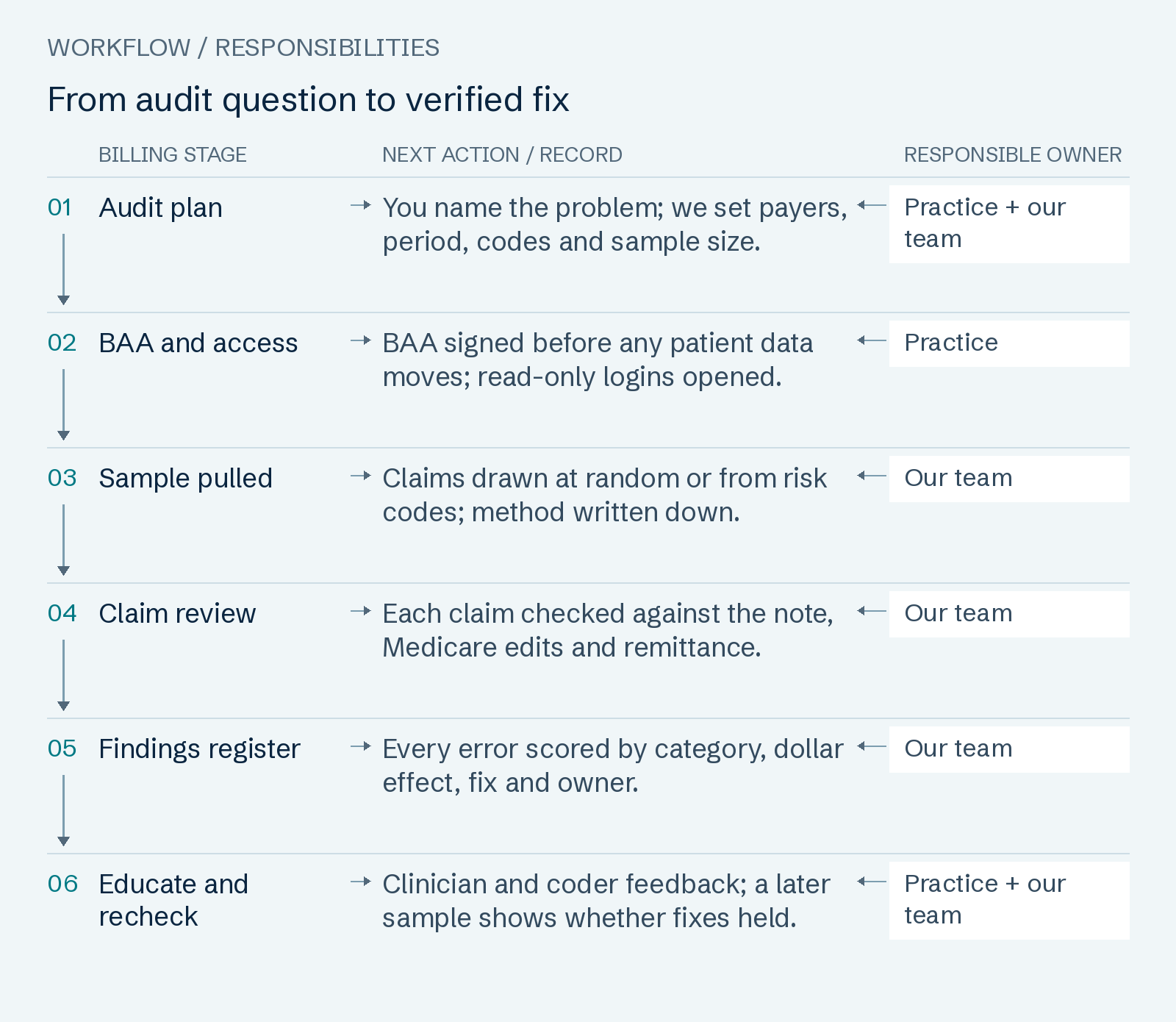
Read the workflow as text
- Audit plan — You name the problem; we set payers, period, codes and sample size. Owner: Practice + our team.
- BAA and access — BAA signed before any patient data moves; read-only logins opened. Owner: Practice.
- Sample pulled — Claims drawn at random or from risk codes; method written down. Owner: Our team.
- Claim review — Each claim checked against the note, Medicare edits and remittance. Owner: Our team.
- Findings register — Every error scored by category, dollar effect, fix and owner. Owner: Our team.
- Educate and recheck — Clinician and coder feedback; a later sample shows whether fixes held. Owner: Practice + our team.
How our billing and coding audit works, from plan to recheck
- Set the question. You name the problem: a denial pattern, one clinician's E/M mix, a payer that pays short. The written audit plan sets payers, period, codes, sample size and price.
- Sign the BAA and open access. Billing work is a business associate activity under HIPAA, so the agreement is signed before any patient data reaches us.
- Pull the sample. We draw claims at random or from the risk-area codes in the plan and record the method, so the recheck can repeat it.
- Review claim by claim. We check every code against the signed note, then the edits and the remittance.
- Read out the findings. A call walks you through the register, ranked by dollar effect and by how often each cause occurs.
- Educate and recheck. Each clinician and coder sees their own findings; a follow-up sample of claims dated after the fixes shows whether they held.
How many of your claims we review
We size the sample to your question. Our floor is HHS-OIG's basic guide for physician practices: five or more medical records per federal payer, or five to ten per physician. A broader question gets a larger sample; a single denial pattern can be audited from its denial queue alone.
What you get: the findings register, readout and recheck
Your findings register lists every sampled claim line with an error: date of service, payer, clinician, code billed, what the note supports, the error category, the dollar effect, the fix and its owner. Overpaid and underpaid amounts sit in separate columns, never netted, and the dollar effect uses your contracted rate when we have your fee schedules.
The readout reports a short set of measures, counted on the same sample definition before and after the fixes, so the recheck shows whether the fix worked. The audit measures are defined below; our revenue cycle KPI guide explains the separate measures used to monitor ongoing billing.
| What we report | How we count it | What it tells you |
|---|---|---|
| Claim error rate | Sampled claims with at least one error ÷ sampled claims reviewed | How often a claim goes out wrong |
| Overpaid dollars | Overpaid amounts on sampled claims, listed separately | Refund exposure for you and your counsel |
| Underpaid dollars | Underpaid amounts on sampled claims, listed separately | Money earned but not billed or collected |
| Findings by clinician and cause | Errors grouped by clinician and by error category | Who gets feedback, and on what |
| Finding closure | Findings closed with evidence ÷ findings issued | Whether the register turned into fixes |
What our billing and coding audits cost
A standalone coding and chart audit is priced in writing once the sample is set, before any records are pulled. Inside Full-Service Billing, coding checks on every claim cost nothing extra: We check every code against your clinician's documentation and never change a code without the clinician's sign-off.
The Free A/R Deadline Map is narrower than a full audit: it lists unpaid claims by deadline and does not review charts or codes. Clock starts with your claim-level aging export and signed BAA; above 10 requests in a week, we confirm your date within 1 business day. Every tier, and what no option includes, is on the full rate card.
| Option | Price | What it covers |
|---|---|---|
| The Free A/R Deadline Map | Free | Unpaid insurance claims over 90 days, sorted by the deadline each faces |
| 60-Day Underpayment Check | $495 | 60 days of payments compared with your contracted rates; each underpaid line appealed; needs your fee schedules |
| Coding and chart audit | Priced in writing after scoping | The sampled review, findings register, readout and recheck on this page |
| Full-Service Billing | 5.0% to 8.5% of insurance payments | Coding checks on every claim, plus Front-Desk Fix Sheet: Each month, your top 3 denial causes with the exact front-desk or documentation fix for each, for future visits, plus a 20-minute call with your front desk every quarter. |
| Complete RCM | 9.0% of insurance payments | Everything in billing, plus a monthly underpayment check |
Audits we run for your specialty
Your specialty decides where the sample leans:
- Primary care and urgent care. We weight the sample toward office E/M level selection. See our primary care billing service.
- Dermatology. We test procedures billed with a visit, and several procedures on one date, against the code-pair edits. See dermatology billing.
- PT, OT and speech therapy. We count documented treatment minutes against the units billed. See therapy billing.
- Mental and behavioral health. For psychiatric prescribers we compare documented decision making or minutes with the E/M level billed. See mental health billing.
Audit terms and guarantees we put in writing
An audit report is evidence, not a ruling: the payer, your Medicare contractor or a regulator decides what is paid or owed. What we commit to is the method, the register and who owns each fix:
- Your register. The audit plan, findings register and recheck results are yours to keep. We check every code against your clinician's documentation and never change a code without the clinician's sign-off.
- Overpayments. Claims that look overpaid are flagged first; the refund decision stays with you and your counsel.
- Corrective work. Denied claims from the sample can move to our denial management team.
If you move billing to us after the audit, these terms apply from go-live:
- On-Our-Watch Guarantee. If a claim misses a filing, corrected-claim or appeal deadline while it is on our watch, we pay you what it would have paid. Claims we get complete 10+ business days before the deadline; contracted rate less any copay you collected, paid automatically within 30 days of final denial; capped $10,000/month; your holds excluded.
- Clean-Exit Terms. Month to month. Leave with 30 days' written notice. No termination fee. Notice by email; optional run-out covers claims we submitted before your exit date, at your plan rate; handover file within 10 business days of exit.
We publish client results only with written permission. Until we have them, judge us by the guarantees and the free Deadline Map.
Common questions
- How much does a medical billing audit cost with you?
- It depends on the scope: The Free A/R Deadline Map is free with your aging export and a signed BAA, the 60-Day Underpayment Check is $495, and a coding and chart audit is priced in writing once the sample is set, before any records are pulled. Compare options in the audit price table or on our pricing page.
- What does your free billing audit cover, compared with a coding audit?
- The Free A/R Deadline Map lists every unpaid insurance claim over 90 days with the deadline it faces and the next action. Clock starts with your claim-level aging export and signed BAA; above 10 requests in a week, we confirm your date within 1 business day. It does not review charts, codes or payments against your contracts; the coding and chart audit on this page does.
- What do you need from our practice for an audit?
- A signed business associate agreement before any patient data moves, read-only logins to your practice-management system and clearinghouse, chart access for the sampled claims, your fee schedules if you want payments checked, and one person who answers documentation questions. Clinicians sign off any code change.
- How fast can an audit start?
- The audit plan comes first: once you name the problem, we write the payers, period, sample size and price, and the review starts when the BAA is signed and logins work. The Free A/R Deadline Map arrives within 5 business days of your claim-level aging export and signed BAA, so you can start there while the chart audit is scoped.
- Do we have to hire you for billing after the audit?
- No. The plan, register and recheck results are yours whether or not you hire us. If you do move billing to us: Month to month. Leave with 30 days' written notice. No termination fee. Go-live comes within 5 business days of access. Clock starts with your signed agreement, signed BAA and working system logins; it extends day for day while we wait on access.
- Can you audit claims another billing company submitted?
- Yes. We audit the claims as they were submitted and paid, whoever sent them, which makes a baseline before or after a switch. For notice, data and run-out when you change companies, read our guide to switching billing companies.
- How do you handle claims the audit finds Medicare overpaid?
- We put them at the top of the register with the date they were identified, because an identified Medicare overpayment generally must be reported and returned within 60 days under 42 CFR 401.305. The refund decision, and any use of sampling to estimate a larger amount, belongs to you and your counsel.
- Do you audit inside our EHR and practice-management system?
- We work inside your existing practice-management system and clearinghouse; tell us which ones and we confirm in writing within 1 business day. We review the signed notes and remittances where they already live, with read-only access you control. See which systems we work in, or ask about your setup.
Sources and review
Page revised October 7, 2026 · Review contact: Hyder Shah (inquiries@claimpillar.com). Rules are quoted from CMS, HHS-OIG, HHS OCR and the eCFR, retrieved October 2, 2026.