Who our primary care billing service is for
Our primary care billing service is built for independent family medicine, internal medicine and general practice groups, from solo clinicians to groups of 6–15 clinicians, including NP- and PA-led panels. Many also run chronic care, transitional care or remote monitoring programs.
Hand your billing to us after:
- your care-management biller left, and CCM and remote monitoring claims stopped going out;
- wellness and same-day problem visits kept coming back denied or underpaid;
- insurance A/R aged past 90 days with nobody free to appeal;
- a new NP or PA started seeing patients before payer enrollment was done.
Well-child claims run through our pediatric billing service on the same rate row.
What we take over and what your practice keeps
We run primary care billing from the signed visit note to the posted payment, including the program claims that never appear on the appointment schedule. We check every code against your clinician's documentation and never change a code without the clinician's sign-off. Every visit goes through our coding review service before it is billed. Your clinicians keep documenting and signing; the figure shows a billing month.
| Task | What we do | What you keep |
|---|---|---|
| Visit charge capture | Match every completed visit to a signed note and a charge; list unsigned notes for each clinician. | Signing notes |
| Office visit coding | Check the visit level, modifier 25 and G2211 against the note and the payer. | Final say on every code |
| Wellness visits | Check the last paid wellness visit or IPPE date; bill a same-day problem visit on its own line when the note supports it. | Documenting both parts of the visit |
| Chronic care and APCM months | Bill each enrolled patient once a month with consent and minutes or level on file. | Running the program and logging staff time |
| Transitional care | Bill 99495 or 99496 only once discharge, contact and visit dates line up. | Calling and seeing the patient after discharge |
| Remote monitoring months | Count reading days and minutes in each 30-day period before billing. | Running the device program |
| Chronic-condition diagnoses | Match each condition the note assesses to a diagnosis code; ask about gaps between the note and the claim. | Assessing each condition you treat |
| Eligibility | Check coverage for new patients and changed insurance before the visit is billed. | Collecting insurance cards at check-in |
| Claims and denials | Send claims within 1 business day of complete charge data; work each denial within 2 business days. | Answering our questions about a note |
| Posting and follow-up | Post remittances within 2 business days; chase open insurance balances by payer and age. | Deposits land in your own bank account |
| Patient statements | Figure the patient share after preventive waivers; send statements in your practice's name. | Copays at check-in |
| Monthly KPI report | Deliver by the 10th of each month, each metric defined in writing. | Ownership of all your billing data |
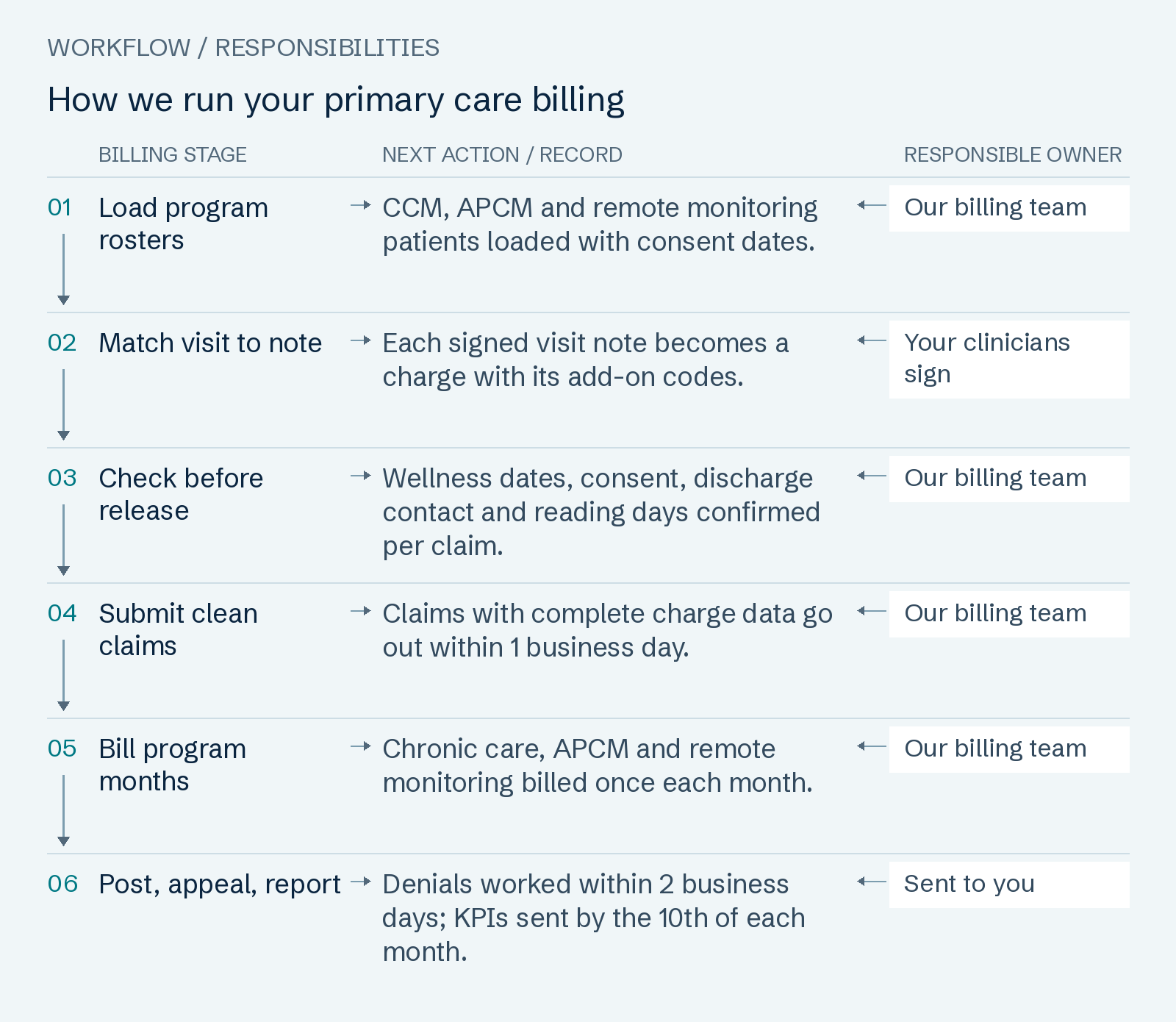
Read the workflow as text
- Load program rosters — CCM, APCM and remote monitoring patients loaded with consent dates. Owner: Our billing team.
- Match visit to note — Each signed visit note becomes a charge with its add-on codes. Owner: Your clinicians sign.
- Check before release — Wellness dates, consent, discharge contact and reading days confirmed per claim. Owner: Our billing team.
- Submit clean claims — Claims with complete charge data go out within 1 business day. Owner: Our billing team.
- Bill program months — Chronic care, APCM and remote monitoring billed once each month. Owner: Our billing team.
- Post, appeal, report — Denials worked within 2 business days; KPIs sent by the 10th of each month. Owner: Sent to you.
Where primary care practices lose revenue, and what we do about it
Primary care claims are small and frequent, so one missed rule repeats on every visit and program month. We run these checks before each claim goes out.
Office and wellness visits
- G2211 stripped from modifier-25 visits. We compare the documented visit and preventive service with the payer's add-on rules before release.
- Wellness visits billed too early. We confirm the last paid wellness or initial preventive visit date before submitting the next wellness claim.
Monthly care-management claims
- CCM months without consent. We match the monthly roster to consent and staff-time records before billing chronic care management.
- Transitional care with dates that don't line up. We reconcile discharge, contact and follow-up dates before the transitional-care claim is released.
- Remote monitoring periods billed twice or short. We check the monitoring period, reading days and time records before billing, and query an overlapping or incomplete period.
Internal medicine panels with Medicare Advantage patients
For Medicare Advantage patients, we match documented conditions to claim diagnoses and ask the clinician about gaps between the note and claim. Your clinician retains the assessment and approves every code change.
Want to know which of your open claims face a filing deadline first? The Free A/R Deadline Map sorts the ones over 90 days for you. Clock starts with your claim-level aging export and signed BAA; above 10 requests in a week, we confirm your date within 1 business day.
What our primary care billing costs
Family medicine, internal medicine and general practice groups share one row of our rate card with pediatrics and urgent care, priced by how many clinicians bill. Your fee is a percentage of insurance payments posted on claims we submitted or worked, net of payer recoupments and refunds. We take 0% of patient payments, copays and anything your front desk collects. Not in the fee base: patient payments, copays, capitation, incentive or grant payments, and payments on claims we never submitted or worked. Setup is $0. Invoices 1–3: only percentage fees on that month's insurance payments, plus any statements or add-ons you order. Percentage fees and mailed statements are capped at 9.0% of that month's insurance payments; from invoice 4, the $400 minimum applies even in a month when the cap comes to less. Groups of 16 or more clinicians can ask for a written quote, and the full medical billing rate card lists every add-on.
| Clinicians who bill | Primary care rate |
|---|---|
| 1 clinician | 6.5% of insurance payments |
| 2–5 clinicians | 6.0% of insurance payments |
| 6–15 clinicians | 5.5% of insurance payments |
| 16 or more clinicians | Pricing is by written quote. |
How we start, whether you bill in-house or use another company
A primary care handover puts two things at risk: old claims near their filing limits, and care-management months nobody bills mid-handover. We start with six things from you:
- The signed agreement and business associate agreement (BAA).
- Logins to your practice-management system and clearinghouse, with read access to signed notes.
- A claim-level aging export, so we sort open claims by deadline on day one.
- Your CCM, APCM and remote monitoring patient lists, with consent dates.
- How your practice hears about hospital discharges, so transitional care dates are caught.
- A 45-minute kickoff call with your practice manager.
Go-live, when your first claims go out, comes within 5 business days of access; any unbilled backlog follows within 10 business days of access. Clock starts with your signed agreement, signed BAA and working system logins; it extends day for day while we wait on access. Every inherited claim within 30 days of a filing, corrected-claim or appeal deadline is worked within 5 business days of access. Starts at access; covers up to 250 claims (more gets a day-1 deadline schedule); worked means submitted, corrected, appealed or returned with the fix.
Our guide to switching billing companies names the files to request before you give notice.
Monthly reporting, service standards and our guarantees
- On-Our-Watch Guarantee: If a claim misses a filing, corrected-claim or appeal deadline while it is on our watch, we pay you what it would have paid. Claims we get complete 10+ business days before the deadline; contracted rate less any copay you collected, paid automatically within 30 days of final denial; capped $10,000/month; your holds excluded.
- Clock-or-Credit Guarantee: From go-live, every new claim goes out within 1 business day of complete charge data, and every denial is worked within 2 business days of posting — or $25 comes off your invoice for each late one. Mon–Fri ET business days by your system's timestamps; worked: resubmitted, appealed or returned with the fix; auto-credited; capped at monthly fee; clearinghouse outages excluded.
We track filing deadlines by plan and product line so a commercial claim does not inherit a Medicare deadline from the payer name alone.
Service standards you can audit in your own system
Each standard is a timestamp you can check, not a results claim. The monthly report defines every KPI in writing and splits results by clinician and by program. Denials run through our denial management service.
We publish client results only with written permission. Until we have them, judge us by the guarantees and the free Deadline Map.
| Standard | Our commitment | Where primary care tests it |
|---|---|---|
| Claim submission | Within 1 business day of complete charge data | An unsigned visit note holds the charge until it is signed |
| Denial work | Within 2 business days of posting | Wellness-frequency and care-management consent denials |
| Payment posting | Within 2 business days of the remittance | Visit, add-on and program lines posted line by line |
| Email replies | Within 1 business day | Questions about a note, a consent date or a discharge |
| Monthly report | By the 10th of each month, with written definitions | Split by clinician and by program |
Your systems, new NPs and PAs, and data access
We work inside your existing practice-management system and clearinghouse; tell us which ones and we confirm in writing within 1 business day. Our EHR and practice-management page lists the access we need. We sign a BAA before we see patient data.
New nurse practitioners and physician assistants are covered by New-Clinician Enrollment: Clinicians who join while you're a client get enrollment filed with up to 5 payers each (the payer decides), with no per-payer fee. For clinicians already on staff, Credentialing & Payer Enrollment is $149 per payer. Billed only after the payer confirms your effective date; $0 if denied or panel closed; filed within 5 business days of your complete packet.
Common questions
- How much do your primary care billing services cost?
- We charge a share of insurance payments: 6.5% for 1 clinician, 6.0% for 2–5 clinicians and 5.5% for 6–15 clinicians. Patient payments carry 0%, and setup is $0. The minimum, cap and add-ons are on our pricing page.
- How should we choose a primary care billing company?
- Ask each company to put in writing how it handles G2211 on modifier-25 visits, how it keeps program months from being missed, what it charges, and who pays when a claim misses its filing limit. Compare contract terms with our billing company checklist.
- Do we have to sign a long-term contract?
- No. Leave with 30 days' notice and no termination fee. Want a run-out? We keep working the claims we submitted for 90 days at your plan rate. Decline it and we charge nothing on payments that post after you leave. Notice by email; optional run-out covers claims we submitted before your exit date, at your plan rate; handover file within 10 business days of exit.
- How soon can our practice switch its billing to you?
- Go-live, when your first claims go out, comes within 5 business days of access; any unbilled backlog follows within 10 business days of access. Clock starts with your signed agreement, signed BAA and working system logins; it extends day for day while we wait on access. What we need from you is listed under how we start.
- Do you bill our CCM, TCM and remote monitoring months?
- Yes. We bill chronic care and APCM monthly from your enrolled-patient list for months with consent and minutes or level on file, transitional care once the dates line up, and remote monitoring by reading days in each 30-day period.
- Can you handle an internal medicine panel with many Medicare Advantage patients?
- Yes, at the primary care rate. For Medicare Advantage patients we match each chronic condition the note assesses to a diagnosis code on the claim, and we ask the clinician about any gap between the note and the claim.
- Which EHR and practice-management systems do you work in?
- We work inside your existing practice-management system and clearinghouse; tell us which ones and we confirm in writing within 1 business day. Our EHR compatibility page lists the logins and clearinghouse access we ask for.
- Can you enroll a new nurse practitioner or physician assistant with our payers?
- Yes. An NP or PA who joins while you are a client is enrolled under New-Clinician Enrollment; its terms, and the per-payer fee for clinicians already on staff, are under systems and credentialing; our provider enrollment service handles the payer applications.
Sources and review
Page revised October 7, 2026 · Review contact: Hyder Shah (inquiries@claimpillar.com). The workflow checklists are editorial recommendations; payer requirements depend on the program and current policy.
- CMS: Evaluation and Management Services, MLN006764 (May 2026)
- CMS: Annual Wellness Visit (Medicare Learning Network)
- CMS: Chronic Care Management Services, MLN909188 (June 2025)
- CMS: Transitional Care Management Services, MLN908628 (August 2025)
- Humana: Claim submissions and time frames
- CMS: Telehealth & Remote Monitoring, MLN901705 (December 2025)
- CMS: Medicare Managed Care Manual, Chapter 7, Risk Adjustment (Rev. 118, 2014)