What do medical billing services cost a practice, and why isn't the headline rate your bill?
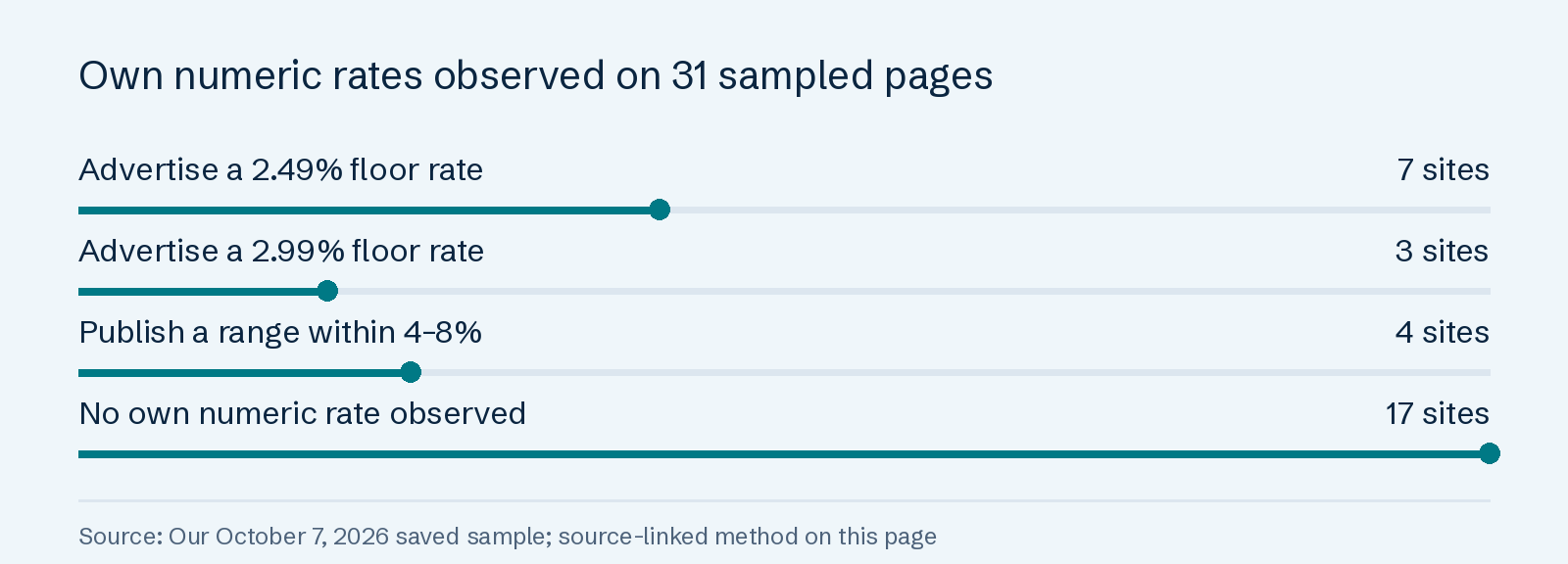
Our October 7, 2026 research record contains 31 sampled pricing, FAQ, cost or home pages. Fourteen recorded an own numeric billing rate: seven starting at 2.49%, three starting at 2.99%, and four ranges within 4–8%. Seventeen recorded no own numeric percentage on the page inspected. This is a purposive historical sample, not a market-wide rate survey or a check of every page on each website. The sample and coding method identify all 31 sources.
The spread is real money: on $50,000 of monthly collections, 4% and 8% are $2,000 a month, or $24,000 a year, apart before any extras.
Why a 2.49% rate is a floor, not your quote
A rate written as "as low as" or "starting at" is the company's best case. The saved BillingParadise observation says its rate depends on specialty, claim volume and payer mix. Ask each bidder for the rate that applies to your specialty, your monthly collections and the work you want covered. These historical observations are not current quotes. Confirm the rate and its conditions directly with the company.
| Historical observation | Sampled pages (of 31) | Recorded figures | What still needs a quote |
|---|---|---|---|
| A floor rate: "as low as" / "starting at" 2.49% | 7 | 2.49% of collections | The rate for your specialty and volume; minimums; what counts as collections |
| A floor rate: "from" / "starting at" 2.99% | 3 | 2.99% of collections | Which practices qualify for the starting rate |
| A range | 4 | 4–7%, 4–8%, 4–8%, 5–6% (one with a $950 monthly floor) | Where your practice sits inside the range |
| No own numeric percentage observed | 17 | No numeric own billing rate recorded on the sampled page | Other pages and private proposals were not exhaustively checked |
How was the historical pricing sample assembled?
This appendix exposes the historical records behind the chart; it does not update their prices to today. The sample was selected from billing-provider research and price-focused discovery, using one pricing, FAQ, cost or home page per domain. It was not random, exhaustive or weighted by provider size. Pages describing an industry range, a software price, a performance percentage or a fee without a numeric percentage did not count as an own numeric billing rate.
- Inspect the selected page for an explicit numeric percentage describing that company’s billing fee.
- Code “from”, “starting at” and “as low as” rates as starting-rate observations; code an explicit interval as a range.
- Count each domain once. When no own numeric percentage was recorded on the inspected page, use the no-rate-observed category without claiming the whole company has no published price.
- Keep the observation date separate from this article’s revision date. Independent follow-up confirmed 13 numeric-rate pages; MedStates used the writer’s saved extraction after that follow-up received an access denial.
The saved records support seven 2.49% starting rates, three 2.99% starting rates, four numeric ranges and 17 pages without an observed own numeric percentage. The rows below reproduce those classifications; provider claims and service performance were not independently audited.
Inspect the 31 historical source pages and classifications
| Sampled source page | Observation date | Coding category | Recorded rate observation | Limit |
|---|---|---|---|---|
| gomedicalbilling.com | 2026-10-07 | 2.49% starting-rate group | 2.49% starting rate | Saved October 7 observation; current terms may differ. |
| bellmedex.com | 2026-10-07 | 2.49% starting-rate group | 2.49% starting rate | Saved October 7 observation; current terms may differ. |
| medlifembs.com | 2026-10-07 | 2.49% starting-rate group | 2.49% starting rate | Saved October 7 observation; current terms may differ. |
| providerscarebilling.com | 2026-10-07 | 2.49% starting-rate group | 2.49% starting rate | Saved October 7 observation; current terms may differ. |
| smartrcmbilling.us | 2026-10-07 | 2.49% starting-rate group | 2.49% starting rate | Saved October 7 observation; current terms may differ. |
| docscare.org | 2026-10-07 | 2.49% starting-rate group | 2.49% starting rate | Saved October 7 observation; current terms may differ. |
| prombs.com | 2026-10-07 | 2.49% starting-rate group | 2.49% starting rate | Saved October 7 observation; current terms may differ. |
| billingparadise.com | 2026-10-07 | 2.99% starting-rate group | 2.99% starting rate | Saved October 7 observation; current terms may differ. |
| medsolercm.com | 2026-10-07 | 2.99% starting-rate group | 2.99% starting rate | Saved October 7 observation; current terms may differ. |
| medstates.com | 2026-10-07 | 2.99% starting-rate group | 2.99% starting rate | Saved writer extraction; the independent re-fetch returned 403. |
| swiftmds.com | 2026-10-07 | Published numeric range | 4–7% of monthly net collections | Saved October 7 observation; current terms may differ. |
| imagnumhealthcare.com | 2026-10-07 | Published numeric range | 4–8% of revenue acquired | Saved October 7 observation; current terms may differ. |
| nexacc.com | 2026-10-07 | Published numeric range | 5–6% of collected payments; $950 monthly floor | Saved October 7 observation; current terms may differ. |
| 247medicalbillingservices.com | 2026-10-07 | Published numeric range | 4–8% of collected payments | Saved October 7 observation; current terms may differ. |
| therathink.com | 2026-10-07 | No numeric own rate observed | Percentage of allowed amount; percentage not stated | Saved October 7 observation; current terms may differ. |
| medicalbillersandcoders.com | 2026-10-07 | No numeric own rate observed | No numeric own billing rate recorded on this page | No-rate category applies to the sampled page, not the whole website or a private quote. |
| medcaremso.com | 2026-10-07 | No numeric own rate observed | No numeric own billing rate recorded on this page | No-rate category applies to the sampled page, not the whole website or a private quote. |
| drcatalyst.com | 2026-10-07 | No numeric own rate observed | No numeric own billing rate recorded on this page | No-rate category applies to the sampled page, not the whole website or a private quote. |
| mbwrcm.com | 2026-10-07 | No numeric own rate observed | No numeric own billing rate recorded on this page | No-rate category applies to the sampled page, not the whole website or a private quote. |
| credexhealthcare.com | 2026-10-07 | No numeric own rate observed | No numeric own billing rate recorded on this page | No-rate category applies to the sampled page, not the whole website or a private quote. |
| plutushealthinc.com | 2026-10-07 | No numeric own rate observed | No numeric own billing rate recorded on this page | No-rate category applies to the sampled page, not the whole website or a private quote. |
| medibillmd.com | 2026-10-07 | No numeric own rate observed | No numeric own billing rate recorded on this page | No-rate category applies to the sampled page, not the whole website or a private quote. |
| medusarcm.com | 2026-10-07 | No numeric own rate observed | No numeric own billing rate recorded on this page | No-rate category applies to the sampled page, not the whole website or a private quote. |
| physicianpracticespecialists.com | 2026-10-07 | No numeric own rate observed | No numeric own billing rate recorded on this page | No-rate category applies to the sampled page, not the whole website or a private quote. |
| practolytics.com | 2026-10-07 | No numeric own rate observed | No numeric own billing rate recorded on this page | No-rate category applies to the sampled page, not the whole website or a private quote. |
| cpamedicalbilling.com | 2026-10-07 | No numeric own rate observed | No numeric own billing rate recorded on this page | No-rate category applies to the sampled page, not the whole website or a private quote. |
| outsourcestrategies.com | 2026-10-07 | No numeric own rate observed | No numeric own billing rate recorded on this page | No-rate category applies to the sampled page, not the whole website or a private quote. |
| p3care.com | 2026-10-07 | No numeric own rate observed | No numeric own billing rate recorded on this page | No-rate category applies to the sampled page, not the whole website or a private quote. |
| rightmedicalbilling.com | 2026-10-07 | No numeric own rate observed | No numeric own billing rate recorded on this page | No-rate category applies to the sampled page, not the whole website or a private quote. |
| larsenbilling.com | 2026-10-07 | No numeric own rate observed | No numeric own billing rate recorded on this page | No-rate category applies to the sampled page, not the whole website or a private quote. |
| carecloud.com | 2026-10-07 | No numeric own rate observed | No numeric own billing rate recorded on this page | No-rate category applies to the sampled page, not the whole website or a private quote. |
How do you work out what your practice would actually pay?
Your real fee depends on four numbers in your practice-management system: twelve months of insurance payments, twelve months of patient payments, your monthly claim count, and your 90+ A/R bucket (balances older than 90 days). The payments set the fee base, the claim count prices a per-claim quote, and aged A/R decides whether old claims become a separate project.
The fee base is the set of payments a percentage is taken on. Published offers call it "collections", "net collections" or "revenue"; one therapy-billing FAQ in our historical sample described a percentage of the allowed amount on each paid claim, plus a monthly fee per tax ID and rendering NPI; it defines the allowed amount as the patient's share plus the insurance payment. "Collections", "net collections" and "revenue" do not say whether copays are inside the base. Example: a practice receives $30,000 of insurance payments and $6,000 of patient payments in a month. A 7% fee on total collections is 7% × $36,000 = $2,520; 7% of insurance payments only is 7% × $30,000 = $2,100. Same rate: $420 a month apart, or $5,040 a year.
Refunds, recoupments and balances from before the switch
Ask how it treats payer recoupments and refunds (a fee on money taken back should be credited), payments on claims your previous biller submitted, and capitation or incentive payments. Get each answer in the agreement, and settle who works which open claims with our guide to handing off open claims when you switch.
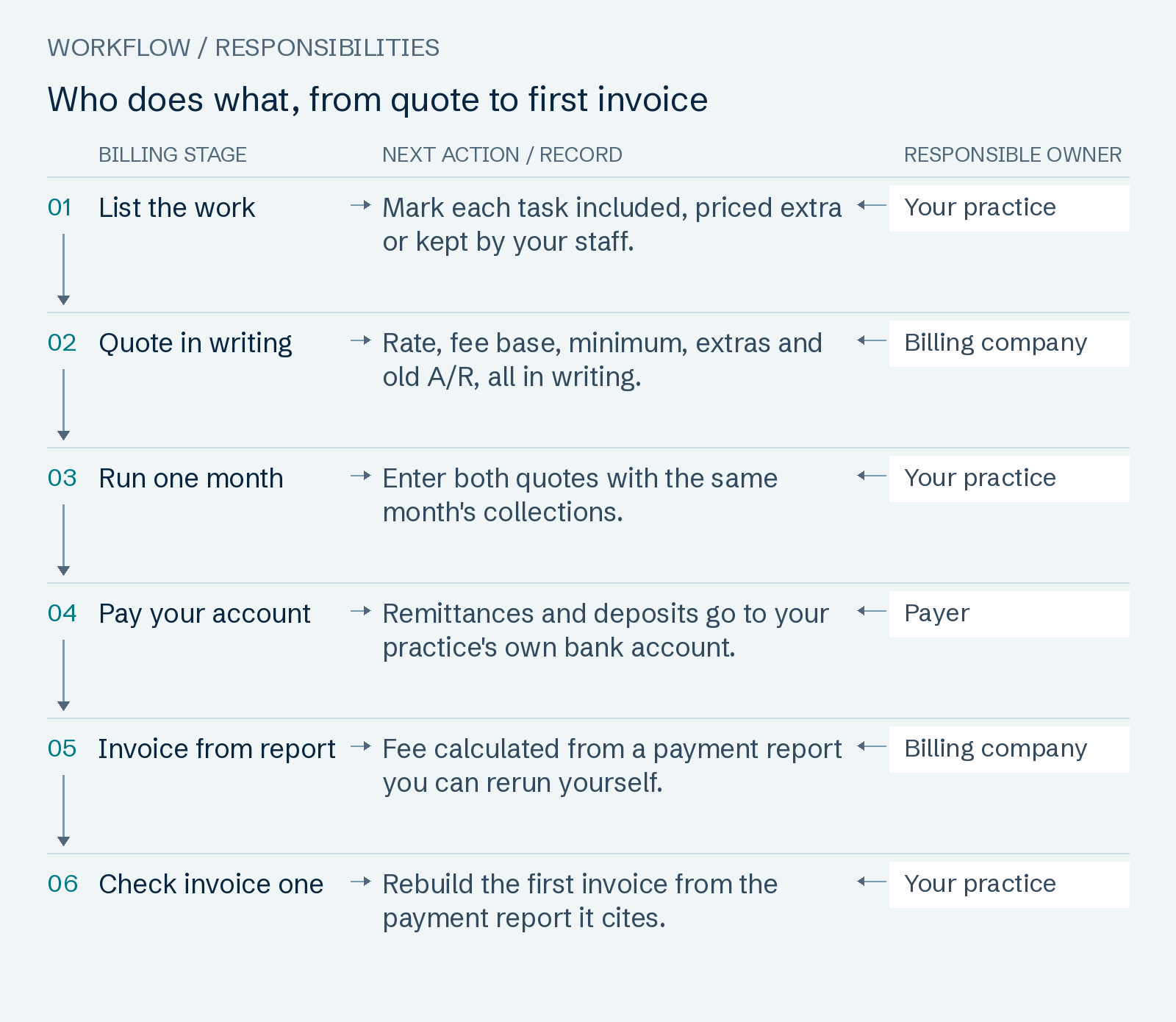
Read the workflow as text
- List the work — Mark each task included, priced extra or kept by your staff. Owner: Your practice.
- Quote in writing — Rate, fee base, minimum, extras and old A/R, all in writing. Owner: Billing company.
- Run one month — Enter both quotes with the same month's collections. Owner: Your practice.
- Pay your account — Remittances and deposits go to your practice's own bank account. Owner: Payer.
- Invoice from report — Fee calculated from a payment report you can rerun yourself. Owner: Billing company.
- Check invoice one — Rebuild the first invoice from the payment report it cites. Owner: Your practice.
Which pricing model fits your practice: percentage, minimum, flat fee or in-house?
Your pricing model decides which months cost you most. A percentage of collections rises and falls with what payers pay; a monthly minimum replaces it in a slow month; per-claim, hourly and flat fees stay the same when payments drop, so your practice carries a bad month.
What a monthly minimum does in a small month
The saved NexAcc observation describes 5–6% of collections or $950 a month, whichever is higher. Example: at 5% on a $10,000 month, the percentage fee is $500, but the floor applies, so the invoice is $950, or 9.5% of that month's collections. Divide any minimum by the rate to find where it takes over: $950 ÷ 5% = $19,000 a month.
What one in-house biller costs by comparison
The median annual wage for billing and posting clerks was $48,500 in May 2025 (BLS Occupational Outlook Handbook). Benefits were 30.0% of private-industry employer compensation costs in June 2026 (BLS Employer Costs for Employee Compensation). If the wage is the other 70.0%, the total is $48,500 ÷ 0.700 = $69,285.71 a year, about $5,774 a month, before software, the clearinghouse and cover for absences. Whether to outsource at all depends on more than price; our in-house vs outsourced billing decision guide works through the break-even.
| Option | What it costs (published example) | Who does the work | What can go wrong |
|---|---|---|---|
| Percentage of collections | 2.49% floors to 4–8% ranges | The billing company works claims; your front desk still collects copays | The fee base is left undefined; a floor rate is not your rate |
| Percentage with a monthly minimum | 5–6% or $950 a month, whichever is higher | The billing company | In a slow month the minimum is a larger share of collections |
| Per-claim fee | None of the 14 published rates is per claim | The billing company | The fee does not fall when a claim pays less |
| Hourly staff | $12 an hour for named staff on set hours; $7 an hour for A/R work | Billing-company staff your practice directs | You pay for hours, not results, and supervise the output |
| Flat monthly fee | Quoted per practice; no figure published | The billing company | You pay the same in a slow month |
| In-house biller | $48,500 median wage (May 2025); about $5,774 a month with benefits | Your employee, on your software | Salary is due whether claims pay; cover for leave and turnover |
What should you ask each billing company before you compare quotes?
Ask every bidder the same questions in writing. Setup, mailed statements, payer enrollment, software and old claims can each sit outside the percentage; the saved observations for at least six of the 14 numeric-rate pages advertised no setup fee. Confirm that term in the current quote.
- Is the fee base insurance payments only, or copays and patient balances too?
- Is there a monthly minimum, and below what collections does it apply?
- Which charges sit outside the percentage?
- How is old A/R priced, and which claims are worked first?
- Do payer payments go straight to your practice's own bank account?
- Will anyone change a code without your clinician's documentation and sign-off?
- Can you rebuild each invoice from a payment report in your own system?
- What are the notice period, termination fee and data export when you leave?
Contract terms beyond price are in our questions to ask any billing company before you sign.
Old A/R: priced separately or inside the rate
Medicare generally allows 12 months, or 1 calendar year, after the date of service to file a claim (CMS claims manual, ch. 1, §70); Cigna lists 90 days after the date of service for participating providers on claims sent directly to it, unless applicable law or the provider agreement allows longer (Cigna claim submission page). The saved BillingParadise price-list observation records 5% of what it collects on A/R aged 61–90 days and 7% on A/R aged 91–120 days; it is a historical example, not a current offer. Once a claim passes its payer's timely filing limit, no fee rate gets it filed on time, so ask for the list of claims a bidder will work first.
Can a billing company take a percentage of your Medicare and Medicaid payments?
Not while it receives those payments. Medicare may pay a billing agent only if its compensation "is not related in any way to the dollar amounts billed or collected" (42 CFR 424.73(b)(3); for physicians and suppliers, 42 CFR 424.80(b)(5)), and CMS says those conditions do not apply if the agent "merely prepares bills for the provider and does not receive and negotiate the checks" (Claims Processing Manual, ch. 1, §30.2.4). Federal Medicaid rules require each state plan to apply the same limit to a business agent that receives payments (42 CFR 447.10(f)), and HHS-OIG has a "longstanding concern that percentage billing arrangements may increase the risk of upcoding" (OIG guidance for third-party billing companies, 1998). State rules can add conditions, so have counsel read the agreement.
| Charge | How bidders price it | Question to ask |
|---|---|---|
| Setup or onboarding | Often advertised as $0; otherwise a one-time fee | Is there any charge before the first invoice? |
| Monthly minimum | A floor that replaces the percentage when higher | Below what monthly collections does the minimum apply? |
| Patient statements | Included, per statement or a monthly fee | Who pays postage, and per statement or per month? |
| Credentialing and payer enrollment | Per payer, per provider or a package | Is the fee due before or after the payer approves? |
| Old A/R from the previous biller | Same rate, a higher rate by age, hourly or excluded | Which claims are in scope, and at what rate? |
| Software and clearinghouse | Paid by the practice or bundled | Whose subscription is it, and who keeps the data? |
Is 6% of collections the same price as 6% of insurance payments?
No. A rate on total collections also applies to patient payments, so convert it before comparing: equivalent rate on insurance payments = quoted rate ÷ (insurance payments ÷ total collections). Example: a practice collects $40,000 in a month, $32,000 from payers and $8,000 from patients. A 6% quote on total collections costs 6% × $40,000 = $2,400; spread over the $32,000 of insurance payments, that is $2,400 ÷ $32,000 = 7.5%. The more of each visit your patients pay, the wider the gap.
- Pull twelve months of payments, split into insurance payments and patient payments.
- Divide insurance payments by total collections to get your insurance share.
- Divide each bidder's rate on total collections by that share.
- Use the calculator below for percentage fees and monthly extras; check each bidder's minimum separately.
The table applies the formula at three example patient shares.
| Example mix of collections | 4% of total collections equals | 6% of total collections equals | 8% of total collections equals |
|---|---|---|---|
| 10% patient, 90% insurance | 4.44% | 6.67% | 8.89% |
| 20% patient, 80% insurance | 5.00% | 7.50% | 10.00% |
| 30% patient, 70% insurance | 5.71% | 8.57% | 11.43% |
How do two billing quotes compare in a slow month and a busy month?
The calculator sets a percentage quote beside a flat monthly quote for one month: collections × percentage ÷ 100 + extras, against flat fee + extras. Your figures stay in your browser.
Run it twice, once with a slow month and once with a busy month, because minimums and flat fees change the gap. The calculator does not apply minimums. For a quote with a minimum, separately calculate collections × percentage ÷ 100, take the higher of that fee and the minimum, then add monthly extras. Keep one-time charges, such as setup, outside the result. It compares fees only, not how fast either company works claims.
This calculator also sits with our other free billing calculators, each with its method shown.
When should you hand off billing, and what would our team charge?
Hand off billing when an outside fee comes in at or below what your practice spends now, or when nobody on staff has time to work denials and aged A/R. We publish our rate instead of a floor: 5.0% to 8.5% of insurance payments, set by specialty and practice size, with 0% of patient payments and $0 setup. Every payment goes straight to your practice's own bank account. We never receive, deposit or endorse your payments; we invoice you once a month. Minimum: Invoices 1–3: only percentage fees on that month's insurance payments, plus any statements or add-ons you order; the $400 minimum starts with invoice 4. Contract: Month to month. Leave with 30 days' written notice. No termination fee. Not included: Your EHR or practice-management subscription and clearinghouse fees (paid to those vendors), any application fee a payer or state charges, mailed patient statements at $0.95 each, and collection-agency, attorney or court costs. Every rate is on our rate card by specialty and practice size.
If your A/R has already aged, start before any quote. The Free A/R Deadline Map: A claim-by-claim list of every unpaid insurance claim over 90 days in the aging report you send: payer, amount, the deadline it faces, the denial reason and the next action, sorted by deadline. Clock starts with your claim-level aging export and signed BAA; above 10 requests in a week, we confirm your date within 1 business day.
Common questions
- What does medical billing cost a practice each month?
- At an illustrative 4–8% fee, a practice collecting $50,000 a month would pay $2,000–$4,000 before minimums or extras. Those rates fall within the ranges recorded in our historical sample, but they are not a market average or your quote. Check the fee base, minimum, setup, statements and old-A/R charges.
- Is a percentage of collections or a per-claim fee cheaper for our practice?
- Divide monthly collections by monthly claims for your average paid amount per claim. Example: at $100 a claim, a $5 per-claim fee equals 5% of collections; at $400 a claim it equals 1.25%. A per-claim fee does not fall when payers pay less.
- Will we pay the billing percentage on copays and patient payments?
- Only if the fee base includes them. A fee on total collections covers copays and patient balances; a fee on insurance payments does not. At 7%, $6,000 of monthly patient payments adds $420 a month. Get the fee base in writing.
- What do setup fees and monthly minimums cover?
- A setup fee is a one-time charge before the first invoice; ask what it includes and whether it applies to your practice. A monthly minimum replaces the percentage when it is higher: at an illustrative 5% with a $950 floor, it takes over below $19,000 of monthly collections.
- Can a billing company take a percentage of our Medicare and Medicaid payments?
- Not while it receives those payments. Medicare pays a billing agent only if its pay is not tied to the amounts billed or collected (42 CFR 424.73(b)(3)), and federal Medicaid rules require state plans to apply the same limit (42 CFR 447.10(f)). Keep payments flowing to your own account.
- Is an in-house biller cheaper than outsourcing for our practice?
- One billing and posting clerk at the May 2025 median wage of $48,500 costs about $4,042 a month, or about $5,774 with benefits at the June 2026 private-industry share. At 4–8%, an outside fee reaches $5,774 between about $72,000 and $144,000 of monthly collections.
- Should old A/R be included in the billing fee?
- Old claims can be billed at the ongoing rate, at a higher rate by age, hourly, or left out; get the choice in writing. Check each claim in scope against its payer's filing deadline first, because a claim past it can no longer be filed on time.
- How do I compare two billing quotes?
- Put both on the same fee base and month: divide any rate on total collections by your insurance share, then run a slow month and a busy month in the quote calculator above. Check minimums separately: take the higher of the percentage fee and the minimum, then add monthly extras.
Sources and review
Page revised October 8, 2026 · Review contact: Hyder Shah (inquiries@claimpillar.com). Rate observations are historical records from October 7, 2026; all 31 sampled pages and coding rules are listed in the method section. This October 8 revision adds provenance and limits without claiming a fresh rate survey or re-verification of every regulatory and labor-data citation below.
- 42 CFR 424.73: payment to a billing agent (Medicare, eCFR)
- 42 CFR 424.80: billing agents for physicians and suppliers (Medicare, eCFR)
- CMS Medicare Claims Processing Manual, Chapter 1 (§30.2.4, §70)
- 42 CFR 447.10: business agents (Medicaid, eCFR)
- HHS-OIG Compliance Program Guidance for Third-Party Medical Billing Companies (1998)
- BLS Occupational Outlook Handbook: Financial Clerks (billing and posting clerks wage, May 2025)
- BLS Employer Costs for Employee Compensation, June 2026 (released September 9, 2026)
- Cigna Healthcare: submitting claims and timely filing (providers)
Correction notes
- : Published the 31 source-page classifications and sampling method. Replaced market-wide and all-source freshness wording with the actual historical scope: one selected page per domain, including a disclosed saved-source exception.