Urgent care billing we handle for your clinic
Our urgent care billing service is built for independent urgent care centers and walk-in clinics that run point-of-care tests and X-ray on site and see work injuries alongside walk-in illness. We take each visit from the signed note to the posted payment, for every site and every rendering clinician, including per-diem staff. We check every code against your clinician's documentation and never change a code without the clinician's sign-off.
Clinics hand off billing when:
- the biller who knew each payer's urgent care format leaves;
- rapid test lines keep rejecting;
- a new site opens with no one to set up its billing;
- work-injury visits sit in health-plan A/R.
Chronic-care follow-ups are billed as our family practice medical billing service bills them. Hospital facility claims are outside our scope.
| Task | What we do | What your clinic keeps |
|---|---|---|
| Site and payer setup | Record each site's POS and CLIA number, and each payer's urgent care visit format. | Your payer contracts and CLIA certificates |
| Visit and procedure coding | Check visit level, modifier 25 and laceration, splint and drainage codes against the note. | Final say on every code |
| Injections and drugs | Bill the injection with the drug and units given. | Drug and dose documentation |
| Waived rapid tests | Add QW where the test needs it and the testing site's CLIA number. | The test menu at each site |
| Workers' comp visits | Send job injuries to the comp carrier first and follow them to payment. | The work-injury question at check-in |
| Claims, denials and A/R | Submit within 1 business day, work denials within 2 business days, follow every open insurance balance. | Encounter sign-off by the clinician |
| Posting and patient balances | Post each remittance within 2 business days; calculate patient balances and send statements in your clinic's name. | Copays and self-pay fees collected at the front desk |
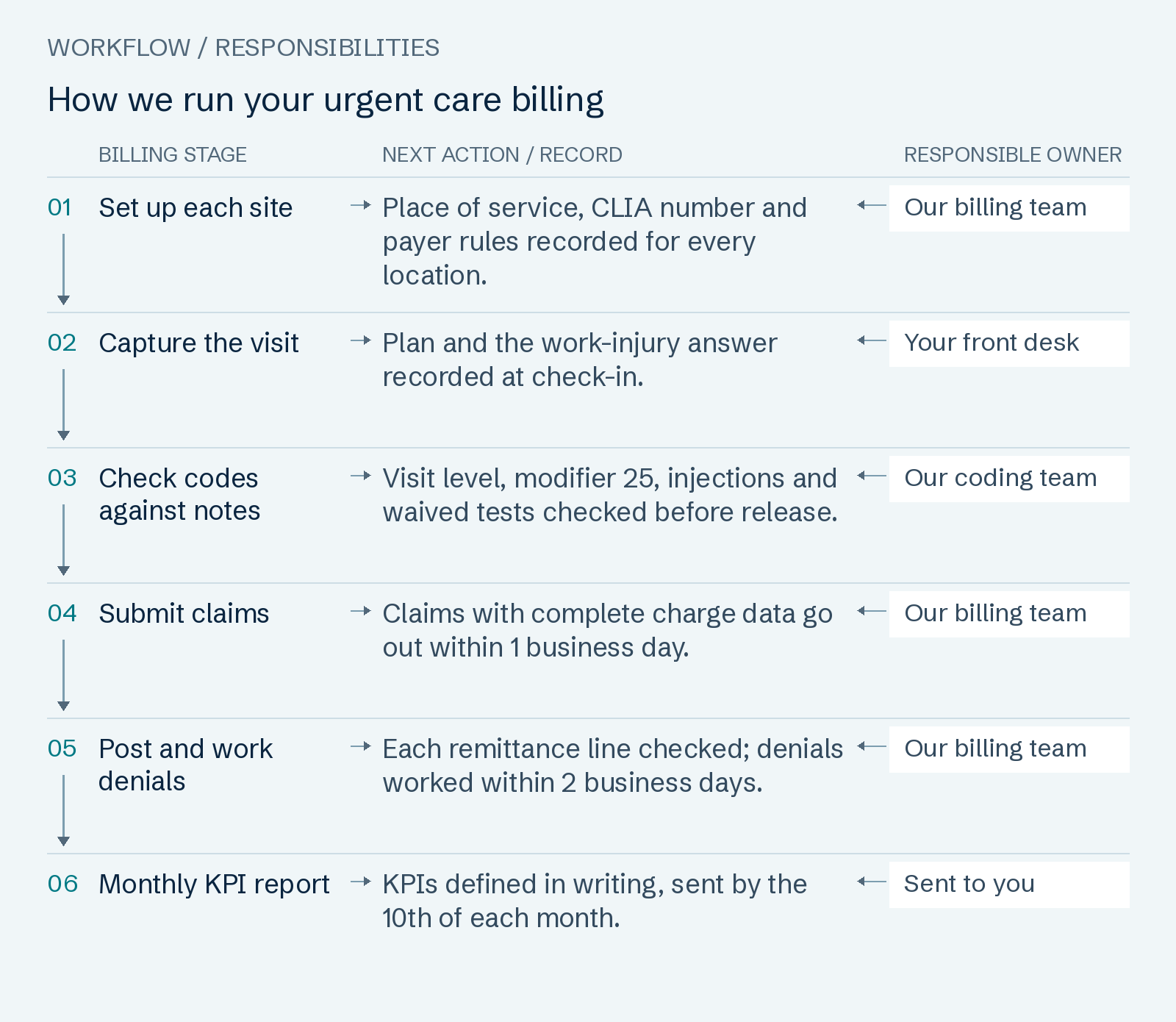
Read the workflow as text
- Set up each site — POS, CLIA number and each payer's visit format recorded per location. Owner: Our billing team.
- Capture the visit — Coverage, self-pay status and the work-injury answer taken at check-in. Owner: Your front desk.
- Check codes against notes — Visit level, modifier 25, injections and waived tests checked before release. Owner: Our coding team.
- Submit claims — Claims with complete charge data go out within 1 business day. Owner: Our billing team.
- Post and work denials — Each remittance line checked; denials worked within 2 business days. Owner: Our billing team.
- Monthly KPI report — KPIs defined in writing, sent by the 10th of each month. Owner: Sent to you.
How we bill your E/M visits, procedures and modifier 25
An urgent care claim is a stack of lines, a visit plus each procedure, injection, X-ray, test and drug, and each line pays or denies on its own. We pick the visit level from the documentation, and the clinician signs off on any change. Our guide to choosing a visit level such as 99213 shows how independent practices make that call.
Modifier 25 when the note supports it
Medicare pays a visit on the same day as a procedure with a global period only when the note shows a significant, separately identifiable service beyond the usual work of the procedure, and a different diagnosis is not required (Claims Processing Manual ch. 12, §30.6.6.B). We add modifier 25 to a laceration or splint day only when the documentation supports it.
Injection-only visits
Medicare does not pay 99211 when it is billed with a drug administration service, including a therapeutic or diagnostic injection code; a significant, separately identifiable visit above 99211 is billed at its own level with modifier 25 (ch. 12, §30.6.7). A nurse-only injection visit gets the injection and drug lines only. Rapid tests that CMS lists with modifier QW need it to be recognized as waived, and Medicare edits lab claims against the testing site's CLIA certificate (CMS transmittal 13465), so we match each site's test menu to its certificate at setup.
S9083 and S9088: how we bill each of your payers
S9083 is a HCPCS global fee code for urgent care centers, and S9088 is an add-on that flags a service given in an urgent care center. Payment depends on the payer, so we record each payer's written position at setup and bill to match. The table shows policies we checked on 2026-11-05; your contract can override them, so we read it first.
A system that adds S9083 to every visit leaves an unpaid line on each claim to a plan that refuses it, so we turn that default off for those payers.
| Payer and plans | Position on S9083 and S9088 | How we bill your visits | Source, retrieved |
|---|---|---|---|
| Medicare | Both codes have status I, not valid for Medicare, in the 2026 physician fee schedule file | Itemized E/M and procedure lines with POS 20 | CMS CY 2026 PFS relative value file (RVU26D), 2026-11-05 |
| UnitedHealthcare Commercial and Individual Exchange | Does not reimburse either code | Itemized E/M and procedure lines plus a POS code | UnitedHealthcare policy 2026R0108A, 2026-11-05 |
| Premera Blue Cross and LifeWise | Informational only; not paid alone or with other services, unless a contract says otherwise | Itemized CPT or HCPCS lines with POS 20 | Premera payment policy CP.PP.369.v2.1 (approved 11/04/25), 2026-11-05 |
| Ambetter from MHS Indiana | Reimbursable from 08/01/2026 only with POS 20; other POS denied | S9083 or S9088 per the notice, always with POS 20 | Ambetter provider notice dated 05/07/26, 2026-11-05 |
| Any other plan | Set by that plan's policy and your contract | Recorded at setup, rechecked when the plan publishes a change | Your contract and the plan's reimbursement policy |
POS 20 and facility setup for each of your sites
CMS defines POS 20, Urgent Care Facility, as a location distinct from a hospital emergency room, an office or a clinic that treats unscheduled, ambulatory patients seeking immediate care (CMS place of service code set). Medicare pays physician services at POS 20 at the non-facility rate, the same list as the office, POS 11 (ch. 12, §20.4.2). Hospital outpatient departments use POS 19 or 22 instead. We set the POS site by site at onboarding and check each visit against the location where care took place.
Front-desk eligibility checklist for every walk-in
Walk-ins arrive unscheduled, so check-in is the one chance to get the payer right. Our eligibility checks for new patients and changed coverage work from what your front desk records:
- A photo of the front and back of the insurance card, every visit.
- Whether coverage changed since the last visit, and the subscriber's name and date of birth.
- The yes-or-no work-injury question, and for a yes, the employer and the comp carrier or claim number.
- Whether the patient is paying as self-pay, so no claim goes to a plan.
- A copay collected at the desk, recorded against the visit.
Workers' comp and self-pay visits we bill
Work injuries are billed to the comp carrier, not the health plan. For Medicare patients, CMS says workers' compensation pays primary for job-related illness and injury, and Medicare generally will not pay for care that comp covers (CMS Medicare Secondary Payer). We route those claims to the carrier from the check-in answer.
Self-pay visits carry 0% of our fee. Your clinic sets its self-pay prices. A patient not using insurance who asks must get a good faith estimate of expected charges (CMS good faith estimate guide), so your self-pay list should stay current. A group that runs urgent care beside a clinic priced like our chiropractic billing services pays each clinician's segment rate.
Rate card: 6.5% solo, 6.0% for 2–5, 5.5% for 6–15 clinicians
Urgent care clinics sit in the Primary care, pediatrics & urgent care row of our rate card, and the number of clinicians we bill for sets the rate. You pay a percentage of insurance payments and 0% of patient payments, and setup is $0. Per-diem shifts move rosters, so the count is written down: Clinicians are counted on the 1st of each month from the rendering NPIs we billed the month before (for ABA, BCBAs and BCaBAs, not RBTs). Your rate moves with your size band the next month, in either direction.
Illustrative example, not client data: a two-site clinic whose claims last month named 4 full-time and 3 per-diem clinicians as rendering providers counts 7 clinicians. That puts it in the 6–15 clinicians band at 5.5% of insurance payments. If its roster drops to 5 the next month, it moves to the 2–5 clinicians band and 6.0%.
Invoices 1–3: only percentage fees on that month's insurance payments, plus any statements or add-ons you order. Percentage fees and mailed statements are capped at 9.0% of that month's insurance payments; from invoice 4, the $400 minimum applies even in a month when the cap comes to less. See every segment on our medical billing rate card.
| Clinic size (rendering clinicians) | Share of insurance payments | Share of patient payments |
|---|---|---|
| 1 clinician | 6.5% | 0% |
| 2–5 clinicians | 6.0% | 0% |
| 6–15 clinicians | 5.5% | 0% |
| 16 or more clinicians | Pricing is by written quote. | 0% |
Deadline guarantees for your high-volume clinic
A busy night produces many small claims, and each one has a filing deadline. Both guarantees come in writing:
- On-Our-Watch Guarantee. If a claim misses a filing, corrected-claim or appeal deadline while it is on our watch, we pay you what it would have paid. Claims we get complete 10+ business days before the deadline; contracted rate less any copay you collected, paid automatically within 30 days of final denial; capped $10,000/month; your holds excluded.
- Clock-or-Credit Guarantee. From go-live, every new claim goes out within 1 business day of complete charge data, and every denial is worked within 2 business days of posting — or $25 comes off your invoice for each late one. Mon–Fri ET business days by your system's timestamps; worked: resubmitted, appealed or returned with the fix; auto-credited; capped at monthly fee; clearinghouse outages excluded.
Both apply on the terms above. We publish client results only with written permission. Until we have them, judge us by the guarantees and the free Deadline Map. The KPI report arrives by the 10th of each month, and denials run through our denial management workflow.
Every inherited claim within 30 days of a filing, corrected-claim or appeal deadline is worked within 5 business days of access. Starts at access; covers up to 250 claims (more gets a day-1 deadline schedule); worked means submitted, corrected, appealed or returned with the fix. To start, your clinic:
- Signs our service agreement and the BAA.
- Gives us practice-management and clearinghouse logins for each site.
- Sends a claim-level aging export and each site's CLIA certificate.
- Joins one 45-minute kickoff call.
Go-live, when your first claims go out, comes within 5 business days of access; any unbilled backlog follows within 10 business days of access. Clock starts with your signed agreement, signed BAA and working system logins; it extends day for day while we wait on access. See our billing handoff plan. Want to see your exposure first? Get my free A/R Deadline Map: every unpaid claim over 90 days, sorted by its deadline. Clock starts with your claim-level aging export and signed BAA; above 10 requests in a week, we confirm your date within 1 business day.
Common questions
- How much do your urgent care billing services cost?
- Urgent care clinics pay 6.5% (1 clinician), 6.0% (2–5 clinicians) or 5.5% (6–15 clinicians) of insurance payments. Copays and self-pay fees carry 0%, and setup is $0. See urgent care billing pricing on the full rate card for the minimum and the fee cap.
- What is S9083, and will you put it on our claims?
- It is a HCPCS global fee code for urgent care centers. We use it only where a payer's policy or your contract pays it; Medicare, UnitedHealthcare commercial and Premera do not, so they get itemized lines.
- Which POS code goes on our clinic's urgent care claims?
- A freestanding urgent care site uses POS 20, which Medicare pays at the non-facility rate. A hospital-based department uses its hospital outpatient POS instead. We set the code site by site at onboarding.
- Do you bill workers' comp for work-injury visits?
- Yes. When the check-in answer says the injury happened at work, we bill the comp carrier first, not the health plan, and follow the claim to payment.
- Can you handle self-pay pricing for walk-in patients?
- Your clinic sets its self-pay prices, and those payments carry 0% of our fee. Self-pay visits never go out as claims, and we send any balance statement in your clinic's name.
- Do we have to sign a long-term contract?
- No. Leave with 30 days' notice and no termination fee. Want a run-out? We keep working the claims we submitted for 90 days at your plan rate. Decline it and we charge nothing on payments that post after you leave. Notice by email; optional run-out covers claims we submitted before your exit date, at your plan rate; handover file within 10 business days of exit.
- How fast can you start billing for our urgent care sites?
- Go-live, when your first claims go out, comes within 5 business days of access; any unbilled backlog follows within 10 business days of access. Clock starts with your signed agreement, signed BAA and working system logins; it extends day for day while we wait on access. What we need is listed under deadline guarantees.
- Can you credential new clinicians who join our clinic?
- Yes. While you are a client, New-Clinician Enrollment covers new hires: Clinicians who join while you're a client get enrollment filed with up to 5 payers each (the payer decides), with no per-payer fee. Extra payers and new-site enrollments go through Credentialing & Payer Enrollment at $149 per payer. Billed only after the payer confirms your effective date; $0 if denied or panel closed; filed within 5 business days of your complete packet.
Sources and review
Page revised November 5, 2026 · Review contact: Hyder Shah (inquiries@claimpillar.com). The workflow checklists are editorial recommendations; payer requirements depend on the program and current policy.
- UnitedHealthcare: Urgent Care Policy, Professional, Commercial and Individual Exchange, 2026R0108A (retrieved 2026-11-05)
- Premera Blue Cross: Urgent Care Center Services payment policy CP.PP.369.v2.1 (retrieved 2026-11-05)
- Ambetter from MHS Indiana: Update for Procedure Codes S9083 and S9088, effective 8/1/2026 (retrieved 2026-11-05)
- CMS: Medicare Claims Processing Manual, Chapter 12 (POS 20 non-facility rate, modifier 25, 99211 with injections) (retrieved 2026-11-05)
- CMS: Place of Service Code Set (retrieved 2026-11-05)
- CMS CY 2026 PFS relative value file (RVU26D) (retrieved 2026-11-05)
- CMS: Medicare Secondary Payer, workers' compensation pays primary (retrieved 2026-11-05)
- CMS: Transmittal 13465, CR 14273, New Waived Tests (retrieved 2026-11-05)
- CMS: Good faith estimate guide for people not using insurance (retrieved 2026-11-05)