What our payment posting service includes
Payment posting is part of Full-Service Billing, not a separate plan. Our rate card has no posting-only line, so the denials, offsets and short payments that posting turns up are worked by the same team that found them. Posting is one stage of our revenue cycle management services.
Practices hand off posting when remittances sit unposted, deposits stop matching the ledger, or the biller who did it leaves. Each row below is a deliverable you can check.
| Task | Deliverable | Timing | What you keep |
|---|---|---|---|
| ERA and EOB posting | Payments, contractual adjustments and patient share posted to each claim line | Within 2 business days of the remittance | Your practice-management system stays the system of record |
| Patient payments | Posted against the patient balance so the next statement is right | As payments post | Your bank account and front-desk collections |
| Denied and zero-paid lines | Sent to the denial queue with group, reason and remark codes attached | Worked within 2 business days of posting | A copy of every correction and appeal |
| Underpayment check | Payments compared with your contracted rates; underpaid lines appealed | Month 3, covering your first 60 days | Your fee schedules and payer contracts |
| Deposit match | Each ERA matched to its bank deposit by trace number; unmatched items listed by age | With each posting batch | Every payment lands in your own bank account |
| Credit balances | Each overpaid account logged with payer, amount and the date found | Sent to you when posted | Every refund decision |
| Monthly report | Posting measures with written definitions, plus the posting log behind them | By the 10th of each month | The report and the full posting log |
ERA auto-posting and manual EOB posting in your system
A payer that pays electronically explains each payment in an electronic remittance advice (ERA). Medicare contractors send every ERA in the X12 835 version 5010 format, and CMS notes that remittance data can be posted automatically to billing applications from an ERA, which saves staff from keying it by hand from a paper remittance.
- ERAs. Where your practice-management system auto-posts 835 files, we let it, then review the batch before it closes. Lines that matched no claim, payments that differ from the billed amount and adjustments the system could not apply are posted by hand, with the payer's codes kept on each line.
- Paper EOBs. When a payer still mails an explanation of benefits, you send us the copy and we post each line from it, with the same checks as an ERA. If your staff want a refresher on reading one, our page on what an EOB shows walks through it.
- Payers still on paper. CMS encourages practices to enroll for both EFT and ERA with each health plan they participate with. During onboarding we check payer by payer that remittances reach the clearinghouse we post from, and each payer still sending paper goes on your list to move to ERA.
Patient payments: we post them at a 0% fee
Your fee is a percentage of insurance payments posted on claims we submitted or worked, net of payer recoupments and refunds. We take 0% of patient payments, copays and anything your front desk collects. We still post patient payments against the balance, so the next statement shows what the patient actually owes and a payment they already made is not billed again. Those balances feed the statements we send in your practice's name.
A balance moves to the patient only where the payer assigned it. CMS states that Medicare beneficiaries may be billed only when Group Code PR is used with an adjustment, so a contractual write-down never reaches a statement. Every payment goes straight to your practice's own bank account. We never receive, deposit or endorse your payments; we invoice you once a month.
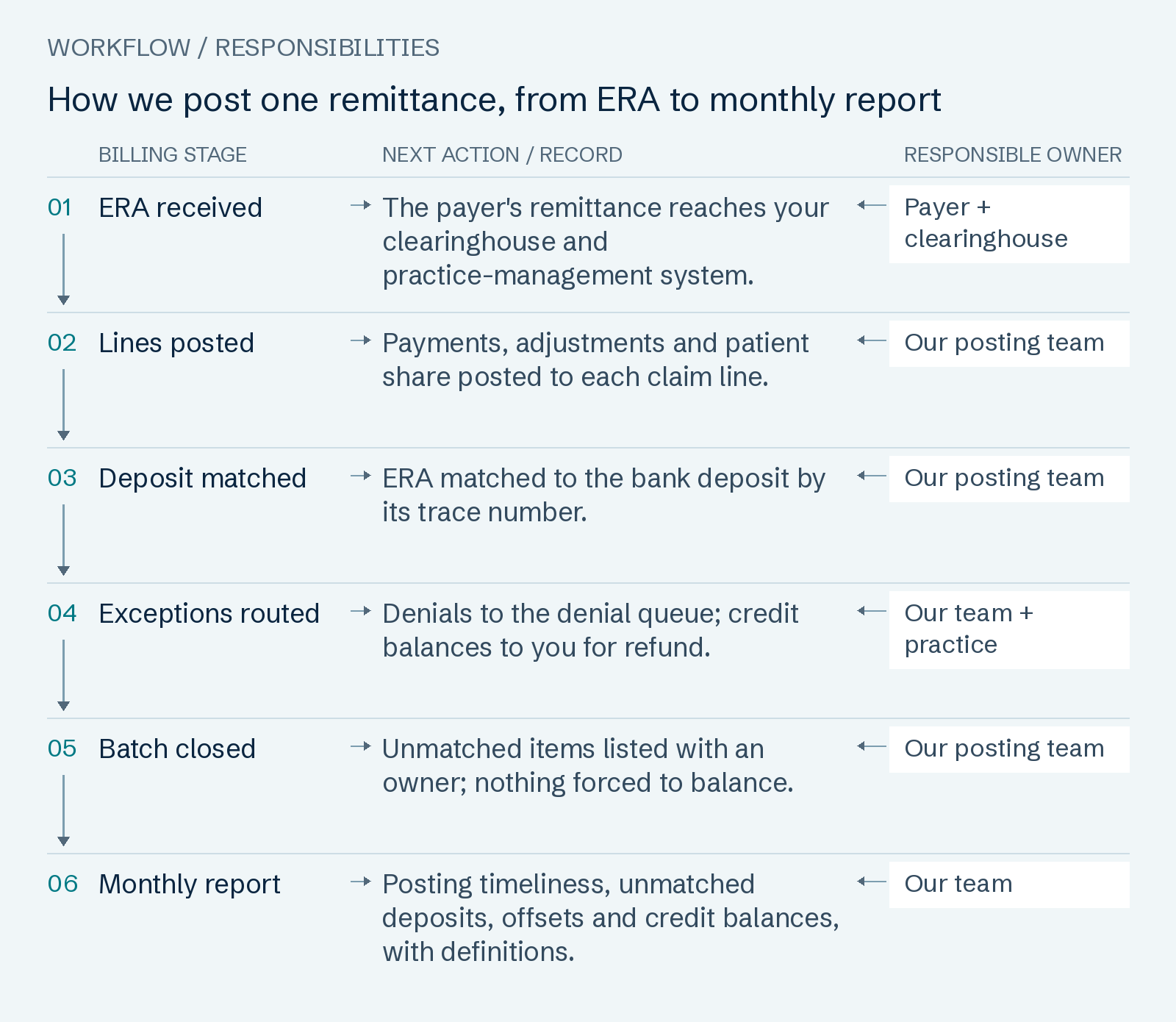
Read the workflow as text
- ERA received — The payer's remittance reaches your clearinghouse and practice-management system. Owner: Payer + clearinghouse.
- Lines posted — Payments, adjustments and patient share posted to each claim line. Owner: Our posting team.
- Deposit matched — ERA matched to the bank deposit by its trace number. Owner: Our posting team.
- Exceptions routed — Denials to the denial queue; credit balances to you for refund. Owner: Our team + practice.
- Batch closed — Unmatched items listed with an owner; nothing forced to balance. Owner: Our posting team.
- Monthly report — Posting timeliness, unmatched deposits, offsets and credit balances, with definitions. Owner: Our team.
Denials routed to our denial team and worked within 2 business days
An unposted remittance hides its denials, and nobody works a denial nobody has seen. At posting, every denied or zero-paid line goes to our denial management services team with its group, reason and remark codes attached. Worked means resubmitted, appealed or returned to you with the fix, and each one is logged with the date it was worked.
What if a denial is worked late?
Clock-or-Credit Guarantee. From go-live, every new claim goes out within 1 business day of complete charge data, and every denial is worked within 2 business days of posting — or $25 comes off your invoice for each late one. Mon–Fri ET business days by your system's timestamps; worked: resubmitted, appealed or returned with the fix; auto-credited; capped at monthly fee; clearinghouse outages excluded. No billing company can force a payer to pay a denied claim; the payer decides. What we guarantee is how fast each denial is worked.
Underpayment checks against your fee schedules
Posting records what a payer paid; an underpayment check asks whether it paid what your contract says. That needs your fee schedules, because the remittance shows what the payer allowed, not what your contract says.
- 60-Day Underpayment Check, included with Full-Service Billing. In month 3 we compare every payment from your first 60 days against your contracted rates and appeal each underpaid line. Needs your fee schedules.
- Every month on Complete RCM. Practices on Complete RCM at 9.0% of insurance payments get an underpayment check every month. One rate for every specialty and size up to 15 clinicians. Same $0 setup, $400 minimum from invoice 4, guarantees and Clean-Exit Terms.
- On its own. Practices that keep billing in-house can buy the same check for $495, listed on our pricing page.
An appeal of an underpaid line asks the payer to pay the contracted rate; the payer decides the outcome. To check your contracts yourself first, use the contracted-rates step in our billing audit checklist.
Reconciliation with your bank deposits
A posted remittance is only half the match; the money has to be in your account. CMS explains that the trace number on an EFT payment should be the same as the one in the ERA that describes it, a match it calls reassociation. We match every deposit to its ERA that way. A deposit with no ERA stays on an unmatched list with its age and next owner, never spread across likely accounts. Deposits stay pointed at your bank: Medicare EFT can send payments directly to a provider's financial institution.
- Payments that arrive short. Provider-level adjustments are usually not related to any specific claim, and CMS lists a deduction for a prior overpayment among them. We post each offset at provider level and tie it to the claim it recovers wherever the payer identifies one.
- Credit balances. Medicare requires an overpayment to be reported and returned by the later of 60 days after it is identified or the date any corresponding cost report is due, with limited suspensions. We log every credit balance the day we post it and send it to you.
Who approves refunds and write-offs?
You do. We post what the payer decided; a refund, write-off or balancing adjustment goes in only with your approval. Nothing is forced to balance.
Reports you get each month
By the 10th of each month you get the posting report: each measure defined in writing, with the posting log you can recount it from. We publish no target rates; month one is your baseline.
- Remittances posted on time: remittances posted within 2 business days ÷ remittances received in the month.
- Unmatched deposits: every deposit without an ERA, and every ERA without a deposit, with its age and next owner.
- Offsets and recoupments: amounts payers withheld at provider level, traced to the original claim where the payer identifies one.
- Open credit balances: count and amount awaiting your refund decision, oldest first.
- Net collection rate: payments ÷ (charges − contractual adjustments).
Denied lines carry into the denial measures we report, and every late denial credit shows on that month's invoice.
What our payment posting costs
Payment posting is priced inside Full-Service Billing, by specialty and practice size, with $0 setup and 0% of patient payments. The fee is figured from the same postings we make in your system, so you can recompute every invoice from your own ledger. Invoices 1–3: only percentage fees on that month's insurance payments, plus any statements or add-ons you order. Percentage fees and mailed statements are capped at 9.0% of that month's insurance payments; from invoice 4, the $400 minimum applies even in a month when the cap comes to less. 16+ clinicians, or anesthesia, radiology, DME, lab and home health: written quote within 1 business day, same fee base, cap and terms.
Therapy and counseling practices can check what mental health billing services cost next to every other specialty on the full rate card.
| Practice type | 1 clinician | 2–5 clinicians | 6–15 clinicians |
|---|---|---|---|
| Mental & behavioral health | 8.0% | 7.5% | 7.0% |
| ABA therapy | 8.5% | 8.0% | 7.5% |
| PT, OT, speech & chiropractic | 7.5% | 7.0% | 6.5% |
| Primary care, pediatrics & urgent care | 6.5% | 6.0% | 5.5% |
| Specialist physician groups | 6.0% | 5.5% | 5.0% |
How we start your payment posting, and how you leave
- Agreement and BAA. Remittances carry patient data, so the service agreement and BAA are signed before we see one ERA; 45 CFR 160.103 counts billing among the activities that make a vendor a HIPAA business associate.
- Access. Logins to the clearinghouse where your ERAs land and to the practice-management system we post in, plus a read-only bank view or a regular deposit report.
- Backlog inventory. We list every unposted remittance at kickoff. Denials found in it join the deadline sweep: Starts at access; covers up to 250 claims (more gets a day-1 deadline schedule); worked means submitted, corrected, appealed or returned with the fix.
- Go-live. Go-live, when your first claims go out, comes within 5 business days of access; any unbilled backlog follows within 10 business days of access. Clock starts with your signed agreement, signed BAA and working system logins; it extends day for day while we wait on access.
Clean-Exit Terms. Month to month. Leave with 30 days' written notice. No termination fee. Notice by email; optional run-out covers claims we submitted before your exit date, at your plan rate; handover file within 10 business days of exit. We publish client results only with written permission. Until we have them, judge us by the guarantees and the free Deadline Map. To see where your unpaid claims stand before you decide, request The Free A/R Deadline Map. Clock starts with your claim-level aging export and signed BAA; above 10 requests in a week, we confirm your date within 1 business day.
Common questions
- What are payment posting services?
- A billing team records each payer's remittance and each patient payment against the claim lines they pay, matches them to your bank deposits and sends exceptions to their owners. Ours runs inside Full-Service Billing: posted within 2 business days, denials worked within 2 business days, and a written report by the 10th of each month.
- Is payment posting included in your billing fee?
- Yes. Posting is part of Full-Service Billing: 5.0% to 8.5% of insurance payments, set by specialty and practice size, 0% of patient payments and $0 setup. Compare plans on our published rate card.
- Can we hire you for payment posting only?
- Our rate card has no posting-only line. Posting is priced inside Full-Service Billing and Complete RCM, so the denials, offsets and short payments it finds are worked by the same team that posted them. Tell us your remittance volume on a call with our team and we will show you which plan fits.
- How fast does your team post our payments?
- Within 2 business days of the remittance, from go-live, and the timeliness figure is in every monthly report. Each denied line found at posting is then worked within 2 business days, or $25 comes off your invoice under the Clock-or-Credit Guarantee, on these terms: Mon–Fri ET business days by your system's timestamps; worked: resubmitted, appealed or returned with the fix; auto-credited; capped at monthly fee; clearinghouse outages excluded.
- Do you check for underpayments?
- Yes. With Full-Service Billing, the 60-Day Underpayment Check is included: In month 3 we compare every payment from your first 60 days against your contracted rates and appeal each underpaid line. Needs your fee schedules. Complete RCM adds an underpayment check every month.
- Do you post patient payments?
- Yes, against the patient balance so the next statement is right, and we take 0% of patient payments. Balances move to the patient only where the payer assigned them, and our patient statement service sends them in your practice's name.
- Do you ever receive or hold our practice's payments?
- No. Every payment goes straight to your practice's own bank account. We never receive, deposit or endorse your payments; we invoice you once a month. We post in your system from the remittance and match it to the deposit in your own account.
Sources and review
Page revised November 4, 2026 · Review contact: Hyder Shah (inquiries@claimpillar.com). CMS and eCFR sources retrieved November 4, 2026. Every price, turnaround and guarantee comes from our published offer terms.