Occupational therapy billing services we handle
Occupational therapy billing turns on three things: minutes per code, the discipline modifier on every line, and plan-of-care or authorization dates. We take over the whole claim cycle and check all three before a claim leaves. We check every code against your clinician's documentation and never change a code without the clinician's sign-off.
Hand your OT billing to us when one of these sounds familiar:
- Weeks of visits sit unbilled because your biller left or your front desk is also your billing desk.
- Medicare returns claims for a missing GO or a CO without GO, or a review finds KX added without the notes behind it.
- Pediatric Medicaid visits deny because the authorization period ended before the visits did.
If your clinic also runs PT and speech, our physical therapy billing services page shows how we run all three disciplines; practices that add counseling or ABA can use one therapy billing company for every discipline. Facing one of the problems above? Tell us about your OT practice, and we reply within 1 business day.
| Task | What we do | What your practice keeps |
|---|---|---|
| Evaluations | Match the evaluation level on the claim to what the evaluation note documents; query a mismatch before release. | Choosing the level from your clinical findings |
| Timed units | Turn each day's documented timed minutes into units by the payer's method. | Recording start and stop times or minute totals |
| Discipline lines | GO on every Medicare OT line, CO where an OTA treated, KX only where your notes support it. | Final say on every code |
| Plans and authorizations | Track certification, recertification and authorization dates and approved visits. | Sending plans to the physician for signature |
| Claims, denials, posting | Submit within 1 business day of complete charges, work each denial within 2 business days, post within 2 business days. | Every payment goes straight to your practice's own bank account. We never receive, deposit or endorse your payments; we invoice you once a month. |
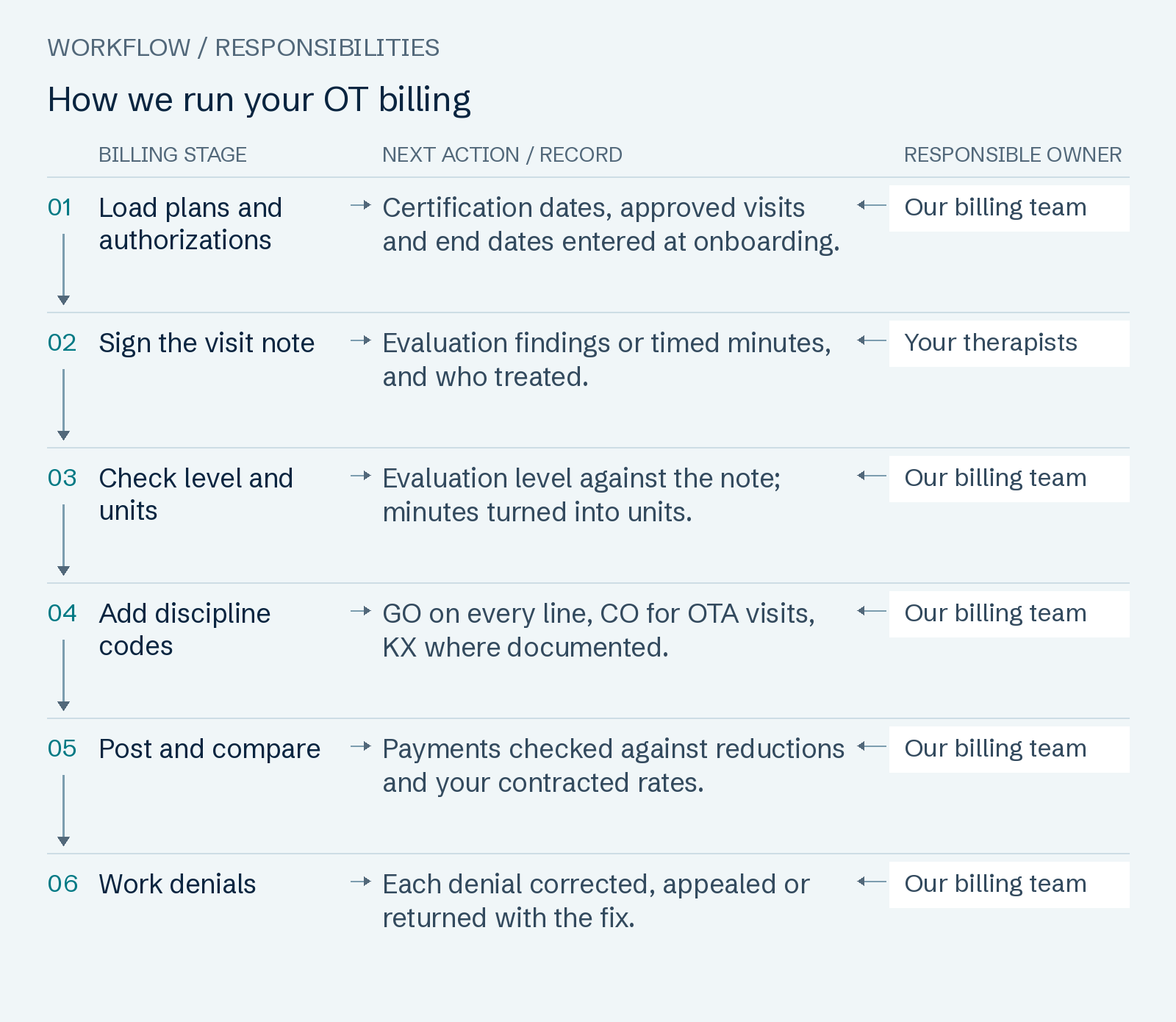
Read the workflow as text
- Load plans and authorizations — Certification dates, approved visits and end dates entered at onboarding. Owner: Our billing team.
- Sign the visit note — Evaluation findings or timed minutes, and who treated. Owner: Your therapists.
- Check level and units — Evaluation level against the note; minutes turned into units. Owner: Our billing team.
- Add discipline codes — GO on every line, CO for OTA visits, KX where documented. Owner: Our billing team.
- Post and compare — Payments checked against reductions and your contracted rates. Owner: Our billing team.
- Work denials — Each denial corrected, appealed or returned with the fix. Owner: Our billing team.
Your OT evaluation claims, 97165–97168, billed by complexity
The code descriptors CMS printed when it adopted these codes, in the CY 2017 Physician Fee Schedule final rule, set each initial level by three required components: the occupational profile and history, how many performance deficits (physical, cognitive or psychosocial) the assessment identifies, and the complexity of the clinical decision making. We check that the note supports the level your therapist picked. Code-by-code detail for your staff is in our occupational therapy billing codes reference.
Under the 2026 Medicare Physician Fee Schedule, the three initial levels carry the same national non-facility amount, $100.54, according to CMS's RVU26D relative value file. On Medicare claims the level is a documentation question, not a payment one.
| Evaluation code | Level | What the note should show (our wording) | What we check before release |
|---|---|---|---|
| 97165 | Low complexity | A brief history, one to three performance deficits, no comorbidities affecting performance | The deficit count and history depth match a low-complexity claim |
| 97166 | Moderate complexity | An expanded history, three to five performance deficits, comorbidities that affect performance may be present | The note records the extra history and the deficits it counts |
| 97167 | High complexity | An extensive history, five or more performance deficits, comorbidities that affect performance | Each deficit is assessed and carried into the plan of treatment |
| 97168 | Re-evaluation | A documented change in function or medical status, an updated occupational profile and a revised plan of care | A plan of care is on file, and the visit is not billed as a new evaluation |
Timed treatment codes: how we apply the 8-minute rule to your units
Most OT treatment codes, such as therapeutic activities (97530), self-care and home management training (97535) and sensory integrative techniques (97533), bill in 15-minute units. For Medicare, the Claims Processing Manual, chapter 5, section 20.2 says a single timed service needs at least 8 minutes for one unit; 8 through 22 minutes is one unit and 23 through 37 minutes is two. Its own example: 60 minutes of 97530 is 4 units. Evaluation codes are not counted this way: North Carolina Medicaid, for one, bills each OT evaluation as one unit per event.
How we count units on your OT visits
- We add up the day's documented timed minutes across all timed codes.
- We work out the units that total allows under the payer's method.
- We assign those units to codes from the minutes documented for each one.
- We return any note with no minute totals to your therapist before the claim goes out.
For the unit math across PT and OT visits, our physical therapy billing units calculator works the same table.
GO modifier, KX threshold and Medicare plan of care on your claims
Our quick reference for the codes we put on your Medicare OT lines:
Plan-of-care dates we track for every Medicare patient
Under the Medicare Benefit Policy Manual, chapter 15, section 220.1.3, a physician or NPP certifies the plan of care, with the certification documented and dated within 30 days of the first treatment (the evaluation counts), and recertifies at least every 90 days or when the plan changes significantly. Under section 220.3, progress reports are due at least once every 10 treatment days. We track these dates and ask for a missing signature before billing, not after the denial.
| Code on the line | When it applies | What we check before release |
|---|---|---|
| GO | Services delivered under an outpatient occupational therapy plan of care | Present on every OT line, evaluations included, with no second discipline code on the same line |
| CO | An OTA furnished the service in whole or in part | Paired with GO; the staff list shows an OTA treated; payment posts at 85% of the otherwise applicable amount |
| KX | The patient's 2026 OT amount has passed $2,480 | The year-to-date OT amount and the notes support medical necessity |
Pediatric OT: how we bill your Medicaid and sensory integration claims
Pediatric OT runs on state Medicaid authorizations. North Carolina Medicaid's Clinical Coverage Policy 10A (amended October 1, 2026) is a clear example: an evaluation visit needs no prior approval, but every treatment visit does; the written evaluation must be completed within three months of the requested start date; and for a child under 21, one authorization period cannot run longer than six calendar months. The same policy lists sensory integrative techniques (97533) among covered OT treatment codes, billed in 15-minute units.
The authorization ledger we keep for each child
We record approved visits, visits used and the end date, warn you before either runs out, and hold any visit outside the approval for your decision. Commercial plans write their own policies for sensory integration, so we check the child's plan policy before the first 97533 claim and tell you what it requires. Requesting authorizations is part of our prior authorization service.
Billing for occupational therapy services in your hand and outpatient clinic
Hand therapy clinics bill more than timed exercise: orthotic management and training (97760, 97763) and casting and strapping codes can appear on the same claim as 97530. North Carolina's policy, for example, lists these among its OT treatment codes, with the orthotic codes in 15-minute units and casting as one unit per event. We check that each orthotic or casting line has its own documentation.
A private-practice OT bills Medicare on a professional claim; that professional claim is the one we file for your practice.
Our rate card for OT practices
Occupational therapy practices pay the rehab row of our rate card, the same row as PT and speech. You pay a percentage of insurance payments and 0% of patient payments, so a copay taken at your front desk never carries our fee. Clinicians are counted on the 1st of each month from the rendering NPIs we billed the month before (for ABA, BCBAs and BCaBAs, not RBTs). Your rate moves with your size band the next month, in either direction.
Worked example: an OT practice whose claims last month named three occupational therapists as rendering providers counts three clinicians. That is the 2–5 clinicians band, so its rate is 7.0% of that month's insurance payments posted.
Setup is $0. Invoices 1–3: only percentage fees on that month's insurance payments, plus any statements or add-ons you order. Percentage fees and mailed statements are capped at 9.0% of that month's insurance payments; from invoice 4, the $400 minimum applies even in a month when the cap comes to less. Month to month. Leave with 30 days' written notice. No termination fee. Every segment is on our medical billing rate card.
How we start with your OT practice
Go-live, when your first claims go out, comes within 5 business days of access; any unbilled backlog follows within 10 business days of access. Clock starts with your signed agreement, signed BAA and working system logins; it extends day for day while we wait on access. Every inherited claim within 30 days of a filing, corrected-claim or appeal deadline is worked within 5 business days of access. We need the signed agreement and BAA, system logins, a claim-level aging export, active plans of care and authorizations, and a staff list showing who is an OT or OTA. Not ready? Start with The Free A/R Deadline Map: A claim-by-claim list of every unpaid insurance claim over 90 days in the aging report you send: payer, amount, the deadline it faces, the denial reason and the next action, sorted by deadline.
| Practice size | Rate for occupational therapy |
|---|---|
| 1 clinician | 7.5% of insurance payments |
| 2–5 clinicians | 7.0% of insurance payments |
| 6–15 clinicians | 6.5% of insurance payments |
| Larger groups | Pricing is by written quote. |
Underpayment checks on your OT fee schedules
Medicare makes two legitimate reductions on OT payments: under the multiple procedure payment reduction, the therapy service with the highest practice-expense RVU is paid in full and the practice-expense payment for the remaining services is reduced to 50%, and CO lines are paid at 85%. We post each remittance against those reductions and your contracted rates, so a line paid below both stands out.
60-Day Underpayment Check: In month 3 we compare every payment from your first 60 days against your contracted rates and appeal each underpaid line. Needs your fee schedules. Underpaid lines go to our denial and appeal work.
On-Our-Watch Guarantee. If a claim misses a filing, corrected-claim or appeal deadline while it is on our watch, we pay you what it would have paid. Claims we get complete 10+ business days before the deadline; contracted rate less any copay you collected, paid automatically within 30 days of final denial; capped $10,000/month; your holds excluded.
Clock-or-Credit Guarantee. From go-live, every new claim goes out within 1 business day of complete charge data, and every denial is worked within 2 business days of posting — or $25 comes off your invoice for each late one. Mon–Fri ET business days by your system's timestamps; worked: resubmitted, appealed or returned with the fix; auto-credited; capped at monthly fee; clearinghouse outages excluded.
We publish client results only with written permission. Until we have them, judge us by the guarantees and the free Deadline Map.
Common questions
- How much do occupational therapy billing services cost?
- 7.5% for 1 clinician, 7.0% for 2–5 clinicians and 6.5% for 6–15 clinicians, of insurance payments, with 0% of patient payments and $0 setup. Minimum and cap: our pricing page.
- Do you bill all four OT evaluation codes, 97165 to 97168?
- Yes. 97165, 97166 and 97167 are the low, moderate and high complexity initial evaluations, and 97168 is the re-evaluation under an established plan of care.
- Do you add the GO modifier to our OT claims?
- Yes, on every line under an OT plan of care, as Medicare's Claims Processing Manual, chapter 5 requires. Where an OTA treated, we add CO alongside GO; CO without GO is returned as unprocessable.
- Do you bill pediatric OT for Medicaid?
- Yes. We follow your state's Medicaid policy, keep an authorization ledger for each child, and hold any visit outside the approval for your decision.
- Do we have to sign a long-term contract?
- No. Leave with 30 days' notice and no termination fee. Want a run-out? We keep working the claims we submitted for 90 days at your plan rate. Decline it and we charge nothing on payments that post after you leave. Notice by email; optional run-out covers claims we submitted before your exit date, at your plan rate; handover file within 10 business days of exit.
- How long does it take to switch our OT billing?
- Go-live, when your first claims go out, comes within 5 business days of access; any unbilled backlog follows within 10 business days of access. Clock starts with your signed agreement, signed BAA and working system logins; it extends day for day while we wait on access. Inherited claims nearest a filing deadline go first.
- Can you credential a new occupational therapist joining our practice?
- Yes. New-Clinician Enrollment: Clinicians who join while you're a client get enrollment filed with up to 5 payers each (the payer decides), with no per-payer fee. Outside that, Credentialing & Payer Enrollment is $149 per payer. Billed only after the payer confirms your effective date; $0 if denied or panel closed; filed within 5 business days of your complete packet.
Sources and review
Page revised November 5, 2026 · Review contact: Hyder Shah (inquiries@claimpillar.com). The workflow checklists are editorial recommendations; payer requirements depend on the program and current policy.
- CMS: Therapy Services (CY 2026 KX threshold, CQ/CO payment, MPPR)
- CMS: Medicare Claims Processing Manual, Chapter 5 (GO and CO modifiers, timed units)
- CMS: Medicare Benefit Policy Manual, Chapter 15, section 220 (plan of care certification, progress reports)
- CMS: CY 2017 Physician Fee Schedule final rule, 81 FR 80170 (OT evaluation code descriptors 97165-97168)
- NC Medicaid: Clinical Coverage Policy 10A, Outpatient Specialized Therapy Services (amended October 1, 2026)
- CMS: PFS Relative Value Files (RVU26D, 2026 national amounts)