Free 8-minute rule calculator for PT and OT billing units
The calculator turns one day's timed therapy minutes into billing units, code by code. It opens loaded with example 3 from CMS's own manual (33 minutes of therapeutic exercise, 97110, and 7 minutes of manual therapy, 97140), so you can see an answer before typing anything.
What to enter
- Type each 15-minute timed code once, such as 97110, 97530 or 97535, with the one-on-one minutes the treatment note records for it that day.
- Add rows with "+ Add a timed code" (up to six) and leave unused rows blank.
- Leave out untimed codes such as evaluations and group therapy, and leave out minutes that are not treatment, such as rest, toileting or waiting for equipment.
How to read the two counts
The first line is the Medicare count, set by the total-time method in CMS Pub. 100-04, chapter 5, section 20.2. The line under it counts the same minutes code by code, one unit at 8 or more minutes past each full 15 on each code, which is how payers that follow the CPT midpoint rule count. When the two totals differ, the payer's own policy decides which one goes on the claim. Nothing you type leaves your browser.
How the Medicare 8-minute rule works
The Medicare 8-minute rule applies to codes defined in 15-minute units of direct, one-on-one time. CMS chapter 5, section 20.2 says not to bill a single timed service done for less than 8 minutes, and that when more than one timed code is billed on the same day, the total timed minutes for that day limit the total units. The chart below is the CMS minutes-to-units chart; CMS adds that the pattern continues past 2 hours.
Only treatment time counts. Section 20.3 starts the clock when the clinician is directly working with the patient, and excludes rest, toileting and waiting for equipment. When two clinicians treat one patient together, each 15 minutes of the patient's treatment is still one unit.
Splitting units across several codes
- Add the timed minutes for every 15-minute code that day and read the unit total off the chart.
- Give each code one unit for every full 15 minutes on that code: CMS says a service done for at least 15 minutes is billed for at least 1 unit, at least 30 minutes for at least 2.
- Give any units left to the codes with the most leftover minutes, largest first.
- When two codes tie for the last unit, either may take it; CMS examples 2 and 5 leave the choice to the qualified professional.
The CMS MLN booklet on outpatient rehabilitation therapy documentation gives the same rule in one line: four separate 8-minute treatments (32 minutes) bill 2 units, not 4.
| Total timed minutes in the day | Units Medicare allows |
|---|---|
| 0 to 7 | 0 |
| 8 to 22 | 1 |
| 23 to 37 | 2 |
| 38 to 52 | 3 |
| 53 to 67 | 4 |
| 68 to 82 | 5 |
| 83 to 97 | 6 |
| 98 to 112 | 7 |
| 113 to 127 | 8 |
Medicare vs the CPT midpoint rule (commercial payers)
The CPT manual published by the AMA sets a different standard. APTA explains that CPT's time guidelines treat a 15-minute unit as earned once its midpoint is passed (7 minutes and 31 seconds), and do not require adding the day's minutes before counting units. A therapist could therefore bill a unit each time the midpoint is passed on each code. APTA's advice is to check whether each payer follows Medicare's method or the midpoint method, and to write the practice's choice into its policy manual.
Some commercial plans publish the midpoint method. The Premera and LifeWise payment policy CP.PP.099 (last approved 08/18/26) says a timed unit is earned when the time midpoint is passed, that the halfway point for a 15-minute code is 8 minutes, and that a billable unit is 8 to 22 minutes or any multiple of that range. Its revision log shows a total-minutes statement added on 11/04/25 and removed on 12/29/25 "due to confusion", so reread a payer's current policy rather than last year's copy.
The two methods do not always favour the same count. The table runs both on four visits; the first three are illustrative, the last is CMS example 1.
| Timed minutes by code | Medicare units (total time) | Per-code midpoint units |
|---|---|---|
| 97110: 23, 97140: 10 (illustrative) | 2: 97110 × 1, 97140 × 1 | 3: 97110 × 2, 97140 × 1 |
| 97530: 10, 97535: 10, 97112: 10 (illustrative) | 2, on any two of the three codes | 3: one on each code |
| 97110: 20, 97140: 18 (illustrative) | 3: 97110 × 2, 97140 × 1 | 2: 97110 × 1, 97140 × 1 |
| 97112: 24, 97110: 23 (CMS example 1) | 3: 97112 × 2, 97110 × 1 | 4: 97112 × 2, 97110 × 2 |
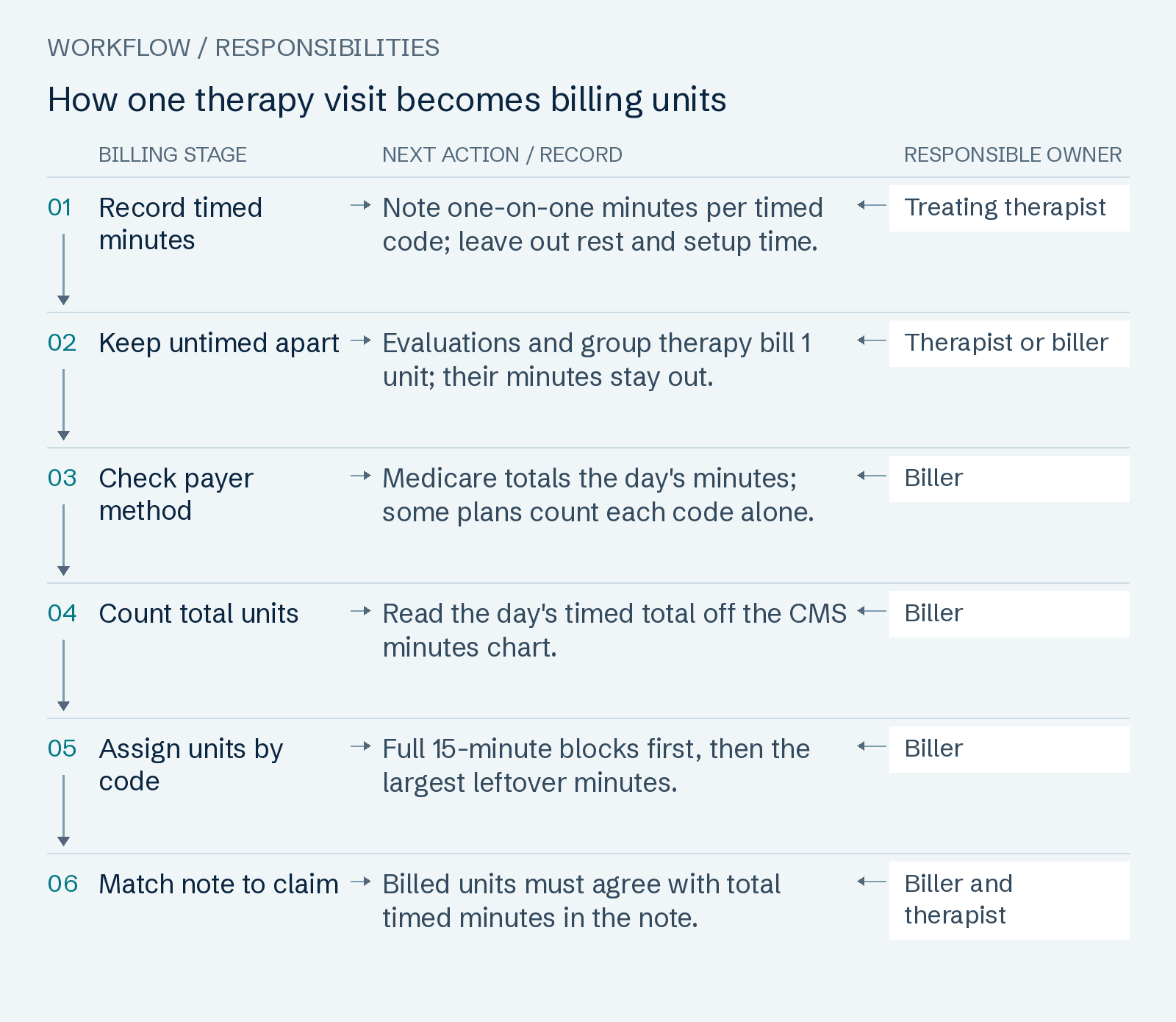
Read the workflow as text
- Record timed minutes — Note one-on-one minutes per timed code; leave out rest and setup time. Owner: Treating therapist.
- Keep untimed apart — Evaluations and group therapy bill 1 unit; their minutes stay out. Owner: Therapist or biller.
- Check payer method — Medicare totals the day's minutes; some plans count each code alone. Owner: Biller.
- Count total units — Read the day's timed total off the CMS minutes chart. Owner: Biller.
- Assign units by code — Full 15-minute blocks first, then the largest leftover minutes. Owner: Biller.
- Match note to claim — Billed units must agree with total timed minutes in the note. Owner: Biller and therapist.
Billing units for physical therapy: worked examples
Three of these physical therapy examples come straight from CMS chapter 5, section 20.2; the fourth is ours and is labelled. Each shows how the total sets the unit count and the per-code minutes decide where the units go.
Two codes, both over 15 minutes
CMS example 1: 24 minutes of neuromuscular re-education (97112) and 23 minutes of therapeutic exercise (97110) make 47 timed minutes, which is 3 units. Each code ran more than 15 minutes, so each gets 1 unit; the third goes to 97112, the code with more time. Bill 97112 × 2 and 97110 × 1.
Four codes, one left unbilled
CMS example 4: 18 minutes of 97110, 13 of manual therapy (97140), 10 of gait training (97116) and 8 of ultrasound (97035) make 49 minutes, which is 3 units. Bill 1 unit each of 97110, 97140 and 97116. The ultrasound is not billed, because 49 minutes cannot support a fourth unit, but CMS says it is still documented in the treatment note.
An evaluation day with two short timed codes
Illustrative example, not client data. A low-complexity PT evaluation (97161) is followed by 12 minutes of 97110 and 10 minutes of 97140. The evaluation bills 1 unit and its minutes stay out of the count. The timed total is 22 minutes, which is 1 unit, and it goes to 97110, the code with more minutes. A per-code midpoint payer would allow 97110 × 1 and 97140 × 1.
The codes in these examples are a handful of the physical therapy billing codes a PT practice bills, and unit counting is one step in the wider physical therapy billing guidelines.
| Example | Timed minutes by code | Timed total | Medicare units billed |
|---|---|---|---|
| CMS example 1 | 97112: 24, 97110: 23 | 47 | 97112 × 2, 97110 × 1 |
| CMS example 3 | 97110: 33, 97140: 7 | 40 | 97110 × 2, 97140 × 1 |
| CMS example 4 | 97110: 18, 97140: 13, 97116: 10, 97035: 8 | 49 | 97110 × 1, 97140 × 1, 97116 × 1 |
| Evaluation day (illustrative) | 97110: 12, 97140: 10, plus 97161 | 22 | 97161 × 1, 97110 × 1 |
Occupational therapy billing units: worked examples
Occupational therapy billing units follow the same Medicare rule when an OT plan of care uses 15-minute timed codes. CMS's own single-code example is occupational therapy: 60 minutes of therapeutic activities (97530) on one day is reported as 4 units, per chapter 5, section 20.2.
Self-care training plus therapeutic activities
Illustrative example, not client data. 25 minutes of self-care and home management training (97535) and 13 minutes of 97530 make 38 minutes, which is 3 units. 97535 earns 1 full unit (15 minutes) with 10 minutes left; 97530 has 13 minutes left. Both leftovers get a unit, so bill 97535 × 2 and 97530 × 1. The per-code midpoint count happens to match.
Three short codes in one session
Illustrative example, not client data. 10 minutes each of 97530, 97535 and neuromuscular re-education (97112) make 30 minutes, which is 2 units. No code reached 15 minutes and all three leftovers are equal, so, as in CMS example 5, the clinician chooses which two codes bill. A per-code midpoint payer would allow 3 units, one per code.
An OT evaluation with treatment
Illustrative example, not client data. A moderate-complexity OT evaluation (97166) plus 20 minutes of 97530 bills 97166 × 1 and 97530 × 1. The evaluation minutes count toward total treatment time in the note, never toward the 20 timed minutes.
Practices that would rather hand off OT claims entirely can compare options for billing for occupational therapy.
Untimed codes and how they affect totals
Untimed codes bill 1 unit no matter how long they take, and their minutes never feed the 8-minute count. The MLN905365 booklet names therapy evaluations, group therapy and supervised modalities as untimed, and says not to count time on untimed services toward timed services. The Medicare Benefit Policy Manual, chapter 15, section 220.3 adds that evaluation minutes are part of total treatment time but are not included in the timed-code minutes, and that the note records both totals.
Chapter 5's speech-language pathology example makes the same point: an evaluation under 92521 is 1 unit regardless of the minutes spent. The chapter's per-day chart also limits PT evaluations (97161 to 97164) and OT evaluations (97165 to 97168) to 1 unit per discipline, per day; units above a listed limit are denied as medically unnecessary.
Session codes that are not 15-minute units
Psychotherapy codes follow their own time ranges instead of 15-minute units. A First Coast Service Options billing article (A57520) assigns 53 or more minutes to 90837 and 38 to 52 minutes to 90834, and says to choose the code closest to the session's actual time; the 90837 CPT code page covers that code in full.
| Code or group | What it is, in plain words | Units per day |
|---|---|---|
| 97161, 97162, 97163 | PT evaluation, by complexity | 1 per discipline |
| 97164 | PT re-evaluation | 1 per discipline |
| 97165, 97166, 97167 | OT evaluation, by complexity | 1 per discipline |
| 97168 | OT re-evaluation | 1 per discipline |
| 97150 | Group therapy, two or more patients | 1 (untimed) |
| 92521 | Speech evaluation (fluency) | 1 per discipline |
Common unit errors that trigger audits
Unit mismatches were the most frequent coding error in one federal audit of Medicare physical therapy claims. In OIG report A-05-14-00041 (March 2018), 61 percent of 300 sampled Medicare outpatient PT claims did not meet medical necessity, coding or documentation requirements. On 86 claims the timed units billed did not match the treatment notes; in one, three units of 97110 were billed when the notes supported two units of 97110 and one of gait training (97116). On 74 claims the treatment notes had deficiencies, such as no total timed minutes.
Errors to check before the claim goes out
- Units above the timed total. Four 8-minute treatments bill 2 units, not 4 (MLN905365).
- All minutes on one code. CMS chapter 5 says not to put every minute on one code when another service ran more than 15 minutes.
- Evaluation minutes counted as timed. They belong in total treatment time only.
- No total timed minutes in the note. MLN905365 lists this among common CERT errors; the billing and the timed total must agree.
- A pattern of short units. CMS expects each unit to average 15 minutes of direct contact and says a consistent practice of billing less than that should be highlighted for review.
- The wrong method for the payer. A per-code count on a Medicare claim, or a total-time count on a plan that pays per code, puts the wrong number of units on the claim.
Each unit carries real money: one unit of 97110 has a 2026 national Medicare amount (unadjusted) of $29.06, and 97530 is $35.07, non-facility. Actual payment varies by locality, setting and payer. For the clinic-level view of what unit errors cost under Medicare, the Medicare physical therapy billing guide adds the KX threshold and 2026 rates. If unit checks, denials and appeals are falling behind, our physical therapy billing services take over claim work for PT, OT and speech practices, with published pricing.
Common questions
- How does the 8-minute rule work?
- Medicare adds every one-on-one minute of 15-minute timed codes on the day, then converts the total with the CMS chart: 8 to 22 minutes is 1 unit, 23 to 37 is 2, 38 to 52 is 3, and so on. Each code first gets 1 unit per full 15 minutes, and any remaining units go to the codes with the most leftover minutes (CMS Pub. 100-04, ch. 5, §20.2).
- How many units is 38 minutes of therapy?
- 3 units under Medicare, because 38 minutes is the first minute of the 38-to-52 band. If the 38 minutes were split 20 and 18 across two codes, the code with 20 minutes bills 2 units and the other 1. A payer counting each code at its own midpoint would allow only 2 units for that split.
- Do commercial payers use the 8-minute rule?
- Not all of them. APTA notes that the CPT midpoint standard counts each code separately, and some plans, such as Premera and LifeWise (policy CP.PP.099), publish a per-code halfway-point rule. Check each payer's policy and contract before setting units.
- Are evaluation codes counted in timed minutes?
- No. The Medicare Benefit Policy Manual, chapter 15, section 220.3 says evaluation minutes are untimed: they count in total treatment time but not in the timed-code minutes. Bill the evaluation as 1 unit and count the timed codes separately.
- Can you bill a unit for 7 minutes of therapy?
- Not when it is the only timed service that day: CMS says not to bill a single service under 8 minutes. If two or more timed services each ran 7 minutes or less and together reach 8 minutes, Medicare allows 1 unit, billed under the service with the most minutes.
- Does the 8-minute rule apply to occupational therapy?
- Yes, for 15-minute timed codes billed to Medicare under an OT plan of care. CMS's own example is 60 minutes of 97530 occupational therapy on one day, reported as 4 units. OT evaluations (97165 to 97168) are untimed and bill 1 unit.
Sources and review
Page revised November 5, 2026 · Review contact: Hyder Shah (inquiries@claimpillar.com). Every source below was retrieved and checked on November 5, 2026; the dollar amounts come from our extract of the CMS CY 2026 RVU26D file.
- CMS Medicare Claims Processing Manual, Pub. 100-04, Chapter 5, §20.2–20.3
- CMS Medicare Benefit Policy Manual, Pub. 100-02, Chapter 15, §220.3 and §230
- CMS MLN905365: Outpatient Rehabilitation Therapy Services, Complying with Documentation Requirements (April 2019)
- APTA: Coding for Timed Codes
- Premera / LifeWise Payment Policy CP.PP.099.v4.0: Physical Medicine and Rehabilitation Services (last approved 08/18/26)
- HHS-OIG A-05-14-00041: Many Medicare Claims for Outpatient Physical Therapy Services Did Not Comply With Medicare Requirements (March 2018)
- First Coast Service Options, Billing and Coding Article A57520: Psychiatric Diagnostic Evaluation and Psychotherapy Services
- CMS: PFS Relative Value Files (CY 2026, RVU26D)