Medicare PT billing guidelines at a glance
Medicare Part B pays outpatient physical therapy only when the claim and the record agree. Chapter 15 of the Medicare Benefit Policy Manual (sections 220 to 230) sets the coverage rules: the plan of care, certification, progress reports and treatment notes. Chapter 5 of the Medicare Claims Processing Manual sets the billing rules: units, therapy modifiers and the KX threshold. The CMS Therapy Services page publishes each year's dollar amounts.
The table below is the short version your front desk, therapists and biller can share. Each row names the manual section to read when a claim is questioned. The sections after it explain each rule, what fails on a claim, and what to check before it goes out.
| Guideline | What Medicare requires | Where it is written |
|---|---|---|
| Plan of care | Established before treatment; lists diagnoses, long-term goals, and the type, amount, duration and frequency of therapy | Benefit Policy Manual ch. 15, §220.1.2; 42 CFR 410.61 |
| Initial certification | Physician or NPP signature dated within 30 days of the first treatment, or the order-or-referral exception | Ch. 15, §220.1.3; 42 CFR 424.24(c) |
| Recertification | At least every 90 days, or sooner on a significant change to the plan | Ch. 15, §220.1.3(C); 42 CFR 424.24(c)(4) |
| Progress report | Written by the clinician at least once every 10 treatment days | Ch. 15, §220.3(D) |
| Treatment note | Every treatment day: date, each service billed, total timed minutes, total treatment time, signature | Ch. 15, §220.3(E) |
| Timed units | Total timed minutes for the day set the units; 8 minutes is the floor for one unit | Claims Processing Manual ch. 5, §20.2 |
| Therapy modifier | GP on every line of a PT plan of care; always-therapy codes are returned without one | Ch. 5, §20 |
| KX threshold (2026) | $2,480 for PT and speech combined; claims above it without KX are denied | CY 2026 PFS final rule (CMS-1832-F); CMS Therapy Services page |
| Targeted medical review | $3,000 for PT and speech combined; claims above it may be selected | CMS Therapy Services page |
| Assistant services | CQ when a PTA furnishes over 10% of a service on their own; paid at 85% | CMS Therapy Services page |
Plan of care certification and recertification
The plan of care is the document every PT claim hangs on. Under chapter 15, section 220.1.2, the plan must be established before treatment begins, and it must carry the signature, professional identity and date of the person who established it. At minimum it lists the diagnoses, the long-term treatment goals, and the type, amount, duration and frequency of therapy. The evaluation and treatment may both be billed on the same day, and payment for services furnished before a plan exists may be denied.
When certification is timely
Certification is a dated signature from a physician or nonphysician practitioner (NP, PA or CNS) showing approval of the plan. Section 220.1.3 treats the initial certification as timely when it is dated within 30 days of the first treatment day, the evaluation included. A verbal order to certify must be followed by a signature within 14 days. One certification covers the plan's duration or 90 calendar days from the first treatment, whichever is less. Recertification is due at least every 90 days, and whenever the plan changes significantly, such as new long-term goals for a new condition. Changes in frequency or a short-term goal do not need recertification.
The order-or-referral exception
The regulation at 42 CFR 424.24(c)(5) now adds an exception for plans a therapist establishes. When the record holds a written order or referral from the patient's physician, NP, PA or CNS, and the therapist has documented evidence that the plan was delivered to that practitioner within 30 days of completing the initial evaluation, the certification does not need that practitioner's signature. Without an order or referral on file, the signature is still required. The regulation adds that nothing in it should be read as requiring an order or referral for outpatient therapy. Recertification at 90 days still needs a signature under paragraph (c)(4).
Late or missing certification
A late certification is not the end of the claim. Section 220.1.3(D) accepts a delayed certification signed at any later date when it comes with the reason for the delay. A denial for a missing certification is a technical denial, which is overturned if an appropriate certification is produced later. The manual warns that in a therapist's office (a supplier setting) a technical denial for absent certification leaves the patient liable, so it recommends telling the patient that certification is needed. Track the sent date of every plan so you can show the diligence a reviewer looks for.
Progress reports every 10 treatment days
The progress report is the document that justifies continued treatment. Section 220.3(D) sets the minimum at once every 10 treatment days. The first reporting period starts on the first day of the episode, whether that day was an evaluation, a re-evaluation or treatment. The period ends on a date the clinician chooses or on the 10th treatment day, whichever comes first, and the next treatment day starts the next period. Recertification dates do not reset the progress report count.
Who writes the report, and what makes it complete
A clinician writes the report: the physical therapist who furnishes the services and supervises the assistant, or the physician or NPP who furnishes or supervises them. The referring physician does not need to sign a therapist's progress report. A PTA may write elements of a report between the therapist's reports, but the manual says reports written by assistants are not complete progress reports. The reporting period is complete only when the report and the clinician's active participation in treatment during that period are both documented, through the clinician's signature on a treatment note or on the report.
Each episode also ends with a discharge note, which is a progress report covering the period from the last report to discharge. The manual calls it the last opportunity to justify the medical necessity of the whole episode. Contractors may also require treatment notes and progress reports to be entered within 1 week of the last date they cover.
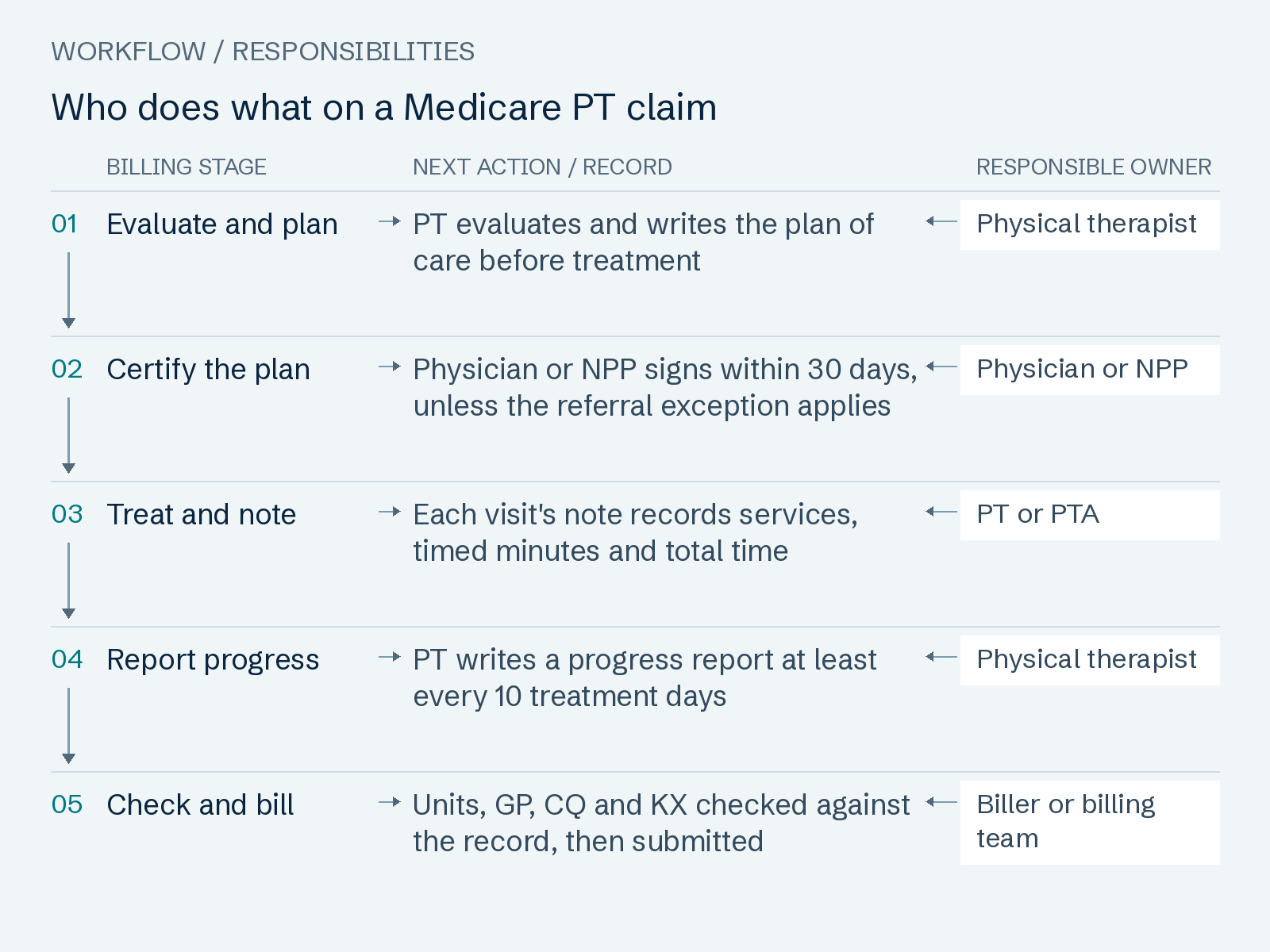
Read the workflow as text
- Evaluate and plan — PT evaluates and writes the plan of care before treatment Owner: Physical therapist.
- Certify the plan — Physician or NPP signs within 30 days, unless the referral exception applies Owner: Physician or NPP.
- Treat and note — Each visit's note records services, timed minutes and total time Owner: PT or PTA.
- Report progress — PT writes a progress report at least every 10 treatment days Owner: Physical therapist.
- Check and bill — Units, GP, CQ and KX checked against the record, then submitted Owner: Biller or billing team.
Timed vs untimed codes and the 8-minute rule
Physical therapy codes come in two kinds. An untimed code, such as a PT evaluation (97161 to 97163) or re-evaluation (97164), bills 1 unit however long it takes. A timed code, such as 97110 (therapeutic exercise) or 97140 (manual therapy), bills in 15-minute units. Chapter 5, section 20.2 sets how Medicare counts them: when more than one timed service is furnished in a day, the total timed minutes decide the number of units. One timed service alone needs at least 8 minutes to bill a unit. Evaluation minutes are untimed and are never counted in the timed minutes in the note, under chapter 15, section 220.3(C).
The table shows the Medicare ranges from the manual. The pattern repeats past 2 hours.
Two more rules from section 20.2 catch clinics out. A service performed for 15 minutes or more on its own must get at least 1 unit, so you cannot pour all the day's minutes into one code when another service ran past 15 minutes. And when two or more services each ran 7 minutes or less but total 8 or more, bill 1 unit for the service with the most minutes. Every line on a PT plan of care also carries the GP modifier; chapter 5 returns always-therapy codes that arrive without one.
For worked visits, minute by minute, see our guide to counting PT and OT billing units.
| Total timed minutes in the day | Units Medicare allows |
|---|---|
| Under 8 | 0 (not billable as a timed unit) |
| 8 to 22 | 1 |
| 23 to 37 | 2 |
| 38 to 52 | 3 |
| 53 to 67 | 4 |
| 68 to 82 | 5 |
| 83 to 97 | 6 |
| 98 to 112 | 7 |
| 113 to 127 | 8 |
KX threshold and targeted medical review
Medicare no longer caps outpatient therapy, but it keeps the old cap amounts as a threshold. The CMS Therapy Services page sets the CY 2026 KX modifier threshold at $2,480 for physical therapy and speech-language pathology combined, and a separate $2,480 for occupational therapy. The CY 2026 PFS final rule (CMS-1832-F, section II.H) finalized that amount: the CY 2025 threshold of $2,410, raised by the 2.7% Medicare Economic Index update and rounded to the nearest $10. The final rule calls these per-beneficiary amounts. Above it, a claim must carry the KX modifier, which confirms that the services are medically necessary and justified by documentation in the record. CMS states plainly that claims over the threshold without KX are denied.
How the threshold is counted per patient
The threshold follows the patient, not your clinic. Chapter 5, section 10.2 applies it to the fee schedule amount of therapy services for each beneficiary, in the order claims are received, and Medicare's Common Working File tracks the running total. Therapy a new patient received elsewhere earlier in the year therefore counts toward the same $2,480, so ask new Medicare patients about therapy they have already had this calendar year before you decide whether KX belongs on the claim.
Targeted medical review at $3,000
The Bipartisan Budget Act of 2018 also kept a targeted medical review process. CMS sets the review threshold at $3,000 for PT and speech combined and $3,000 for OT, for each year until 2028, when it starts to be indexed. Not every claim above $3,000 is reviewed; CMS selects them. A KX modifier is your clinic's attestation, so the progress reports and treatment notes behind it should read as if a reviewer will open them.
CQ modifier for PTA services
Services a physical therapist assistant furnishes are paid at a reduced rate. The CMS Therapy Services page explains the rule from the Bipartisan Budget Act of 2018: a PT service furnished in whole or in part by a PTA carries the CQ modifier, next to GP, and Medicare pays 85% of the fee schedule amount. Occupational therapy uses CO for services by an OTA.
The 10% de minimis standard and its two exceptions
CQ applies only when the PTA's minutes furnished independently of the therapist exceed 10% of the service or unit. Minutes the PTA and PT furnish together count as the therapist's. Two exceptions apply when a final unit is left to bill. If the PT furnished 8 or more minutes of that last unit, it is billed without CQ. When two units of the same service remain and the PT and PTA each furnished between 9 and 14 minutes, and their combined time is 23 to 28 minutes, one unit is billed with CQ and one without.
What it costs your clinic: one unit of 97110 has a 2026 national Medicare amount (unadjusted) of $29.06, so the same unit billed with CQ is $24.70 (our arithmetic: $29.06 x 85%). Actual payment varies by locality, setting and payer. The rate drop is correct when the note supports it; the loss comes from applying CQ to a unit the therapist actually furnished, or from leaving it off a unit the assistant furnished.
Commercial payer guidelines that differ from Medicare
Medicare's rules are the baseline your team learns, but your commercial contracts can count units, cap visits and set deadlines differently. Check each payer's policy and your contract before you apply Medicare's rules to its claims.
- Unit counting. The APTA explains that the CPT time standard bills a unit once the midpoint is passed and does not require adding up the day's minutes, unlike Medicare's total-time method. It tells clinics to check whether each payer follows the Medicare 8-minute rule, and notes that a contract stating its own rule takes precedence.
- A daily cap on timed codes. UnitedHealthcare's 2026 commercial reimbursement policy (2026R0101A) follows CMS on the 8-minute floor, but pays up to four timed units per date of service for the same specialty, in any combination. Units above four are considered on a reconsideration request. The policy excludes home and rehabilitation facility settings.
- Filing deadlines. Original Medicare allows 12 months from the date of service. Cigna allows 90 days after the date of service for participating providers and 180 days out of network, and Humana commercial allows 90 days, per our timely filing dataset compiled from each payer's own pages. A PT claim held for a missing certification can miss a 90-day limit long before it would miss Medicare's.
- Medicare Advantage. A Medicare Advantage plan is a separate payer with its own contract, policies and filing terms. Read its provider manual rather than assuming Original Medicare's KX and progress report rules decide payment.
Payer enrollment is its own prerequisite: a PT who is not yet enrolled with a plan cannot bill it in network. Our physical therapy credentialing service files those enrollments.
If you would rather hand these rules to a billing team, see our physical therapy billing services, or our therapy billing services if your clinic also bills OT and speech.
Documentation checklist
Use this checklist before a Medicare PT claim goes out. Print it, or copy it into your EHR's pre-billing task list. Each line traces to the rule above it on this page.
- Plan of care on file before treatment: diagnoses, long-term goals, type, amount, duration and frequency, signed and dated by the therapist who established it.
- Certification covers the date of service: a physician or NPP signature dated within 30 days of the first treatment, or a written order or referral plus proof the plan was delivered within 30 days of the evaluation.
- Recertification is current: signed within 90 days of the start of the plan, or sooner after a significant change in goals.
- Progress report is current: written by the PT within the last 10 treatment days, with the PT's participation in treatment documented in that period.
- Treatment note is complete: date, every service furnished (timed and untimed), total timed minutes, total treatment time and the signature of who furnished or supervised it.
- Units match the minutes: timed units fall in the Medicare range for the day's total timed minutes, and no evaluation minutes are counted as timed.
- Modifiers are right: GP on every line; CQ where the PTA furnished over 10% on their own; KX only when the patient's year-to-date therapy is above $2,480 and the record supports medical necessity.
- Payer rules checked: for non-Medicare claims, the payer's unit rule, daily caps, any authorization and the filing deadline.
When to hand the checklist to a billing team
If certifications go unsigned, progress reports slip past day 10, or KX and CQ are applied by habit rather than by the record, those are claims you will see denied or reviewed later. Our physical therapy billing services run this check on every claim before submission, chase missing certifications, and track each patient's progress toward the KX threshold. Rehab practices pay 7.5% to 6.5% of insurance payments, depending on size, with $0 setup. Month to month. Leave with 30 days' written notice. No termination fee. See the full rate card and terms, or talk to us about your clinic.
Common questions
- What are the Medicare billing guidelines for physical therapy?
- Medicare pays outpatient PT when a plan of care is established before treatment and certified by a physician or NPP (or covered by the order-or-referral exception), recertified at least every 90 days, supported by a progress report every 10 treatment days and a note for every visit. Claims count timed units by the 8-minute rule, carry GP, add KX above $2,480 in 2026, and add CQ for qualifying PTA services. The rules live in the Benefit Policy Manual, chapter 15 and the Claims Processing Manual, chapter 5.
- How often is a PT progress report required?
- At least once every 10 treatment days under chapter 15, section 220.3(D). The count starts on the first day of the episode, and the period ends on the 10th treatment day or an earlier date the therapist chooses. A PTA's report does not count as a complete progress report, and recertification dates do not reset the count.
- What is the KX threshold for 2026?
- $2,480 for physical therapy and speech-language pathology combined, and a separate $2,480 for occupational therapy, per the CMS Therapy Services page. Claims above the threshold without the KX modifier are denied. Above $3,000, CMS may select claims for targeted medical review.
- When is the CQ modifier required?
- When a PTA furnishes more than 10% of a PT service or unit independently of the therapist. Time the PTA and PT spend together counts as the therapist's. A final unit where the PT furnished 8 or more minutes is billed without CQ when the note shows those minutes. CQ lines are paid at 85% of the fee schedule amount.
- Does the 8-minute rule apply to our commercial patients?
- Only if the payer adopts it. The APTA notes that the CPT midpoint standard does not total the day's minutes, and that a contract with its own rule takes precedence. UnitedHealthcare's commercial policy follows the 8-minute floor but pays up to four timed units a day for the same specialty.
- Can our billing team handle PT certifications and the KX threshold for us?
- Yes. Our physical therapy billing service checks each claim against the plan, certification, progress report and modifiers before it goes out, and follows up on unsigned certifications. Your therapists keep writing the plan, notes and reports; the clinical record stays theirs. Month to month. Leave with 30 days' written notice. No termination fee.
Sources and review
Page revised November 5, 2026 · Review contact: Hyder Shah (inquiries@claimpillar.com). Every source below was retrieved on November 5, 2026. The Medicare amount is the 2026 national Medicare amount (unadjusted) from our copy of the CMS CY 2026 PFS relative value file; actual payment varies by locality, setting and payer. Commercial rules apply to the payer and product named; your contract can set different terms.
- CMS: Medicare Benefit Policy Manual, Chapter 15, sections 220.1.2, 220.1.3 and 220.3
- eCFR: 42 CFR 424.24(c), certification of outpatient therapy plans
- CMS: Medicare Claims Processing Manual, Chapter 5, section 20.2 (timed and untimed codes)
- CMS: Therapy Services (CY 2026 KX threshold, targeted medical review, CQ/CO)
- Federal Register: CY 2026 Physician Fee Schedule final rule (CMS-1832-F), section II.H, KX modifier thresholds
- APTA: Coding for Timed Codes
- UnitedHealthcare: Physical Medicine & Rehabilitation Maximum Combined Frequency per Day Policy, 2026R0101A
- Cigna Healthcare: Submit claims (timely filing)
- CMS CY 2026 PFS relative value file (RVU26D)