What is at risk when your biller or billing company goes?
Your practice keeps seeing patients after your biller leaves; what stops is the work that turns those visits into payments. Three exposures start costing money within weeks:
- Unbilled visits age toward each payer's filing deadline. After it passes, the payer can deny the claim outright, however correct it is.
- Denied claims sit with no correction or appeal while their own appeal windows run.
- Payments keep landing in your bank, but nobody posts them, so you cannot see what paid, what was short and what each patient owes.
Responsibility for the claims stays with your practice whoever did the work. For Medicare, the enrollment application for physicians and other practitioners puts it plainly: even if you use a billing agency, you "remain responsible for the accuracy of the claims submitted on your behalf" (CMS-855I, section 8). Staff turnover also earns no extra time from Medicare: the exceptions to its filing limit in 42 CFR 424.44(b) cover errors by Medicare or its contractors and retroactive changes to a patient's coverage, not a practice that lost its biller.
What should you do in the first week after your medical biller quits?
Run these checks in order. The owner or practice manager can run most of them without billing training; they need access to your systems, not coding knowledge. Each one tells you how much trouble the practice is in and how fast it has to move.
- Secure every login. List each system the biller or billing company used, who holds the password and whose name the account is in.
- Compare insurance deposits. Set the last 30 days of insurance deposits against the same stretch in prior months. Fewer deposits at the same patient volume can mean claims stopped going out weeks earlier.
- Find where remittances go. Electronic remittance advice (ERA) explains what each deposit pays for. Ask your clearinghouse and each large payer where ERAs are delivered today.
- Pull the unbilled list. From your practice-management system or EHR, every visit with no claim, with its date of service and payer.
- Pull open claims and denials. Every claim sent but not paid or closed, and every denial with no correction or appeal yet, with its date.
- Sort both lists by deadline. For each line, the payer's filing limit or appeal window minus the days already gone. The next section shows the arithmetic.
- Keep today's claims moving. Name who enters charges and submits new claims from tomorrow, so the backlog stops growing while you decide.
Which logins must your practice control today?
Your practice-management system, clearinghouse, payer portals, the Medicare contractor's portal and the bank's reporting access should all sit in accounts your practice owns, with a named user for each person. For Medicare electronic billing, CMS tells its contractors to inform providers that they "are not permitted to share their personal EDI access number and password with any billing agent or clearinghouse" (Medicare Claims Processing Manual, ch. 24). A billing company should submit under its own credentials and an agreement you signed. If the person who left knew your practice's own EDI password, ask your Medicare contractor how to reset it, and remove the departed user from every other system the same day.
What if your billing company is the one that went silent?
A vendor that stops answering holds your data, may receive your remittances and may still be listed on your Medicare enrollment. Work through three steps, in writing:
- Demand your data. Ask by email and letter for every open claim with its status, the denial log, payer correspondence and remittance files. HIPAA sets only a floor here: a business associate contract must provide that when the contract ends, the vendor will, "if feasible, return or destroy all protected health information" it holds for you (45 CFR 164.504(e)). Destroying the data also meets that rule, so the clause that gets your files back is the data-return clause in your own contract. Quote it in the letter.
- Confirm where the money lands. Medicare may pay a billing agent only under set conditions, and "Payment to an agent will always be made in the name of the supplier" (42 CFR 424.80(b)(5)). Check that every payer's electronic funds transfer goes to an account in your practice's name.
- Tell Medicare before you move. CMS says providers must notify their Medicare contractor "in writing in advance" of a change in billing agent or clearinghouse, including the date they stop using the old one (ch. 24). Billing agency details also sit in section 8 of your CMS-855I.
If the vendor is cooperating and you are simply leaving, the run-out and exit terms are a different job; the guide to a planned change of billing company walks through it.
| Check | Why it matters to your practice | What good looks like | Red flag |
|---|---|---|---|
| Logins | Whoever holds the logins controls your claims and payment data | Every account in the practice's name, one named user per person | Only the departed biller or vendor knows the passwords |
| Insurance deposits | Shows whether claims are still turning into cash | Deposits in line with recent months at the same patient volume | Deposits falling while the schedule is full |
| Remittance delivery | Deposits without ERAs cannot be posted or checked for underpayment | ERAs delivered to a clearinghouse or portal you control | ERAs go only to a vendor you cannot reach |
| Unbilled visits | Each one ages toward the payer's filing deadline | Every signed visit has a claim | Visits weeks old with no claim |
| Open claims and denials | Appeal windows close while nobody works them | Each line has a next action, an owner and a date | Denials with no action and no owner |
| Patient balances | Patients cannot pay balances nobody has billed | Statements going out on your usual cycle | No statements since the biller left |
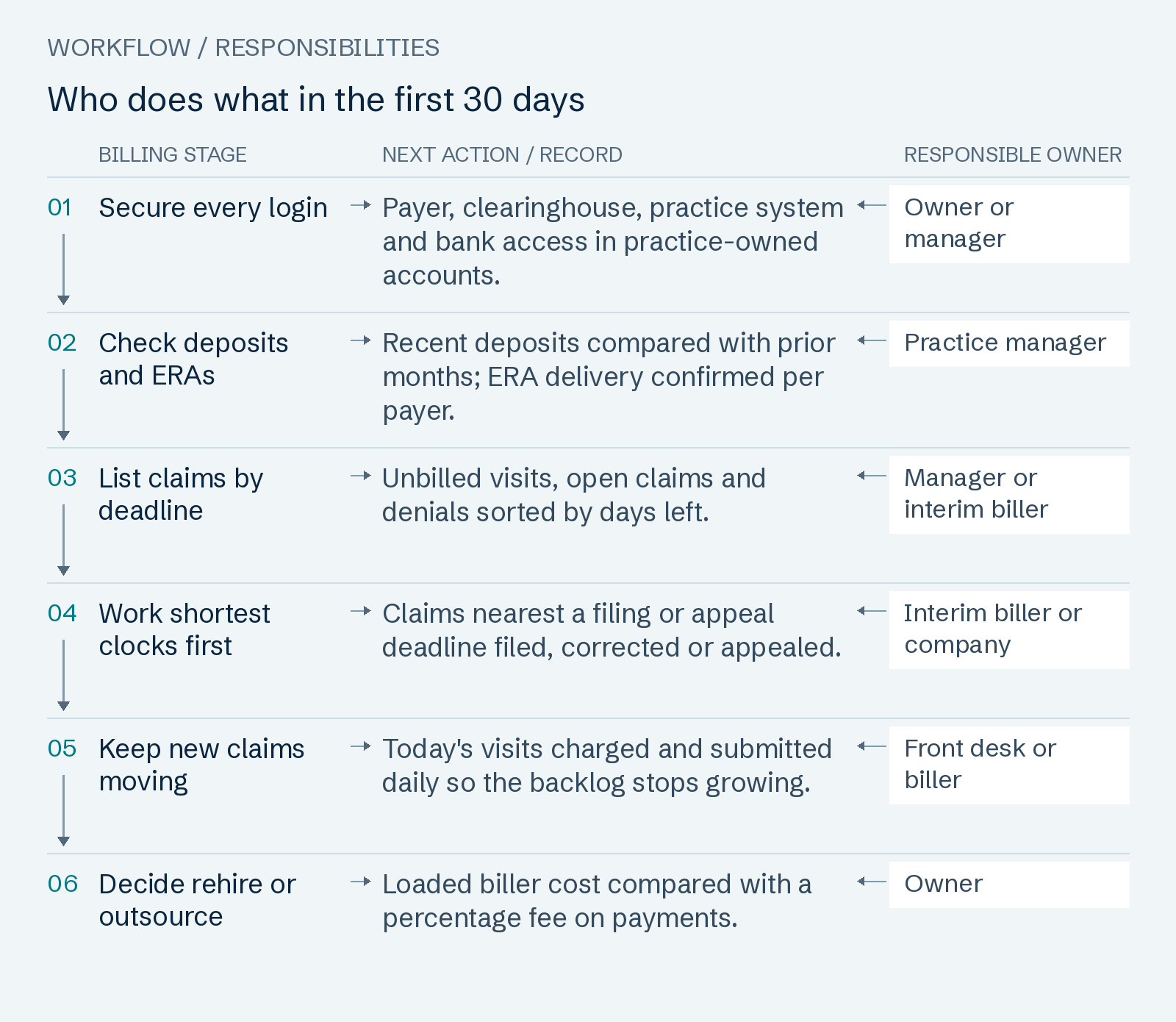
Read the workflow as text
- Secure every login — Payer, clearinghouse, practice system and bank access in practice-owned accounts. Owner: Owner or manager.
- Check deposits and ERAs — Recent deposits compared with prior months; ERA delivery confirmed per payer. Owner: Practice manager.
- List claims by deadline — Unbilled visits, open claims and denials sorted by days left. Owner: Manager or interim biller.
- Work shortest clocks first — Claims nearest a filing or appeal deadline filed, corrected or appealed. Owner: Interim biller or company.
- Keep new claims moving — Today's visits charged and submitted daily so the backlog stops growing. Owner: Front desk or biller.
- Decide rehire or outsource — Loaded biller cost compared with a percentage fee on payments. Owner: Owner.
Which claims should your practice work first?
Work the backlog in the order its deadlines expire, not by dollar amount or by age alone. A timely filing limit is the payer's deadline for submitting a claim, usually counted from the date of service, and payers set very different ones. The table is a worked example: one visit dated 45 days ago that was never billed, checked against limits that payers publish in their own manuals and provider pages (from our timely-filing dataset).
A behavioral health visit under a 60-day contract has two weeks left, while the same visit billed to Original Medicare has most of a year. Medicare claims can wait behind the 60- and 90-day payers; the short-limit payers cannot wait for a new hire to start. Limits for other payers are in our filing deadlines by payer, and the full sourced list downloads as a CSV file.
How long do you have on claims already denied?
A denial starts an appeal window that is often counted from the denial notice, not the date of service. Original Medicare allows a redetermination request "within 120 calendar days from the date a party receives the notice of the initial determination" (42 CFR 405.942). Cigna's commercial appeals of a payment or denial must be submitted within 180 calendar days of the initial payment or denial notice, and Humana gives non-participating Medicare Advantage providers 65 calendar days from the denial date (our dataset). Put denials in the same deadline-sorted list as unbilled visits, so one list decides the order of work.
Claims that are already past 90 days need a recovery plan of their own; see what to do about claims over 90 days.
| Payer and plan | Published filing limit | Days left on a 45-day-old visit (example) | What can change it |
|---|---|---|---|
| Magellan Healthcare, behavioral health network | 60 days under most provider contracts | 15 (60 − 45) | Your contract or a state mandate |
| Humana, commercial | 90 days from the date of service | 45 (90 − 45) | A state mandate or your contract |
| Cigna Healthcare, commercial, participating | 90 days after the date of service | 45 (90 − 45) | Applicable law or your agreement |
| Optum Behavioral Health | 90 calendar days from the date of service | 45 (90 − 45) | State or federal law, or the member's plan |
| Wellcare Medicare Advantage, participating | 180 calendar days (95 days for Texas plans) | 135 (180 − 45); 50 in Texas | Your provider agreement |
| Original Medicare (Part A and B) | 1 calendar year after the date of service | About 320 (365 − 45) | Only the exceptions in 42 CFR 424.44(b) |
What do you do with what you find?
The deadline-sorted list decides how much help you need. If nothing is due for weeks, your own staff can catch up; if dozens of claims are inside their last month, you need trained hands this week. Whichever option you pick, give that person the list and review it with them every week until it is empty. If you are choosing a new vendor under pressure, use the questions to ask a replacement billing company before you sign.
| Option | When it fits | What it costs your practice | What can go wrong |
|---|---|---|---|
| Fix it in-house | Small backlog, no deadline inside a few weeks, someone who knows your system | Staff hours and overtime | Daily work crowds out follow-up; deadlines pass unnoticed |
| Ask your billing company to catch up | It still answers and the gap is staffing on its side | Its contract fee; ask whether catch-up work costs extra | Promises without a dated claim list; the same delays return |
| Bring in a temporary biller | You plan to rehire and need cover for the gap | Hourly pay, plus your time to grant access and explain your payers | A newcomer learning your payers while deadlines run |
| Hand it off to a billing company | Large backlog, near deadlines, nobody trained in-house | A percentage of insurance payments, sometimes a separate rate for old claims | Work starts only after logins and a signed BAA are in place |
Should you rehire or outsource, and what does each cost?
Rehiring and outsourcing both need a backup plan: identify who keeps claims moving when the primary biller is absent. Compare each option on monthly cost, coverage and who owns the backlog before you post a job ad or sign a vendor agreement.
An employed biller costs more than the wage. Billing and posting clerks earned a median $48,500 a year in May 2025 (BLS Occupational Outlook Handbook), which is $4,042 a month. In June 2026, benefits made up 30.0% of private-industry employer compensation costs (BLS Employer Costs for Employee Compensation), so the loaded cost is about $5,774 a month ($4,042 ÷ 0.70), before software, the clearinghouse and cover for vacations. Our in-house cost model shows the loaded biller arithmetic and where the break-even falls.
- Rehire when your claim volume needs a full-time person, you can cover the weeks of hiring and training, and someone else in the practice can step in the next time a biller is out.
- Outsource when one biller was your only coverage, the backlog holds claims close to their deadlines, or a percentage of payments costs less than a loaded salary at your volume.
If neither fits cleanly, find your practice's row in which billing model fits your practice.
When should you hand the backlog off?
Hand the backlog off when your deadline-sorted list holds claims within 30 days of a limit and nobody in your practice has the hours to work them this week. Our full-service medical billing starts with those claims: Every inherited claim within 30 days of a filing, corrected-claim or appeal deadline is worked within 5 business days of access. Starts at access; covers up to 250 claims (more gets a day-1 deadline schedule); worked means submitted, corrected, appealed or returned with the fix.
Not ready to choose? Send a claim-level aging export and get every unpaid claim over 90 days sorted by its deadline. Clock starts with your claim-level aging export and signed BAA; above 10 requests in a week, we confirm your date within 1 business day. Rates by specialty and practice size are on our rate card.
Common questions
- What should we do first when our biller quits?
- Secure access before anything else: move every payer, clearinghouse, practice-management and bank login into accounts your practice owns, and remove the departed user. Then compare recent insurance deposits with prior months and list unbilled visits and open claims by deadline. A job ad can wait a week; a 60-day filing limit cannot.
- How do we get our claims data back from a billing company that went silent?
- Ask in writing, by email and letter, for every open claim with its status, the denial log, payer correspondence and remittance files, and quote your contract's data-return clause. HIPAA requires a business associate contract to provide for returning or destroying your protected health information when the contract ends, where feasible (45 CFR 164.504(e)); destruction also meets that rule, so your contract's own return clause is what gets the files back. Meanwhile, rebuild the open-claims list from your own system, payer portals and remittances.
- How long do we have to bill the visits our biller never sent?
- It depends on the payer and your contract. Original Medicare allows 1 calendar year after the date of service (42 CFR 424.44); Humana commercial lists 90 days, and Magellan 60 days under most provider contracts. Your contract or state law can change a limit, so check the short ones first in our payer filing deadlines.
- Can our front-desk staff keep billing until we decide?
- They can keep new claims going out if they have clearinghouse access and someone reads the rejection reports every day. Denials, appeals and old claims need trained follow-up; give those to whoever takes the backlog, with the deadline-sorted list.
- Do we have to tell Medicare when our billing company changes?
- Yes. CMS says providers must notify their Medicare contractor in writing in advance of a change in billing agent or clearinghouse, including the date they stop using the old one (Medicare Claims Processing Manual, ch. 24). Billing agency details also sit in section 8 of the CMS-855I enrollment application.
- Should we hire a new biller or outsource billing?
- Compare monthly cost and coverage. One billing clerk at the BLS median wage costs about $5,774 a month with benefits, before software and cover; a billing company charges a share of insurance payments. Ask either an employee plan or a billing company who covers the work when its primary biller is absent; a vendor without backup can leave the same gap.
- What does it cost to clear a billing backlog?
- It depends on who works it: staff overtime, a temporary biller's hourly pay, or a billing company's fee, which may be higher for old claims; get that rate in writing. Ours: For inherited claims 90+ days past the date of service: 15% of the insurance payments that post after we work them, and $0 on claims that never pay. Fee only on insurance payments posting after our logged action; patient payments 0%; full-service clients stay under the 9.0% fee cap. Our pricing page lists the rest.
Sources and review
Page revised October 7, 2026 · Review contact: Hyder Shah (inquiries@claimpillar.com). Commercial and Medicare Advantage filing limits and appeal windows come from our timely-filing dataset, each value quoted from the payer's own document and retrieved 2026-10-02; your contract or state law can change them. Federal sources were checked 2026-10-07.
- CMS-855I Medicare enrollment application (section 8, billing agency)
- CMS Medicare Claims Processing Manual, Chapter 24 (EDI)
- eCFR: 42 CFR 424.44, time limits for filing claims
- eCFR: 42 CFR 405.942, time frame for filing a redetermination
- eCFR: 42 CFR 424.80, payment to a billing agent
- eCFR: 45 CFR 164.504(e), business associate contracts
- BLS Occupational Outlook Handbook: Financial Clerks (pay, May 2025)
- BLS: Employer Costs for Employee Compensation, June 2026