What does a medical billing company do, and what stays with your practice?
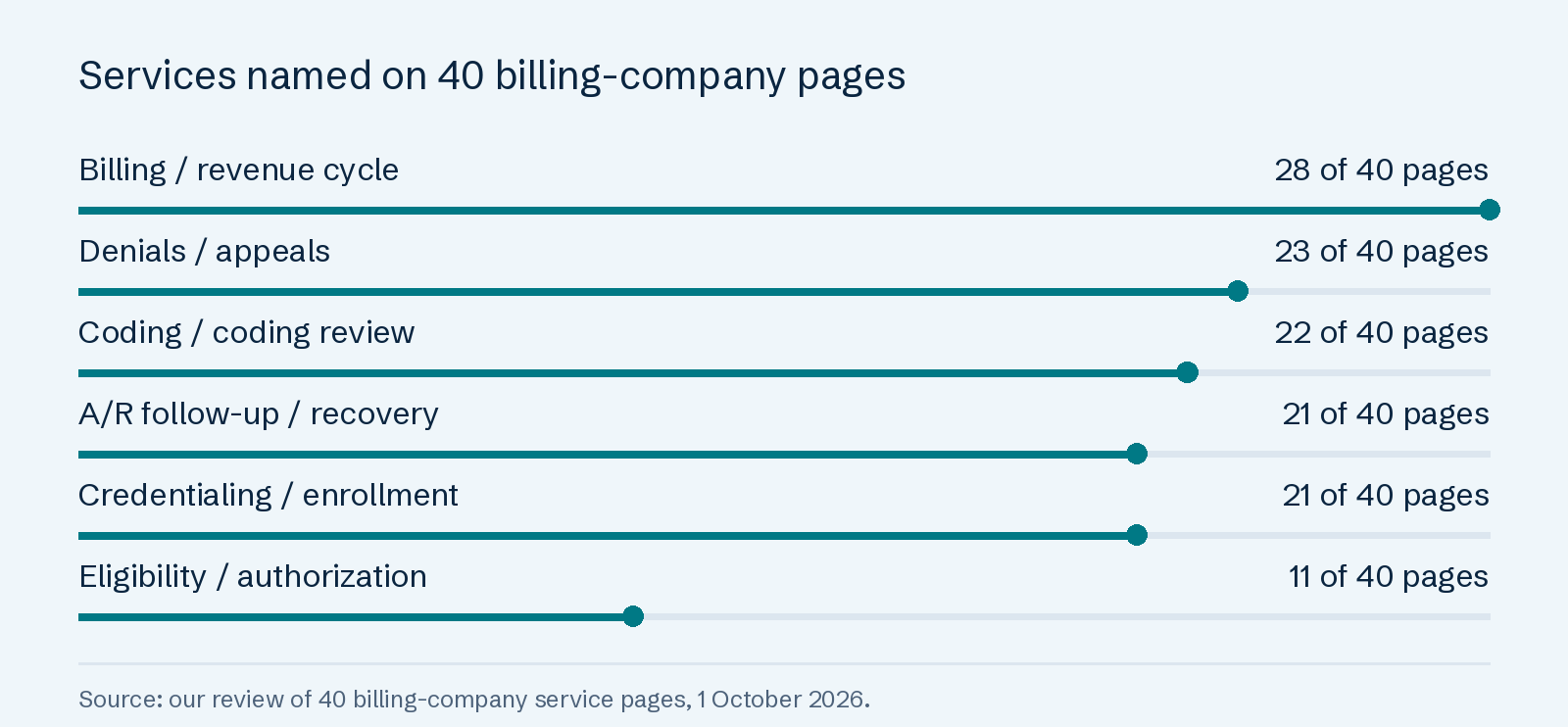
A medical billing company submits your claims, posts the payments, works denials and follows up on unpaid insurance balances. Coding, credentialing and eligibility checks may or may not be included, so the same label can describe very different scopes. In our purposive review of 40 selected provider pages on October 1, 2026, billing or revenue cycle management was recorded on 28 and eligibility or authorization on 11. The source-linked sample and coding rules explain what was counted; a missing mention does not mean the provider does not offer the work.
Your practice keeps the work that sits in your building and your notes: clinical documentation, signing off encounters, collecting copays at the front desk and answering coding questions about your own notes. HHS-OIG's 1998 compliance guidance for third-party billing companies recommends that the written contract enumerate those functions that are shared responsibilities and those that are the sole responsibility of either the billing company or the provider
(63 FR 70138). Ask for that list before you compare fees.
Separate patient statements from insurance follow-up in that scope list. Our patient statement service describes the statement and billing-question handoff, including the decisions your practice retains.
| Function | Named on (of 40 pages) | Ask each candidate |
|---|---|---|
| Billing / revenue cycle management | 28 | Which claim, posting and follow-up tasks are in the fee? |
| Denials / appeals | 23 | Are denials appealed, or only resubmitted? |
| Coding / coding review | 22 | Who codes, and who answers documentation questions? |
| A/R follow-up / recovery | 21 | Is A/R older than your start date included, and at what fee? |
| Credentialing / enrollment | 21 | Is enrollment in the fee or priced per payer? |
| Eligibility / authorization | 11 | Who checks coverage and tracks authorizations before visits? |
What does the 40-page service sample actually measure?
On October 1, 2026, we recorded one selected page for each of 40 provider domains found through eight US-targeted service searches. Some selections were homepages; others focused on one service or specialty. Discovery position was not a verified Google ranking. This purposive sample describes the wording on those selected pages, not the full services, quality or market share of each provider.
We manually assigned the six categories below to explicit service descriptions in the saved observations. A provider can appear in several categories, but only once in each. A missing category means it was not recorded on that sampled page; it does not establish that the company does not offer the service.
- Billing / RCM: Explicit billing or RCM offer; includes a described claim submission/payment-posting bundle. Not proof every RCM task is included.
- Denials / appeals: Explicit denial management, appeals, prevention or denial-linked recovery. Generic AR work alone does not qualify.
- Coding / coding review: Explicit medical coding, code validation or coding audit, including specialty/facility work. Generic auditing without a coding tag does not qualify.
- AR follow-up / recovery: Explicit AR management, follow-up, cleanup or recovery. General reporting, denial prevention or billing alone does not qualify.
- Credentialing / enrollment: Explicit provider credentialing or payer enrollment offer. A billing offer or software implementation alone does not qualify.
- Eligibility / authorization: Explicit insurance eligibility/benefits verification or prior authorization support. Provider enrollment is classified separately.
Inspect the 40 historical source pages and category assignments
| Sampled source page | Observation date | Assigned categories |
|---|---|---|
| Medical Billers and Coders | 2026-10-01 | Billing / RCM; Denials / appeals; Coding / coding review; AR follow-up / recovery; Credentialing / enrollment |
| MedCare MSO | 2026-10-01 | Billing / RCM; Denials / appeals; Coding / coding review; Eligibility / authorization |
| BillingParadise | 2026-10-01 | Billing / RCM; Denials / appeals; Coding / coding review; AR follow-up / recovery |
| DrCatalyst | 2026-10-01 | Billing / RCM; Coding / coding review; AR follow-up / recovery; Credentialing / enrollment; Eligibility / authorization |
| 3Gen Consulting | 2026-10-01 | Billing / RCM; Coding / coding review; AR follow-up / recovery; Credentialing / enrollment |
| HealthCare Resolution Services | 2026-10-01 | Coding / coding review |
| TruBridge | 2026-10-01 | Denials / appeals; Coding / coding review |
| PCH Health | 2026-10-01 | Denials / appeals; Coding / coding review |
| K&K Healthcare Solutions | 2026-10-01 | Coding / coding review |
| MBW RCM | 2026-10-01 | Billing / RCM; Denials / appeals; Coding / coding review; AR follow-up / recovery |
| CodeEMR / Nivaran announcement | 2026-10-01 | Billing / RCM; Coding / coding review |
| Behavioral Health Billing Solutions | 2026-10-01 | Billing / RCM; Credentialing / enrollment |
| Credex Healthcare | 2026-10-01 | Billing / RCM; Credentialing / enrollment |
| Plutus Health | 2026-10-01 | Billing / RCM; Denials / appeals; Coding / coding review; Eligibility / authorization |
| Resilience Billing | 2026-10-01 | Billing / RCM; Denials / appeals; AR follow-up / recovery; Credentialing / enrollment; Eligibility / authorization |
| Behavioral Health Billing Collaborative | 2026-10-01 | Billing / RCM; AR follow-up / recovery; Eligibility / authorization |
| TheraThink | 2026-10-01 | Billing / RCM |
| AnnexMed | 2026-10-01 | Denials / appeals; AR follow-up / recovery |
| CompuGroup Medical / ARIA RCM | 2026-10-01 | Billing / RCM; Denials / appeals; Coding / coding review; AR follow-up / recovery; Credentialing / enrollment; Eligibility / authorization |
| CureMD | 2026-10-01 | Billing / RCM; AR follow-up / recovery; Credentialing / enrollment |
| MediBillMD | 2026-10-01 | Billing / RCM; Denials / appeals; Coding / coding review; AR follow-up / recovery; Credentialing / enrollment |
| DoctorsManagement | 2026-10-01 | Credentialing / enrollment |
| Med USA | 2026-10-01 | Credentialing / enrollment |
| Physician Practice Specialists | 2026-10-01 | Credentialing / enrollment |
| BerryDunn | 2026-10-01 | Credentialing / enrollment |
| Sullivan Management & Consulting Group | 2026-10-01 | Credentialing / enrollment |
| Pinnacle Healthcare Revenue Solutions | 2026-10-01 | Billing / RCM; Denials / appeals; Coding / coding review; AR follow-up / recovery; Credentialing / enrollment |
| Optum | 2026-10-01 | Denials / appeals; AR follow-up / recovery |
| Precision Practice Management | 2026-10-01 | Denials / appeals; AR follow-up / recovery |
| SybridMD | 2026-10-01 | Billing / RCM; Denials / appeals; Coding / coding review; AR follow-up / recovery; Credentialing / enrollment; Eligibility / authorization |
| Physical Therapy Billing Services (.net) | 2026-10-01 | Billing / RCM; Denials / appeals; AR follow-up / recovery; Credentialing / enrollment |
| PT Billing Services (.com) | 2026-10-01 | Billing / RCM |
| BSI Medical Billing | 2026-10-01 | Billing / RCM; Coding / coding review; AR follow-up / recovery; Credentialing / enrollment |
| Larsen Billing | 2026-10-01 | Billing / RCM; Denials / appeals; AR follow-up / recovery; Credentialing / enrollment |
| StrataPT | 2026-10-01 | Billing / RCM; Denials / appeals; Eligibility / authorization |
| Medlife | 2026-10-01 | Billing / RCM; Denials / appeals; Coding / coding review; Eligibility / authorization |
| BellMedEx | 2026-10-01 | Billing / RCM; Denials / appeals; Coding / coding review; AR follow-up / recovery; Credentialing / enrollment; Eligibility / authorization |
| Mediknocx | 2026-10-01 | Billing / RCM; Denials / appeals; Coding / coding review; AR follow-up / recovery; Eligibility / authorization |
| Healthcare Administrative Partners | 2026-10-01 | Billing / RCM; Denials / appeals; Coding / coding review; AR follow-up / recovery |
| Ventra Health | 2026-10-01 | Billing / RCM; Denials / appeals; Coding / coding review; Credentialing / enrollment |
How to choose a medical billing company: the checks to run
A billing company earns a place on your shortlist by answering eight checks in writing, before price decides anything. Send every candidate the same list, and file each answer next to the document that proves it. A candidate that cannot produce the document has not passed the check, however good the sales call felt.
- Scope in writing. A task list marked included, excluded or kept by your practice.
- Who works your account. A named contact, a backup and a reply time.
- Coding questions go to your clinician. OIG says that when documentation is ambiguous or conflicting, the billing company should contact the provider for clarification (OIG guidance).
- Payments land in your account. Payer deposits reach your practice's bank account, not the company's.
- Reports with written definitions. A blank sample report and the formula behind each number.
- A working compliance program. OIG lists seven elements, from written policies and a designated compliance officer to internal monitoring and corrective action. Ask who the compliance officer is.
- A BAA before any patient data. Plus the names of any subcontractors that will see your records.
- A written exit. Notice period, termination fee, run-out and the data you get back, in the contract itself.
Where your payer payments land
Payer deposits should land in your practice's own bank account. For Medicare fee-for-service, the Medicare Claims Processing Manual (chapter 1, §30.2.4) lets Medicare pay a billing agent in the provider's name only when the agent's pay is not related in any way to the dollar amount billed or collected
and does not depend on collection, among other conditions. CMS says those conditions do not apply when the agent merely prepares bills
and does not receive and negotiate the payments (CMS manual, chapter 1). If a company paid a percentage proposes to receive your Medicare payments, ask it in writing how that arrangement meets the rule.
Reports you can check, and targets in the contract
Ask how the company calculates net collection rate (payments ÷ (charges − contractual adjustments)) and A/R days (total A/R ÷ average daily charges), and which claims it leaves out. A clean-claim or collection figure in a proposal means little without its denominator and period. Then ask which targets are written into the contract and what happens when one is missed; a target that lives only in the sales deck is not a commitment.
| Check | Why it matters to your practice | What good looks like | Red flag |
|---|---|---|---|
| Scope in writing | Work nobody owns stops getting done, and you find out from aging A/R. | A task list in the contract: theirs, yours and shared. | "Full-service" with no task list. |
| Who works your account | You need someone who answers when cash drops. | A named contact, a backup and a stated reply time. | "Our team handles it" and no name. |
| Coding questions | A code changed without your clinician is a compliance risk to your practice. | Questions go back to the clinician; codes change only with sign-off. | Codes edited to get claims paid, no query log. |
| Where payments land | For Medicare fee-for-service, an agent paid on what it bills or collects may not receive your payments in your name. | Deposits land in your bank account; the company invoices you. | A percentage-paid company receives your Medicare payments. |
| Report definitions | You can only judge the work with numbers you can check. | A blank sample report with formulas and exclusions. | Dashboard totals with no definitions. |
| Compliance program | OIG warns an ineffective program can expose the company's provider clients to liability. | A named compliance officer and written policies. | Nobody can name the compliance officer. |
| BAA and subcontractors | Your patients' records leave your building. | BAA signed before any data moves; subcontractors named. | Asks for patient data before a BAA. |
| A written exit | Leaving should not cost more than staying. | Notice, fees, run-out and data return in the contract. | Export fee or timeline "to be agreed". |
Read the workflow as text
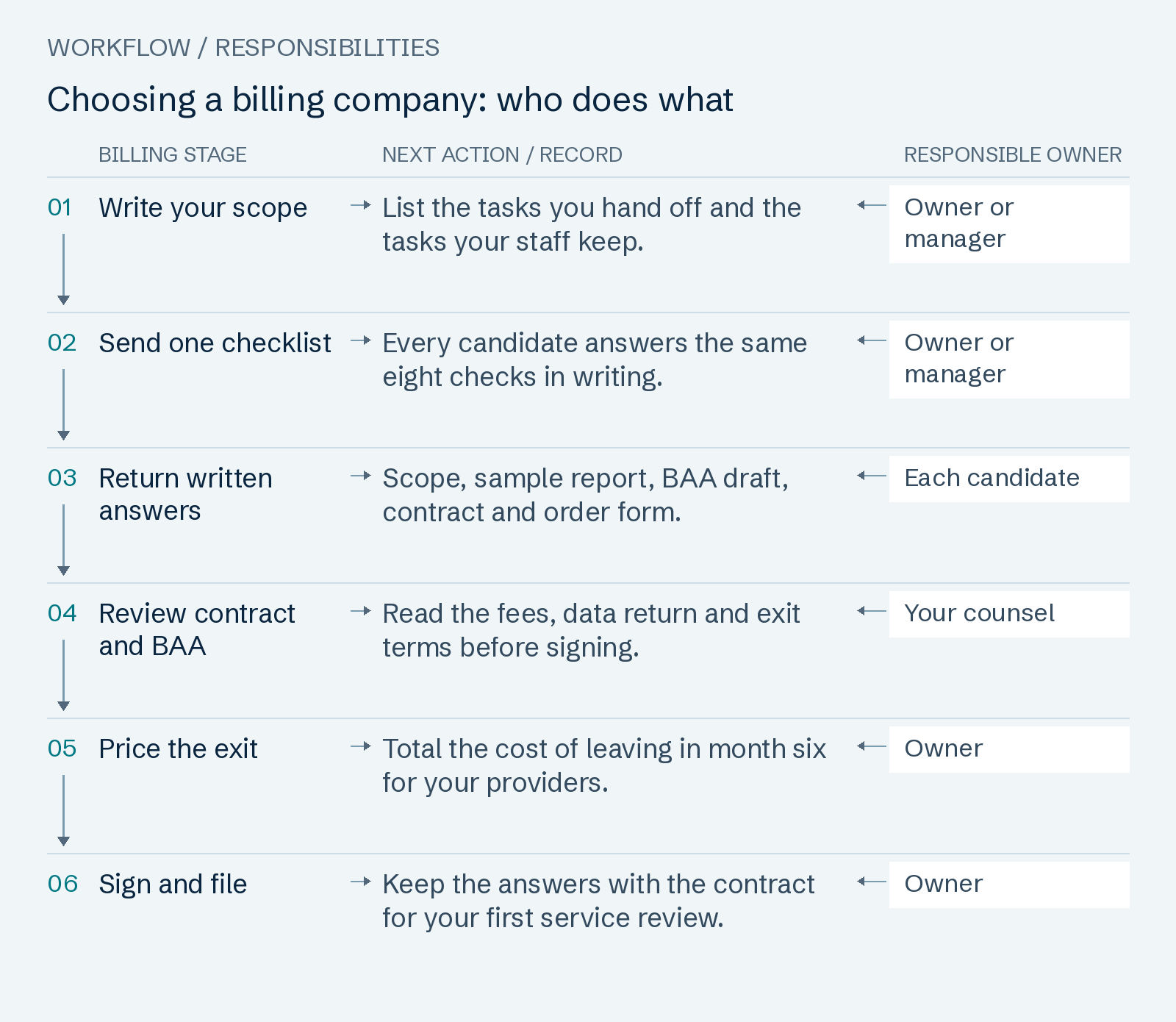
- Write your scope — List the tasks you hand off and the tasks your staff keep. Owner: Owner or manager.
- Send one checklist — Every candidate answers the same eight checks in writing. Owner: Owner or manager.
- Return written answers — Scope, sample report, BAA draft, contract and order form. Owner: Each candidate.
- Review contract and BAA — Read the fees, data return and exit terms before signing. Owner: Your counsel.
- Price the exit — Total the cost of leaving in month six for your providers. Owner: Owner.
- Sign and file — Keep the answers with the contract for your first service review. Owner: Owner.
What should the billing contract say before you sign?
Nine contract terms decide what a billing agreement costs over its life and what leaving would cost. Read each one in the signed agreement and its order form, because the signed documents govern, not the proposal summary. The last column gives our own term, so you can hold us to the same list.
Separate the payer's fee from the credentialing fee
A credentialing invoice can combine the billing company's fee for preparing and following the application with any fee the payer charges to apply. For Medicare, CMS says physicians, non-physician practitioners and physician organizations do not pay an enrollment application fee, while institutional providers and suppliers such as DMEPOS suppliers generally do; the 2026 fee is $750 (CMS provider enrollment). That covers Medicare only; ask commercial plans and your state Medicaid program about their own fees. The credentialing cost guide breaks down the rest.
Get the cost of leaving in the signed documents
Ask each candidate to calculate the total cost of leaving in month six at your current provider count: termination fee, charges for the remaining months, run-out fee and export charge. A number written in the order form is a term; a number said on a call is not. The plan for switching billing companies lists what to export when that day comes.
| Contract term | Why it matters | Ask before signing | Our term |
|---|---|---|---|
| Initial term | A multi-year term commits you to the fee and the service for the whole period, whether or not the work meets expectations. | How long is the first term, and is it set in the order form or the master agreement? | Month to month. Leave with 30 days' written notice. No termination fee. |
| Auto-renewal and price changes | An automatic renewal can restart a full term if notice misses a window, and a renewal can bring a new rate. | What notice stops renewal, by what date, and can the rate rise at renewal? | See initial term. Your rate-card rate can't rise for 12 months from your start date; size-band changes still apply; later changes need 60 days' written notice. |
| Early-termination fee | A fee per provider, or a charge for the remaining months, can cost more than staying and keeps you in a contract that no longer works. | What would leaving early cost, calculated for our provider count? | Clean-Exit Terms: Leave with 30 days' notice and no termination fee. Want a run-out? We keep working the claims we submitted for 90 days at your plan rate. Decline it and we charge nothing on payments that post after you leave. Notice by email; optional run-out covers claims we submitted before your exit date, at your plan rate; handover file within 10 business days of exit. |
| Minimum fee per provider | A per-provider minimum charges each clinician a floor even in a slow month, so a part-time or new clinician's minimum can exceed the percentage fee on that clinician's claims. | Is there a monthly minimum, per provider or per practice, and from which invoice? | Invoices 1–3: only percentage fees on that month's insurance payments, plus any statements or add-ons you order. Percentage fees and mailed statements are capped at 9.0% of that month's insurance payments; from invoice 4, the $400 minimum applies even in a month when the cap comes to less. |
| Fee base and patient payments | The same percentage costs more when it is taken on copays and patient payments your front desk collects as well as on insurance payments. | What exactly is the percentage taken on, and what is excluded? | Your fee is a percentage of insurance payments posted on claims we submitted or worked, net of payer recoupments and refunds. We take 0% of patient payments, copays and anything your front desk collects. Not in the fee base: patient payments, copays, capitation, incentive or grant payments, and payments on claims we never submitted or worked. |
| Exclusivity | An exclusivity clause can stop you hiring a second company for an old A/R project or a specialty the first company does not cover. | Can we use another billing company for any work during the term? | Any commitment to us ends with your notice (30 days); see initial term. |
| Run-out after you leave | Claims submitted before the exit date can still pay or deny after it. The contract decides who works them, at what fee, and whether you can decline. | Who works claims submitted before exit, for how long, at what fee, and can we say no? | Optional run-out of 90 days. Notice by email; optional run-out covers claims we submitted before your exit date, at your plan rate; handover file within 10 business days of exit. |
| Data-export fee | Claim history, the denial log and payer correspondence are what the next company needs on day one; a fee or delay to release them is a fee to leave. | What data comes back, in what format, by when and at what charge, written into the contract? | Handover file within 10 business days of exit: Every open claim with its status and next action, the denial log, payer correspondence and credentialing files, in CSV and PDF. |
| Credentialing refunds | A payer can deny an application or keep its panel closed. If the credentialing fee is owed anyway, you pay for an enrollment you did not get. | Is the credentialing fee refunded, or never charged, if the payer denies or the panel is closed? | Credentialing & Payer Enrollment: $149 per payer. Billed only after the payer confirms your effective date; $0 if denied or panel closed; filed within 5 business days of your complete packet. |
Who holds your patient data, and can you take it with you?
A billing company that handles your claims is your business associate: the HIPAA definition names billing and practice management among the functions that make a company one (45 CFR 160.103). The business associate agreement must require it to report any use or disclosure the contract does not allow, including breaches of unsecured protected health information, to bind its subcontractors to the same restrictions, and, at termination and if feasible, to return or destroy all protected health information
it still holds (45 CFR 164.504(e)).
What to check in the BAA
Ask who signs it, which subcontractors will see your records, and which files come back at exit, in what format and by when. Have your privacy lead or counsel read it; this checklist is not legal advice. The service agreement itself should set the format, timing and price of the billing export.
EHR-vendor billing or an independent company
Billing sold by your EHR vendor fits a practice that is replacing its software anyway and wants one contract; an independent company fits one that wants to change billing companies later without a software migration. Certified health IT must be able to export all the electronic health information the certified product can store, for one patient or for your whole patient population, and ONC notes this could require action or support on the part of the health IT developer
(ONC (b)(10) guide). The federal information-blocking fees exception does not cover a fee for that export for the purposes of switching health IT
, or an export fee not agreed to in writing at the time the technology was acquired
(45 CFR 171.302). Whether a given fee breaks those rules is a legal question. We are the independent kind: We work inside your existing practice-management system and clearinghouse; tell us which ones and we confirm in writing within 1 business day.
A candidate's answer falls short: what are your options?
A gap in one answer does not have to end the evaluation, but it has to end with a written fix, a task your staff keep, or a different company. Do not average a missing answer away because the rest of the presentation scored well: an unanswered scope, payment or exit question is still open on the day you sign. If you cannot yet describe what is going wrong in your billing, a defined billing review can come before any ongoing contract.
| Option | When it fits | Who does the work | What can go wrong |
|---|---|---|---|
| Ask the candidate to fix it in writing | The gap is a missing document or an unclear term. | The candidate, reviewed by you or your adviser. | The fix lands in an email, not the contract. |
| Keep that task in-house | Your staff already do it well, such as front-desk collections. | Your staff, with the handoff written into the scope. | Nobody owns the handoff, and work falls between you. |
| Choose a different company | The gap is in payments, the BAA or the exit terms. | You, rerunning the same checklist with the next candidate. | Delay while your current A/R keeps aging. |
What should you ask about price before you sign?
When a quote is a percentage, the first question is what the percentage is taken on: insurance payments only, or copays and patient payments too. Then ask about a monthly minimum, a cap, setup and anything billed as an extra. The guide to medical billing cost compares two quotes on the same month. Our Full-Service Billing is 5.0%–8.5% of insurance payments by specialty and practice size, with setup at $0. Invoices 1–3: only percentage fees on that month's insurance payments, plus any statements or add-ons you order; the $400 minimum starts with invoice 4. Every rate is on our pricing page.
When should you hand billing to a company?
Hand billing to a company once one candidate has answered all eight checks in writing and the cost of leaving is priced in its order form; until then the shortlist is not finished. ClaimPillar's medical billing services are built for independent practices of 1 to 15 clinicians. Our outsourced medical billing service answers the same checks, with its fee base, exit and data terms in one table of terms. Every payment goes straight to your practice's own bank account. We never receive, deposit or endorse your payments; we invoice you once a month. If you want to see your exposure first, The Free A/R Deadline Map sorts your unpaid claims over 90 days by the deadline each one faces. Clock starts with your claim-level aging export and signed BAA; above 10 requests in a week, we confirm your date within 1 business day. request the deadline map. If your biller has already gone, start with what to do the week your biller quits.
Still deciding whether to outsource at all? The in-house vs outsourced billing comparison sets out the break-even.
If you run a PT, OT or speech practice, compare that proposal with the physical therapy billing scope before assuming a general billing package covers your clinic’s work.
Common questions
- What questions should I ask a billing company before signing?
- Ask the eight checks: what is in scope, who works your account, how coding questions reach your clinician, where payments land, how reports are defined, who runs compliance, when the BAA is signed and what leaving costs. Get each answer in writing; the checklist table shows what good looks like.
- What does a medical billing company do, and what stays with our practice?
- It submits claims, posts payments, works denials and follows up on unpaid insurance balances; coding, credentialing and eligibility checks vary by company. Your practice keeps documentation, encounter sign-off, front-desk collections and answers to coding questions.
- What should a billing contract say about termination and our data?
- The notice period, any termination fee, who works claims submitted before your exit and at what fee, and which data comes back, in what format, by when and at what charge. The nine-term table gives the question for each.
- What performance targets should a billing company commit to in writing?
- Ask for turnaround times on claim submission, payment posting and denial work, a monthly report date, and what happens when a target is missed. Ours: Payments posted within 2 business days of the remittance, emails answered within 1 business day, and the KPI report with written definitions by the 10th. Terms of our Clock-or-Credit Guarantee: Mon–Fri ET business days by your system's timestamps; worked: resubmitted, appealed or returned with the fix; auto-credited; capped at monthly fee; clearinghouse outages excluded. On the terms above: From go-live, every new claim goes out within 1 business day of complete charge data, and every denial is worked within 2 business days of posting — or $25 comes off your invoice for each late one.
- Does the billing fee include coding and credentialing?
- Not always. Ask each candidate to mark coding, credentialing, old A/R and patient statements as included, priced separately or excluded. Included in our fee: We check every code against your clinician's documentation and never change a code without the clinician's sign-off. Credentialing is separate: $149 per payer (Billed only after the payer confirms your effective date; $0 if denied or panel closed; filed within 5 business days of your complete packet.).
- What are red flags in a billing proposal?
- "Full-service" with no task list, performance figures with no definitions, a request for patient data before a BAA, payments routed through the company's account, and exit or export fees left "to be agreed".
- Should I use my EHR vendor for billing or an independent company?
- Your EHR vendor can fit if you are replacing software anyway and want one contract. An independent company fits if you want to keep your software and be able to change billing companies without migrating it. Either way, get the billing term, exit fee and data-export price in writing.
Sources and review
Page revised October 8, 2026 · Review contact: Hyder Shah (inquiries@claimpillar.com). The chart records the October 1, 2026 purposive sample. All 40 selected pages and the category rules are listed in the sample section. This October 8 revision exposes that method; it does not claim a new service survey or a fresh check of every regulatory reference below.
- HHS-OIG: Compliance Program Guidance for Third-Party Medical Billing Companies (63 FR 70138, 1998)
- CMS: Medicare Claims Processing Manual, Chapter 1 (§30.2.4 Payment to Agent)
- eCFR: 45 CFR 160.103 Definitions (business associate)
- eCFR: 45 CFR 164.504(e) Business associate contracts
- ONC: §170.315(b)(10) Electronic Health Information export, certification companion guide
- eCFR: 45 CFR 171.302 Fees exception
- CMS MLN9658742: Medicare Provider Enrollment (application fee)
Correction notes
- : Added all 40 observed source pages and category rules. Clarified that missing service wording on a selected page does not prove the provider does not offer that service.