Dermatology billing we handle for your practice
Our dermatology billing service is built for independent medical dermatology clinics, Mohs surgeons and practices that also run a cosmetic side, from one dermatologist to a group of 6–15 clinicians. Practices hand off billing when signed procedure notes pile up unbilled, when Mohs and repair claims come back paid short, or when nobody can say which denials the current biller worked. We check every code against your clinician's documentation and never change a code without the clinician's sign-off.
| Task | What we do | What you keep |
|---|---|---|
| Charge capture | Match every procedure on the schedule to a signed note and chase missing notes by name | Signing notes promptly |
| Lesion and Mohs coding | Check lesion type, body area, excised diameter, stages and blocks against each note | Final say on every code |
| Same-day visits | Send a visit with a procedure only where the note shows separate work | Documenting that separate exam |
| Cosmetic vs covered | Check each benign removal for a documented medical reason before it goes to Medicare | Cosmetic pricing and patient conversations |
| Pathology and in-office lab | Link each specimen to its lesion and bill only what your practice performed | Your choice of dermatopathology lab |
| Biologic authorizations | Track approval end dates; renewal requests are on Complete RCM | Prescribing decisions and chart notes |
| Denials, posting and reporting | Denials worked within 2 business days; remittances posted within 2 business days; KPI report by the 10th of each month | Every payment lands in your own bank account |
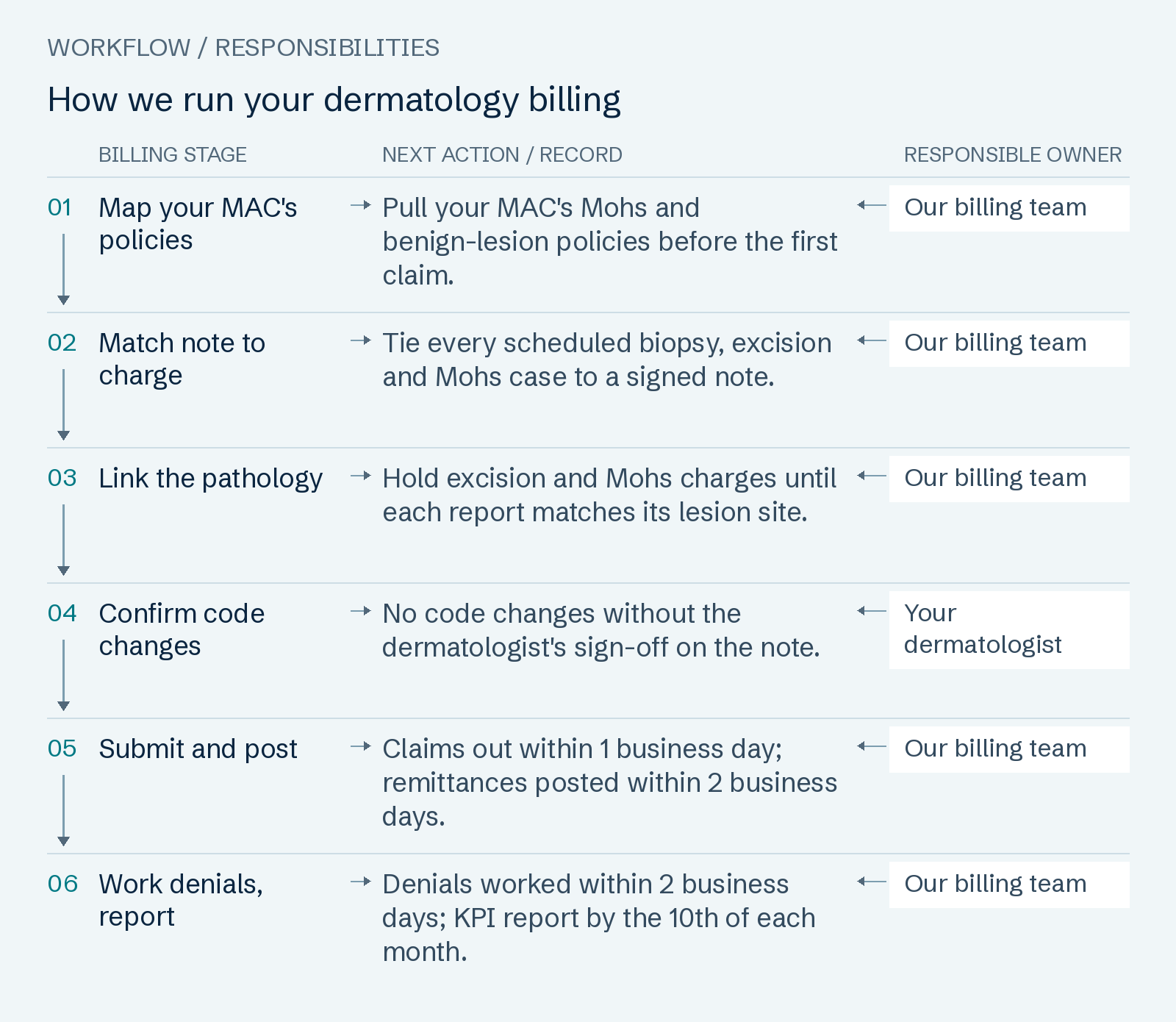
Read the workflow as text
- Pull MAC policies — Your MAC's Mohs and benign-lesion policies, read before the first claim. Owner: Our billing team.
- Match note to charge — Every scheduled biopsy, excision and Mohs case tied to a signed note. Owner: Our billing team.
- Link the pathology — Excision charges held until the report matches the lesion site. Owner: Our billing team.
- Sign off changes — No code changes without the dermatologist's sign-off on the note. Owner: Your dermatologist.
- Submit, post, appeal — Claims out within 1 business day; denials worked within 2 business days. Owner: Our billing team.
- Report monthly — KPI report with written definitions by the 10th of each month. Owner: Our billing team.
How we code your biopsies, excisions and Mohs cases
A dermatology procedure pays on facts in the note: which lesion each sample came from, whether pathology called it benign or malignant, the excised diameter, and how many Mohs stages and blocks the surgeon read. We code from those facts and query the dermatologist when one is missing, against the bundling edits in the 2026 NCCI Policy Manual, chapter III.
Biopsies on the same day as a removal
NCCI includes a biopsy of the same lesion in the removal done at that encounter; a biopsy of a different lesion is billed on its own line. We match every biopsy to its lesion site before the claim goes out.
Mohs stages and the closure
The Mohs codes already include the surgeon's biopsy, excision and pathology of that tumor, and Noridian denies Mohs claims that add surgical pathology on margin tissue (billing article A56514). Repairs, grafts and flaps are reported separately with Mohs, so we bill the closure from its own note. When a suspected cancer is biopsied for diagnosis before Mohs on the same day, NCCI allows that biopsy and its frozen section with modifier 59, XS, XU or 58, and we add one only when the note documents it.
| Claim type (example codes) | What we confirm in the note | What we bill alongside it |
|---|---|---|
| Skin biopsy, first and added lesions (11102–11107) | Which lesion each sample came from | A removal only when it is a different lesion |
| Benign lesion excision (11400–11446) | Excised diameter, body area and the medical reason for removal | Intermediate or complex repair only above 0.5 cm |
| Malignant lesion excision (11600–11646) | Final pathology tied to the lesion site | Intermediate or complex repair when documented |
| Mohs first and added stages (17311–17315) | Stages, blocks and that one surgeon did surgery and reading | The repair, graft or flap, never margin pathology |
| Diagnostic biopsy before Mohs, same day (11102 with 88331) | That diagnosis came before the decision to do Mohs | The Mohs stages that followed |
| Intermediate and complex repair (12031–13153) | Repair type, length and site | The excision or Mohs case it closes |
Modifier 25 and same-day procedures on your claims
When a dermatology visit ends with a procedure, the same-day visit decides part of what the claim pays. Medicare includes a visit on the day of a minor surgery in the procedure payment unless a significant, separately identifiable service is also performed (Claims Processing Manual, chapter 12, section 40.1); modifier 25 reports that separate visit.
- We add modifier 25 only when the note supports work beyond the usual care for the procedure.
- Where the note shows only the decision to biopsy, we send the procedure alone and flag the visit for your review.
- Under the standard multiple-surgery rules, Medicare pays the highest-valued procedure at 100% and the second through fifth at 50% each (section 40.6). We post every line on its own and appeal a line paid below that rule. 60-Day Underpayment Check: In month 3 we compare every payment from your first 60 days against your contracted rates and appeal each underpaid line. Needs your fee schedules.
Cosmetic vs covered services: 0% fee on your patient payments
Your fee is a percentage of insurance payments posted on claims we submitted or worked, net of payer recoupments and refunds. We take 0% of patient payments, copays and anything your front desk collects. So the fillers, neurotoxin and cosmetic removals your patients pay for at the desk never carry our fee, and neither do copays on covered visits.
The harder line is the benign removal that could be either. WPS treats removal of a benign lesion that poses no threat to health or function as cosmetic and not covered (LCD L35498). It covers removal when the record documents a reason such as bleeding, itching, pain, recent change or growth, inflammation, obstruction of vision or an orifice, clinical uncertainty about the diagnosis, a prior biopsy suggesting malignancy, or documented repeated trauma at the site. Before a benign removal goes to Medicare, we confirm one of your MAC's listed reasons is in the note. Where none is, we return the claim to your team so the patient's coverage and liability are settled before anything is billed.
Pathology and in-office lab claims we bill for you
Most excisions wait on a pathology report, and dermatopathology arrangements vary by practice. We bill what your practice performed and nothing more:
- Specimen counts. NCCI allows one surgical pathology code when several lesions go in one specimen, and one per lesion when each is submitted separately with its location. We count from the requisition.
- Split components. Surgical pathology (88305) has a professional and a technical component in the 2026 CMS fee schedule file, so a practice that reads slides prepared elsewhere bills only the reading, with modifier 26.
- In-office lab. CMS requires every laboratory to hold proper CLIA certification to receive Medicare or Medicaid payment (CMS CLIA program). We confirm your certificate before billing in-office tests.
A standalone dermatopathology lab is a different claim set; it belongs with pathology lab billing services.
Prior auth for your patients' biologics
A biologic for psoriasis or atopic dermatitis can stall on payer approval. One example: PA Health & Wellness, a Pennsylvania Medicaid plan, requires prior authorization for every Dupixent prescription, asks for chart notes showing its criteria are met, including, for atopic dermatitis, a failed trial of (or a reason the patient cannot use) a topical corticosteroid and a topical calcineurin inhibitor, and approves 6 months on a new request and 12 on renewal (clinical policy PHW.PDL.737.01). The American Academy of Dermatology runs a members-only appeal letter tool for prior authorization denials that covers more than 70 drugs.
On Full-Service Billing, we track every approval's end date; your team submits the renewal. On Complete RCM at 9.0%, we also request and renew authorizations from your clinical documentation; compare both on our prior authorization services page.
Rate card: 6.0% solo, 5.5% for 2–5, 5.0% for 6–15 clinicians
Dermatology practices pay our specialist physician rate, and it steps down as you add clinicians. Clinicians are counted on the 1st of each month from the rendering NPIs we billed the month before (for ABA, BCBAs and BCaBAs, not RBTs). Your rate moves with your size band the next month, in either direction. Setup is $0. Invoices 1–3: only percentage fees on that month's insurance payments, plus any statements or add-ons you order. Percentage fees and mailed statements are capped at 9.0% of that month's insurance payments; from invoice 4, the $400 minimum applies even in a month when the cap comes to less.
Illustrative example, not client data: a dermatology practice of 2–5 clinicians posts $50,000 of insurance payments in a month and takes $12,000 at the desk for cosmetic procedures and copays. The fee is 5.5% of the $50,000 only; the $12,000 carries 0%.
Multi-specialty practices: each clinician's claims are billed at that clinician's segment rate; the size band counts every clinician. If your group adds a chiropractor for back and neck care, those claims sit at the rehab rate described under chiropractic billing services; foot and nail procedures follow podiatry billing services. The rate card for every specialty lists add-ons and fee terms.
| Practice size | Your rate (specialist physician groups) |
|---|---|
| 1 clinician | 6.0% of insurance payments |
| 2–5 clinicians | 5.5% of insurance payments |
| 6–15 clinicians | 5.0% of insurance payments |
| Larger groups | 16+ clinicians, or anesthesia, radiology, DME, lab and home health: written quote within 1 business day, same fee base, cap and terms. |
Deadline protection for your high-volume derm claims
A busy dermatology day produces many small claims, and excision claims held for pathology can sit until their filing window closes. Medicare allows 12 months from the date of service (chapter 1, section 70), and commercial plans often allow less; the filing deadlines by payer show each one. Every claim we hold for pathology gets a release date, not an open wait.
- On-Our-Watch Guarantee. If a claim misses a filing, corrected-claim or appeal deadline while it is on our watch, we pay you what it would have paid. Claims we get complete 10+ business days before the deadline; contracted rate less any copay you collected, paid automatically within 30 days of final denial; capped $10,000/month; your holds excluded.
- Clock-or-Credit Guarantee. From go-live, every new claim goes out within 1 business day of complete charge data, and every denial is worked within 2 business days of posting — or $25 comes off your invoice for each late one. Mon–Fri ET business days by your system's timestamps; worked: resubmitted, appealed or returned with the fix; auto-credited; capped at monthly fee; clearinghouse outages excluded.
Both apply on the terms above. We publish client results only with written permission. Until we have them, judge us by the guarantees and the free Deadline Map.
Every inherited claim within 30 days of a filing, corrected-claim or appeal deadline is worked within 5 business days of access. Starts at access; covers up to 250 claims (more gets a day-1 deadline schedule); worked means submitted, corrected, appealed or returned with the fix. To start, your practice:
- Signs our service agreement and the BAA.
- Gives our team logins to your PM system and clearinghouse.
- Gives read access to procedure notes, Mohs maps and pathology reports.
- Sends a claim-level aging export, so near-deadline claims are worked first.
Go-live, when your first claims go out, comes within 5 business days of access; any unbilled backlog follows within 10 business days of access. Clock starts with your signed agreement, signed BAA and working system logins; it extends day for day while we wait on access. Want to see your exposure first? Get my free A/R Deadline Map, every unpaid claim over 90 days sorted by its deadline. Clock starts with your claim-level aging export and signed BAA; above 10 requests in a week, we confirm your date within 1 business day.
Common questions
- How much do your dermatology billing services cost?
- 6.0% of insurance payments for 1 clinician, 5.5% for 2–5 clinicians and 5.0% for 6–15 clinicians, with 0% of patient payments and $0 setup. See medical billing pricing by specialty.
- Do you charge a fee on cosmetic payments our patients make?
- No. Our fee is a share of insurance payments only, and we take 0% of patient payments, so cosmetic procedures paid at the desk never enter it.
- How do you bill Mohs surgery for our practice?
- We bill each Mohs stage and added block from the Mohs note, and the repair, graft or flap from its closure note, which NCCI lets you report with Mohs. We never add surgical pathology on margin tissue, which the Mohs codes already include.
- Do biologics need prior authorization, and do you handle it?
- Often. PA Health & Wellness, for example, requires it for every Dupixent prescription. On Full-Service Billing we track approval end dates; on Complete RCM we also request and renew the authorizations from your documentation.
- Is there a long-term contract or a cancellation fee?
- No. Leave with 30 days' notice and no termination fee. Want a run-out? We keep working the claims we submitted for 90 days at your plan rate. Decline it and we charge nothing on payments that post after you leave. Notice by email; optional run-out covers claims we submitted before your exit date, at your plan rate; handover file within 10 business days of exit.
- Which EHR and practice-management systems do you work in?
- We work inside your existing practice-management system and clearinghouse; tell us which ones and we confirm in writing within 1 business day. We bill from the procedure notes, Mohs maps and pathology reports already in your system. See EHR and PM compatibility.
Sources and review
Page revised November 5, 2026 · Review contact: Hyder Shah (inquiries@claimpillar.com). The workflow checklists are editorial recommendations; payer requirements depend on the program and current policy.
- CMS: Medicare NCCI Policy Manual 2026, Chapter III (Integumentary System), retrieved 2026-11-05
- CMS: Medicare Claims Processing Manual, Chapter 12, sections 40.1 and 40.6, retrieved 2026-11-05
- Noridian: Billing and Coding: Mohs Micrographic Surgery (A56514), retrieved 2026-11-05
- WPS: LCD Removal of Benign Skin Lesions (L35498), retrieved 2026-11-05
- CMS: Clinical Laboratory Improvement Amendments (CLIA), retrieved 2026-11-05
- PA Health & Wellness: Clinical Policy Dupixent (PHW.PDL.737.01), retrieved 2026-11-05
- American Academy of Dermatology: Prior Authorization Appeal Letter Tool, retrieved 2026-11-05
- CMS: Medicare Claims Processing Manual, Chapter 1, section 70 (timely filing), retrieved 2026-11-05