Podiatry billing we handle for your practice
Our podiatry billing service is built for independent DPM practices, from one podiatrist to groups of 6–15 clinicians, across office and surgery settings. Practices hand off podiatry billing when:
- Medicare denies nail and callus care for patients with diabetes or vascular disease, and nobody can say which notes lacked a finding;
- post-op visits after bunion or hammertoe surgery go out as billable visits, while unrelated visits inside the global period get written off;
Podiatry shares a specialist rate card with our dermatology billing services; no code changes without your podiatrist's sign-off in our coding review.
| Podiatry claim type | What we do | What you keep |
|---|---|---|
| Routine foot care and nail care | Read each note for the systemic condition and class findings, and carry the managing MD or DO and the date last seen onto the claim. | Recording findings in every note |
| Nail and wound debridement | Match each debridement to the nails or wound depth the note describes, and hold visits sooner than your contractor's interval. | Describing each nail or wound you treat |
| Foot and ankle surgery | Count each surgery's global period and flag every visit or procedure that falls inside it. | Operative notes and surgery schedule |
| Diabetic shoes and inserts | Hold each claim until certification, order and fitting records are on file, then send it to the DME MAC. | Fitting, dispensing and the certifying physician relationship |
| Denials, posting and patient balances | Work every denial, post every remittance line and send statements in your practice's name. | Your financial policy and payments in your own bank account |
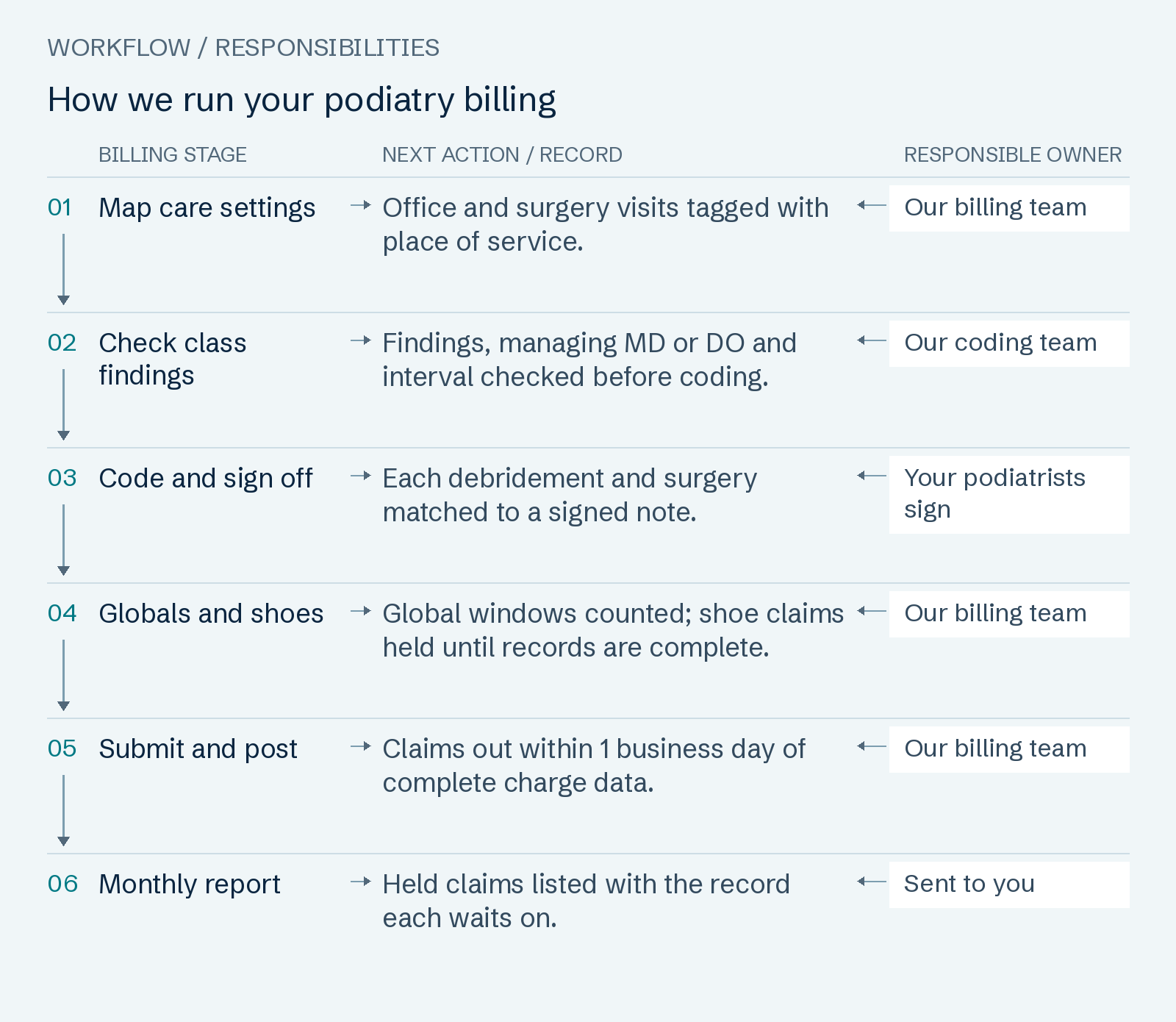
Read the workflow as text
- Map care settings — Office and surgery visits tagged with place of service. Owner: Our billing team.
- Check class findings — Findings, managing MD or DO and interval checked before coding. Owner: Our coding team.
- Code and sign off — Each debridement and surgery matched to a signed note. Owner: Your podiatrists sign.
- Globals and shoes — Global windows counted; shoe claims held until records are complete. Owner: Our billing team.
- Submit and post — Claims out within 1 business day of complete charge data. Owner: Our billing team.
- Monthly report — Held claims listed with the record each waits on. Owner: Sent to you.
Routine foot care and class findings modifiers we check before billing
Medicare excludes routine foot care, including corn and callus removal and nail trimming or debridement, unless an exception applies, such as a systemic condition like diabetes or peripheral vascular disease (Medicare Benefit Policy Manual, chapter 15, section 290). Coverage is presumed when the podiatrist documents one Class A finding, two Class B findings, or one Class B and two Class C findings.
The class findings map to three HCPCS modifiers: Q7 for one Class A finding, Q8 for two Class B findings, and Q9 for one Class B and two Class C findings. In Wellpoint Federal's states (jurisdictions 6 and K), the Routine Foot Care and Debridement of Nails LCD (L33636) and its billing and coding article (A57759) require one of them on routine foot care claims, and on nail debridement when coverage rests on a systemic condition. Patients with neuropathy but no vascular impairment are billed without them. We add the modifier only when the note supports it.
Managing physician and date last seen
For conditions that require active care by an MD or DO, the claim carries that physician's name (Wellpoint Federal's article asks for the NPI) and the approximate date the patient last saw them; active care is accepted when that visit falls within the 6 months before the foot care. We keep that physician and date on file for each patient and hold the claim when the date has aged out.
Routine care interval
Article A57759 treats routine foot care as necessary once in 60 days, and flags debridement of more than five nails in one day for review. Other contractors publish their own LCDs; we apply yours.
Class findings we look for in each note
| Class | Findings CMS lists | What we confirm in your note |
|---|---|---|
| Class A | Nontraumatic amputation of the foot or an integral skeletal part of it | Which foot, and that the amputation was not traumatic |
| Class B | Absent posterior tibial pulse; absent dorsalis pedis pulse; advanced trophic changes (three of: hair growth decrease or absence, nail thickening, discoloration, thin shiny skin, rubor) | Each pulse finding recorded on the date of service, and three named trophic changes, not the phrase alone |
| Class C | Claudication; temperature changes such as cold feet; edema; paresthesias; burning | Each symptom written in the note, not carried forward from an old visit |
Diabetic shoes and DME claims we bill to the DME MAC for you
Diabetic therapeutic shoes are a separate Part B benefit billed to the DME MAC (Benefit Policy Manual, chapter 15, section 140). Coverage is one pair of depth shoes with three pairs of inserts, or one pair of custom-molded shoes with two extra pairs of inserts, per calendar year. We hold each shoe claim until every item on this checklist, drawn from the DME MACs' Therapeutic Shoes LCD (L33369) and policy article A52501, is in the file:
Diabetic shoe documentation checklist
- The certifying MD or DO managing the diabetes documents it; a podiatrist cannot certify.
- At least one qualifying condition is documented: prior foot amputation, past ulceration, pre-ulcerative calluses, neuropathy with callus formation, foot deformity, or poor circulation.
- An in-person visit with the certifying physician addressed diabetes management within 6 months before delivery.
- The certification statement is signed on or after that visit and within 3 months before delivery.
- A standard written order, signed on or after the prescriber's visit, is on file before the claim goes out. Your podiatrist may be the prescriber.
- The supplier's in-person evaluation is documented before the items are selected.
- An objective fit assessment at delivery is documented, with proof of delivery kept.
- KX goes on the shoe, insert and modification lines only when the criteria are met; otherwise the line carries GY.
Shoe, insert and other supplier claims you bill under your own DMEPOS enrollment sit on our written-quote pricing row, handled with our DME billing service.
Wound care and debridement claims we code from your notes
Care that would otherwise be routine can be covered when it is a necessary part of treating an ulcer, wound or infection (chapter 15, section 290). Mycotic nail care needs clinical evidence of mycosis plus pain or secondary infection from the thickened nail, or, for a patient who walks, marked limitation of walking. We code each debridement to the nails or wound depth recorded, and query notes missing the supporting symptom.
Subluxation is where podiatry and chiropractic part ways: Medicare does not cover treatment of a foot subluxation as an isolated condition, though ankle subluxation can be. Spinal subluxation is billed under our chiropractic billing services.
Surgical globals we track for your foot and ankle surgeries
Medicare assigns each surgical code a global period of 0, 10 or 90 days, and for 90-day majors the package starts the day before surgery (Claims Processing Manual, chapter 12, section 40). In the CY 2026 PFS relative value file, hammertoe correction (28285) and bunion correction (28296) carry 90-day globals, and permanent nail removal (11750) carries 10 days. We load each surgery's global period into your schedule so that:
- related post-op visits are recorded but not billed;
- an unrelated visit inside the window goes out with modifier 24, and an unrelated procedure with modifier 79, when the note supports it; a 79 procedure starts its own global period;
- a planned second-stage procedure carries modifier 58 when the documentation supports it;
- a transfer of post-op care is split with 54 and 55 once the written transfer agreement is on file.
Rate card for your specialist group
Podiatrists pay our specialist rates, charged only on insurance payments for claims we submitted or worked. Patient payments carry 0% and setup is $0. Invoices 1–3: only percentage fees on that month's insurance payments, plus any statements or add-ons you order. Percentage fees and mailed statements are capped at 9.0% of that month's insurance payments; from invoice 4, the $400 minimum applies even in a month when the cap comes to less.
Worked example for a podiatry group
Illustrative example, not client data: a group of seven podiatrists falls in the 6–15 clinicians band, so its rate is 5.0%. In a month when $50,000 of insurance payments post on claims we worked, the fee is 5.0% of that $50,000; copays and patient balances collected that month add nothing, and the fee never exceeds 9.0% of that month's insurance payments. The full podiatry and specialist pricing lists add-ons and exclusions.
| Podiatry practice size | Your percentage of insurance payments |
|---|---|
| Solo podiatrist (1 clinician) | 6.0% |
| Small practice (2–5 clinicians) | 5.5% |
| Group (6–15 clinicians) | 5.0% |
| Larger groups, or diabetic shoe and other supplier claims | Pricing is by written quote. |
Deadline protection for your DME and surgery claims
Shoe claims waiting on a certifying statement and surgery claims waiting on an operative note age out first. Original Medicare claims must generally be filed within 12 months, or 1 calendar year, after the date of service; commercial plans set their own limits, listed in our payer timely filing tables. Your monthly report lists every held claim, the record it waits on and its expiry date.
Two written guarantees back your claims:
- On-Our-Watch Guarantee: If a claim misses a filing, corrected-claim or appeal deadline while it is on our watch, we pay you what it would have paid. Claims we get complete 10+ business days before the deadline; contracted rate less any copay you collected, paid automatically within 30 days of final denial; capped $10,000/month; your holds excluded.
- Clock-or-Credit Guarantee: From go-live, every new claim goes out within 1 business day of complete charge data, and every denial is worked within 2 business days of posting — or $25 comes off your invoice for each late one. Mon–Fri ET business days by your system's timestamps; worked: resubmitted, appealed or returned with the fix; auto-credited; capped at monthly fee; clearinghouse outages excluded.
Each applies on the terms above. Denied foot care, frequency and global-period claims go to our denial management services.
Starting with us
- Sign our service agreement and BAA.
- Give us access to your practice-management system, clearinghouse and visit and operative notes.
- Send a claim-level aging export, so inherited claims are worked by deadline.
- Share each podiatrist's surgery schedule.
- If you dispense shoes, name the supplier enrollment and the physicians who certify your patients.
Go-live, when your first claims go out, comes within 5 business days of access; any unbilled backlog follows within 10 business days of access. Clock starts with your signed agreement, signed BAA and working system logins; it extends day for day while we wait on access. Not ready to switch? Get my free A/R Deadline Map: Clock starts with your claim-level aging export and signed BAA; above 10 requests in a week, we confirm your date within 1 business day.
Common questions
- How much do your podiatry billing services cost?
- Your rate depends on how many podiatrists we bill for: 6.0% for 1 clinician, 5.5% for 2–5 clinicians and 5.0% for 6–15 clinicians, always of insurance payments. Patient payments carry 0%, setup is $0, and the minimum and cap are on our rate card.
- When is routine foot care covered, and do you check that before billing?
- When a systemic condition such as diabetes or peripheral vascular disease makes it hazardous without a professional, or when it is part of treating an ulcer, wound or infection. We check every note for class findings, the managing MD or DO, the date last seen and your contractor's interval first.
- How are diabetic shoes billed when your team handles them?
- They go to the DME MAC under your supplier enrollment. We hold each claim until the certifying statement, written order, supplier evaluation and fit assessment are on file, and add KX only when the criteria are met.
- Do you bill podiatry DME?
- Yes. Diabetic shoes, inserts and other supplier claims are priced by written quote; physician claims stay on the specialist rates.
- Is there a long-term contract for your podiatry billing service?
- No. Month to month. Leave with 30 days' written notice. No termination fee. If you leave, the Clean-Exit Terms apply: Leave with 30 days' notice and no termination fee. Want a run-out? We keep working the claims we submitted for 90 days at your plan rate. Decline it and we charge nothing on payments that post after you leave. Notice by email; optional run-out covers claims we submitted before your exit date, at your plan rate; handover file within 10 business days of exit.
- How quickly can your team take over our podiatry claims?
- Go-live, when your first claims go out, comes within 5 business days of access; any unbilled backlog follows within 10 business days of access. Clock starts with your signed agreement, signed BAA and working system logins; it extends day for day while we wait on access. What we need from you is listed under starting with us.
Sources and review
Page revised November 5, 2026 · Review contact: Hyder Shah (inquiries@claimpillar.com). Global periods come from the CMS CY 2026 PFS relative value file (RVU26D); MAC LCDs and billing articles apply only in the states they name.
- CMS: Medicare Benefit Policy Manual, Chapter 15, sections 140 (therapeutic shoes) and 290 (foot care)
- CMS Medicare Coverage Database: LCD L33636, Routine Foot Care and Debridement of Nails (Wellpoint Federal)
- CMS Medicare Coverage Database: Billing and Coding article A57759, Routine Foot Care and Debridement of Nails
- CMS Medicare Coverage Database: LCD L33369, Therapeutic Shoes for Persons with Diabetes (DME MACs)
- CMS Medicare Coverage Database: Policy article A52501, Therapeutic Shoes for Persons with Diabetes
- CMS: Medicare Claims Processing Manual, Chapter 12, section 40 (global surgery)
- CMS: Medicare Claims Processing Manual, Chapter 1, section 70 (time limits for filing)
- CMS CY 2026 PFS relative value files (RVU26D global periods)