When to outsource denial management
Practices hand off denial management when denials arrive faster than their staff can work them:
- Zero-paid lines sit unread. Each unread day runs down the appeal window: Medicare allows 120 days from receipt of the notice to request a redetermination (CMS appeals chapter). We work every denied line within 2 business days of posting.
- Your biller left. Inherited denials arrive with no deadline log. We sort them by the date each window closes and work the nearest first.
- The same denials return every month. A repeat cause points to a broken front-end step. We send each one to the person who owns that step.
- Appeals go out as form letters. A coding or medical necessity dispute is decided on the records. We build each appeal around the documentation it turns on.
- Timely filing denials start to appear. A Medicare finding that a claim was filed late carries no appeal rights (chapter 29, §200), so that money is usually gone. We send every new claim within 1 business day of complete charge data.
What our denial management service covers, and what you keep
Our denial management team works every denied line on your remittances, from the day it posts until the payer pays it or makes a final decision.
What stays with your practice?
Your practice-management system stays the system of record, every submission and payer letter is copied to you, and clinical statements and signatures stay with your clinicians. Coding disputes run through our coding review against your documentation. We check every code against your clinician's documentation and never change a code without the clinician's sign-off.
| Task | Deliverable | Timing | What you keep |
|---|---|---|---|
| Denial intake | Every denied or zero-paid line logged with payer, amount, group code, reason and remark codes | As each remittance posts; payments posted within 2 business days | Your practice-management system stays the system of record |
| Deadline check | Filing, corrected-claim and appeal dates logged for the claim | Before any fix is chosen | The deadline log, in every monthly report |
| Root-cause tag | Each denial tagged eligibility, coding, authorization, timely filing, COB or medical necessity | At intake | The tags and counts in your report |
| Correction or reopening | Corrected claim or reopening request, with proof of submission | Worked within 2 business days of posting | A copy of every submission |
| Reconsideration or appeal | Appeal letter and payer form, built around the records the dispute turns on | Worked within 2 business days; a record only you hold is requested with its deadline | Clinical statements and signatures stay with your clinicians |
| Follow-up to decision | Dated payer follow-up until a decision posts | Until the payer pays, upholds or closes it | All payer correspondence |
| Monthly report | KPI report with written definitions, plus your top 3 denial causes and their fix | By the 10th of each month | The report and the full denial log |
How we start and run your denial work
- Agreement and BAA. You sign the service agreement and a business associate agreement; HHS lists billing among the activities a business associate performs for a covered entity.
- Access. You give us logins to your practice-management system and clearinghouse.
- Inherited denials by deadline. Every inherited claim within 30 days of a filing, corrected-claim or appeal deadline is worked within 5 business days of access. Starts at access; covers up to 250 claims (more gets a day-1 deadline schedule); worked means submitted, corrected, appealed or returned with the fix.
- Go-live. Go-live, when your first claims go out, comes within 5 business days of access; any unbilled backlog follows within 10 business days of access. Clock starts with your signed agreement, signed BAA and working system logins; it extends day for day while we wait on access.
- Daily denial work. New denials enter the workflow below the day they post.
What we need from your practice
Sign the service agreement and BAA, give us logins to your practice-management system and clearinghouse, join one 45-minute kickoff call, sign off encounters so charges are complete, and answer our documentation questions within 5 business days. For a clinical appeal, we ask only for the notes and signed statements; we assemble the rest.
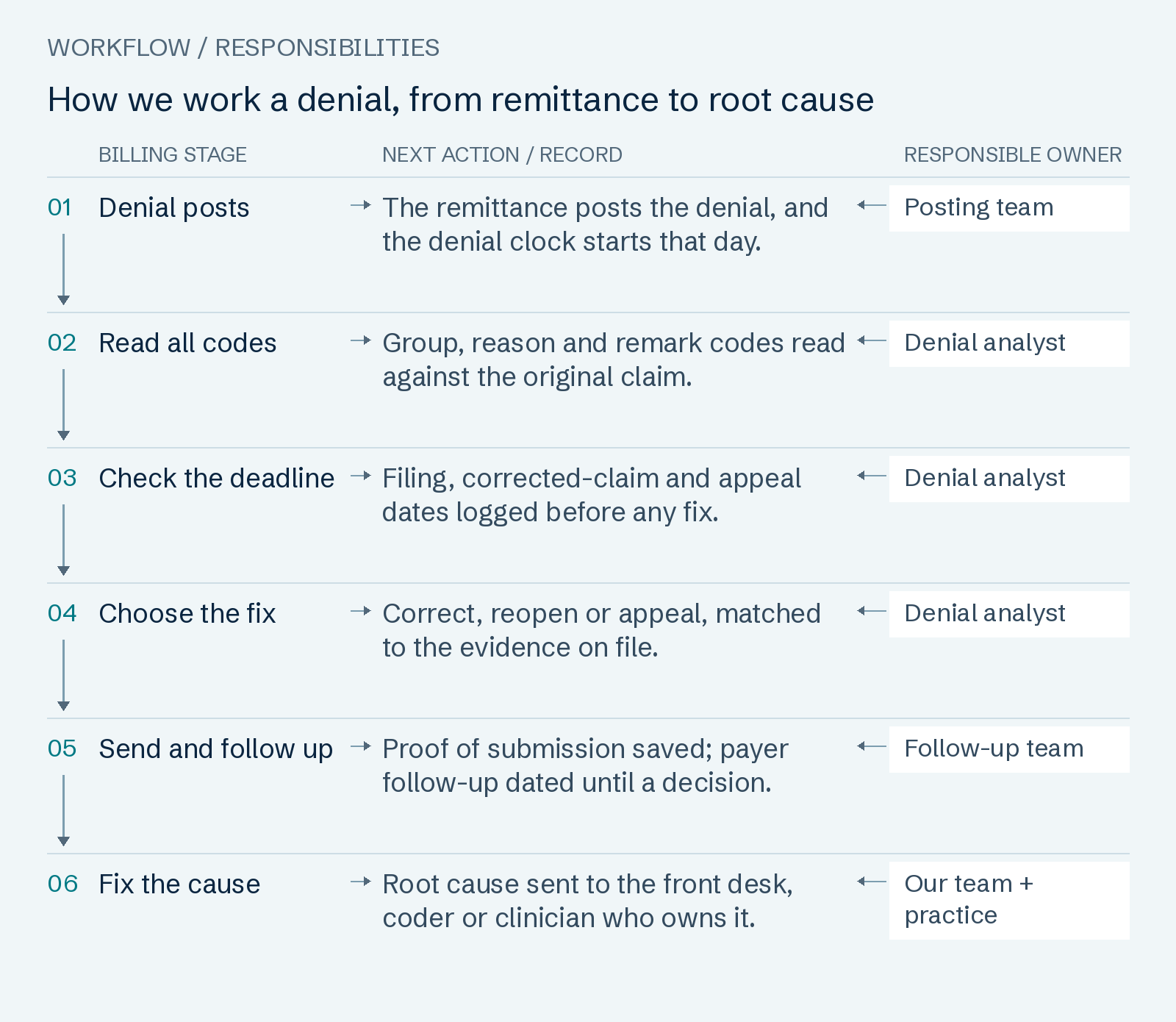
Read the workflow as text
- Denial posts — The remittance posts the denial, and the denial clock starts that day. Owner: Posting team.
- Read all codes — Group, reason and remark codes read against the original claim. Owner: Denial analyst.
- Check the deadline — Filing, corrected-claim and appeal dates logged before any fix. Owner: Denial analyst.
- Choose the fix — Correct, reopen or appeal, matched to the evidence on file. Owner: Denial analyst.
- Send and follow up — Proof of submission saved; payer follow-up dated until a decision. Owner: Follow-up team.
- Fix the cause — Root cause sent to the front desk, coder or clinician who owns it. Owner: Our team + practice.
Where denials cost a practice money, and what we do about each
Denied claims lose money at five points between the remittance and the payer's decision:
- Acting on the reason code alone. The group code on the same line decides who owes the balance, and the remark code adds detail (CMS remittance advice guidance). We read all three against the original claim before choosing a fix.
- Appealing a claim that needed a correction. Medicare gives no appeal rights to a claim returned or rejected as incomplete or invalid (chapter 29). We correct the field and send a new claim.
- Appealing a clerical error. Medicare corrects minor errors on a processed claim only through reopening, which a party can request within 1 year of the initial determination for any reason (chapter 34). We send those to reopening, not appeal.
- Missing the payer's window. Every payer and contract sets its own appeal window. We log the filing, corrected-claim and appeal dates before any fix is chosen.
- Fixing the claim but not the cause. We tag every denial as eligibility, coding, authorization, timely filing, coordination of benefits or medical necessity and send it to its owner; eligibility and payer-order causes feed our pre-visit eligibility and payer-order checks. Front-Desk Fix Sheet: Each month, your top 3 denial causes with the exact front-desk or documentation fix for each, for future visits, plus a 20-minute call with your front desk every quarter.
Staying in-house? Read how to reduce claim denials at your practice.
What denial management services cost
Denial work is part of Full-Service Billing: from 5.0% to 8.5% of insurance payments, set by specialty and practice size, and 0% of patient payments. Setup is $0.
Are appeals billed separately?
No. Corrected claims, reopenings, reconsiderations and appeals all sit inside your percentage, and the percentage fee applies only when insurance payments post. Percentage fees and mailed statements are capped at 9.0% of that month's insurance payments; the $400 minimum still applies from invoice 4.
Not included: Your EHR or practice-management subscription and clearinghouse fees (paid to those vendors), any application fee a payer or state charges, mailed patient statements at $0.95 each, and collection-agency, attorney or court costs. Compare every tier on the full rate card.
| Option | Price | What it covers for denials | Terms |
|---|---|---|---|
| Full-Service Billing | 5.0%–8.5% of insurance payments | Every new denial worked: corrected, reopened or appealed, alongside claims, posting and A/R follow-up | Invoices 1–3: only percentage fees on that month's insurance payments, plus any statements or add-ons you order; the $400 minimum starts with invoice 4. |
| Complete RCM | 9.0% of insurance payments | Everything above, plus inherited and aged A/R worked at no added percentage | One rate for every specialty and size up to 15 clinicians. Same $0 setup, $400 minimum from invoice 4, guarantees and Clean-Exit Terms. |
| A/R Recovery | 15% | For inherited claims 90+ days past the date of service: 15% of the insurance payments that post after we work them, and $0 on claims that never pay. | Fee only on insurance payments posting after our logged action; patient payments 0%; full-service clients stay under the 9.0% fee cap. |
What we report on your denials every month
Your denial report arrives by the 10th of each month with a written definition for each measure and the denial log behind it, so you can recompute every number. We publish no target rates: your payer mix and specialty set the baseline, and month one of the report is that baseline.
| What we report | How we count it |
|---|---|
| Denials worked on time | Denials worked within 2 business days of posting ÷ denials posted in the month |
| Overturn rate | Worked denials later paid ÷ worked denials with a payer decision |
| Paid on worked denials | Insurance payments posted in the month on claims we worked after a denial |
| Denial rate | Claims denied in the month ÷ claims adjudicated in the month |
| Top 3 denial causes | Denials by root cause, each with its front-desk or documentation fix |
| Open denials by deadline | Every open denial with its next deadline and next action |
Specialty practices whose denials we work
The field that trips a denial differs by specialty. Noridian, the Medicare Part B contractor for Jurisdiction F, lists these among its most common claim submission errors, and each is a field we check at intake:
- Chiropractic billing: the initial treatment date, checked at charge entry on every Medicare claim.
- Invoice-priced claims: the invoice price and required description, checked against the payer’s submission format.
- Laboratory billing: the CLIA certification number and, where the MolDX program requires it, the DEX Z-Code identifier.
- Pathology: the date of service, compared with any inpatient stay before the claim goes out.
Guarantees and terms behind our denial work
We cannot force a payer to pay a denied claim; the payer decides. What we guarantee is speed and deadlines, in writing:
- Clock-or-Credit Guarantee. From go-live, every new claim goes out within 1 business day of complete charge data, and every denial is worked within 2 business days of posting — or $25 comes off your invoice for each late one. Mon–Fri ET business days by your system's timestamps; worked: resubmitted, appealed or returned with the fix; auto-credited; capped at monthly fee; clearinghouse outages excluded.
- On-Our-Watch Guarantee. If a claim misses a filing, corrected-claim or appeal deadline while it is on our watch, we pay you what it would have paid. Claims we get complete 10+ business days before the deadline; contracted rate less any copay you collected, paid automatically within 30 days of final denial; capped $10,000/month; your holds excluded.
- Clean-Exit Terms. Month to month. Leave with 30 days' written notice. No termination fee. Notice by email; optional run-out covers claims we submitted before your exit date, at your plan rate; handover file within 10 business days of exit.
We publish client results only with written permission. Until we have them, judge us by the guarantees and the free Deadline Map. To see where your open denials stand first, request The Free A/R Deadline Map. Clock starts with your claim-level aging export and signed BAA; above 10 requests in a week, we confirm your date within 1 business day.
Common questions
- How much do denial management services cost?
- With us, denial work and appeals are part of Full-Service Billing: from 5.0% to 8.5% of insurance payments, and 0% of patient payments. Invoices 1–3: only percentage fees on that month's insurance payments, plus any statements or add-ons you order; the $400 minimum starts with invoice 4. See the rate card by specialty and practice size.
- Can we hire you only for our old denials?
- Yes, for claims already 90 or more days past the date of service, through A/R Recovery: 15% of the insurance payments that post after we work them, $0 on claims that never pay. Fee only on insurance payments posting after our logged action; patient payments 0%; full-service clients stay under the 9.0% fee cap. Newer denials are worked as part of Full-Service Billing.
- How fast does your team work a new denial?
- Within 2 business days of the remittance posting it, from go-live, or $25 comes off your invoice for each late one under the Clock-or-Credit Guarantee. Mon–Fri ET business days by your system's timestamps; worked: resubmitted, appealed or returned with the fix; auto-credited; capped at monthly fee; clearinghouse outages excluded.
- Do you work denials our previous billing company left behind?
- Yes. Inherited denials are sorted by the date their window closes and worked nearest first, under the deadline sweep in how we start. Claims 90 or more days past the date of service go to A/R Recovery at 15%, or are included in Complete RCM. Fee only on insurance payments posting after our logged action; patient payments 0%; full-service clients stay under the 9.0% fee cap. Deadline Claims at Your Plan Rate: Inherited claims within 30 days of a deadline when you start are worked at your plan rate, not the 15% A/R Recovery rate. The handoff plan for switching billing companies covers what to collect before you give notice.
- Do you also handle follow-up on claims with no payer decision?
- Yes. A/R follow-up and denial work run as two queues inside Full-Service Billing. Follow-up chases claims with no payer decision by their follow-up date; any denial it finds moves to the denial queue with its appeal deadline logged, and an appeal with no decision by its follow-up date returns to follow-up.
- Which practice-management systems and clearinghouses do you work in?
- We work inside your existing practice-management system and clearinghouse; tell us which ones and we confirm in writing within 1 business day. Details are on our EHR and practice-management compatibility page.
- What do you report on our denials each month?
- By the 10th of each month, every measure in the report table above with its written definition and the denial log behind it. We answer questions on any number within 1 business day. Questions before you sign go to our team.
Sources and review
Page revised October 7, 2026 · Review contact: Hyder Shah (inquiries@claimpillar.com). The workflow checklists are editorial recommendations; payer requirements depend on the program and current policy.