What changes for your practice under each billing model?
Medical billing outsourcing moves the claim work (charge entry, claim submission, payment posting, denials and insurance follow-up) from employees on your payroll to a billing company paid a share of insurance payments. In-house billing keeps that work with your staff. Software-only means your staff, or you, do the same work in a billing or practice-management system bought for the purpose. A hybrid splits the queues: your front desk keeps eligibility checks and copays, for example, while an outside team works denials and aged A/R.
The choice decides whether billing is fixed payroll or a cost that moves with payments, who covers the work when someone is out, and which terms you need in writing.
| Criterion | In-house biller | Software only | Outsourced company | Hybrid |
|---|---|---|---|---|
| What you pay | Salary and benefits every pay period | A subscription, plus the staff time to use it | A percentage of insurance payments, invoiced | A smaller payroll plus a fee on the outsourced queues |
| Who works denials and unpaid claims | Your biller | Your staff, inside the software | The company's team | Whichever side owns that queue |
| When the cost rises | When you hire, give raises or pay overtime | When you add users or staff hours | When insurance payments rise | Both, in proportion to the split |
| Cover when someone is out | None unless you cross-train or hire a temp | None unless you cross-train | Ask the company who covers your queue | Depends on which side owns the stalled queue |
| Who receives payments | Your practice | Your practice | Your practice under a percentage fee (Medicare rule) | Your practice |
| Patient data | Your own HIPAA program | Your program plus the vendor's agreement | A business associate agreement first | An agreement covering the outsourced work |
| Leaving the model | Notice, then rehire or reassign | Data export under the vendor contract | Contract exit terms and a data handover | Exit terms on the outsourced part |
What does an in-house biller really cost your practice?
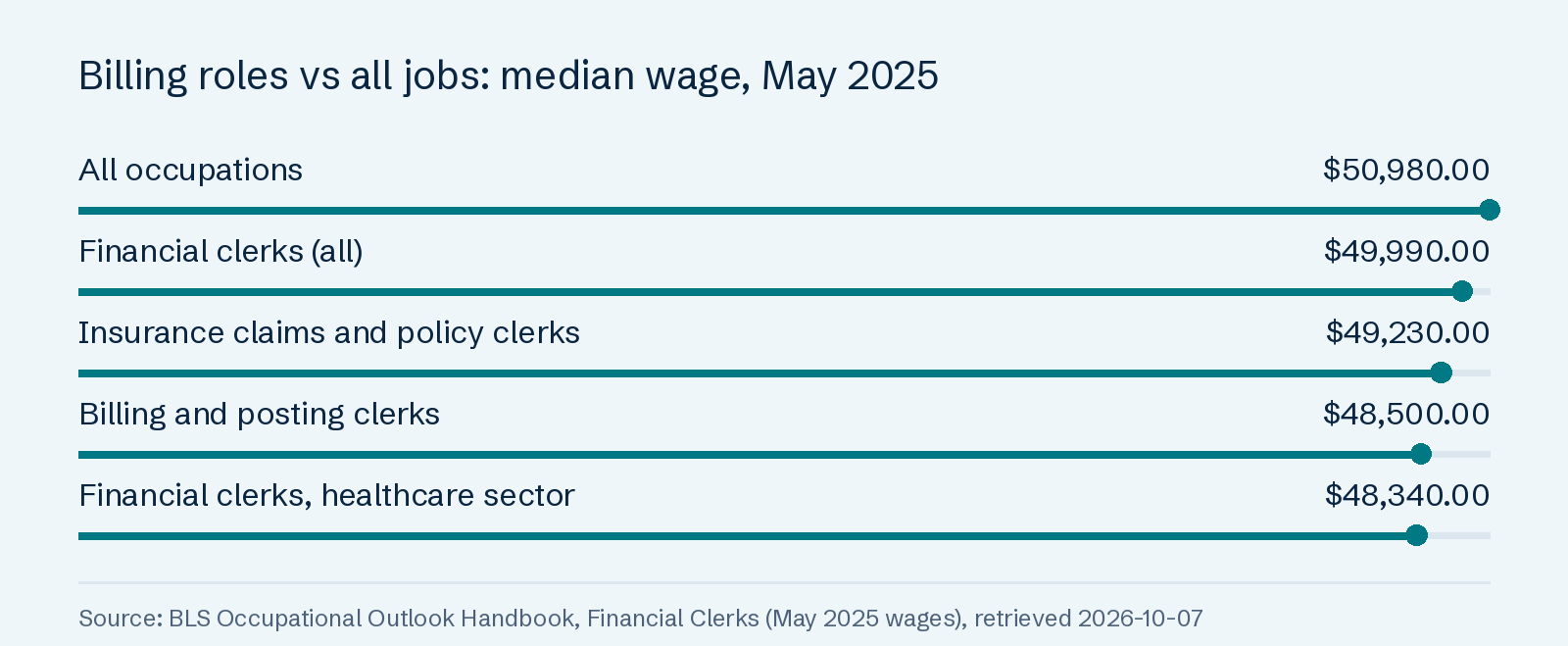
A wage-only comparison leaves out benefits, software and backup cover. Billing and posting clerks earned a national median $48,500 a year in May 2025, according to the BLS Occupational Outlook Handbook. Financial clerks as a group earned $49,990, and those in healthcare and social assistance $48,340. The chart sets these against the median for all occupations.
How the loaded monthly cost is calculated
- Wage: $48,500 ÷ 12 = $4,042 a month.
- Benefit share: in June 2026, wages were 70.0% of private-industry employer compensation costs and benefits the other 30.0% (BLS Employer Costs for Employee Compensation).
- Loaded cost: $48,500 ÷ 0.700 = $69,286 a year, about $5,774 a month.
This illustrative model combines an occupational median wage with an all-private-industry benefit share; BLS does not report it as the cost of a medical-practice biller. At the 68.5% wage share for full-time workers, the same wage gives about $5,900 a month. Use your actual payroll, benefits and taxes for a hiring decision; the table lists costs omitted from the illustration.
How many billers would your practice need?
Measure the work before choosing a headcount. Track time spent submitting claims, posting payments, answering payer requests, working denials and following up unpaid balances. Include cover for absences. Claim count alone cannot show how much follow-up your payer mix and claim types require. Use those hours and the work each quote includes to compare staffing with outsourcing.
| Cost line | Where your number comes from | In the loaded figure? |
|---|---|---|
| Wage | BLS median $48,500 a year, or your payroll | Yes |
| Benefits and payroll taxes | BLS 30.0% share, or your plan's cost | Yes |
| Billing or practice-management software seat | Your vendor's invoice | No |
| Clearinghouse fees | Your clearinghouse invoice | No |
| Cover for vacation, sick days and turnover | Temp or overtime cost, or claims left unworked | No |
| Your own time supervising billing | Hours a week times your hourly value | No |
| Hiring and training a replacement | Job ads and weeks of onboarding | No |
How do you estimate a medical billing outsourcing break-even?
In this simplified model, an 8% fee equals the illustrated $5,774 monthly wage-and-benefits cost at $72,175 in monthly insurance payments; a 6% fee equals it at $96,233. These are example fee comparisons, not universal thresholds for outsourcing. To estimate your own break-even:
- Add the monthly in-house costs you would actually avoid for the same scope of work. Leave out software, staff and supervision costs you would retain under both options.
- Subtract fixed outsourcing extras from that avoidable cost, then divide the remainder by the quoted fee rate (6% = 0.06). If the remainder is zero or negative, the variable-fee model has no positive cost break-even.
- Compare that payment level with 12 months of remittances using the quote's actual fee base. Check minimums, one-time transition fees, service scope and expected workload separately.
The table uses rounded monthly wage inputs and four example rates; it assumes no retained-cost difference, fixed outsourcing extras or monthly minimum. For a hypothetical two-biller staffing plan, double the loaded cost first: $11,548 ÷ 0.08 = $144,350 a month at 8%. Replace the example rates with the ones in your quotes; ours are on the rate card by specialty and practice size.
What is the percentage taken on?
A rate means little until you know its base. A fee on total collections includes the copays and balances your patients pay; a fee on insurance payments does not. Example: at 6%, a practice whose patients pay $8,000 a month pays $480 a month more under a total-collections quote (0.06 × $8,000). A monthly minimum can also outweigh the percentage in a slow month. The line-by-line comparison of billing quotes puts setup fees, minimums and add-ons on the same footing.
| Example fee rate | Break-even vs wage only ($4,042/mo) | Break-even vs one loaded biller ($5,774/mo) | Break-even vs two loaded billers ($11,548/mo) |
|---|---|---|---|
| 4% | $101,050 a month | $144,350 a month | $288,700 a month |
| 6% | $67,367 a month | $96,233 a month | $192,467 a month |
| 8% | $50,525 a month | $72,175 a month | $144,350 a month |
| 10% | $40,420 a month | $57,740 a month | $115,480 a month |
Read the workflow as text
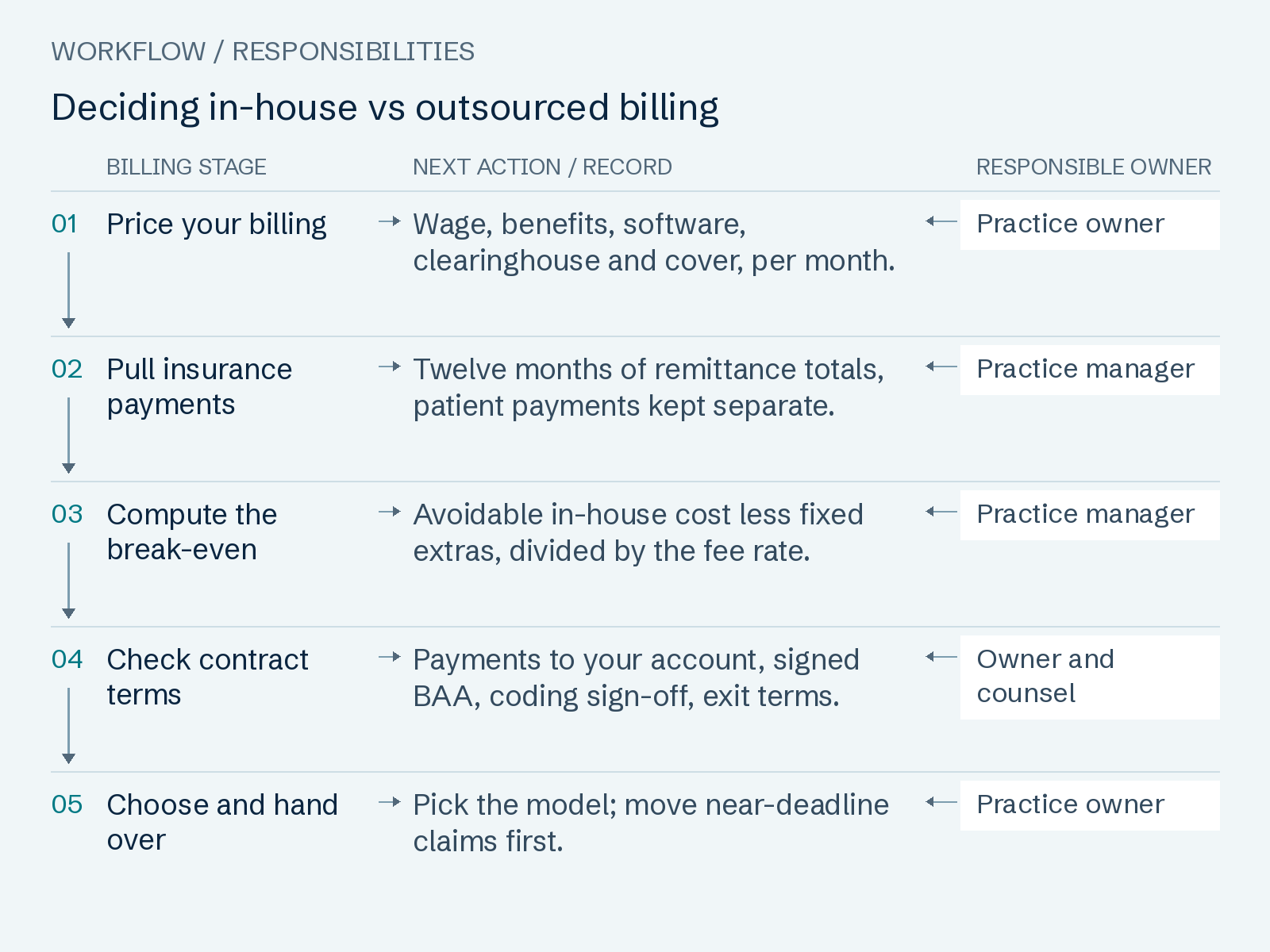
- Price your billing — Wage, benefits, software, clearinghouse and cover, per month. Owner: Practice owner.
- Pull insurance payments — Twelve months of remittance totals, patient payments kept separate. Owner: Practice manager.
- Compute the break-even — Avoidable in-house cost less fixed extras, divided by the fee rate. Owner: Practice manager.
- Check contract terms — Payments to your account, signed BAA, coding sign-off, exit terms. Owner: Owner and counsel.
- Choose and hand over — Pick the model; move near-deadline claims first. Owner: Practice owner.
How do you know your practice has outgrown in-house billing?
Five signs, each measurable from records you already keep, say it is time to get a written quote. The deadlines behind them are the payers' own: Original Medicare, for example, denies a claim filed more than 12 months, or 1 calendar year, after the date of service (CMS Claims Processing Manual, ch. 1, §70). The "act when" lines are our working thresholds, not industry benchmarks. To see who should be watching each clock, read who watches your payers' filing deadlines. If your only biller has just left, start with what to do the week your biller leaves.
| Sign | How to measure it | Act when (our working line) | What is at stake |
|---|---|---|---|
| Insurance payments below your break-even | 12-month average of remittance totals vs in-house cost ÷ quoted rate | Your average sits below the break-even for a quote you hold | At 8%, one loaded biller matches about $72,175 a month |
| Claims close to their filing limit | Aging report sorted by days left to each payer's limit | Any unbilled or unworked claim within 30 days of its limit | A claim past the limit is denied; Medicare allows 12 months |
| Denials sitting without action | Days since each denial posted, against the payer's appeal window | Any denial with no logged action after 30 days | The appeal window keeps closing while the denial waits |
| One person runs all billing | Staff who can post payments, appeal a denial and run aging | The count is one, or that person gives notice | Filing and appeal clocks keep running while the seat is empty |
| Aged A/R share climbing | Share of A/R older than 90 days at each month-end | The share rises three month-ends in a row | Each older balance sits closer to its payer's limit |
What must an outsourcing contract protect for your practice?
Federal rules do not ban outsourcing; they decide where the money goes, how the fee may relate to it and how patient data moves.
Will payments still go to your practice's account?
They should. Medicare may pay a billing agent only when the agent's compensation is not related to the dollar amounts billed or collected and does not depend on collection, and payment to an agent is always made in the supplier's name (42 CFR 424.80(b)(5), applying 424.73(b)(3)). CMS's claims manual says those conditions do not apply when the agent merely prepares bills and does not receive or negotiate the payments (ch. 1, §30.2.4). Under a percentage fee, Medicare payments therefore land in your practice's account; for commercial payers, put the same term in the contract.
Does a percentage fee put your coding at risk?
HHS-OIG's compliance guidance for third-party billing companies records a "longstanding concern that percentage billing arrangements may increase the risk of upcoding and similar abusive billing practices" (OIG guidance, 1998). The same guidance says billing companies are rarely in a position to make restitution for their clients, so repaying an overpayment generally stays with the provider. Get in writing how codes are checked against documentation and who approves a code change.
Who may see your patient data, including offshore teams?
A company that handles patient information for billing is your business associate, and so is any subcontractor that handles it for that company (45 CFR 160.103). You may share data with a business associate only after it gives satisfactory assurances, documented in a written agreement, and the company must get the same from each subcontractor (45 CFR 164.502(e)). For offshore work, ask which tasks go to subcontractors and whether an agreement covers each one.
Which billing model fits your practice?
Use these situations to shortlist models for a written comparison. Cost, backup cover, service scope and who will work claims all matter. A lower fee alone does not establish better value, and an in-house team still needs enough time and skill for the work.
| Your situation | Option to compare | Why | Check first |
|---|---|---|---|
| Solo or new practice, payments below the break-even | Outsourced | The fee falls in a slow month; a salary does not | The monthly minimum and any setup fee |
| Payments well above the break-even, an experienced biller and a trained backup | In-house | Payroll may cost less if the same scope and backup are covered | Your plan for vacations and turnover |
| Front desk handles eligibility and copays well, but denials and aged A/R pile up | Hybrid | An outside team works the queues that age | Who owns each queue, in writing |
| Your only biller has left or given notice | Outsourced, at least for now | Filing clocks keep running while the seat is empty | Claims closest to their filing limit go first |
| Billers have spare skill but slow tools | In-house with better software | BLS expects software to raise clerks' productivity | Staff hours saved before any headcount change |
| Measured workload may require a second biller | Compare two billers with the quote | A second identical wage-and-benefits input doubles this simplified cost line | Measured task hours, follow-up complexity and backup cover |
What mistakes do owners make when comparing the options?
Each mistake below compares the wrong two numbers or skips a term that belongs in writing. Each has a check you can run before you sign or hire.
| Mistake | What it costs your practice | Do this instead |
|---|---|---|
| Setting the fee against the wage only | At 8%, the break-even looks like $50,525 instead of $72,175 | Use your actual benefits and taxes, then include software and clearinghouse costs each model would retain |
| Comparing rates without the fee base | A total-collections base charges on copays and patient balances | Ask what the percentage is taken on |
| Ignoring the monthly minimum | A minimum can cost more than the percentage in a slow month | Price your lowest month of the last year |
| Buying software to replace a biller | Denials and unpaid claims still need a person to work them | Price the staff hours the software still needs |
| Letting a percentage-fee company receive payments | Medicare pays an agent only on a fee not tied to amounts collected | Payments go to your practice's account |
| Sharing patient data before an agreement | HIPAA requires written assurances first, subcontractors included | Sign the business associate agreement first |
How do you decide in five steps?
- Price your billing fully. Wage, benefits, software, clearinghouse and cover, per month, from your payroll and invoices, for the staffing that measured workload and backup cover require.
- Pull 12 months of insurance payments. Use remittance totals, not charges, and keep patient payments separate.
- Get written quotes on the same scope. Record the rate, fee base, minimum, setup fee and exit terms. Our questions to put to any billing company keep the answers comparable.
- Run the break-even and the contract check. Payments into your account, a business associate agreement before any data moves, and code changes only with clinician sign-off, all in writing.
- Decide, then plan the handover. If you outsource, move the claims nearest their deadlines first; see how to hand over billing without losing claims.
What would our billing service cost your practice?
If the break-even favors outsourcing, compare our outsourced medical billing service: 5.0% to 8.5% of insurance payments, set by specialty and practice size, with $0 setup and 0% of patient payments.
Every payment goes straight to your practice's own bank account. We never receive, deposit or endorse your payments; we invoice you once a month. We check every code against your clinician's documentation and never change a code without the clinician's sign-off.
Minimum: Invoices 1–3: only percentage fees on that month's insurance payments, plus any statements or add-ons you order; the $400 minimum starts with invoice 4. Contract: Month to month. Leave with 30 days' written notice. No termination fee.
On-Our-Watch Guarantee: If a claim misses a filing, corrected-claim or appeal deadline while it is on our watch, we pay you what it would have paid. Claims we get complete 10+ business days before the deadline; contracted rate less any copay you collected, paid automatically within 30 days of final denial; capped $10,000/month; your holds excluded. It applies on the terms above.
To see where your A/R stands first, The Free A/R Deadline Map sorts your unpaid claims over 90 days by the deadline each faces. Clock starts with your claim-level aging export and signed BAA; above 10 requests in a week, we confirm your date within 1 business day.
Common questions
- Is outsourcing medical billing worth it for a small practice?
- Compare the quoted service with the costs you would actually avoid, the costs you retain and the work each team covers. Our simplified example puts an 8% fee level with one modeled wage-and-benefits cost at about $72,000 in monthly insurance payments. That is not a universal threshold: minimums, fixed fees, workload and backup cover can change the result. See the options by situation.
- What does an in-house biller really cost with benefits and software?
- Our illustrative wage-and-benefits model is about $5,774 a month: a $48,500 BLS occupational median divided by the 70.0% all-private-industry wage share, then by 12. Those are different national aggregates, not a measured cost for your practice. Software, clearinghouse fees, backup cover and replacement hiring are additional. Use your own payroll and invoices; the calculation steps show the assumptions.
- How many billers does a practice our size need?
- Measure the hours your current claim work takes, including payment posting, denials, payer follow-up and cover for absences. Claim count and clinician count alone cannot determine staffing. Compare the cost of covering those hours with a written outsourcing quote for the same work; the two-biller column above is a cost scenario, not a staffing benchmark.
- Is billing software cheaper than a billing service?
- Only if someone on your staff has the time and skill to use it. BLS expects automated invoice-processing software to raise billing and posting clerks' productivity and projects their jobs to hold flat (418,000 in 2025, 417,700 in 2035), but someone still works the denials and unpaid claims in it. Price the subscription plus those staff hours, then compare with the fee.
- What does our practice still do after outsourcing?
- Your clinicians document and sign off on codes, your front desk checks coverage and collects copays, and you approve write-offs and keep your bank account. HHS-OIG's guidance says billing companies should encourage a good-faith effort to collect copayments and deductibles, and repaying overpayments generally stays with the provider. Keep control in the contract: payments to your account, your own logins, a monthly report and a full data handover at exit.
- Is offshore medical billing allowed under HIPAA?
- HIPAA tests the agreements, not the location. Any subcontractor that handles your patient data for a billing company is itself a business associate, and the company must get written assurances from it before sharing data (45 CFR 164.502(e)). Ask which work goes to subcontractors, where they work, and for confirmation that an agreement covers each one.
- Does the math change for a therapy, ABA or specialty practice?
- The formula does not; the inputs do. Use your own 12 months of insurance payments, measured billing workload and the rate each company quotes for your specialty. If your workload requires additional staff, include their full cost before comparing payroll with a percentage fee.
Sources and review
Page revised October 7, 2026 · Review contact: Hyder Shah (inquiries@claimpillar.com). Wages and benefit shares come from different national BLS populations. The loaded costs and break-even values are our illustrative arithmetic, using rounded monthly inputs in the table; they are not observed medical-practice costs or staffing benchmarks. The two BLS sources were checked on 2026-10-07. Other references support their adjacent statements; this revision date is not a new verification of every legal provision.
- BLS Occupational Outlook Handbook: Financial Clerks (pay, May 2025; projections 2025-35)
- BLS: Employer Costs for Employee Compensation, June 2026
- eCFR: 42 CFR 424.80, payment to a billing agent (Medicare)
- CMS Medicare Claims Processing Manual, Chapter 1 (§30.2.4, §70)
- HHS-OIG: Compliance Program Guidance for Third-Party Medical Billing Companies (1998)
- eCFR: 45 CFR 160.103, definition of business associate
- eCFR: 45 CFR 164.502(e), disclosures to business associates