When to outsource insurance verification
Practices hand off eligibility checks when the same problems keep coming back on the remittance:
- Medicare claims come back as wrong-payer denials because the patient had moved to a Medicare Advantage plan, elected hospice, or had an employer plan that should have paid first.
- A new patient's card was scanned, but nobody compared the coverage start date with the appointment date.
- Your front desk spends mornings on payer hold lines.
- Patients dispute bills because nobody told them the plan was out of network or needed a referral.
- The biller who ran eligibility left, and no-coverage denials started piling up.
Eligibility checks answer whether the patient is covered on the visit date and which plan pays. Whether a payer approves a specific service is a separate request, which our prior authorization service handles.
What our insurance verification service covers, and what you keep
We work inside your practice-management system and the payers' own channels, and every result is written onto the appointment, so your front desk sees it before check-in.
What stays with your front desk
Your team still collects both sides of every card, asks Medicare patients the secondary-payer questions, and decides whether to see, reschedule or self-pay a patient whose coverage fails. That decision is always yours.
| Task | Deliverable | Timing | What you keep |
|---|---|---|---|
| Eligibility and benefits check | Coverage dates, plan type, payer order, copay, deductible and coinsurance on the appointment | Before the visit: new patients and changed coverage (Full-Service Billing); every scheduled visit (Complete RCM) | Card collection at check-in and the decision to see the patient |
| Medicare payer-order check | Secondary-payer answers reconciled with the eligibility response; payers set in the right order | Answers at each visit; we reconcile before the claim goes out | Asking the secondary-payer questions at the desk |
| Network and referral check | In- or out-of-network status and whether a valid referral is on file | Before the visit | Referral requests to the patient's PCP |
| Exception routing | The named problem plus the exact fix the patient or front desk must make | Your questions answered within 1 business day | Patient conversations and rescheduling decisions |
| Wrong-payer rebill | Claim sent to the right payer, with proof of timely filing where the payer asks for it | Worked within 2 business days of the denial posting | Nothing: we carry it |
| Eligibility denial feedback | Top denial causes with the front-desk fix for each (Front-Desk Fix Sheet) | Monthly, with the KPI report by the 10th of each month | Training decisions for your staff |
How we run eligibility checks on your schedule
- We pull new patients and reported coverage changes from your schedule; on Complete RCM, every scheduled visit.
- Your front desk scans the front and back of every insurance card and, for Medicare patients, records the secondary-payer answers.
- We run the eligibility check through your clearinghouse or payer portal and record coverage dates, plan type and payer order.
- We check what the 271 leaves out: network status, a referral on file, authorization need and grace-period status.
- Anything that fails goes back to your front desk with the specific fix: a corrected ID, a new card, a missing answer, a referral request.
- When a claim still denies for eligibility, we rebill the right payer or correct the payer order within 2 business days of the denial posting.
Why we do not stop at an active 271
An active 271 is a coverage report for one date, not a promise to pay. UnitedHealthcare's 2026 guide states that network status is not returned on 270/271 eligibility transactions, so we confirm it in the payer portal. CMS asks providers to ask the secondary-payer questions at each visit and check eligibility for other primary coverage, so we reconcile both. An appointment is marked ready only when every gap is closed or flagged.
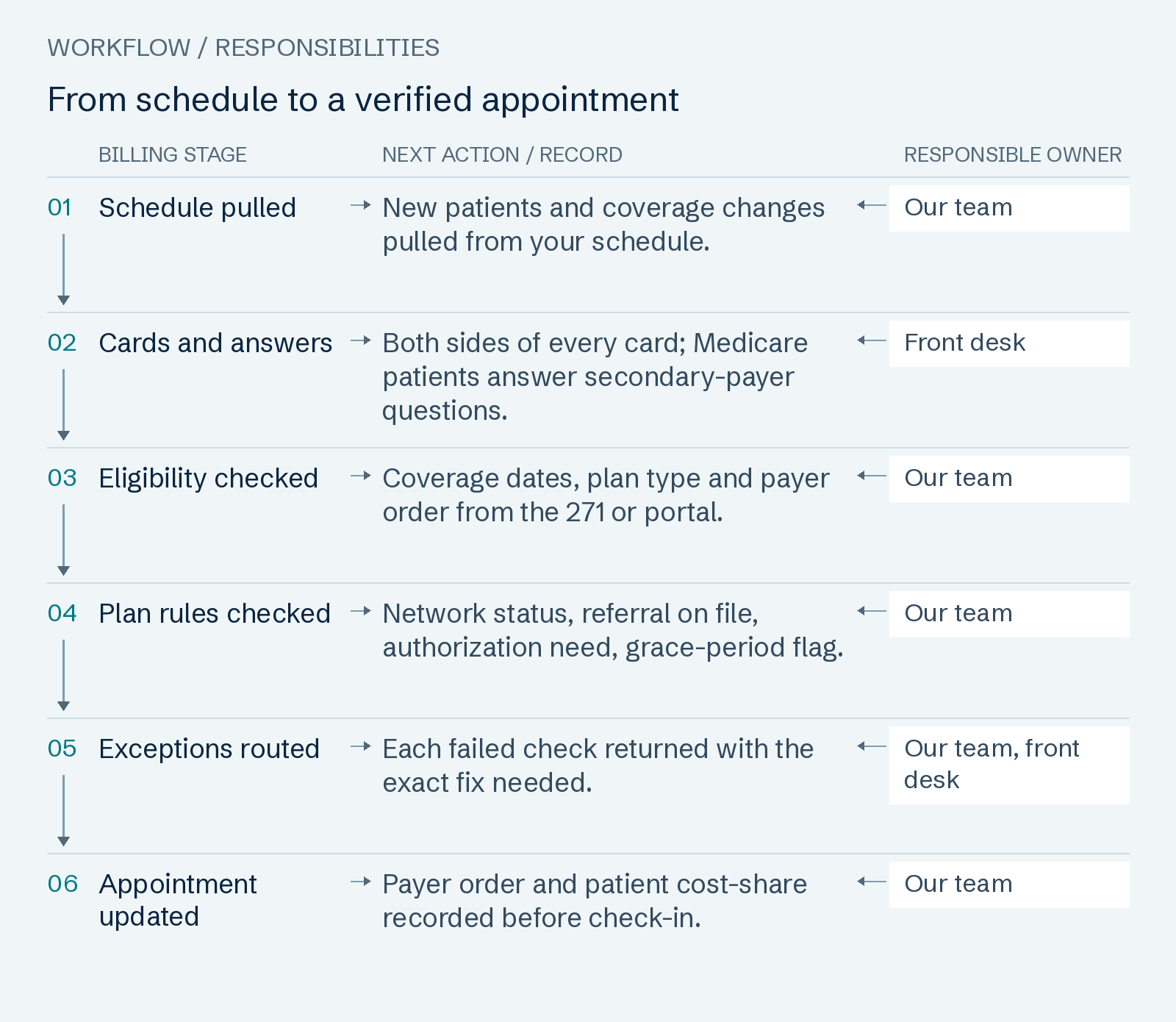
Read the workflow as text
- Schedule pulled — New patients and coverage changes pulled from your schedule. Owner: Our team.
- Cards and answers — Both sides of every card; Medicare patients answer secondary-payer questions. Owner: Front desk.
- Eligibility checked — Coverage dates, plan type and payer order from the 271 or portal. Owner: Our team.
- Plan rules checked — Network status, referral on file, authorization need, grace-period flag. Owner: Our team.
- Exceptions routed — Each failed check returned with the exact fix needed. Owner: Our team, front desk.
- Appointment updated — Payer order and patient cost-share recorded before check-in. Owner: Our team.
Where eligibility errors cost your practice, and what we do about each
- Wrong payer order. CMS tells providers to bill the primary payer before billing Medicare. We reconcile the secondary-payer answers with the eligibility response and set payer order before the claim goes out.
- A plan that changed since the card was scanned. A card on file can show a plan the patient has left, which can draw patient-not-found denials. We check the plan on the visit date, not the plan on file.
- Out of network. UnitedHealthcare warns that a non-participating provider's patient may have higher costs or no coverage. We record network status so the patient hears it before the visit, not on the statement.
- Missing referral. UnitedHealthcare tells specialists to confirm a valid referral is on file before each office visit. We check the payer's referral record and send any gap back as a referral request.
- Exchange grace period. UnitedHealthcare pends claims in month 2 of an Exchange member's premium grace period. We put the grace-period flag on the appointment so you can decide before the visit whether to reschedule.
- A service Medicare may not cover. We flag scheduled services that may fall outside Medicare benefits, so your team can decide on an advance beneficiary notice first.
When an eligibility denial still gets through, the right payer's filing limit is the clock that matters; our filing limits by payer list them.
What insurance verification services cost
Eligibility checks are not sold one at a time. Your plan decides which visits we check: Full-Service Billing checks new patients and anyone reporting a coverage change; Complete RCM checks every scheduled visit.
Your fee is a percentage of insurance payments posted on claims we submitted or worked, net of payer recoupments and refunds. We take 0% of patient payments, copays and anything your front desk collects. Setup is $0. Invoices 1–3: only percentage fees on that month's insurance payments, plus any statements or add-ons you order. Percentage fees and mailed statements are capped at 9.0% of that month's insurance payments; from invoice 4, the $400 minimum applies even in a month when the cap comes to less.
Every tier, size band, term and exclusion is on the full rate card.
| Plan | Which visits we check | Fee |
|---|---|---|
| Full-Service Billing | New patients and patients reporting changed coverage | 5.0% to 8.5% of insurance payments, by specialty and size |
| Complete RCM | Every scheduled visit | 9.0% of insurance payments |
| Verification on its own | Not offered | Not offered |
How we start, including a switch from another billing company
- Agreement and BAA. You sign the service agreement and a business associate agreement.
- Access. You give us logins to your practice-management system and clearinghouse. We work inside your existing practice-management system and clearinghouse; tell us which ones and we confirm in writing within 1 business day.
- Kickoff. One kickoff call; we agree who at your front desk receives eligibility exceptions.
- Go-live. Go-live, when your first claims go out, comes within 5 business days of access; any unbilled backlog follows within 10 business days of access. Clock starts with your signed agreement, signed BAA and working system logins; it extends day for day while we wait on access.
Leaving another billing company? Our handoff plan for switching billing companies covers access, open work and the cutover date.
What we report on eligibility every month
Your KPI report arrives by the 10th of each month with a written definition for each number. We quote no industry benchmark; you track your own trend month to month.
| What we report | How we define it |
|---|---|
| Verification coverage | Visits checked before the date of service ÷ visits in scope |
| Eligibility rejections | Claims that failed front-end or clearinghouse edits for member or eligibility errors ÷ claims submitted |
| Eligibility denials | Adjudicated denials caused by coverage, payer order or a wrong payer ÷ all denials |
| Wrong-payer rebill time | Business days from the denial posting to the rebill to the right payer |
| Front-desk fixes | Your top 3 eligibility causes with the front-desk fix for each (Front-Desk Fix Sheet) |
Specialty practices we check coverage for
- Specialist groups. We check the payer's referral record for each visit included in your plan’s verification scope. See cardiology billing.
- Mental and behavioral health. On UnitedHealthcare Medicare Advantage plans, behavioral health products are provided by Optum, so we confirm network status with whoever manages the benefit. More on mental health billing.
- PT, OT, speech and chiropractic. Where the payer reports a visit limit, we record the limit and the visits used on the appointment. See PT, OT and speech billing.
- DME suppliers. We confirm which contractor or plan processes each item before the claim is built. See DME billing.
- Primary care. A hospice election or Medicare Advantage enrollment on the visit date goes on the appointment as a flag, not only in the chart. See primary care billing.
Guarantees and terms we put in writing
No check brings back coverage that ended before the visit. We control how fast an eligibility denial reaches the right payer, and we carry the deadline risk on the terms below:
- Clock-or-Credit Guarantee. From go-live, every new claim goes out within 1 business day of complete charge data, and every denial is worked within 2 business days of posting — or $25 comes off your invoice for each late one. Mon–Fri ET business days by your system's timestamps; worked: resubmitted, appealed or returned with the fix; auto-credited; capped at monthly fee; clearinghouse outages excluded.
- On-Our-Watch Guarantee. If a claim misses a filing, corrected-claim or appeal deadline while it is on our watch, we pay you what it would have paid. Claims we get complete 10+ business days before the deadline; contracted rate less any copay you collected, paid automatically within 30 days of final denial; capped $10,000/month; your holds excluded.
We publish client results only with written permission. Until we have them, judge us by the guarantees and the free Deadline Map. Get my free A/R Deadline Map from your aging export and a signed BAA, or talk to us about your schedule.
Common questions
- How much do insurance verification services cost?
- Eligibility checks are included in Full-Service Billing, which runs 5.0% to 8.5% of insurance payments by specialty and practice size, with 0% of patient payments and $0 setup. Complete RCM, at 9.0%, adds checks on every scheduled visit. See the rate card.
- Can we outsource insurance verification without outsourcing billing?
- Not today. Eligibility checks come only inside Full-Service Billing and Complete RCM, so the team that runs the check also rebills any eligibility denial that gets through and reports its cause to your front desk each month. Billing plans: Month to month. Leave with 30 days' written notice. No termination fee.
- What does your team check during an eligibility verification?
- Coverage on the date of service, plan type, payer order, copay, deductible and coinsurance, network status, a referral on file and any grace-period flag. For Medicare patients we also reconcile the secondary-payer answers your front desk collects. Each result goes on the appointment; anything that fails goes back to your front desk with the fix. Full-Service Billing covers new patients and changed coverage; Complete RCM adds verification for every scheduled visit.
- How far ahead of the visit do you check coverage?
- Full-Service Billing covers new patients and patients reporting changed coverage, checked before the visit. Complete RCM checks every scheduled visit, with the lead time set in the plan terms on the pricing page. For Medicare, CMS's eligibility system accepts requests up to four months ahead.
- What do you need from our practice to start?
- Sign the service agreement and BAA, give us logins to your practice-management system and clearinghouse, join one 45-minute kickoff call, sign off encounters so charges are complete, and answer our documentation questions within 5 business days. For eligibility specifically: both sides of every insurance card, the secondary-payer answers for Medicare patients, and a note in the schedule when a patient reports a new plan.
- Which practice-management systems do you work in?
- We work inside your existing practice-management system and clearinghouse; tell us which ones and we confirm in writing within 1 business day. We run eligibility checks and bill inside your system, so nothing migrates. See how we work in your software.
- What happens when the check shows no active coverage?
- The appointment goes back to your front desk with the reason: no coverage on that date, a name or ID mismatch, or a different payer on file. The patient brings the current card, or you decide whether to reschedule or see the patient as self-pay. If a claim already denied, we rebill the right payer within 2 business days once the correct coverage is found.
Sources and review
Page revised October 7, 2026 · Review contact: Hyder Shah (inquiries@claimpillar.com). CMS and UnitedHealthcare pages retrieved October 3, 2026. UnitedHealthcare's guide applies to its own plans; your payer contracts govern.