What belongs on the billing and credentialing checklist when you start a medical practice?
Billing setup is the revenue slice of opening a practice; the lease, entity, licensing and malpractice cover come first. Run these checks, or have your practice manager run them, in this order: each form needs the one before it.
- One legal name, tax ID and practice bank account. Medicare's electronic funds transfer (EFT) section asks for a voided check or bank letter showing the legal name and the account and routing numbers (CMS enrollment guide). Every application should carry the same name.
- An NPI for each clinician and one for the group. CMS makes the NPI step 1 of Medicare enrollment: Type 1 for individuals, Type 2 for organizations.
- A CAQH profile for each clinician, attested. DataSpring, the new name for CAQH, lets a clinician enter data once and share it with each plan they authorize, and keeps profiles on a 120-day attestation cycle (DataSpring).
- Medicare enrollment filed in PECOS before opening day. PECOS is CMS's online enrollment system. The group files the CMS-855B; each clinician files the CMS-855I, which also reassigns their benefits to the group. Medicare requires EFT at enrollment (42 CFR 424.510(e)).
- Medicaid enrollment with your state. Each state Medicaid agency screens the providers it enrolls and may rely on screening a Medicare contractor already performed (42 CFR 455.410), one more reason to file Medicare first.
- Each commercial plan credentialed, contracted and loaded. UnitedHealthcare requires both credentialing and contracting before you see its members in network, then asks you to allow up to 60 days to load the contract into its systems (UnitedHealthcare network page).
- Electronic claims and remittances enrolled with your Medicare Administrative Contractor (MAC). The MAC accepts electronic claims only after the practice signs its EDI (electronic data interchange) Enrollment Form, sends electronic remittance advice (ERA) only after a signed ERA Enrollment Form, and denies the EDI agreement when it cannot verify the NPI as active in PECOS (Medicare Claims Processing Manual, ch. 24).
- The practice-management system loaded and one test claim per payer. Each clinician, payer ID and fee schedule goes in before the full schedule starts billing.
What blocks what
Three dependencies set the order, and they are the questions to ask in a weekly status check. The bank account comes before Medicare enrollment, because the EFT section needs its documents. Medicare enrollment comes before EDI, because the MAC denies the EDI agreement until PECOS shows the NPI active. A loaded contract comes before in-network claims, because UnitedHealthcare warns that a claim sent earlier can be denied or paid at the out-of-network level.
Opening a therapy or PT practice
The same order applies. Medicare's effective-date and 30-day rules name physical therapists, occupational therapists and speech-language pathologists alongside physicians and non-physician practitioners (42 CFR 424.520 and 424.521), and CMS lists physical or occupational therapy groups in private practice among the suppliers that file the CMS-855B. Plan a PT practice's Medicare enrollment on the slower clock: CMS places physical therapists in its moderate screening level, which carries a site visit (Program Integrity Manual, ch. 10), so the site-visit standard in the next section applies.
| Check | Why it matters to your practice | What good looks like | Red flag |
|---|---|---|---|
| Legal name and bank account | Medicare's EFT section needs the bank letter or voided check | One legal name on the bank letter and every application | Applications filed under a name the bank letter does not show |
| NPIs | Every payer application asks for them | Type 1 per clinician; Type 2 for the group | NPIs not confirmed in the NPPES registry before applications go out |
| CAQH profiles | Plans read clinician data from the profiles you authorize | Complete profile, current documents, recent attestation | Attestation older than the 120-day cycle |
| Medicare enrollment | Sets your Medicare first billable date | Filed in PECOS before opening day, EFT included | Filing planned for after the first Medicare visit |
| Medicaid enrollment | Each state runs its own enrollment and screening | Filed with the state; effective date confirmed in writing | Medicaid patients booked before the state confirms |
| Commercial contracts | In-network payment needs credentialing, a signed contract and loading | Effective date and load date confirmed in writing for each plan | Members booked as in-network on credentialing approval alone |
| EDI and ERA enrollment | No electronic Medicare claims or remittances without it | EDI and ERA forms signed with the MAC once PECOS shows the NPI active | Clearinghouse account open but MAC forms never signed |
| Test claim per payer | Finds setup errors before the full schedule bills | One accepted claim per payer before volume ramps | First week of claims sent in bulk with no acceptance check |
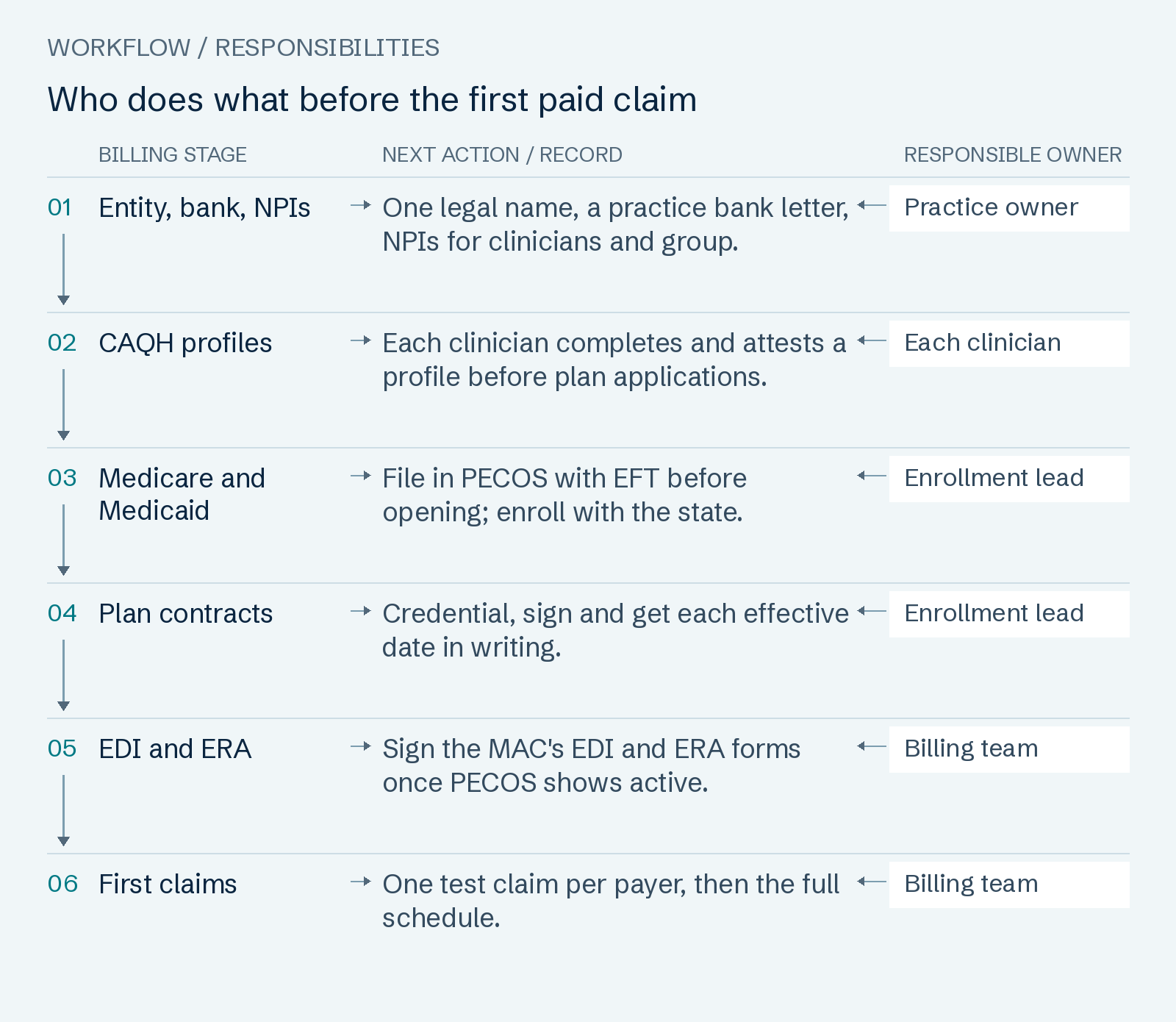
Read the workflow as text
- Entity, bank, NPIs — One legal name, a practice bank letter, NPIs for clinicians and group. Owner: Practice owner.
- CAQH profiles — Each clinician completes and attests a profile before plan applications. Owner: Each clinician.
- Medicare and Medicaid — File in PECOS with EFT before opening; enroll with the state. Owner: Enrollment lead.
- Plan contracts — Credential, sign and get each effective date in writing. Owner: Enrollment lead.
- EDI and ERA — Sign the MAC's EDI and ERA forms once PECOS shows active. Owner: Billing team.
- First claims — One test claim per payer, then the full schedule. Owner: Billing team.
How long does each billing enrollment take?
Plan around the slowest payer that covers a large share of your patients. Medicare publishes the processing standards its contractors must meet, in calendar days from receipt, in Program Integrity Manual chapter 10; they measure the contractor, not a promise for one application. A commercial plan publishes a time only if it chooses to.
Payers that publish no time
A plan with no published number still runs a clock. Ask its network team for the expected effective date in writing and log it beside the application. For the plans you expect to bill most, our insurance credentialing guide explains how credentialing works from application to approval.
| Step | Published time | Clock starts | Published by |
|---|---|---|---|
| Medicare enrollment in PECOS, no site visit, development or fingerprinting | 95% within 15 days; 100% within 50 days | MAC receives the application | CMS Program Integrity Manual, ch. 10 |
| Medicare enrollment in PECOS, with site visit, development or fingerprinting | 95% within 50 days; 100% within 85 days | MAC receives the application | CMS Program Integrity Manual, ch. 10 |
| Reply to a MAC request for more information | Within 30 days, or the MAC may reject the application | The MAC's request | CMS MLN9658742 |
| UnitedHealthcare credentialing | Up to 45 calendar days or more | Completed application with all required information | UnitedHealthcare |
| UnitedHealthcare contract loading | Allow up to 60 days | Credentialing approved and signed contract received | UnitedHealthcare |
When will your first insurance payment arrive?
Your first insurance payment arrives once two things line up: the payer's first billable date for your practice, and that payer's processing time for a clean claim. Each payer type sets the first date its own way, as the table shows.
File Medicare before your first visit
Medicare's effective date is the later of the filing date of an application the contractor approves and the date you first furnished services at the new practice location (42 CFR 424.520(d)). File before opening day and, once approved, the effective date matches your first service date. File after opening and the filing date becomes the effective date: earlier visits can be billed for up to 30 days before it, and only when circumstances prevented enrolling in advance, every program requirement including state licensure was met, and the services were at the enrolled location (42 CFR 424.521). The rule repeats for each clinician you add; see how the effective-date rule applies to a new clinician.
Example: a Medicare-first opening, dated
Example only, using Medicare's published standards. The MAC receives your PECOS application on March 2, and it needs no site visit, development or fingerprinting. The standard is 95% processed within 15 days (March 2 + 15 = March 17) and all within 50 days (March 2 + 50 = April 21). Say approval arrives by March 17 and your EDI form is signed before you open on April 1: the effective date is April 1. A clean electronic claim for that visit received April 2 sits in Medicare's 13-day payment floor, counted from the day after receipt, through April 15, and Medicare must pay or deny it within 30 days, by May 2, or pay interest (Medicare Claims Processing Manual, ch. 1). Paper claims are not eligible for payment before the 29th day after receipt.
Claims held while a payer finishes enrollment keep aging against its timely filing limit. In our dataset, Original Medicare allows 12 months from the date of service, while Cigna lists 90 days for participating commercial claims unless state law or the provider agreement allows longer, so a contract that loads three months after opening can leave early visits out of time. Ask each plan in writing whether it accepts claims for visits between approval and loading. Our timely filing limits by payer table covers more plans.
| Payer type | What must be in place | First billable date | Visits before that date |
|---|---|---|---|
| Original Medicare (Part B) | Approved CMS-855I (and CMS-855B for a group), EFT, signed EDI Enrollment Form for electronic claims | Later of the approved application's filing date or the first service at the new location | Up to 30 days back when circumstances prevented earlier enrollment (90 when a Presidentially declared disaster prevented it) |
| Commercial plan (UnitedHealthcare as the published example) | Credentialing approved, contract signed and loaded | Set by the plan; allow up to 60 days for loading after approval and signature | Can be denied or paid at the out-of-network level |
| Medicaid | State Medicaid enrollment and screening | Set by each state program | Set by each state program |
| Medicare Advantage plan | The plan's own credentialing and contract | Set by the plan contract | Set by the plan contract |
Run setup yourselves, split it, or hand it off?
Every check above needs an owner: you, your practice manager, a vendor you already pay, or one team that runs enrollment and the first claims together. Whichever you choose, three things stay with the practice: the clinicians' signatures and attestations, the bank account, and the decision on which plans to join.
Our credentialing cost guide compares the cost of filing enrollments yourselves with hiring a credentialing company.
| Option | Who does the work | What it costs | What can go wrong |
|---|---|---|---|
| Your own team runs setup | You or your practice manager file every application and build the billing system | Staff hours plus vendor fees for the practice-management system and clearinghouse | Applications stall while the same person is also opening the practice |
| Split: enrollment vendor, billing in-house | A credentialing company files enrollments; your staff send the claims | Per-payer enrollment fees plus your biller's pay | Effective dates never reach the billing system, so claims go out early or late |
| One team for enrollment and billing | A billing company files enrollments and sends the first claims | Enrollment fees plus a share of insurance payments | Claims sent before each payer's effective date is in writing |
What does billing setup cost a new practice?
Medicare enrollment and the CAQH profile cost a physician practice nothing. Medicare charges no enrollment application fee to physicians, non-physician practitioners, physician organizations or non-physician practitioner organizations; the 2026 fee of $750 is generally paid by institutional providers and suppliers such as DMEPOS suppliers and opioid treatment programs (CMS MLN9658742). CMS's enrollment manual also exempts physical therapists enrolling as individuals or group practices from the fee (Program Integrity Manual, ch. 10). DataSpring provides the CAQH profile at no cost to clinicians, provider groups and practices.
Time is the larger cost. Each week between opening day and a payer's first billable date is a week of visits that payer may never pay. Vendor costs, such as the practice-management system and the clearinghouse, appear only in each vendor's quote.
Cash to hold until payments start
Medicare's reserve-funds rule is written for home health agencies, not for physician or therapy practices: a new agency must have initial reserve operating funds to run for the three months after Medicare conveys billing privileges, not counting Medicare receivables (CMS Program Integrity Manual, ch. 10). The same arithmetic works as a planning check for any practice: monthly operating costs multiplied by the months between opening and the first payments from the payers that cover most of your schedule.
What keeps your billing privileges active after opening?
Enrollment records need upkeep once claims pay. Medicare must hear about a change of ownership, an adverse legal action or a change, addition or deletion of a practice location within 30 days, and every other enrollment change within 90 days (42 CFR 424.516). CAQH profiles stay current on DataSpring's 120-day attestation cycle.
When should you hand billing setup off?
Practices hand off billing setup when no one on the opening team can run the enrollment queue and the first claims at the same time, when the opening date is fixed and applications are not yet filed, or when a clinician-owner would otherwise do it between patients. Our billing service for practices of one to five clinicians is built for that start: we file and track each enrollment application and send the first claims once each payer's effective date is in place. Enrollment is priced at $149 per payer. Billed only after the payer confirms your effective date; $0 if denied or panel closed; filed within 5 business days of your complete packet. Billing rates and terms are on our pricing page.
For a family medicine, internal medicine or NP-led primary care practice, review the primary care billing scope alongside the enrollment work so the ongoing handoff is clear before opening.
Common questions
- How long after opening until insurance pays us?
- It depends on each payer's first billable date. Medicare can pay soonest if you filed before opening: it pays or denies a clean claim within 30 days of receipt, after a 13-day waiting period for electronic claims (Medicare Claims Processing Manual, ch. 1). Commercial plans pay in network only after the contract is loaded, which UnitedHealthcare says can take up to 60 days after credentialing approval.
- When can our new practice submit its first claim?
- For Original Medicare, once the enrollment is approved and the EDI Enrollment Form is signed with your MAC, for visits on or after the effective date (or up to 30 days before it when 42 CFR 424.521 applies). For a commercial plan, once its contract is loaded. For Medicaid and Medicare Advantage plans, on the date each program or plan contract sets. Send one test claim per payer first.
- How early should we start credentialing?
- As soon as the legal name, bank account, NPIs and CAQH profiles exist. The published clocks show why: Medicare's standard gives its contractors up to 85 days for an application that needs a site visit, development or fingerprinting, and UnitedHealthcare says credentialing generally takes up to 45 calendar days or more after a complete application, then asks you to allow up to 60 days to load the signed contract. Filing Medicare before opening day also lets its effective date match your first visit.
- How much cash should we hold until insurance payments start?
- Enough to run the practice until the payers that cover most of your patients pay their first claims. Medicare's reserve-funds rule is written for home health agencies, not physician or therapy practices: it requires a new agency to hold operating funds for three months after billing privileges begin. Build your number from your monthly costs and each payer's first billable date.
- Should a new practice use a billing company from day one?
- It fits when enrollment and the first claims would otherwise fall on a clinician-owner or one new hire. It matters less when a practice manager has opened a practice before and has time to track every application. Either way, get each payer's effective date in writing before any claim goes out.
- What does billing setup cost a new practice?
- In fees, little: Medicare charges physicians, non-physician practitioners, their organizations and physical therapy practices no enrollment application fee, and CAQH profiles cost nothing. The real costs are vendor fees, any service you hire, and visits a payer will not pay before your effective date.
- Does our practice have to bill Medicare electronically?
- Not if it is small. Under the Administrative Simplification Compliance Act (ASCA) exception in chapter 24 of the Medicare Claims Processing Manual, a physician, practitioner or supplier with fewer than 10 full-time equivalent employees may submit all, some or none of its Original Medicare claims electronically. Electronic claims still need the MAC's EDI Enrollment Form, and paper claims are not eligible for payment before the 29th day after receipt, compared with the 14th day for a compliant electronic claim.
Sources and review
Page revised October 8, 2026 · Review contact: Hyder Shah (inquiries@claimpillar.com). Every source below was retrieved and checked on October 7, 2026. The filing-limit figures come from our timely filing dataset, built from each payer's own published documents and retrieved October 2 and 3, 2026.
- CMS MLN9658742: Medicare Provider Enrollment
- CMS: Medicare Claims Processing Manual, Chapter 24, General EDI and EDI Support Requirements
- CMS: Medicare Claims Processing Manual, Chapter 1, General Billing Requirements (sections 80.2.1.1 and 80.2.1.2)
- eCFR: 42 CFR part 424 subpart P, Medicare provider and supplier enrollment (424.510, 424.516, 424.520, 424.521)
- CMS: Medicare Program Integrity Manual, Chapter 10, Medicare Enrollment
- eCFR: 42 CFR 455.410, Medicaid enrollment and screening of providers
- DataSpring, powered by CAQH: For clinicians
- UnitedHealthcare: Join our network, medical providers