What is a timely filing limit, and what does missing one cost your practice?
A timely filing limit is the payer's deadline for submitting a claim, counted from the date of service or the start date the payer names. For Medicare, CMS says claims must reach the right contractor no later than 12 months, or 1 calendar year, after the date of service (Medicare Claims Processing Manual, chapter 1, §70). Commercial and Medicaid limits are often far shorter, and many sit in your contract rather than on a public page.
A missed limit costs your practice the whole claim. CMS says a denial for late filing is not an initial determination, so it is not subject to appeal; Medicare extends the deadline only under the written exceptions in §70.7. UnitedHealthcare's reconsideration process lets you submit proof that the claim was received and accepted within your filing limit. Otherwise the write-off usually stays with your practice: Cigna's contract prohibits balance billing the patient when a claim is denied as late (Cigna claim filing page). Late filing is one kind of denial; the denials payers decide on the merits are a separate problem with separate fixes.
Three clocks run on every claim
Each claim carries up to three deadlines, and each clock runs from a different date. The first-claim limit runs from the date of service. At some payers the corrected-claim limit runs on the same clock: UnitedHealthcare applies its filing limit to corrected claims, so with a 90-day limit and a May 1 date of service, every correction must arrive within 90 days of May 1 (2026 UnitedHealthcare Administrative Guide). Others start a separate window: Fidelis Care's New York Medicaid managed care plans allow a corrected claim within 60 days of the remittance advice. The appeal window runs from the payer's decision. The table shows how far apart the three clocks sit at four payers in our dataset.
| Payer (scope) | First-claim limit | Corrected claims | Appeal window |
|---|---|---|---|
| Medicare fee-for-service (national) | 12 months from the date of service | No services added after the limit | 120 days from receipt of the notice |
| Cigna commercial (national) | 90 days in-network; 180 days out-of-network | Unrequested resubmissions stay on the filing limit | 180 calendar days from the payment or denial notice |
| Optum Behavioral Health (national network) | 90 calendar days from the date of service | Within 90 days of first claim receipt | 12 months for reconsideration and appeal together |
| Texas Medicaid fee-for-service | Received within 95 days of each date of service | Not stated in the manual section checked | 120 days from the disposition date |
Which of your payers give your practice the least time?
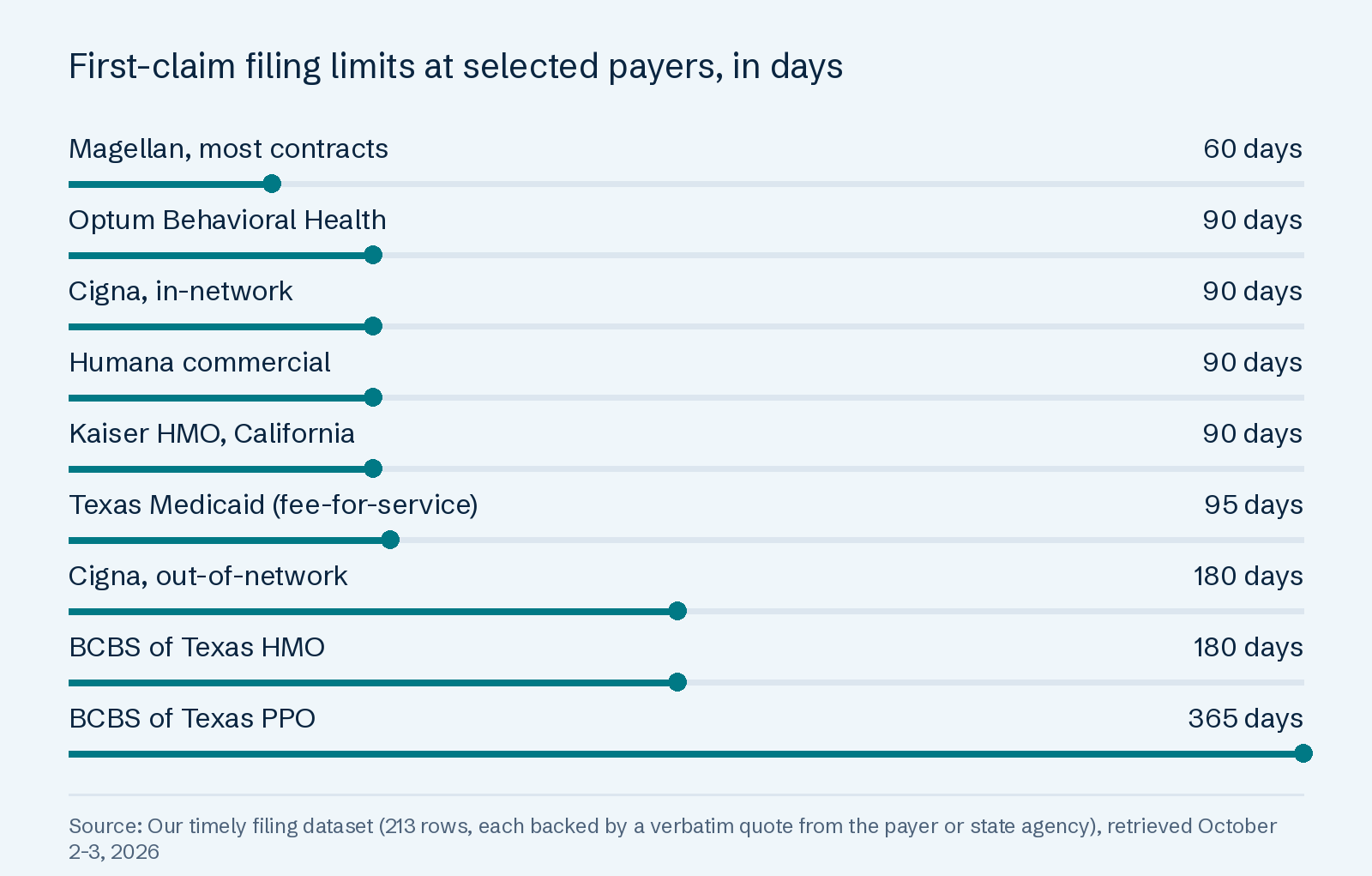
In our dataset, the least time comes from behavioral health plans, some in-network commercial contracts and some state Medicaid programs. Magellan's national provider handbook says most of its contracts require claims within 60 days. Optum Behavioral Health, Cigna for participating providers and Humana commercial allow 90 days, and Texas Medicaid requires claims to be received within 95 days of each date of service. A practice that bills both Magellan and BCBS of Texas PPO plans can face 60 days on one claim and 365 on the next, from the same date of service.
Every value in the chart comes from our timely filing dataset: 213 rows, each tied to a verbatim quote from the payer's or state agency's own document. You can download the full dataset, or pick a payer in the deadline calculator at the top of this page to count a claim's last filing day.
Read the scope before the number
Network status, product line and state change the answer. Cigna allows 90 days in-network and 180 out-of-network. Humana allows 90 days on commercial claims and one year on Medicare Advantage claims, unless state law or your agreement sets another limit. UnitedHealthcare's guide says its limits vary by state and contract and sends you to your agreement for the number. When a payer publishes no default, the number in your signed contract is the one that applies.
How can you tell if claims are expiring in your practice?
Claims are expiring when timely filing write-offs show up in your adjustment report, or when nobody can name the payer that gives you the least time. Four signs come first:
- Rejections that sit. A rejection fails front-end or clearinghouse edits and never enters adjudication. CMS says rejected claims are not considered received until they are resubmitted as corrected, complete claims, so a rejection queue is a queue of claims with no filing date.
- Charges that wait on notes. A visit with an unsigned note cannot be billed, and its filing clock is already running.
- Coverage found late. A claim sent to the wrong payer is not filed with the right one.
- Aged A/R nobody has dated. The aging report groups unpaid balances by age; focus here on its balances older than 90 days. A claim over 90 days old that never reached Cigna is past its standard participating-provider limit unless the agreement, state law or an applicable exception allows longer.
Numbers to pull this month
Ask for three numbers: the dollars written off for timely filing in the last 12 months, the count and age of open rejections, and the aged A/R balance split by payer. A/R days (total accounts receivable divided by average daily charges) tells you how fast money comes in; the write-off total tells you how much never will. These sit beside the monthly billing numbers to review. If much of your A/R is already past 90 days, start with what is still collectible in A/R over 90 days.
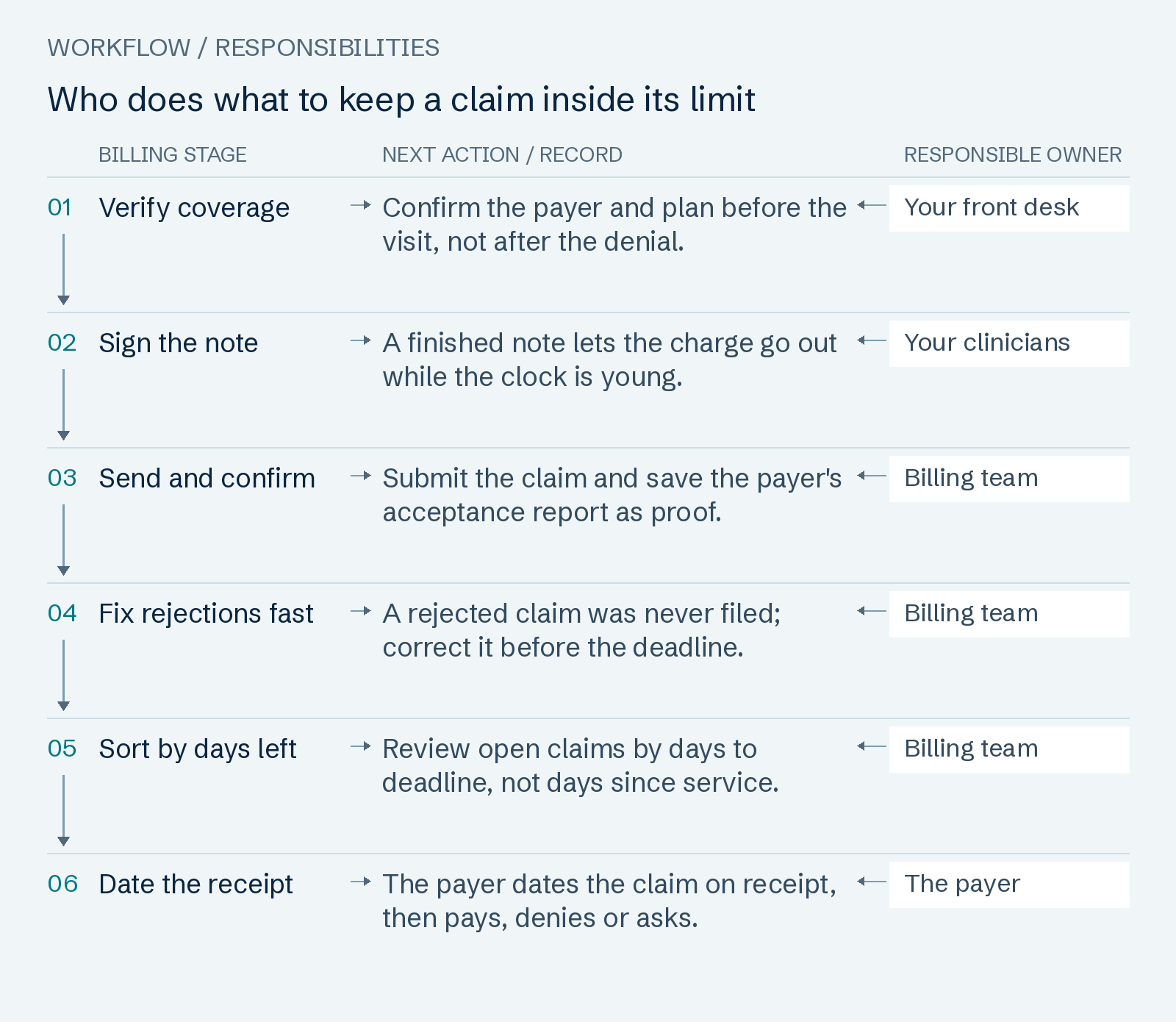
Read the workflow as text
- Verify coverage — Confirm the payer and plan before the visit, not after the denial. Owner: Your front desk.
- Sign the note — A finished note lets the charge go out while the clock is young. Owner: Your clinicians.
- Send and confirm — Submit the claim and save the payer's acceptance report as proof. Owner: Billing team.
- Fix rejections fast — A rejected claim was never filed; correct it before the deadline. Owner: Billing team.
- Sort by days left — Review open claims by days to deadline, not days since service. Owner: Billing team.
- Date the receipt — The payer dates the claim on receipt, then pays, denies or asks. Owner: The payer.
How do you prevent timely filing denials, and who should own your filing calendar?
One named person should own every payer's filing calendar, with a backup who can read it. The owner keeps each payer's three limits current from your contracts and manuals, and works open claims in deadline order. The figure shows who does what, and the table compares your options. The staff wage is the Bureau of Labor Statistics median for medical records specialists, the occupation that includes medical coders: $51,140 a year in May 2025.
| Option | What it costs | Who does the work | What can go wrong |
|---|---|---|---|
| Your in-house biller owns it | Part of a salary (BLS median for medical records specialists: $51,140 a year, May 2025) | Your biller, using the work queues in your practice-management system | One person holds every deadline; vacations and turnover stop the watching |
| Your manager reviews a deadline report weekly | Manager hours each week | Your biller works the claims; you check the report | The report is only as good as the payer limits loaded into it |
| A billing company owns filing and deadlines | A percentage of insurance payments (see the cost section) | The billing team; you supply notes, coverage details and system access | A contract that does not say who pays when a deadline is missed |
| Nobody owns it until denials arrive | The full value of every expired claim | Whoever opens the denial | Medicare late-filing denials cannot be appealed |
What should you ask whoever files your claims?
Ask your biller or billing company these questions:
- Which of our payers has the shortest filing limit, and where is it written? The answer should name a contract or manual, not a list from a blog.
- Do you track the corrected-claim limit and the appeal window, or only the first-claim limit?
- Where do you keep proof of filing? UnitedHealthcare's proof must show the date the claim was submitted, the date it was accepted, the member ID, the date of service and the provider ID, and it says a rejected claim is not proof.
- How old is the oldest rejection in the queue today?
- Can you show open claims sorted by days left to their deadline?
- Who pays when a claim misses a deadline on your watch? If the contract does not say, assume your practice absorbs the loss.
If your billing company cannot answer these, the questions in what to check when you switch billing companies apply. To check the rest of your billing yourself, use a billing audit checklist you can run in-house.
What do missed deadlines cost, and what does watching them cost?
A late-filing denial that cannot be recovered puts the otherwise collectible payment at risk, plus the staff time spent investigating. Example: one week of unrecoverable expired therapy claims, twelve 60-minute psychotherapy visits (CPT 90837), valued at the 2026 national Medicare amount (unadjusted) of $167.00 each: 12 × $167.00 = $2,004.00 in illustrative allowed value. The amount comes from the CMS CY 2026 physician fee schedule relative value file (RVU26D); actual payment varies by locality, setting and payer, and your commercial contracts pay their own rates.
Watching the deadlines costs staff time in-house, or a fee if a billing company does it. Our full-service rate starts at 5.0% of insurance payments, with a $400 monthly minimum. Invoices 1–3: only percentage fees on that month's insurance payments, plus any statements or add-ons you order; the $400 minimum starts with invoice 4. The full rate card is on our pricing page.
When should you hand your filing deadlines to a billing team?
Practices hand off filing deadlines when one person holds every payer's clock, when rejections sit unworked, or when aged A/R has never been dated against payer limits. To see where your practice stands first, request The Free A/R Deadline Map: A claim-by-claim list of every unpaid insurance claim over 90 days in the aging report you send: payer, amount, the deadline it faces, the denial reason and the next action, sorted by deadline. It arrives in 5 business days. Clock starts with your claim-level aging export and signed BAA; above 10 requests in a week, we confirm your date within 1 business day. For claims younger than 90 days, the calculator at the top of this page counts each deadline.
If we take over your billing, deadlines carry a written promise. On-Our-Watch Guarantee: If a claim misses a filing, corrected-claim or appeal deadline while it is on our watch, we pay you what it would have paid. Claims we get complete 10+ business days before the deadline; contracted rate less any copay you collected, paid automatically within 30 days of final denial; capped $10,000/month; your holds excluded. No billing company can make a payer pay a claim that reached it late; what we guarantee, on the terms above, is the deadline.
Common questions
- How much revenue do practices lose to missed filing deadlines?
- We found no reliable public national figure, so measure your own: total the adjustments your system posted for timely filing denials over the last 12 months. Those adjustments show the balances written off; they do not establish how much the claims would have collected. The cost section above works one week of therapy visits as an example.
- Who absorbs a claim that missed the deadline: our practice or the patient?
- Usually your practice. Cigna says its contract prohibits balance billing the patient for claims denied as late. For Medicare, CMS says beneficiaries may be billed only when the remittance uses group code PR, patient responsibility (CMS remittance advice page). CMS chapter 1, §70.4 adds that where the beneficiary's request for payment was timely but the provider is responsible for the late claim, the provider may not charge the beneficiary except the deductible and coinsurance that would have applied had Medicare paid. Bill a patient after a late-filing denial only for amounts the remittance marks PR, or that your contract or the payer's rule allows.
- Does a corrected claim restart the filing clock?
- It depends on the payer. UnitedHealthcare applies the same number of days to corrected claims, counted from the original date of service. Cigna applies its filing limit to any resubmission it did not request. Medicare does not allow an adjustment that adds a missed service once the filing limit has passed (chapter 1, §70.5). Some payers set a separate window: Fidelis Care's New York Medicaid managed care plans allow a corrected claim within 60 days of the remittance advice.
- Can a claim past its deadline still be paid?
- Sometimes. Medicare extends its limit only for its written exceptions, such as administrative error by Medicare or its contractor, retroactive Medicare entitlement and retroactive disenrollment from a Medicare Advantage plan or PACE. Cigna lists exceptions where law or your provider agreement allows more time, and for extraordinary circumstances. UnitedHealthcare's reconsideration process lets you submit proof that the claim was received and accepted within your filing limit.
- How do we find open claims that are close to a deadline?
- Sort open claims by days left to each payer's limit, not by days since service. For one claim, enter its date of service and payer in the calculator on this page. For every unpaid claim over 90 days, The Free A/R Deadline Map sorts them by deadline. Clock starts with your claim-level aging export and signed BAA; above 10 requests in a week, we confirm your date within 1 business day.
- Can our front-desk staff own the filing calendar?
- They can own the start of it: verifying coverage before the visit prevents claims going to the wrong payer. The calendar itself belongs with whoever works rejections and open claims, because a rejected claim does not count as filed and that person sees rejections as they come back.
- Does a rejected claim count as filed for our deadline?
- No. CMS says rejected claims are not considered received until they are resubmitted as corrected, complete claims, and UnitedHealthcare says a rejected claim is not proof of timely filing. The filing clock keeps running until a corrected, complete claim reaches the payer.
Sources and review
Page revised October 8, 2026 · Review contact: Hyder Shah (inquiries@claimpillar.com). Every source below was retrieved and checked on October 7, 2026. The chart, the three-clock table and the calculator presets draw on our timely filing dataset, built from payer and state agency documents retrieved October 2-3, 2026; the 90837 amount comes from content/data/pfs-2026-national.csv (CMS RVU26D).
- CMS Medicare Claims Processing Manual (Pub. 100-04), Chapter 1, §70: Time Limitations for Filing Claims
- Cigna Healthcare: Claims Submission, Payments, and Filing
- 2026 UnitedHealthcare Care Provider Administrative Guide
- Texas Medicaid Provider Procedures Manual, Section 6: Claims Filing (TMHP)
- Bureau of Labor Statistics: Medical Records Specialists, Occupational Outlook Handbook
- CMS: PFS Relative Value Files (CY 2026, RVU26D)
- CMS: Health Care Payment and Remittance Advice (group codes)
Correction notes
- : Automatic filing-deadline presets now use only high-confidence rows with one filing limit. The full dataset retains rows with uncertain applicability for manual review; selected presets show the recorded source and retrieval dates.