Who our cardiology billing service is for
Our cardiology billing service is built for independent cardiology practices, from one cardiologist to groups of 6–15 clinicians. Some run office tests on their own echo, nuclear and vascular equipment; others read studies and perform caths, PCIs, ablations and implants in hospital labs; many do both and run a device clinic.
Hand your billing to us when:
- the biller who knew which hospital bills the technical side has left, and reads go out wrong or not at all;
- cath and EP claims keep coming back for authorization or bundling, with no one free to appeal;
- device clinic checks and hospital reads sit unbilled or unsigned while A/R ages past 90 days.
What we take over and what your practice keeps
We take over cardiology billing from the signed report to the posted payment: the professional claim for every read, the full claim for each test performed on your own office equipment, and the follow-up on both. We check every code against your clinician's documentation and never change a code without the clinician's sign-off. Our documentation-based coding review runs on every echo, cath and EP claim before it goes out. Your cardiologists keep reading, supervising and signing; the figure below shows a month of our cardiology billing.
| Task | What we do | What you keep |
|---|---|---|
| Charge capture by service line | Match office tests, hospital reads, cath lab cases and device checks to a signed report and a charge. | Signing reads promptly |
| Component assignment | Bill global, -26 or the technical component by who owned the equipment, with the POS of the testing site. | Telling us which hospitals and vendors bill the technical side |
| PCI and EP coding | Code each PCI by major coronary artery with its artery modifier, and check ablation and implant claims against Medicare NCCI bundling. | Procedure notes that name each artery and lesion |
| Vascular lab | Bill duplex and ABI studies by component and check same-day technical reductions on each remittance. | Signed vascular reports |
| Supervision check | Flag stress, stress-echo and cath claims with no documented supervising physician before they go out. | Supervising and documenting the test |
| Device clinic calendar | Track each patient's remote monitoring period and in-person checks against your MAC's frequency rule, so each period is checked before it is billed. | The device roster and transmission schedule |
| Authorization tracking | Record auth numbers, CPT codes and expiry dates for caths, EP implants and stress echoes. | Clinical notes the payer asks for |
| Sending claims | Every claim with complete charge data goes to the payer within 1 business day. | Closing encounters in your EHR |
| Denial work | Each denial is resubmitted, appealed or sent back to you with the fix within 2 business days of posting. | Replies when we ask about a read or note |
| Posting and follow-up | Remittances posted within 2 business days; open insurance balances chased until paid or closed. | Deposits land in your practice's account |
| Monthly reporting | KPIs split by office testing, hospital reads, cath and devices, with written definitions, by the 10th of each month. | Ownership of all billing data |
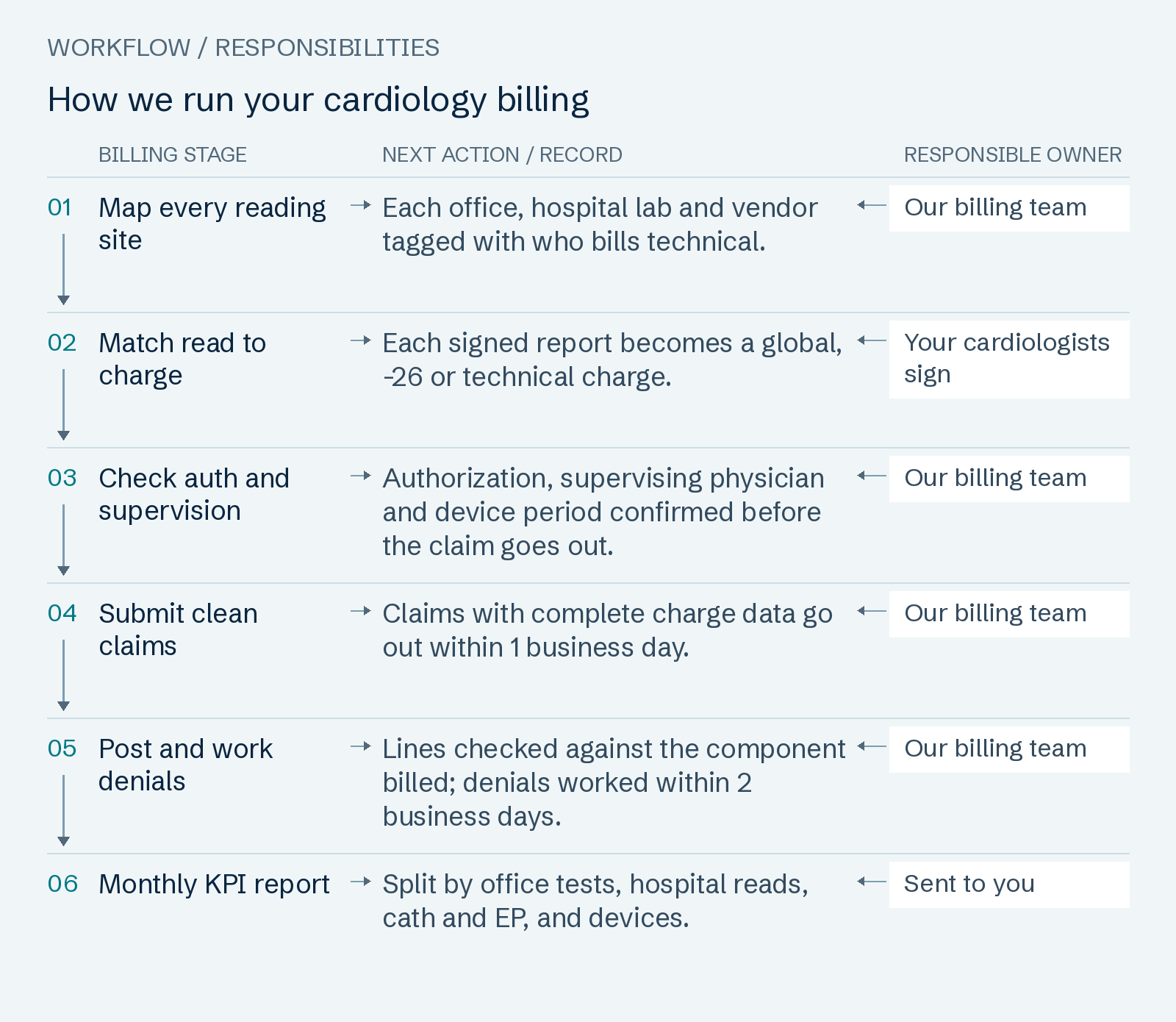
Read the workflow as text
- Map every reading site — Each office, hospital lab and vendor tagged with who bills technical. Owner: Our billing team.
- Match read to charge — Each signed report becomes a global, -26 or technical charge. Owner: Your cardiologists sign.
- Check auth and supervision — Authorization, supervising physician and device period confirmed before the claim goes out. Owner: Our billing team.
- Submit clean claims — Claims with complete charge data go out within 1 business day. Owner: Our billing team.
- Post and work denials — Lines checked against the component billed; denials worked within 2 business days. Owner: Our billing team.
- Monthly KPI report — Split by office tests, hospital reads, cath and EP, and devices. Owner: Sent to you.
Where cardiology practices lose revenue, and what we do about it
Cardiology revenue leaks where one test is split between two billers, or where a procedure claim depends on paperwork outside the claim. We check these points on every cardiology claim.
Office tests and hospital reads
- The wrong component for the setting. A read of a hospital-performed test must carry the place-of-service code of the setting where the patient had the test, per CMS Claims Processing Manual chapter 13, section 150. We record who owns the equipment at each lab you read for and bill global, -26 or technical to match.
- Supervision left undocumented. Under 42 CFR 410.32(b), Medicare treats a diagnostic test furnished without its required supervision level as not reasonable and necessary. We hold stress, stress-echo and cath claims that name no supervising physician.
- Same-day technical cuts left unchecked. Medicare pays 75% of each additional same-day diagnostic cardiovascular technical component for one patient and group, per CMS Transmittal 1149. We post every echo and vascular-lab line against that expected amount, so an extra cut stands out.
- Device checks billed inside the same period. Novitas article A56602 limits remote pacemaker and ICD monitoring (93293–93296) to once every 90 days. We track each patient's monitoring period against the processing contractor's article.
Cath lab, PCI and EP claims
- PCI still coded by branch. CPT deleted the PCI branch add-on codes on January 1, 2026, and one code now covers a major coronary artery and its branches, per the SCAI 2026 coding summary. We code each PCI per major artery, with its artery modifier.
- A missing authorization sinks the read too. On the commercial plans in UnitedHealthcare's cardiology prior authorization program, a cath or EP implant without authorization puts the whole claim, the -26 read included, at risk of administrative denial. Our authorization tracking logs each number, code and expiry against the scheduled case.
Our guide to where cardiology practices lose revenue shows the numbers to check. To see which open cardiology claims sit closest to a filing deadline, ask for The Free A/R Deadline Map, delivered in 5 business days. Clock starts with your claim-level aging export and signed BAA; above 10 requests in a week, we confirm your date within 1 business day.
What our cardiology billing costs
Cardiology groups sit in the specialist physician row of our rate card, and the rate steps down as the number of billed clinicians grows. Your fee is a percentage of insurance payments posted on claims we submitted or worked, net of payer recoupments and refunds. We take 0% of patient payments, copays and anything your front desk collects. A hospital's payment for the technical side of a test your cardiologist read goes to the hospital, so it never counts toward your fee. Setup costs $0. Invoices 1–3: only percentage fees on that month's insurance payments, plus any statements or add-ons you order. Percentage fees and mailed statements are capped at 9.0% of that month's insurance payments; from invoice 4, the $400 minimum applies even in a month when the cap comes to less. Every add-on is on the full rate card.
| Clinicians we bill for | Rate of insurance payments |
|---|---|
| 1 clinician | 6.0% |
| 2–5 clinicians | 5.5% |
| 6–15 clinicians | 5.0% |
| Groups of 16+ clinicians | 16+ clinicians, or anesthesia, radiology, DME, lab and home health: written quote within 1 business day, same fee base, cap and terms. |
How we start: switching from in-house or another billing company
A handover puts aged reads near their filing limits and untracked device monitoring periods at risk first. We start with five things from you:
- Your signature on our agreement and business associate agreement (BAA).
- Practice-management and clearinghouse logins, plus read access to your echo, cath and device reporting systems.
- A claim-level aging report, which we sort by deadline.
- Your device clinic roster with each patient's last remote and in-person check date.
- The hospitals, labs and vendors where your cardiologists read, and who bills the technical side at each.
Go-live, when your first claims go out, comes within 5 business days of access; any unbilled backlog follows within 10 business days of access. Clock starts with your signed agreement, signed BAA and working system logins; it extends day for day while we wait on access. Every inherited claim within 30 days of a filing, corrected-claim or appeal deadline is worked within 5 business days of access. Starts at access; covers up to 250 claims (more gets a day-1 deadline schedule); worked means submitted, corrected, appealed or returned with the fix.
Our billing handoff checklist lists what to request from your current company.
What we report each month and the guarantees behind it
Two written guarantees back the work, each with its terms beside it.
- On-Our-Watch Guarantee: If a claim misses a filing, corrected-claim or appeal deadline while it is on our watch, we pay you what it would have paid. Claims we get complete 10+ business days before the deadline; contracted rate less any copay you collected, paid automatically within 30 days of final denial; capped $10,000/month; your holds excluded.
- Clock-or-Credit Guarantee: From go-live, every new claim goes out within 1 business day of complete charge data, and every denial is worked within 2 business days of posting — or $25 comes off your invoice for each late one. Mon–Fri ET business days by your system's timestamps; worked: resubmitted, appealed or returned with the fix; auto-credited; capped at monthly fee; clearinghouse outages excluded.
Unsigned reads are the cardiology hold: a -26 claim without a signed report is not complete charge data. Cigna lists 90 days from the date of service for participating providers, so we flag every unsigned read back to the reading physician.
Service standards you can check against your own timestamps
Each standard below is a clock you can check in your own system, not a results claim. The monthly report defines clean claims, A/R days and net collection rate in writing, and adds two cardiology counts: claims paid at a component other than the one billed, and technical lines cut under the same-day rule. Denials move through our denial management workflow on the same clock.
We publish client results only with written permission. Until we have them, judge us by the guarantees and the free Deadline Map.
| Standard | Our commitment | Where cardiology claims test it |
|---|---|---|
| Claim submission | Within 1 business day of complete charge data | A -26 read is complete only once its report is signed |
| Denial work | Within 2 business days of posting | Missing-authorization denials on cath, EP implant and stress echo claims |
| Payment posting | Within 2 business days of the remittance | Each line checked against its component, setting and same-day technical reduction |
| Email replies | Within 1 business day | Questions about a read, an artery modifier or a device monitoring period |
| Monthly report | By the 10th of each month, with written definitions | Split by office testing, hospital reads, cath and EP, device clinic and vascular lab |
Your systems, new cardiologists and data access
We bill inside your own practice-management system and clearinghouse (see the systems we work in), and we sign a BAA before we touch patient data.
We confirm payer enrollment and effective dates for each new cardiologist before releasing their reads. New-Clinician Enrollment: Clinicians who join while you're a client get enrollment filed with up to 5 payers each (the payer decides), with no per-payer fee. Beyond that, Credentialing & Payer Enrollment costs $149 per payer. Billed only after the payer confirms your effective date; $0 if denied or panel closed; filed within 5 business days of your complete packet.
Common questions
- How much do your cardiology billing services cost?
- Cardiology groups pay 6.0% (1 clinician), 5.5% (2–5 clinicians) or 5.0% (6–15 clinicians) of insurance payments, with 0% of patient payments and $0 setup. See medical billing pricing for the minimum, cap and add-ons.
- How should we choose a cardiology billing company?
- Ask each company to explain in writing when it bills global versus -26, how it keeps device checks inside their monitoring periods, what it charges and who pays if a claim misses its filing limit. Our answers, including two written guarantees, are on this page; our billing company checklist lists the contract terms to compare.
- Is there a long-term contract or a cancellation fee?
- Neither. Leave with 30 days' notice and no termination fee. Want a run-out? We keep working the claims we submitted for 90 days at your plan rate. Decline it and we charge nothing on payments that post after you leave. Notice by email; optional run-out covers claims we submitted before your exit date, at your plan rate; handover file within 10 business days of exit.
- How fast can you take over our cardiology claims?
- Go-live, when your first claims go out, comes within 5 business days of access; any unbilled backlog follows within 10 business days of access. Clock starts with your signed agreement, signed BAA and working system logins; it extends day for day while we wait on access. On day one we sort inherited reads by filing deadline and load your device clinic roster; the full list of what we need is under how we start.
- Do you bill our hospital reads with modifier 26 as well as our office tests?
- Yes. We bill the global claim for tests performed on your own equipment and the -26 claim for studies and procedures your cardiologists read in hospital or vendor labs, with the place-of-service code of the testing site, as CMS Claims Processing Manual chapter 13 requires.
- Can you handle our device clinic's remote monitoring claims?
- Yes. We bill in-person and remote pacemaker, ICD and loop recorder checks from their signed reports and track each patient's monitoring period against your device roster, so each period is checked before it is billed.
- Which EHR and practice-management systems do you work in?
- We work inside your existing practice-management system and clearinghouse; tell us which ones and we confirm in writing within 1 business day. See EHR and practice-management compatibility.
- Can you credential a new cardiologist joining our group?
- Yes. A cardiologist who joins while you are a client is enrolled under New-Clinician Enrollment, so their hospital reads and office tests can be billed once each payer confirms the effective date. The payer count, the per-payer fee beyond it and its terms are under systems and credentialing.
Sources and review
Page revised October 7, 2026 · Review contact: Hyder Shah (inquiries@claimpillar.com). The workflow checklists are editorial recommendations; payer requirements depend on the program and current policy.
- CMS: Medicare Claims Processing Manual, Chapter 13 (sections 20.1, 100.1 and 150)
- eCFR: 42 CFR 410.32, supervision of diagnostic tests
- CMS Transmittal 1149 (CR 7848): MPPR on the technical component of diagnostic cardiovascular services
- Novitas Solutions: Billing and Coding, Cardiac Rhythm Device Evaluation (A56602)
- SCAI: 2026 PCI CPT coding changes summary
- UnitedHealthcare: Cardiology prior authorization program FAQ (commercial plans)
- Cigna Healthcare: Submit claims and timely filing