What does cardiology revenue cycle management cover, and why does it matter to your revenue?
Cardiology revenue cycle management is every step between an ordered test and the last dollar posted for it: authorization, the signed report, the claim, payment posting and denial follow-up. Medicare splits many cardiology tests, including echoes, nuclear studies, caths and vascular scans, into two billable parts: the read (the professional component, billed with modifier 26) and the technical component (equipment, staff and supplies). Who owns the equipment decides who bills which part.
When a hospital outpatient department runs the test, Medicare pays the hospital under the outpatient prospective payment system, per the CMS Claims Processing Manual, chapter 13, and your cardiologist bills the read. When your practice owns the machine and employs the staff, you bill global. The table shows where each service line leaks, with 2026 national Medicare amounts (unadjusted) from the CMS CY 2026 PFS relative value file (RVU26D); actual payment varies by locality, setting and payer.
| Service line | Where cash leaks | 2026 national Medicare amount (unadjusted): global / read |
|---|---|---|
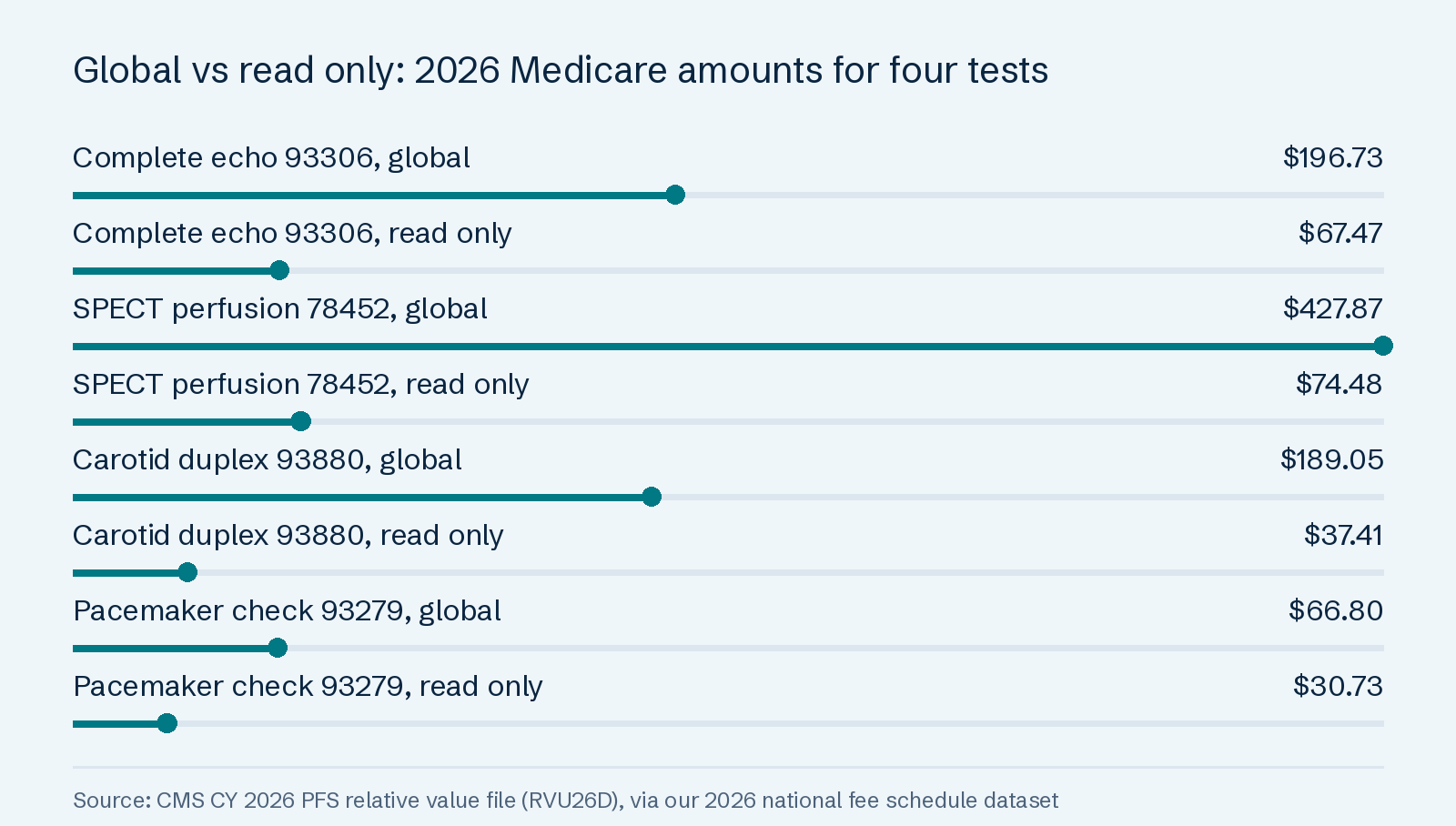
| Echo lab | Echoes on your own machine billed as reads only; stress echoes done without commercial authorization | 93306 complete echo: $196.73 / $67.47 |
| Nuclear cardiology | Global billed for a hospital's camera, or read only billed on your own camera | 78452 SPECT perfusion, multiple studies: $427.87 / $74.48 |
| Vascular lab | The 75% same-day technical rate posted as an underpayment, or never checked | 93880 carotid duplex, both sides: $189.05 / $37.41 |
| Cath and EP labs | A missing authorization can deny the whole claim, read included; PCI codes changed in 2026 | 93458 left heart cath with angiography: $1,010.04 / $287.25 |
| Device clinic | Remote monitoring periods never billed; in-person checks left unsigned | 93279 in-person pacemaker check: $66.80 / $30.73 |
Where does your practice lose cardiology revenue between the test and the payment?
Each leak has a payer rule behind it, and each rule has a scope: Medicare rules bind Medicare claims, a MAC article binds its states, a commercial list binds that plan.
Equipment you own: are you billing the technical component?
Your practice bills global only when it furnishes both parts within one Medicare payment locality; chapter 13, section 150 adds that matching the place-of-service code does not make a split test global. The costlier error runs the other way: an echo on your own machine billed as a read alone leaves the technical side unbilled, $129.26 of the $196.73 global amount on a complete echo (93306), 2026 national Medicare amounts (unadjusted). The chart shows the gap for four tests.
Prior authorizations: who gets the number before a cath, stress echo or EP implant?
UnitedHealthcare's cardiology prior authorization FAQ, for the commercial and Individual Exchange plans in its program, requires authorization for diagnostic caths, EP implants and stress echoes in office and outpatient settings. Each number is valid for 45 calendar days, for one procedure on one date of service. Without it, a cath or EP implant claim, including the read billed with modifier 26, can be denied administratively, and the member cannot be billed; a stress-echo read is spared that denial. Emergency, urgent care, observation and inpatient settings are outside the program.
Device clinic: is every monitoring period billed?
Remote device checks are billed by period, not by visit. In Novitas states (Arkansas, Colorado, Louisiana, Mississippi, New Mexico, Oklahoma, Texas, Delaware, the District of Columbia, Maryland, New Jersey and Pennsylvania), billing article A56602 allows the remote monitoring codes 93293-93296 no more than once every 90 days and not for a period under 30 days; in-person checks are billed per procedure. Other MACs publish their own articles. The leak is a period that ends with no claim: one remote pacemaker period's read (93294) has a 2026 national Medicare amount (unadjusted) of $29.39, repeated across a roster.
Signed reports and supervision: can every read you perform be billed?
A read is billed as an interpretation, and chapter 13 states that the interpretation of a diagnostic procedure includes a written report. Under 42 CFR 410.32(b), a Medicare test furnished without its required supervision level is not reasonable and necessary. The CMS file assigns direct supervision (physician in the office suite, or present by real-time audio-video where the rule allows) to a stress echo's technical part (93351) and personal supervision (physician in the room) to a left heart cath's (93458). Unsigned reads also age toward the filing limit: 12 months for Original Medicare, and for UnitedHealthcare commercial participating providers the Agreement's limit, at least 90 days. See our tracker of each payer's filing clock.
Two tests on one day: is a short payment actually correct?
Medicare pays the highest diagnostic cardiovascular technical component in full and 75% of each additional one for the same patient on the same day from the same group NPI, per CMS Transmittal 1149, in effect since January 1, 2013; the 2026 relative value file still flags these tests for the reduction. The read is not reduced, so a short technical payment can be correct; posting has to know the expected amount.
Worked example (2026 national Medicare amounts, unadjusted): your office performs a complete stress echo (93351, global $233.47) and a carotid duplex (93880, global $189.05) for one patient on one day. Unreduced, they total $422.52. The stress echo technical component ($152.31) is the higher one and pays in full. The carotid technical component pays 75%: $151.64 × 0.75 = $113.73, a $37.91 reduction. Expected total: $422.52 − $37.91 = $384.61.
Cath lab: is your charge sheet current for 2026?
The Society for Cardiovascular Angiography and Interventions 2026 PCI coding summary says one PCI code now covers a major coronary artery and its branches, and the branch add-on codes were deleted. A charge sheet still built on the old codes sends claims with deleted codes.
How can you tell where your practice's cardiology revenue cycle stands?
Four standard numbers and three cardiology counts tell you, pulled for the last full quarter by payer and service line:
- A/R days: total accounts receivable divided by average daily charges.
- Aged A/R: balances older than 90 days, split into reads and technical or global claims.
- Net collection rate: payments divided by (charges minus contractual adjustments).
- Denials by reason: authorization, documentation and component denials counted separately, with rejections apart: a rejection fails front-end or clearinghouse edits and never enters adjudication; a denial is an adjudicated claim the payer will not pay as billed.
- Unsigned reads: tests performed but not yet signed, with the oldest date of service.
- Device periods billed against your roster: remote-monitoring patients compared with the periods billed in the last 90 days.
- Payments below the expected amount after the same-day technical rate, by payer.
Warning signs: one denial reason repeats for one lab, few global claims for tests on your own equipment, or nobody knows who bills the technical side at each hospital lab. Our guide to the revenue-cycle numbers worth tracking each month shows how to read the trend.
Read the workflow as text
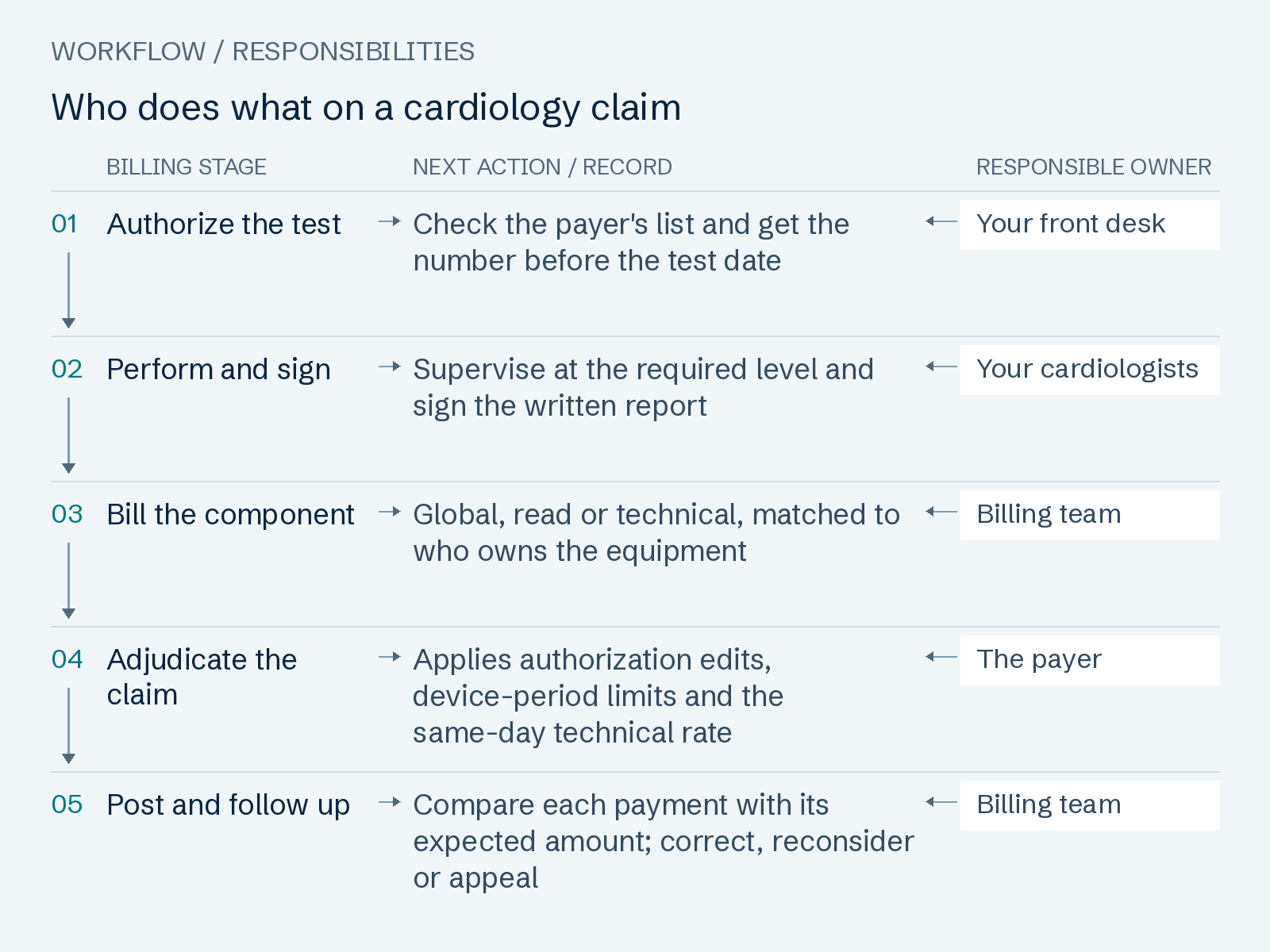
- Authorize the test — Check the payer's list and get the number before the test date Owner: Your front desk.
- Perform and sign — Supervise at the required level and sign the written report Owner: Your cardiologists.
- Bill the component — Global, read or technical, matched to who owns the equipment Owner: Billing team.
- Adjudicate the claim — Applies authorization edits, device-period limits and the same-day technical rate Owner: The payer.
- Post and follow up — Compare each payment with its expected amount; correct, reconsider or appeal Owner: Billing team.
Should your practice keep cardiology billing in-house, add help or hand it off?
The right choice depends on how many settings your cardiologists work in, not on headcount. A practice that only reads hospital studies bills one component; a practice that also runs its own echo, nuclear or vascular lab and a device clinic bills three patterns at once.
| Option | What it costs | Who does the work | What can go wrong |
|---|---|---|---|
| In-house biller | A salary plus benefits, software and your supervision time | Your staff, end to end | One person holds the lab-by-lab component rules; work stalls when they leave |
| In-house plus an outside review | Salary plus the review fee | Your staff bill; a reviewer samples claims | Errors surface after payment; denials still need someone to work them |
| New billing software or clearinghouse | Subscription fees | Your staff, with automated claim edits | Edits catch format errors, not missing authorizations or unsigned reads |
| Full billing service | A percentage of insurance payments | A billing team, from signed report to posted payment | Depends on clean handoffs: signed reports, device roster, authorization numbers |
What should you check before you decide who runs your cardiology billing?
Before you choose, get these on paper for your practice:
- Every lab your cardiologists read for, who owns its equipment, and who bills the technical side there.
- Each payer's authorization list for caths, stress echoes, nuclear studies and EP implants, and who requests the number before the test date.
- Your device clinic roster, with each patient's last remote period and last in-person check.
- The supervising physician on each stress test and office cath, recorded where the claim can show it.
- The expected amount for your most-billed tests by payer, after the same-day technical rate.
- A claim-level aging report sorted by each claim's filing deadline. Our billing audit checklist walks through the rest of a self-check.
What does running cardiology billing cost your practice?
Cardiology billing costs include staff or vendor fees, software and oversight. Unpaid or incorrectly billed tests create a separate revenue risk: a cath done without required authorization under UnitedHealthcare's cardiology program can lose the read with it, and an office echo billed as a read alone leaves $129.26 of technical payment unbilled at the 2026 national Medicare amount (unadjusted). For staffing context, the Bureau of Labor Statistics reports a $51,140 median annual wage for medical records specialists, who classify and code patient information, in May 2025, before benefits, software and the time your administrator spends checking lab-by-lab component rules.
Our Full-Service Billing for specialist practices costs 6.0% of insurance payments for 1 clinician, 5.5% for 2–5 clinicians and 5.0% for 6–15 clinicians, with 0% of patient payments and $0 setup. Invoices 1–3: only percentage fees on that month's insurance payments, plus any statements or add-ons you order; the $400 minimum starts with invoice 4. Month to month. Leave with 30 days' written notice. No termination fee. Every rate and add-on is on our pricing page.
When should your practice hand off cardiology billing?
In cardiology, the trigger to watch for is a new setting, not a new hire: an office echo or nuclear lab opens, a cardiologist starts reading for a second hospital, the remote-monitoring roster grows past what one person can match to claims, or cath authorization denials sit unappealed. Practices hand off cardiology billing at that point; your cardiologists keep performing, supervising and signing reads either way.
If you want the component, authorization and device-period checks done outside your office, our cardiology billing service is built for independent practices that run office labs, read hospital studies or both. It bills each test at the component that matches where it was performed, when the documentation supports it, posts each payment against its expected amount and checks each device period before it is billed. To see what is at risk first, request The Free A/R Deadline Map: A claim-by-claim list of every unpaid insurance claim over 90 days in the aging report you send: payer, amount, the deadline it faces, the denial reason and the next action, sorted by deadline. Clock starts with your claim-level aging export and signed BAA; above 10 requests in a week, we confirm your date within 1 business day. Request your deadline map.
Common questions
- Where do cardiology practices lose the most revenue?
- Where one test is split between two billers or depends on paperwork outside the claim: technical components on owned equipment, authorizations for caths, stress echoes and EP implants, unsigned reads, unbilled device periods and unchecked same-day technical reductions. Denials by reason and aged A/R by service line show which costs your practice most.
- How much does a missed prior authorization for a cath or stress echo cost us?
- Under UnitedHealthcare's cardiology program plans, a cath or EP implant done without authorization can lose the whole claim, the read included, and the member cannot be billed; a stress-echo read billed with modifier 26 is spared. For scale, a left heart cath read (93458-26) has a 2026 national Medicare amount (unadjusted) of $287.25; commercial plans pay contracted rates.
- Are we billing the technical component when we own the equipment?
- Pull last quarter's echo, nuclear and vascular claims for tests done in your office. Each should be billed global, or technical only if an outside physician read it, when the documentation supports it. A read-only claim for a test on your own machine leaves the technical side unbilled: $129.26 on a complete echo (93306), 2026 national Medicare amount (unadjusted).
- What should a cardiology practice's monthly billing report show?
- A/R days, aged A/R over 90 days, net collection rate and denials by reason, each defined in writing. Add the cardiology counts: unsigned reads, device periods billed against your roster, authorization denials, and payments below the expected amount after the same-day technical rate.
- Is our device-clinic follow-up being billed every time it qualifies?
- Compare your roster with your claims. In Novitas states, remote pacemaker and ICD monitoring is billed no more than once every 90 days and not for a period under 30 days, while in-person checks are billed per procedure (A56602). A roster patient with no remote claim in the last 90 days is a period to review; other MACs set their own limits.
- Should a cardiology practice outsource billing?
- Outsource when one person can no longer track the component, authorization and device-clinic rules, or when denials go unworked. Keep it in-house if one experienced biller covers every lab you read for and your reports show steady A/R. Our comparison of in-house and outsourced billing lays out the trade-offs.
Sources and review
Page revised October 7, 2026 · Review contact: Hyder Shah (inquiries@claimpillar.com). Dollar amounts are 2026 national Medicare amounts (unadjusted) from the CMS CY 2026 PFS relative value file (RVU26D); filing limits come from our timely filing dataset. Actual payment varies by locality, setting and payer.
- CMS: PFS relative value files (CY 2026 file RVU26D)
- CMS Medicare Claims Processing Manual, Chapter 13 (sections 20, 100.1 and 150)
- CMS Transmittal 1149: reduction on diagnostic cardiovascular technical components
- eCFR: 42 CFR 410.32, supervision of diagnostic tests
- Novitas Solutions article A56602: cardiac rhythm device evaluation
- UnitedHealthcare: cardiology prior authorization FAQ (commercial plans)
- SCAI: 2026 PCI coding changes summary
- BLS Occupational Outlook Handbook: Medical Records Specialists