What our prior authorization service covers, and what you keep
Every request keeps its payer reference, the open question and the payer’s decision in one record your staff can read. The table shows who owns each step.
What stays with your clinicians
Your clinicians keep every clinical and treatment decision and make the clinical case on any peer-to-peer call. We assemble what is already in the chart and send gaps back to the clinician; we never write documentation to make a request fit. We check every code against your clinician's documentation and never change a code without the clinician's sign-off. Code questions go to our medical coding team under the same plan.
| Task | What we do | When | What you keep |
|---|---|---|---|
| Requirement check | Check the member’s payer and plan list for the scheduled service | Before the request | Booking the visit |
| Request packet | Assemble the clinician’s notes and orders; flag anything missing | Before submission | Supplying and approving the clinical record |
| Submission | Submit through the payer’s channel and save the reference | Once the packet is complete | Authorized system and portal access |
| Payer questions | Log each information request and route it to the person who answers it | Until a decision | Answering clinical questions |
| Decision record | Save the approved service, dates, units, provider and location | At decision | Scheduling and care around those terms |
| Renewals and units | Count visits or units used and request renewal before the approval ends | Through the treatment course | Updating the treatment plan |
| Adverse decision | Log the payer’s stated reason and every deadline it gives, and send the decision to your clinician | From the payer’s notice | Whether to seek a peer-to-peer call or reconsideration, and the clinical case |
| Claim | Put the authorization number on the claim it covers | At billing | Signing off the encounter |
How we run each authorization request
Each request moves through the same six steps, and each step has one owner, so a stalled case shows exactly who it waits on: us, the payer or your clinician.
We record each decision in the payer’s own terms, not a bare “approved” label: Aetna says an approval covers only the service or supply named (2026 participating provider list) and that a tracking number assigned during record review is not an approval (precertification lists).
When the payer says no, who does what
We log the decision, its stated reason and each deadline the payer gives, then send it to your clinician, with the request and notes it was built from. Your clinician decides whether to seek a peer-to-peer call or reconsideration and makes the clinical case; we never argue it for them. In the AMA’s 2025 survey, only 21% of physicians always appeal an adverse decision, and 52% of those who do not cite insufficient staff resources or time. We keep the deadlines in view so a denied request is not lost to staff time.
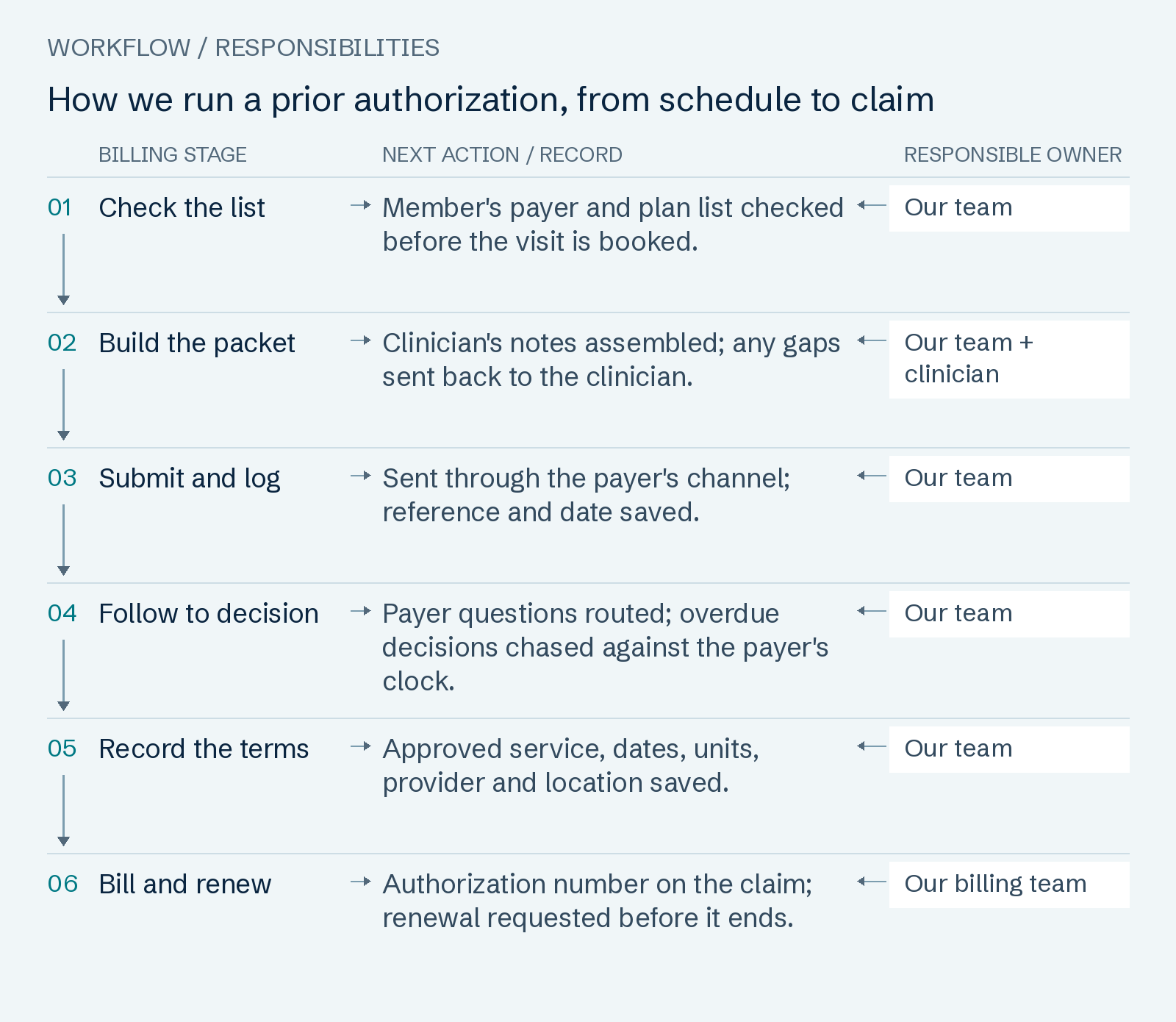
Read the workflow as text
- Check the list — Member's payer and plan list checked before the visit is booked. Owner: Our team.
- Build the packet — Clinician's notes assembled; any gaps sent back to the clinician. Owner: Our team + clinician.
- Submit and log — Sent through the payer's channel; reference and date saved. Owner: Our team.
- Follow to decision — Payer questions routed; overdue decisions chased against the payer's clock. Owner: Our team.
- Record the terms — Approved service, dates, units, provider and location saved. Owner: Our team.
- Bill and renew — Authorization number on the claim; renewal requested before it ends. Owner: Our billing team.
Common questions
- How much do prior authorization services cost?
- Requests, tracking and renewals come inside Complete RCM at 9.0% of insurance payments, with 0% of patient payments and $0 setup. Full-Service Billing, 5.0% to 8.5%, tracks authorization expiry while your staff submit. See the rate card.
- Can we outsource prior authorization without outsourcing our billing?
- Not today. We take on authorizations only inside our billing plans, because an approval pays off when the same team bills the visit and works any denial that follows. If you are weighing the whole function, the in-house vs outsourced billing comparison sets out the trade-offs.
- Can you guarantee the payer approves our requests?
- No. The payer decides, on its own criteria and your clinician’s documentation. We commit to the work we control: requests built from your notes, every decision recorded with its terms, and renewals requested before approvals end, from your clinician’s current documentation. On the claims that follow, the Clock-or-Credit Guarantee applies: Mon–Fri ET business days by your system's timestamps; worked: resubmitted, appealed or returned with the fix; auto-credited; capped at monthly fee; clearinghouse outages excluded.
- What do you need from our practice to start?
- Sign the service agreement and BAA, give us logins to your practice-management system and clearinghouse, join one 45-minute kickoff call, sign off encounters so charges are complete, and answer our documentation questions within 5 business days. For authorizations, also name the clinician who answers documentation questions and send the open requests and current approvals you track today.
- What happens when a payer denies an authorization request?
- We log the payer’s reason and every deadline it gives and send the decision to your clinician, with the request and notes behind it. Your clinician decides whether to seek a peer-to-peer call or reconsideration and makes the clinical case; the split is under who does what when the payer says no. If the claim for a delivered service later denies, denial management works it.
- Which systems and payer portals does your team work in?
- We work inside your existing practice-management system and clearinghouse; tell us which ones and we confirm in writing within 1 business day. We submit through each payer’s own channel, using access your practice authorizes. See systems we work in.
- Should we keep prior authorization in-house or outsource it?
- Count the hours first: requests per week × minutes per request, including portal checks, payer calls and peer-to-peer scheduling. For example, 25 requests × 30 minutes is 12.5 staff hours a week. Keep it in-house when that fits inside one person’s week and few payers are involved; hand it to us when requests wait on staff time or approvals lapse. Physicians in the AMA’s 2025 survey reported 13 hours of physician and staff time a week.
Sources and review
Page revised October 7, 2026 · Review contact: Hyder Shah (inquiries@claimpillar.com). The workflow checklists are editorial recommendations; payer requirements depend on the program and current policy.
- AMA: Prior authorization reform pledge falls short with physicians (2026 press release)
- AMA: 2025 Prior Authorization Physician Survey (PDF)
- Aetna: Participating provider precertification list, updated October 1, 2026 (PDF)
- Aetna: Precertification lists
- UnitedHealthcare: Radiology prior authorization
- UnitedHealthcare: Cardiology prior authorization
- CMS: Interoperability and Prior Authorization Final Rule (CMS-0057-F) fact sheet
- HHS: Business Associates