Who our oncology billing service is for
Our oncology billing service is built for independent medical oncology and hematology-oncology practices, from a single oncologist with a few chairs to groups of 6–15 clinicians. These practices buy, mix and infuse drugs in the office, so every infusion day bills both the administration and the drug itself.
Hand your billing to us when:
- your infusion biller has left, and drug lines now go out short or not at all;
- Medicare claims come back for a missing JW or JZ, or Medicaid drug lines for a missing NDC, faster than anyone can fix them;
- regimen authorizations lapse mid-cycle and later infusion days age past 90 days unpaid.
What we take over and what your practice keeps
We run your professional revenue cycle from the closed infusion record to the posted payment, drug lines included. Every infusion day passes our documentation-based coding review before release, and no code changes without your oncologist's sign-off. Your oncologists and nurses keep treating and charting; the figure traces one month of that work.
| Task | What we do | What you keep |
|---|---|---|
| Regimen authorization tracking | Log each approved regimen, drug code, unit count and end date against the chair schedule. | Clinical notes the plan asks for |
| Administration coding | Check that each encounter carries one initial code, with sequential, concurrent and add-on codes matching charted times. | Final say on every code |
| Drug units, JW and JZ | Convert each dose to billing units and add the JW line or JZ modifier from the vial record. | Accurate vial and waste charting |
| NDC reporting | Add the NDC and quantity to drug lines for Medicaid and other plans that require them. | Drug invoices and NDC labels |
| Same-day oncologist visits | Check the oncologist's note supports a separate visit before modifier 25 goes on the infusion-day claim. | Visit notes that stand on their own |
| Claims out the door | Every claim, drug lines included, goes out within 1 business day of complete charge data. | Signed-off infusion encounters |
| Denied infusion and drug lines | Each denied line is worked within 2 business days of posting: corrected, appealed or sent back to you with the fix. | Replies when we query a chart |
| Payment posting | Post each administration and drug line within 2 business days of the remittance. | Payments in your own bank account |
| Patient balances | Calculate coinsurance on drug and administration lines; send statements in your practice's name. | Financial counseling and assistance programs |
| Monthly reporting | A KPI report, each measure defined in writing, by the 10th of each month. | Ownership of all your billing data |
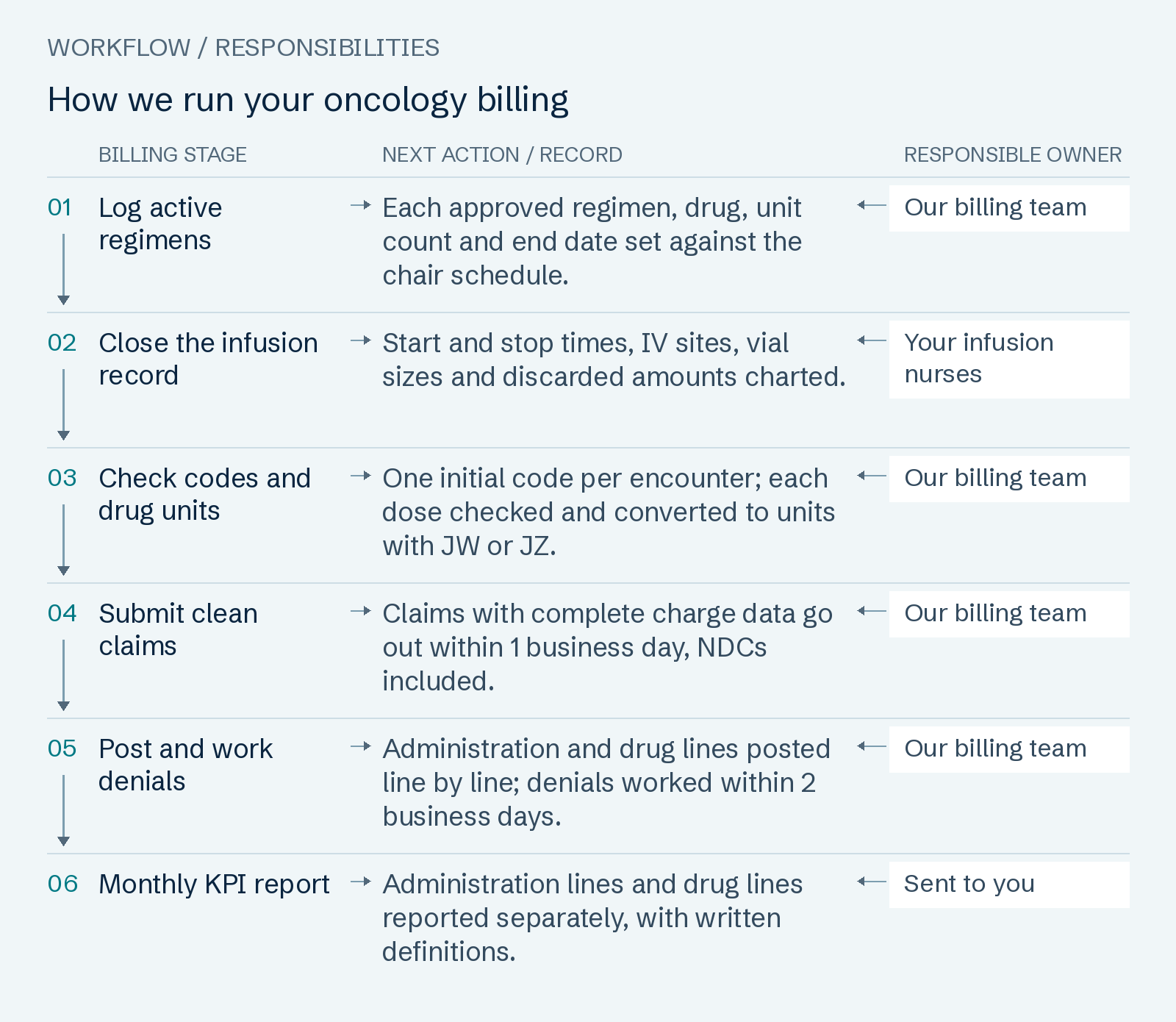
Read the workflow as text
- Log active regimens — Each approved regimen, drug, unit count and end date set against the chair schedule. Owner: Our billing team.
- Close the infusion record — Start and stop times, IV sites, vial sizes and discarded amounts charted. Owner: Your infusion nurses.
- Check codes and drug units — One initial code per encounter; each dose checked and converted to units with JW or JZ. Owner: Our billing team.
- Submit clean claims — Claims with complete charge data go out within 1 business day, NDCs included. Owner: Our billing team.
- Post and work denials — Administration and drug lines posted line by line; denials worked within 2 business days. Owner: Our billing team.
- Monthly KPI report — Administration lines and drug lines reported separately, with written definitions. Owner: Sent to you.
Where oncology practices lose revenue, and what we do about it
Oncology revenue leaks where the infusion record meets the claim: one chair visit can carry a visit, a premedication push, a chemotherapy infusion and a drug drawn from several vials. We check six points on every infusion claim.
Administration coding on infusion days
- A second initial code on the same day. We reconcile the administration sequence and start/stop times before selecting the initial and subsequent service lines.
- Supportive drugs billed as chemotherapy. We check each drug and administration record so supportive treatment is not coded from the chair location or regimen name alone.
- The visit on an infusion day. We compare the separately documented visit with the infusion record before billing both services, and query any overlap.
Drug lines, waste and NDCs
- Discarded drug left off the claim. We match each applicable drug line to the vial record, documented dose and discarded amount before release.
- Medicaid drug lines without NDCs. We check the required product identifiers and unit conversion against the drug administered and the payer's claim instructions.
- New drugs billed without records. We flag missing drug descriptions or supporting records before releasing a new or unlisted drug claim.
What our oncology billing costs
Oncology groups are billed at the specialist physician rate for their size. Your fee is a percentage of insurance payments posted on claims we submitted or worked, net of payer recoupments and refunds. We take 0% of patient payments, copays and anything your front desk collects. Payments on the drug lines of claims we submit are insurance payments too, while the coinsurance your patients pay on those lines never carries our fee. Setup is $0. 60-Day Underpayment Check: In month 3 we compare every payment from your first 60 days against your contracted rates and appeal each underpaid line. Needs your fee schedules. Invoices 1–3: only percentage fees on that month's insurance payments, plus any statements or add-ons you order; the $400 minimum starts with invoice 4. The rate card by specialty and size lists every add-on.
| Practice size | Rate (specialist physician groups) |
|---|---|
| 1 clinician | 6.0% of insurance payments |
| 2–5 clinicians | 5.5% of insurance payments |
| 6–15 clinicians | 5.0% of insurance payments |
| Larger groups | Pricing is by written quote. |
How we start, whether you bill in-house or use another company
Switching oncology billing puts the highest-dollar claims at risk first, because one unpaid infusion day can carry several drug lines. At kickoff we ask your practice for five things:
- Our service agreement and a business associate agreement (BAA), both signed.
- Practice-management and clearinghouse logins, with read access to the medication administration records where vial sizes and waste are charted.
- A claim-level aging export, so near-deadline infusion claims are sorted on day one.
- Your current authorization list for active regimens.
- One kickoff call with your practice manager and infusion nurse lead.
Go-live, when your first claims go out, comes within 5 business days of access; any unbilled backlog follows within 10 business days of access. Clock starts with your signed agreement, signed BAA and working system logins; it extends day for day while we wait on access. Every inherited claim within 30 days of a filing, corrected-claim or appeal deadline is worked within 5 business days of access. Starts at access; covers up to 250 claims (more gets a day-1 deadline schedule); worked means submitted, corrected, appealed or returned with the fix.
Our billing handoff plan covers what to request from your current company. Want to see your exposure before you decide? Request The Free A/R Deadline Map: A claim-by-claim list of every unpaid insurance claim over 90 days in the aging report you send: payer, amount, the deadline it faces, the denial reason and the next action, sorted by deadline. Clock starts with your claim-level aging export and signed BAA; above 10 requests in a week, we confirm your date within 1 business day.
Our monthly reporting, service standards and guarantees
On-Our-Watch Guarantee. If a claim misses a filing, corrected-claim or appeal deadline while it is on our watch, we pay you what it would have paid. Claims we get complete 10+ business days before the deadline; contracted rate less any copay you collected, paid automatically within 30 days of final denial; capped $10,000/month; your holds excluded.
Clock-or-Credit Guarantee. From go-live, every new claim goes out within 1 business day of complete charge data, and every denial is worked within 2 business days of posting — or $25 comes off your invoice for each late one. Mon–Fri ET business days by your system's timestamps; worked: resubmitted, appealed or returned with the fix; auto-credited; capped at monthly fee; clearinghouse outages excluded.
An infusion record without stop times or the discarded amount is not complete charge data for the administration and drug lines, so we send the chart back to your infusion nurse with the missing field named.
Clocks you can audit in your own system
Every row below is timed by your system's own timestamps. Our monthly report gives written definitions of clean claims, A/R days and net collection rate, and splits administration lines from drug lines. Denied lines follow the same clock in our denial management service.
We publish client results only with written permission. Until we have them, judge us by the guarantees and the free Deadline Map.
| Standard | Our commitment | Where infusion claims test it |
|---|---|---|
| New claims | Sent within 1 business day once charge data is complete | Required times and vial records must be charted and all charge data complete |
| Denied lines | Worked within 2 business days after posting | Infusion days denied for a lapsed regimen authorization |
| Remittances | Posted within 2 business days after they arrive | Administration and drug lines posted line by line |
| Your emails | Answered within 1 business day | Questions about a vial size, a charted time or an authorization |
| KPI report | Delivered by the 10th of each month, every measure defined | Administration and drug lines reported separately |
Your systems, new oncologists and data access
We work inside your existing practice-management system and clearinghouse; tell us which ones and we confirm in writing within 1 business day. The EHR and practice-management compatibility page explains how that works. Both sides sign a BAA before any login is shared, and we ask only for read access to medication administration records.
We check payer enrollment status and effective dates for each new clinician before releasing their claims. New-Clinician Enrollment: Clinicians who join while you're a client get enrollment filed with up to 5 payers each (the payer decides), with no per-payer fee. Beyond that, Credentialing & Payer Enrollment costs $149 per payer. Billed only after the payer confirms your effective date; $0 if denied or panel closed; filed within 5 business days of your complete packet. Questions about your practice? Talk to our team.
Common questions
- How much do your oncology billing services cost?
- Oncology practices pay 6.0% (1 clinician), 5.5% (2–5 clinicians) or 5.0% (6–15 clinicians) of insurance payments, drug-line payments included, with 0% of patient coinsurance. The full rate card shows the monthly minimum and every add-on.
- How should we choose an oncology billing company?
- Get three answers in writing: how waste lines are built from your vial records, how NDCs reach your Medicaid drug lines, and who covers a claim that misses its deadline. Ours are on this page, backed by two guarantees; our billing company checklist covers the contract terms.
- Do you bill both the administration codes and the drug lines?
- Yes. Each infusion day goes out as one claim with the administration codes, any same-day visit the note supports as separate and every drug line with its units, JW or JZ, and NDC where the payer requires it.
- Can you handle Medicaid NDC requirements on our drug claims?
- Yes. We add the NDC and quantity to each physician-administered drug line in the format the paying state program or Medicaid plan requires, using your drug invoices and labels.
- Do we have to sign a long-term contract?
- No. Leave with 30 days' notice and no termination fee. Want a run-out? We keep working the claims we submitted for 90 days at your plan rate. Decline it and we charge nothing on payments that post after you leave. Notice by email; optional run-out covers claims we submitted before your exit date, at your plan rate; handover file within 10 business days of exit.
- When would our first infusion claims go out?
- Go-live comes within 5 business days of access. Clock starts with your signed agreement, signed BAA and working system logins; it extends day for day while we wait on access. The kickoff list and the near-deadline sweep are under how we start.
- Which EHR and practice-management systems do you work in?
- The practice-management system and clearinghouse you already use, plus read access to your medication administration record. How we confirm them is under systems and credentialing.
- Can you credential a new oncologist joining our practice?
- Yes. Oncologists who join while you are a client are covered by New-Clinician Enrollment; its payer limit and the per-payer fee beyond it are under systems and credentialing.
Sources and review
Page revised October 7, 2026 · Review contact: Hyder Shah (inquiries@claimpillar.com). The workflow checklists are editorial recommendations; payer requirements depend on the program and current policy.
- CMS: Medicare Claims Processing Manual, Chapter 12, section 30.5 (chemotherapy administration and drug infusions)
- CMS: Medicare Claims Processing Manual, Chapter 17, section 40 (discarded drugs, JW and JZ)
- CMS: Discarded Drugs and Biologicals – JW Modifier and JZ Modifier Policy FAQ
- eCFR: 42 CFR 447.520, physician-administered drugs (Medicaid NDC requirement)
- Cigna Healthcare: Claims submission, payments and filing