When to outsource aged insurance A/R
Practices hand off their aged insurance claims when nobody inside the practice owns them anymore. Aged A/R means balances older than 90 days; we work the insurance share. Five moments signal it is time:
- Your biller left. Nobody knows which old claims were denied, which never reached the payer and which wait on a record.
- You switched billing companies. The old company stopped working its claims; we take over the ones stranded in between.
- The 90+ bucket grows every month. New claims get worked first, so old ones age toward their deadlines.
- Denials came back and nobody appealed. Cigna, for one, wants provider appeals within 180 calendar days of the payment or denial notice.
- A payer says it has no claim on file. Then the original filing limit governs, and it can be short: 90 days after the date of service for Cigna participating providers.
New denials refilling the backlog? Our denial management service works the current flow while we clear the old one.
What our AR recovery service takes over, and what you keep
Our A/R team takes over each inherited insurance claim as its own line and works it to one of three endings: a posted payment, a final denial you approve as a write-off, or a balance correctly moved to the patient.
What counts as working a claim?
A claim is worked when we log a dated action on it: a status check that locates the claim, a corrected claim, a reconsideration or appeal, or a return to you with the exact record the payer needs. We check every code against your clinician's documentation and never change a code without the clinician's sign-off.
Outside this service: patient collection calls, collection agencies or lawsuits, and contract-rate underpayment audits.
| Task | Deliverable | Timing | What you keep |
|---|---|---|---|
| Aging intake | Claim-level list tied to your aging report total: payer, date of service, balance, last action | Before any claim is worked | Your aging report and practice-management data |
| Deadline dating | The deadline each claim faces and the payer rule it comes from | Before any claim is worked | The dated worklist |
| Payer status check | Claim status, payer reference number and date, logged per claim | Nearest deadline first | Every payer reference and call note |
| Corrected claim or resubmission | Corrected claim filed, or the missing record requested from you with the payer's due date | Nearest deadline first | Clinician sign-off on any code change |
| Reconsideration or appeal | Appeal packet: denial notice, records and any proof of timely submission | Inside the payer's appeal window | A copy of every packet sent |
| Late-filing exception | Request with evidence when the payer's own rules allow a late claim | When a claim qualifies | The evidence file |
| Write-off list | Claims with no remaining path, each with the rule that closed it | As each claim closes | Authority to approve every write-off |
| Monthly report | Payments that posted after our logged action, claim by claim | Monthly, with the invoice | Every payment, in your own bank account |
Where aged claims lose money, and what we do about each
Aged claims lose money in five predictable places. The payer rules behind them live in our timely filing limits by payer reference.
- Sorting by age instead of deadline. Two claims of the same age can face different clocks: a claim the payer never received runs on a filing limit from the date of service, as short as Cigna's 90 days for participating providers, while a denied claim runs on an appeal window from the notice, such as Medicare's 120 days from receipt of the notice. We date every claim by payer before any call and work the nearest deadline first.
- Claims that look late but were filed on time. Optum Behavioral Health asks for confirmation that it received and accepted the claim as proof of timely filing. We look for that proof in your clearinghouse and payer records before filing anything new.
- Late claims with a written exception. Medicare extends its limit only in the situations listed in 42 CFR 424.44(b), such as a contractor error or retroactive entitlement. We file the exception request with its evidence when one applies.
- Late-filing losses pushed to patients. Cigna's contract prohibits balance billing the patient for a late-filed denial, and Optum says providers may not bill the member for late submissions. We never move those balances to the patient.
- Write-offs nobody can explain. A smaller 90+ bucket does not prove money arrived; adjustments and write-offs shrink it too. We list each write-off with the payer rule that closed it, for your approval.
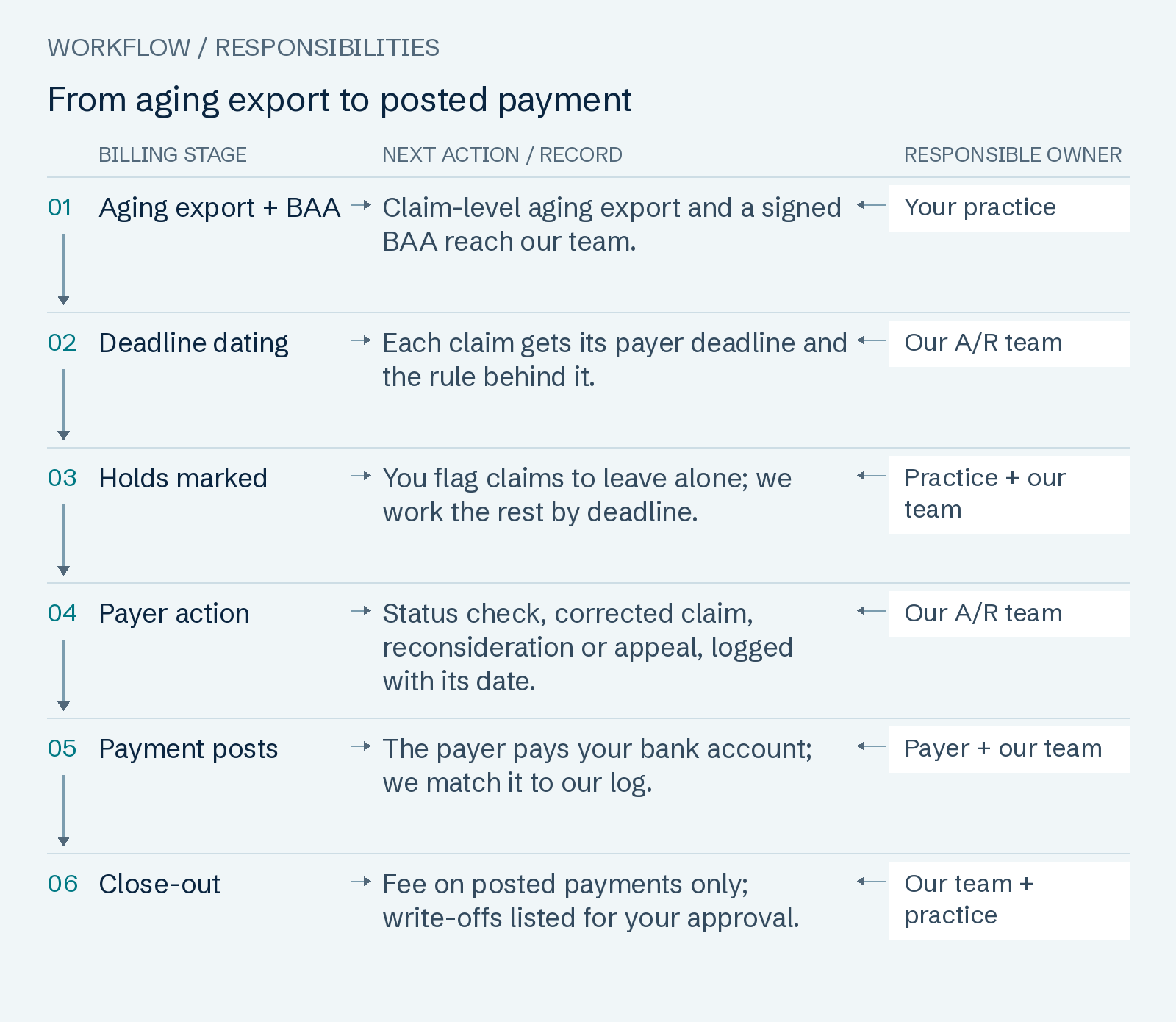
Read the workflow as text
- Aging export + BAA — Claim-level aging export and a signed BAA reach our team. Owner: Your practice.
- Deadline dating — Each claim gets its payer deadline and the rule behind it. Owner: Our A/R team.
- Holds marked — You flag claims to leave alone; we work the rest by deadline. Owner: Practice + our team.
- Payer action — Status check, corrected claim, reconsideration or appeal, logged with its date. Owner: Our A/R team.
- Payment posts — The payer pays your bank account; we match it to our log. Owner: Payer + our team.
- Close-out — Fee on posted payments only; write-offs listed for your approval. Owner: Our team + practice.
How we start on your aged claims
- Sign the BAA and send the aging export. HHS lists billing among the activities a business associate performs, so patient data reaches us only under a BAA. The Free A/R Deadline Map comes first: a claim-by-claim deadline list of every unpaid claim over 90 days, in 5 business days. Clock starts with your claim-level aging export and signed BAA; above 10 requests in a week, we confirm your date within 1 business day.
- We date every claim. Each gets the deadline it faces and the payer rule behind it, which shows which old claims are still collectible.
- You mark the holds. Claims you want left alone, such as a patient dispute, come off the list.
- We work each claim, nearest deadline first. A status check, then the action the status calls for, logged with its date and payer reference.
- Payments post to your account. Every payment goes straight to your practice's own bank account. We never receive, deposit or endorse your payments; we invoice you once a month.
- We close out the list. Claims with no remaining path go to your write-off list; patient-responsibility balances go back to you for statements.
What do we need from your practice?
The signed agreement and BAA, the aging export, logins to your practice-management system, clearinghouse and payer portals (every login stays yours), and answers to our documentation questions. We work inside your existing practice-management system and clearinghouse; tell us which ones and we confirm in writing within 1 business day.
What AR recovery services cost
A/R Recovery on its own: For inherited claims 90+ days past the date of service: 15% of the insurance payments that post after we work them, and $0 on claims that never pay. Fee only on insurance payments posting after our logged action; patient payments 0%; full-service clients stay under the 9.0% fee cap.
What is our fee charged on?
Only insurance payments that post after our logged action on that claim. Payments posting before our first action are outside it, and patient payments carry a 0% fee. For Full-Service Billing clients: Invoices 1–3: only percentage fees on that month's insurance payments, plus any statements or add-ons you order. Percentage fees and mailed statements are capped at 9.0% of that month's insurance payments; from invoice 4, the $400 minimum applies even in a month when the cap comes to less.
Every tier, and what no tier includes, is on our full rate card.
| Option | Price | How aged claims are handled |
|---|---|---|
| A/R Recovery on its own | 15% of insurance payments that post after we work the claim | Inherited claims 90+ days past the date of service; nothing on claims that never pay |
| Full-Service Billing | From 5.0% of insurance payments | Deadline Claims at Your Plan Rate: Inherited claims within 30 days of a deadline when you start are worked at your plan rate, not the 15% A/R Recovery rate. |
| Complete RCM | 9.0% of insurance payments | Inherited and aged A/R worked at no added percentage |
What we report on your aged claims every month
Our monthly report arrives with each invoice and measures recovery on the claims we worked against your opening list, never by the aging total alone. Every line carries the claim-level dates and amounts behind it, so you can recompute each number. We publish no recovery benchmark. Review each claim's status, supporting records, applicable payer rules and remaining deadlines before estimating what may be collectible.
Try our A/R days calculator.
| Report line | What it shows |
|---|---|
| Opening list | Every inherited claim we took over: payer, date of service, balance and the deadline it faces |
| Payments posted after our action | Insurance payments posted on worked claims after our logged action: the fee base, claim by claim |
| Deadline exposure | Dollars on open claims whose deadline falls within 30 days |
| Open claims by next action | Each open claim's status, last logged action and next step |
| Write-offs by payer rule | Write-offs you approved, grouped by the rule that closed each claim |
| Aged A/R | Your insurance balances older than 90 days, from each month's aging export |
Specialty practices whose aged claims we work
- Mental and behavioral health. Optum Behavioral Health wants claims no more than 90 calendar days from the date of service, and Magellan says most of its provider contracts require claims within 60 days. So therapy claims often lead our deadline order; see our mental health billing service.
- Physical therapy. Cigna lists the PT prescription and the facility's itemized PT dates among items a complete claim includes, so our worklist names the missing document and who holds it. See physical therapy billing.
- Home health and other institutional billers. Medicare dates an institutional span-date claim by its "Through" date, so we date your UB-04 claims from the span's last day. See home health billing.
- DME suppliers. Medicare dates each DME line by its "From" date and denies the untimely part of a split line, so we date rental claims line by line. See DME billing.
AR recovery terms and guarantees we put in writing
No billing company can make a payer pay a late claim or reverse a denial the record does not support. What we put in writing:
- A/R Recovery: 15%, and $0 on claims that never pay. Fee only on insurance payments posting after our logged action; patient payments 0%; full-service clients stay under the 9.0% fee cap.
- On-Our-Watch Guarantee (Full-Service Billing clients): If a claim misses a filing, corrected-claim or appeal deadline while it is on our watch, we pay you what it would have paid. Claims we get complete 10+ business days before the deadline; contracted rate less any copay you collected, paid automatically within 30 days of final denial; capped $10,000/month; your holds excluded.
We publish client results only with written permission. Until we have them, judge us by the guarantees and the free Deadline Map. Ask our A/R team about your aging report, or start with the free deadline list.
Common questions
- How much do your AR recovery services cost?
- 15% of the insurance payments that post after we work a claim, and $0 on claims that never pay. Fee only on insurance payments posting after our logged action; patient payments 0%; full-service clients stay under the 9.0% fee cap. See pricing for every tier.
- Can we hire you only for our old claims, without full-service billing?
- Yes. A/R Recovery is sold on its own for inherited insurance claims 90+ days past the date of service. To bill new claims too, Full-Service Billing starts from 5.0% of insurance payments, and Complete RCM at 9.0% works inherited and aged A/R at no added percentage.
- How fast do you start on our aged claims?
- The Free A/R Deadline Map arrives in 5 business days: every unpaid claim over 90 days, sorted by deadline. Clock starts with your claim-level aging export and signed BAA; above 10 requests in a week, we confirm your date within 1 business day. Nearest deadlines get worked first; after we file, the payer's clock sets the pace. Cigna says an appeal review will be completed in 60 days.
- Do you take over claims our previous billing company left behind?
- Yes. We date each of those claims, look for proof of the earlier submission, and work the nearest deadline first. Our handoff plan for switching billing companies covers the open-work inventory to request before the old contract ends.
- Can you still recover claims that are past the payer's filing deadline?
- Sometimes, and only where the payer's own rules allow it. Medicare extends its limit only in the situations listed in 42 CFR 424.44(b), and proof of a timely, accepted submission can also save a claim. Otherwise it goes on your write-off list with the rule that closed it, and you pay $0 on it.
- Which practice-management systems and clearinghouses do you work in?
- We work inside your existing practice-management system and clearinghouse; tell us which ones and we confirm in writing within 1 business day. Every login stays in your name. See how we work inside your existing systems.
- Do you work patient balances or claims under 90 days?
- A/R Recovery covers insurance claims 90+ days past the date of service, and patient payments carry a 0% fee. Younger inherited claims and patient statements are covered when you are a full-service billing client; see our patient statement service.
Sources and review
Page revised October 8, 2026 · Review contact: Hyder Shah (inquiries@claimpillar.com). Payer deadlines are quoted from each payer's or agency's own document, retrieved October 2, 2026. Payers change them without notice, and your contract can set different limits.
- CMS Pub. 100-04, Medicare Claims Processing Manual, ch. 1, §70: time limits for filing claims
- CMS Pub. 100-04, Medicare Claims Processing Manual, ch. 29, §310.2: redetermination time limit
- eCFR: 42 CFR 424.44, time limits for filing claims
- Cigna Healthcare: Claims submission, payments and filing
- Cigna Healthcare: Appeals and disputes policy and procedures
- Optum Behavioral Health: National Network Manual (effective Sept. 1, 2026)
- HHS: Business associates
- Magellan Healthcare: National provider handbook