Pediatric billing we handle for your practice
Our pediatric billing service is built for independent pediatric practices, from a solo pediatrician to groups of 6–15 clinicians, that bill Medicaid managed care, separate CHIP plans and commercial insurance. Practices hand billing off when the biller who knew the state's vaccine rules leaves, when Medicaid claims sit unworked, or when screening lines keep coming back bundled. We check every code against your clinician's documentation and never change a code without the clinician's sign-off. Your pediatricians keep examining, counseling families and signing notes.
| Task | What we do | What you keep |
|---|---|---|
| Coverage and VFC status | Check Medicaid, CHIP, managed care or commercial coverage for new patients and changed coverage, and bill each vaccine to the VFC status your desk records. | Asking families the VFC questions at check-in |
| Checkups and sick visits | Check the age-band checkup, any separate problem visit and modifier 25 against the note and the payer's policy. | Final say on every code |
| Vaccine lines | Pair each vaccine with the administration lines and stock modifier its payer requires. | Vaccine inventory and VFC records |
| Screens | Bill developmental, autism, behavioral and caregiver depression screens where the payer pays them. | Running each screen and scoring it |
| Newborn claims | Bill under the mother's Medicaid ID where the state allows it, then move to the baby's own number. | Newborn details from the hospital |
| Denials and A/R | Work every denial within 2 business days of posting and follow every open balance. | Answers to our documentation questions |
| Family statements | Calculate each family's share and leave off any VFC administration fee you waived. | Copays and fee waivers at the front desk |
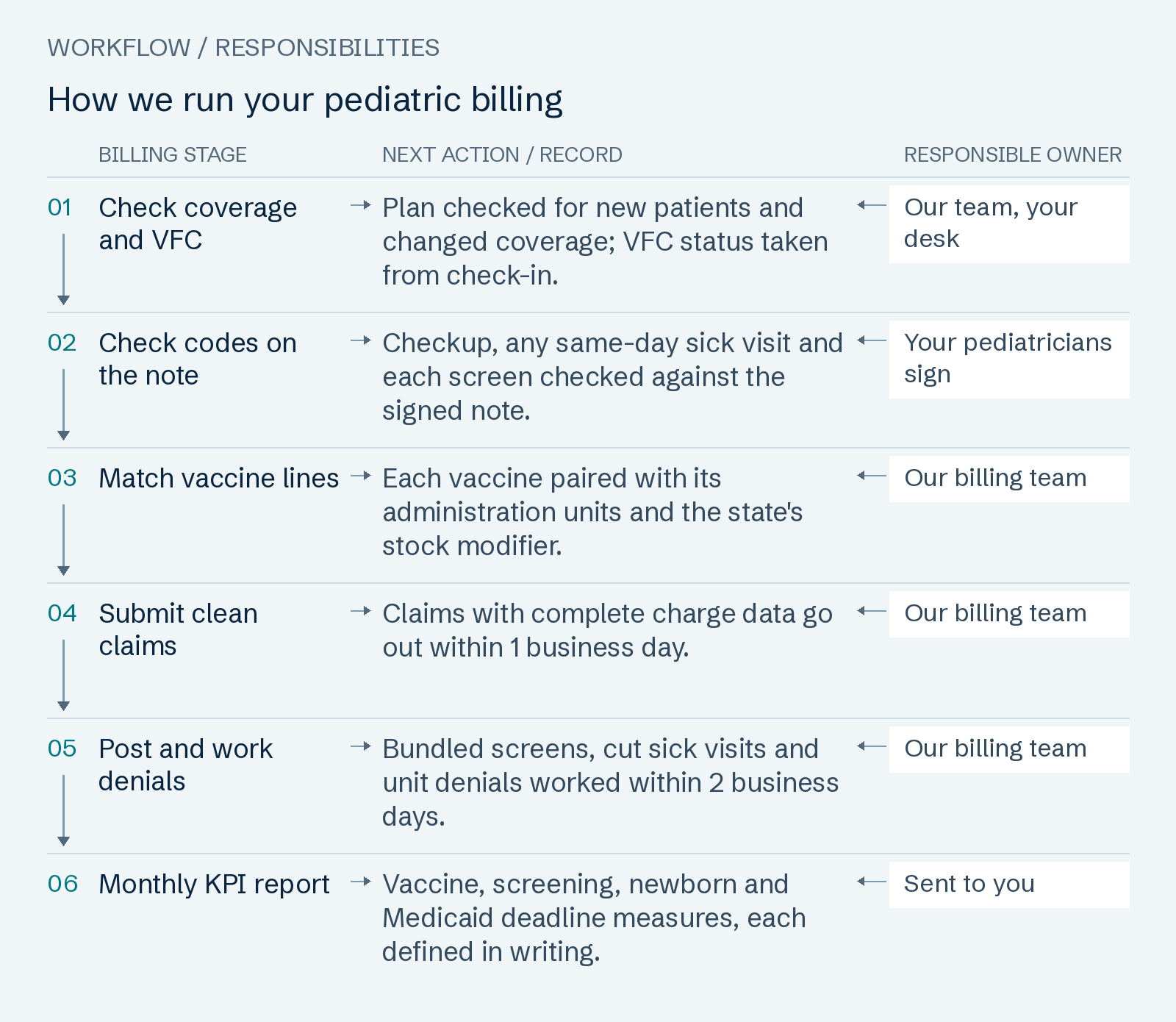
Read the workflow as text
- Check coverage and VFC — Plan checked for new patients and changed coverage; VFC status taken from check-in. Owner: Our team, your desk.
- Check codes on the note — Checkup, any same-day sick visit and each screen checked against the signed note. Owner: Your pediatricians sign.
- Match vaccine lines — Each vaccine paired with the administration lines and stock modifier its payer requires. Owner: Our billing team.
- Submit clean claims — Claims with complete charge data go out within 1 business day. Owner: Our billing team.
- Post and work denials — Bundled screens, cut sick visits and vaccine denials worked within 2 business days. Owner: Our billing team.
- Monthly KPI report — Vaccine, screening, newborn and Medicaid deadline measures, each defined in writing. Owner: Sent to you.
Well-child visits and EPSDT checkups we bill for you
Medicaid's EPSDT benefit covers children under age 21 enrolled in Medicaid, and each state sets a periodicity schedule or adopts a national one such as Bright Futures. Every Medicaid child must receive blood lead screening tests at 12 and 24 months of age. We bill each checkup against your state's schedule and its plan's claim format.
EPSDT claim format by plan
- The EP modifier. Some Medicaid plans want it on the checkup line: Nebraska Total Care's EPSDT billing guide uses EP on 99381-99385 and 99391-99395 when a full or partial screening is performed, along with a referral indicator. We add it only where the plan asks for it.
- Separate claims. Washington Apple Health's EPSDT billing guide (July 1, 2025) asks for treatment codes and the well-child checkup codes on separate claim forms. We split them where the plan requires it.
Same-day sick visits with modifier 25
When your pediatrician treats a separate problem at a checkup, the problem visit carries modifier 25, when the note supports it. Payment still differs by plan: UnitedHealthcare policy 2026R0013C (commercial and individual exchange) pays the checkup plus 50% of the problem visit billed with modifier 25, and nothing for a minor problem. We check each payment against the payer's own policy and appeal a short one.
Newborns of mothers on Medicaid at the birth can be billed under the mother's Medicaid number until the state issues the baby a separate one, as 42 CFR 435.117 allows. The state must issue the baby a separate number from the start when the mother had emergency-only Medicaid, separate CHIP coverage or another state's Medicaid. We track each baby's switch to their own number.
Your vaccines: how we bill VFC stock and 90460-90461 administration
The Vaccines for Children (VFC) program covers children 18 and younger who are uninsured, Medicaid-eligible or enrolled, American Indian or Alaska Native, or underinsured; underinsured children get VFC vaccine only through an FQHC, a rural health clinic or a deputized provider. Children in a separate CHIP program count as insured. Each vaccine line on your claim follows that status, and each state Medicaid program sets its own administration-code policy, as the Texas Medicaid provider manual and Washington's guide show:
| Situation | What the program or payer says | What we do on your claim |
|---|---|---|
| VFC vaccine given | VFC providers cannot charge patients for any vaccine given to an eligible child (CDC). | Keep VFC vaccine cost off every family statement. |
| Family cannot pay the administration fee | The per-vaccine fee must be removed, and vaccination cannot be refused for inability to pay (CDC). | Leave each waived fee off the statement you send. |
| Counseling given, Texas Medicaid | 90460 and 90461 cover birth through 18 years when counseling is given; 90461 is not paid for TVFC vaccines. | Bill 90460 on each TVFC vaccine line, with no 90461. |
| No counseling, Texas Medicaid | 90471-90474 apply at any age; mixing the two families on one vaccine denies the second line. | Use one administration family per vaccine. |
| VFC stock, Washington Apple Health | Vaccine billed with modifier SL; 90460-90461 not allowed with VFC vaccines; 90471-90474 bill instead. | Add SL to the vaccine line and switch the administration codes. |
Developmental and behavioral screening we bill: 96110 and 96127
Screens pay on their own only when the payer agrees they are more than part of the checkup. UnitedHealthcare pays a developmental screen such as 96110 beside the preventive visit only when the screening produces an interpretation and report in the record, and treats a plain parent questionnaire as part of the checkup. We check the scored tool and the result in the note before a screen goes on the claim. Our guide to 96110 and other testing codes explains how the codes differ.
Washington Apple Health's required screens follow the Bright Futures/AAP periodicity schedule (approved December 2024), which lists developmental, autism, behavioral and depression screening rows. Its billing guide sets these screens at routine checkups:
| Screen | When Washington Apple Health expects it | What we check before it bills |
|---|---|---|
| 96110 developmental | 9, 18 and 30 months | Validated tool named and scored in the note |
| 96110 autism | 18 and 24 months | Tool and result recorded; referral noted when positive |
| 96127 or 96160 behavioral | Every well-child checkup | One code per screening, never both |
| 96127 or 96160 depression | 12 years and older | Instrument named and scored |
| 96161 caregiver depression | 1, 2, 4, 6, 9 and 12 months | Billed under the infant's ID, up to two per checkup |
ADHD follow-ups and integrated behavioral health we bill for your practice
We bill ADHD follow-ups, such as medication checks and rating-scale reviews, at the level your pediatrician's note supports, and a scored rating scale as its own line where the payer pays it per instrument, when the documentation supports it. When an ADHD check happens inside a checkup and needs separate work, it bills as a problem visit with modifier 25, paid under that payer's same-day policy described above.
If your practice employs a psychologist, counselor or social worker who bills under their own NPI, we bill their therapy and testing claims too. Multi-specialty practices: each clinician's claims are billed at that clinician's segment rate; the size band counts every clinician. Their claims follow our behavioral health billing service.
Autism referrals and ABA billing for your practice
When a screen points to a possible delay, Washington's guide says the practice must refer the child for an assessment. Your side of that path can be billed: the screening line, the follow-up visit and any diagnostic work your clinicians do. We bill those claims.
An outside ABA provider bills its own therapy. If your group runs its own ABA program, we bill it under our ABA therapy billing service, with authorization hours tracked and its own rate row.
Our pediatric rate card: 6.5% solo, 6.0% for 2–5, 5.5% for 6–15 clinicians
Pediatric practices sit in our Primary care, pediatrics & urgent care row. Your fee is a percentage of insurance payments posted on claims we submitted or worked, net of payer recoupments and refunds. We take 0% of patient payments, copays and anything your front desk collects. Clinicians are counted on the 1st of each month from the rendering NPIs we billed the month before (for ABA, BCBAs and BCaBAs, not RBTs). Your rate moves with your size band the next month, in either direction.
Worked example. A practice whose claims last month named 3 pediatricians and 2 nurse practitioners counts 5 clinicians: the 2–5 clinicians band, so its claims bill at 6.0%. When a sixth pediatrician starts billing, the next month moves to 5.5%. A chiropractor who sees children in the same group bills at the rehab row, as on our chiropractic billing services page.
To start, we need three things from you:
- The signed service agreement and business associate agreement (BAA).
- Logins to your practice-management system and clearinghouse.
- A claim-level aging report with Medicaid and CHIP claims flagged, which we sort by deadline.
Setup is $0. Invoices 1–3: only percentage fees on that month's insurance payments, plus any statements or add-ons you order. Percentage fees and mailed statements are capped at 9.0% of that month's insurance payments; from invoice 4, the $400 minimum applies even in a month when the cap comes to less. The full pediatric and specialty price list shows every add-on.
On-Our-Watch Guarantee. If a claim misses a filing, corrected-claim or appeal deadline while it is on our watch, we pay you what it would have paid. Claims we get complete 10+ business days before the deadline; contracted rate less any copay you collected, paid automatically within 30 days of final denial; capped $10,000/month; your holds excluded.
Not sure where your open Medicaid claims stand? Get my free A/R Deadline Map: The Free A/R Deadline Map sorts every unpaid claim over 90 days by its deadline in 5 business days. Clock starts with your claim-level aging export and signed BAA; above 10 requests in a week, we confirm your date within 1 business day.
| Clinicians who bill | Pediatric rate |
|---|---|
| 1 clinician | 6.5% of insurance payments |
| 2–5 clinicians | 6.0% of insurance payments |
| 6–15 clinicians | 5.5% of insurance payments |
| 16 or more clinicians | Pricing is by written quote. |
Common questions
- How much do pediatric billing services cost?
- From 6.5% for a solo pediatrician down to 5.5% for a group of 6–15 clinicians, of insurance payments, with 0% of family payments and $0 setup. Our medical billing pricing page shows the minimum, cap and add-ons.
- How do you bill VFC vaccines on our practice's claims?
- We bill each vaccine to the VFC status your front desk records, keep VFC vaccine cost off family statements as CDC provider guidance requires, and use the administration codes and stock modifier your state's program accepts.
- Can you bill 96110 with our well-child visits?
- Yes, where the payer pays it beside the checkup and the note holds the scored tool with an interpretation and report. Where a payer treats the screen as part of the checkup, we tell you rather than bill it.
- Do you bill Medicaid EPSDT checkups?
- Yes. We bill each checkup to your state's periodicity schedule and the plan's format, including the EP modifier, referral indicators and separate claim forms where the plan asks for them.
- Can you bill our side of an ABA referral?
- Yes. We bill your practice's side of the referral: the screening line, the follow-up visit and any diagnostic work. An outside ABA provider bills its own therapy. If your group runs its own ABA program, our ABA billing service bills it.
- Do we have to sign a long-term contract?
- No. Leave with 30 days' notice and no termination fee. Want a run-out? We keep working the claims we submitted for 90 days at your plan rate. Decline it and we charge nothing on payments that post after you leave. Notice by email; optional run-out covers claims we submitted before your exit date, at your plan rate; handover file within 10 business days of exit.
- How fast can you take over our pediatric claims?
- Go-live, when your first claims go out, comes within 5 business days of access; any unbilled backlog follows within 10 business days of access. Clock starts with your signed agreement, signed BAA and working system logins; it extends day for day while we wait on access. Every inherited claim within 30 days of a filing, corrected-claim or appeal deadline is worked within 5 business days of access. Starts at access; covers up to 250 claims (more gets a day-1 deadline schedule); worked means submitted, corrected, appealed or returned with the fix. Talk to our billing team about your start date.
Sources and review
Page revised November 5, 2026 · Review contact: Hyder Shah (inquiries@claimpillar.com). Program and payer sources were retrieved on November 5, 2026; payer policies change, and we check each against your plans.
- CDC: Vaccines for Children Program, Information for Providers (retrieved 2026-11-05)
- CDC: Vaccines for Children Program Eligibility (retrieved 2026-11-05)
- Medicaid.gov: Early and Periodic Screening, Diagnostic, and Treatment (retrieved 2026-11-05)
- AAP/Bright Futures: Recommendations for Preventive Pediatric Health Care, approved December 2024 (retrieved 2026-11-05)
- UnitedHealthcare: Preventive Medicine and Screening Policy, Professional, 2026R0013C (retrieved 2026-11-05)
- TMHP: Texas Medicaid Provider Procedures Manual, Medical Specialties and Physician Services Handbook (retrieved 2026-11-05)
- Washington HCA: Apple Health EPSDT Well-Child Program Billing Guide, July 1, 2025 (retrieved 2026-11-05)
- Nebraska Total Care: EPSDT Quick Reference Billing and Coding Guide (retrieved 2026-11-05)
- eCFR: 42 CFR 435.117, Deemed newborn children (retrieved 2026-11-05)