Speech therapy billing services we handle
Our speech therapy billing service is built for SLPs in private practice, pediatric speech and feeding clinics, voice and fluency practices, and groups of 6–15 clinicians or more. Practices hand off SLP billing when:
- The person who billed left, and recent sessions have not gone out.
- Children's Medicaid sessions come back because the referral or authorization did not match.
- Medicare claims return without GN, or plans of care sit unsigned.
- A new SLP is waiting on payer enrollment.
We take over claim scrubbing and submission within 1 business day of complete charges, posting within 2 business days, denial work within 2 business days through our denial work and appeals process, insurance follow-up and family statements. We check every code against your clinician's documentation and never change a code without the clinician's sign-off. You keep evaluations, plans of care, session notes and signatures. PT and OT therapists in the same clinic are billed through our physical therapy billing services on the same rate row, and one therapy billing company team bills every discipline.
To start, your practice sends four things:
- The signed agreement and BAA (business associate agreement).
- Logins to your practice-management system and clearinghouse.
- Current plans of care, referrals and authorizations for every active patient.
- A claim-level aging export, so we work inherited claims in deadline order.
Go-live, when your first claims go out, comes within 5 business days of access; any unbilled backlog follows within 10 business days of access. Tell us what your practice needs.
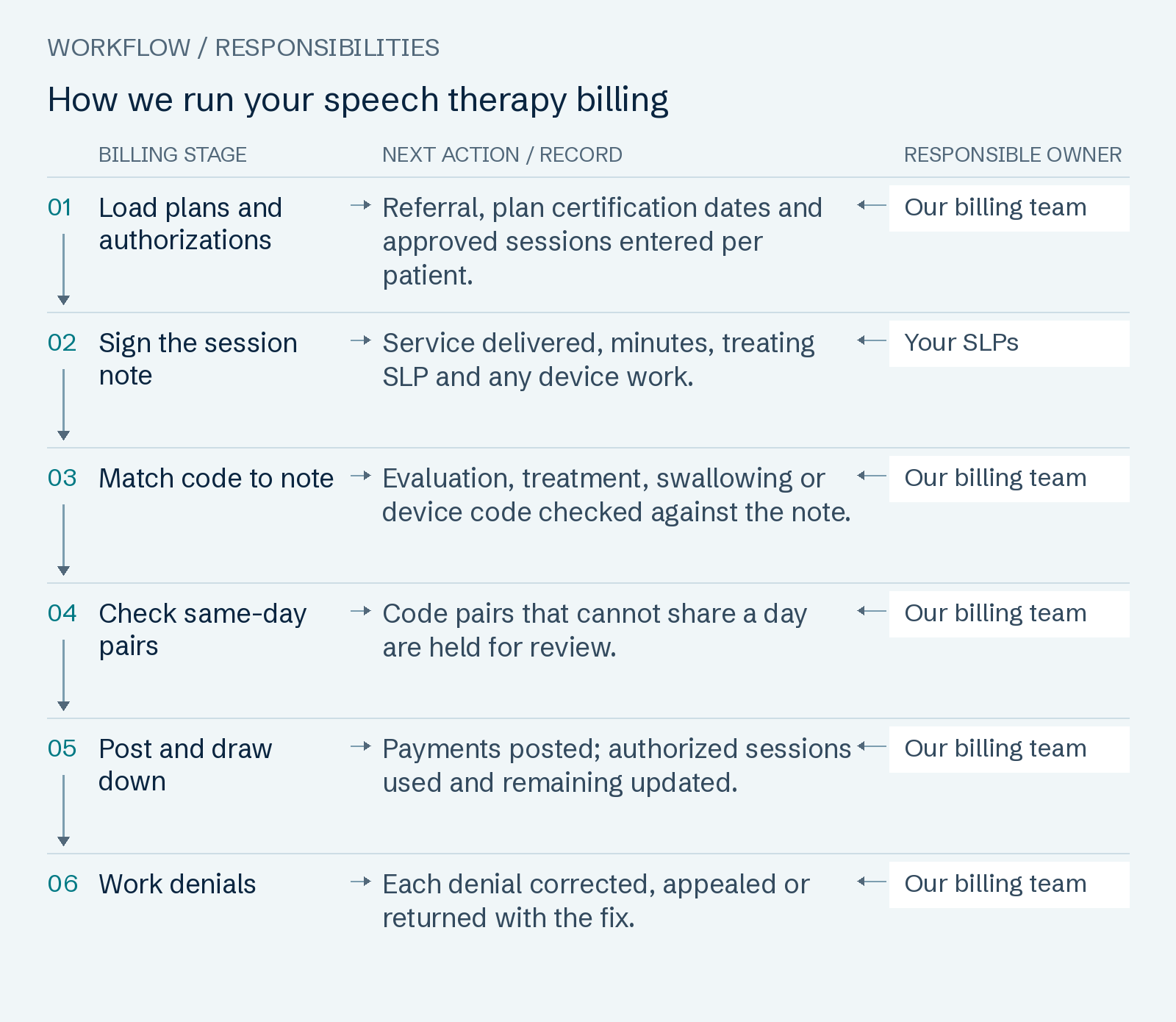
Read the workflow as text
- Load plans and authorizations — Referral, plan certification dates and approved sessions entered per patient. Owner: Our billing team.
- Sign the session note — Service delivered, minutes, treating SLP and any device work. Owner: Your SLPs.
- Match code to note — Evaluation, treatment, swallowing or device code checked against the note. Owner: Our billing team.
- Check same-day pairs — Code pairs that cannot share a day are held for review. Owner: Our billing team.
- Post and draw down — Payments posted; authorized sessions used and remaining updated. Owner: Our billing team.
- Work denials — Each denial corrected, appealed or returned with the fix. Owner: Our billing team.
Untimed SLP codes we bill for you: 92507, 92508 and evaluations 92521–92524
Most speech codes are untimed. ASHA's Medicare coding rules for SLP services explain that an untimed code is billed once per day, regardless of the time spent, and CMS's Claims Processing Manual, chapter 5 uses speech evaluation 92521 as its one-unit example. A 30-minute and a 60-minute individual session bill the same single unit.
How we move your claims to the 2027 timed codes
ASHA reports that 92507 stays in effect through December 31, 2026 and is replaced by ten timed codes, 92654 to 92663: a 30-minute base code and a 15-minute add-on for each of five disorder areas. 92508 becomes a stand-alone group code, and other payers decide if and when to adopt the new codes. We confirm each payer's start date, update your note templates so minutes are recorded per disorder area, and switch payer by payer. Code-by-code detail sits in our guide to speech therapy billing codes.
| SLP service | Code | Timed or untimed | What we check before it goes out |
|---|---|---|---|
| Individual speech-language treatment | 92507 (through Dec 31, 2026) | Untimed: one unit a day | No cognitive treatment codes 97129 or 97130 by the same SLP that day |
| Group speech-language treatment | 92508 | Untimed | The note documents a group session |
| Fluency evaluation | 92521 | Untimed: one unit a day | Evaluation type matches the report |
| Speech sound evaluation | 92522 | Untimed: one unit a day | Evaluation type matches the report |
| Speech sound and language evaluation | 92523 | Untimed: one unit a day | Both areas documented; a language-only evaluation takes modifier 52 |
| Voice and resonance analysis | 92524 | Untimed: one unit a day | Instrumental voice studies billed under their own codes |
| Speech-generating device evaluation | 92607 with add-on 92608 | Timed: first hour, then 30-minute add-on | Face-to-face time recorded; 92608 never billed alone |
| Replacement treatment codes | 92654 to 92663 (from Jan 1, 2027) | Timed: 30-minute base, 15-minute add-ons | Each payer's adoption date confirmed first |
Your swallowing and feeding claims: 92526 and 92610
Dysphagia and pediatric feeding work bills under two codes: 92610 for the clinical swallowing evaluation and 92526 for swallowing and feeding treatment, both untimed. ASHA's SLP coding FAQ names 92610 as the code for a clinical swallowing evaluation. ASHA's Medicare coding rules page says to report 92526, not a separate electrical-stimulation code, when stimulation is part of a full swallowing session, and not to report 92526 when the SLP performed only electrical stimulation. We bill stimulation inside the swallowing session when the note supports it and hold a stimulation-only visit for your review.
When a payer approves feeding treatment and speech treatment separately, we track the two approvals apart so a feeding visit never draws down speech sessions.
GN modifier and Medicare plan of care on your claims
Every Medicare speech line carries GN. CMS's claims manual, chapter 5, defines GN as services delivered under an outpatient speech-language pathology plan of care. We add GN to each therapy line and check that a plan covers the date of service.
Plan-of-care dates we track for you
Under the CMS Benefit Policy Manual, chapter 15, the physician or nonphysician practitioner certifies the initial plan as soon as it is obtained, or within 30 days of the initial therapy treatment, and the certification covers the plan's duration or 90 calendar days from the initial treatment, whichever is less. We keep each patient's certification and recertification dates and ask your team for a signature before the window closes. The same chapter says Medicare does not recognize speech-language pathology assistant services, so we never bill SLPA sessions to Medicare as therapy.
The KX threshold your SLP and PT patients share
The CMS therapy services page sets the 2026 KX modifier threshold at $2,480 for PT and SLP services combined. We carry forward each patient's year-to-date therapy total and add KX only when the documentation supports continued medical necessity.
Pediatric speech therapy: how we bill your Medicaid and EPSDT claims
Under EPSDT, Medicaid covers children under age 21 for coverable services needed to treat, correct or reduce conditions, regardless of whether the service is covered in the state's Medicaid plan. Payment still depends on paperwork your state and its managed care plans set.
- Referral on file. Federal rules at 42 CFR 440.110(c) describe speech services for which the patient is referred by a physician or other licensed practitioner. We check that each child's referral is current before the first claim.
- Who rendered the session. The same rule defines a speech pathologist by the ASHA certificate of clinical competence, its equivalent, or progress toward it under supervision. We bill each session under the SLP your state Medicaid program has enrolled.
- Authorizations and limits. ASHA's Medicaid coverage overview notes that each state sets the type, amount, duration and scope of covered services. We keep a session ledger per child and plan, and flag low balances and end dates before visits run past them.
New requests and renewals can run through our prior authorization services, built from your evaluation and progress notes.
AAC device evaluations we bill, and the DME claim your supplier keeps
For augmentative and alternative communication, we bill your SLP's work: the speech-generating device evaluation (92607, with 92608 when the time supports it) and device therapy under 92609, which ASHA's coding FAQ says includes programming and modification. The device itself is billed by the DME supplier: Medicare's national coverage determination 50.1 places speech-generating devices in the durable medical equipment benefit.
The supplier's claim rests on your report. The DME contractors' device policy, L33739, requires a formal SLP evaluation of cognitive and communication abilities and says the SLP may not be an employee of, or have a financial relationship with, the supplier. We bill the evaluation once the report is signed.
Our rate card for SLP practices
Speech practices pay the rehab row of our rate card, the same row as PT and OT. Our fee is a percentage of insurance payments; family copays and private-pay sessions carry 0%. Clinicians are counted on the 1st of each month from the rendering NPIs we billed the month before (for ABA, BCBAs and BCaBAs, not RBTs). Your rate moves with your size band the next month, in either direction.
Illustrative example, not client data: a pediatric speech clinic whose claims last month named 3 SLPs as rendering providers counts 3 clinicians. That is the 2–5 clinicians band, so its rate is 7.0%. If $18,000 of insurance payments posted that month, the fee is 7.0% of $18,000, and the month's percentage fees can never exceed 9.0% of that month's insurance payments.
Setup is $0. Invoices 1–3: only percentage fees on that month's insurance payments, plus any statements or add-ons you order. Percentage fees and mailed statements are capped at 9.0% of that month's insurance payments; from invoice 4, the $400 minimum applies even in a month when the cap comes to less. Month to month. Leave with 30 days' written notice. No termination fee. See our medical billing rate card.
On-Our-Watch Guarantee. If a claim misses a filing, corrected-claim or appeal deadline while it is on our watch, we pay you what it would have paid. Claims we get complete 10+ business days before the deadline; contracted rate less any copay you collected, paid automatically within 30 days of final denial; capped $10,000/month; your holds excluded. We publish client results only with written permission. Until we have them, judge us by the guarantees and the free Deadline Map.
Not ready to switch? Get my free A/R Deadline Map: every unpaid claim over 90 days, sorted by deadline. Clock starts with your claim-level aging export and signed BAA; above 10 requests in a week, we confirm your date within 1 business day.
| Practice size (SLPs and other clinicians we bill for) | Rate for speech therapy |
|---|---|
| 1 clinician | 7.5% of insurance payments |
| 2–5 clinicians | 7.0% of insurance payments |
| 6–15 clinicians | 6.5% of insurance payments |
| Larger groups | 16+ clinicians, or anesthesia, radiology, DME, lab and home health: written quote within 1 business day, same fee base, cap and terms. |
Telehealth speech therapy billing for your practice
We bill telehealth sessions alongside in-person visits. For Medicare, the CMS therapy services page says the Consolidated Appropriations Act, 2026 extended the ability of PTs, OTs and SLPs to furnish telehealth services through December 31, 2027. Medicaid programs and commercial plans set their own rules, so before the first virtual claim we confirm each payer's place of service and modifier and flag telehealth visits at charge entry.
Common questions
- How much do speech therapy billing services cost?
- Our rate is 7.5% for 1 clinician, 7.0% for 2–5 clinicians and 6.5% for 6–15 clinicians, of insurance payments, with 0% of patient payments and $0 setup. The minimum and fee cap are on our pricing page.
- Do you bill 92507 as a timed code?
- No. Through December 31, 2026, 92507 is untimed: one unit per day whatever the session length, with GN on Medicare lines. ASHA reports that timed codes 92654 to 92663 replace it on January 1, 2027; we switch each payer when it adopts them.
- Do you add the GN modifier to our speech therapy claims?
- Yes, on every Medicare therapy line, as CMS requires for services under a speech-language pathology plan of care. We also check the plan's certification dates before the claim goes out.
- Can you bill our telehealth speech therapy sessions?
- Yes. Medicare lets SLPs furnish telehealth through December 31, 2027; for Medicaid and commercial plans we confirm each payer's rules before the first virtual claim.
- Do we have to sign a long-term contract?
- Month to month. Leave with 30 days' written notice. No termination fee. Notice by email; optional run-out covers claims we submitted before your exit date, at your plan rate; handover file within 10 business days of exit.
- How fast can you take over our SLP billing?
- Go-live, when your first claims go out, comes within 5 business days of access; any unbilled backlog follows within 10 business days of access. Our guide to switching billing companies lists what to request from your current biller, and our EHR compatibility page covers system access.
- Can you credential a new SLP who joins our practice?
- Yes. New-Clinician Enrollment: Clinicians who join while you're a client get enrollment filed with up to 5 payers each (the payer decides), with no per-payer fee. Outside that, Credentialing & Payer Enrollment is $149 per payer. Billed only after the payer confirms your effective date; $0 if denied or panel closed; filed within 5 business days of your complete packet.
Sources and review
Page revised November 5, 2026 · Review contact: Hyder Shah (inquiries@claimpillar.com). Rules and dates below come from CMS, federal regulation and ASHA pages retrieved 2026-11-05. Prices and terms come from our published offer.
- ASHA: New speech-language pathology treatment codes replacing 92507 (retrieved 2026-11-05)
- ASHA: Medicare CPT coding rules for speech-language pathology services (retrieved 2026-11-05)
- ASHA: Coding for reimbursement FAQ, speech-language pathology (retrieved 2026-11-05)
- ASHA: Medicaid coverage policies, speech-language pathology (retrieved 2026-11-05)
- CMS: Medicare Claims Processing Manual, chapter 5 (therapy modifiers, untimed units) (retrieved 2026-11-05)
- CMS: Medicare Benefit Policy Manual, chapter 15 (plan certification, SLP assistants) (retrieved 2026-11-05)
- CMS: Therapy services (2026 KX threshold, therapist telehealth through 2027) (retrieved 2026-11-05)
- Medicaid.gov: Early and Periodic Screening, Diagnostic, and Treatment (retrieved 2026-11-05)
- eCFR: 42 CFR 440.110, speech, hearing and language services under Medicaid (retrieved 2026-11-05)
- CMS: NCD 50.1, Speech Generating Devices (retrieved 2026-11-05)
- CMS: LCD L33739, Speech Generating Devices (retrieved 2026-11-05)