Chiropractic credentialing services: Medicare, commercial plans and networks
For a chiropractor, we file three kinds of application: Medicare, your state Medicaid program where you choose to join it, and each commercial plan or chiropractic network your patients carry. It is the same insurance credentialing service we run for medical practices, set up around the payers and network managers that handle chiropractic care.
Medicare enrolls a chiropractor as a physician
CMS lists doctors of chiropractic under the physician category of the CMS-855I enrollment application, and associates reassign benefits to your practice on the same form. What the enrollment pays for is narrow: Medicare coverage of a chiropractor extends only to manual manipulation of the spine to correct a subluxation (Benefit Policy Manual, chapter 15, section 240). We set that expectation at kickoff, so your Medicare revenue plan matches what the enrollment covers. Our chiropractic billing services take the claims from there if you want one team for both.
Physical therapy credentialing services: your PTPP Medicare enrollment
For a physical therapist, Medicare enrollment is the strictest file your clinic builds, and we build it first when you treat Medicare patients. Each PT enrolls on the CMS-855I as a therapist in private practice (PTPP) and reassigns benefits to your group; a PT group in private practice enrolls on the CMS-855B.
Your office space and the site visit
Under 42 CFR 410.60(c), a PT in private practice bills Medicare only for care in the practice's office space or the patient's home, and that space must be owned, leased or rented by the practice and used for the exclusive purpose of operating it. Physical therapists are a moderate-risk category under 42 CFR 424.518, so a site visit is required before the contractor decides on a PT's initial private-practice enrollment, at each practice location, unless the PT's practice location is a home address and the PT treats patients only in their homes (Program Integrity Manual, chapter 10, section 10.2.3.10). A PT already enrolled in private practice who only reassigns benefits to your group does not need a new one. We confirm the lease wording and that the office is open and operating before we file.
The table shows where a PT file and a chiropractor file part ways.
| What differs | Chiropractor (DC) | Physical therapist (PT) |
|---|---|---|
| Medicare category | Physician, on the CMS-855I | Therapist in private practice, on the CMS-855I |
| CMS screening level | Limited (physicians) | Moderate: site visit before approval |
| What Medicare covers | Spinal manipulation to correct a subluxation | Outpatient therapy under a written plan of treatment |
| Office space condition | None in the PT private-practice regulation | Owned, leased or rented, used only for the practice; or the patient's home |
| Medicare opt-out | Not allowed | Not allowed |
| Main commercial route | The plan, or a network manager it names | The plan, or a network manager it names |
Insurance credentialing for your physical therapists and PTAs
We credential every PT on your schedule with each payer, one line per therapist and payer. Physical therapist assistants work differently. CMS's list of clinicians who enroll on the CMS-855I names occupational or physical therapists in private practice, not assistants, and 42 CFR 410.60(c)(2) lets a PTA perform services under the general supervision of the PT in private practice. So for Medicare we enroll your PTs, not your PTAs. For each commercial plan, we check its written requirement before filing anything for an assistant.
New PT hires while enrollment is pending
The same regulation says services by an unenrolled physical therapist must be under the direct supervision of the enrolled PT. We file each new hire's application as soon as the license and NPI exist, and you schedule that therapist's Medicare visits only when an enrolled PT can provide that direct supervision. For the claims side of a rehab clinic, see our physical therapy billing services.
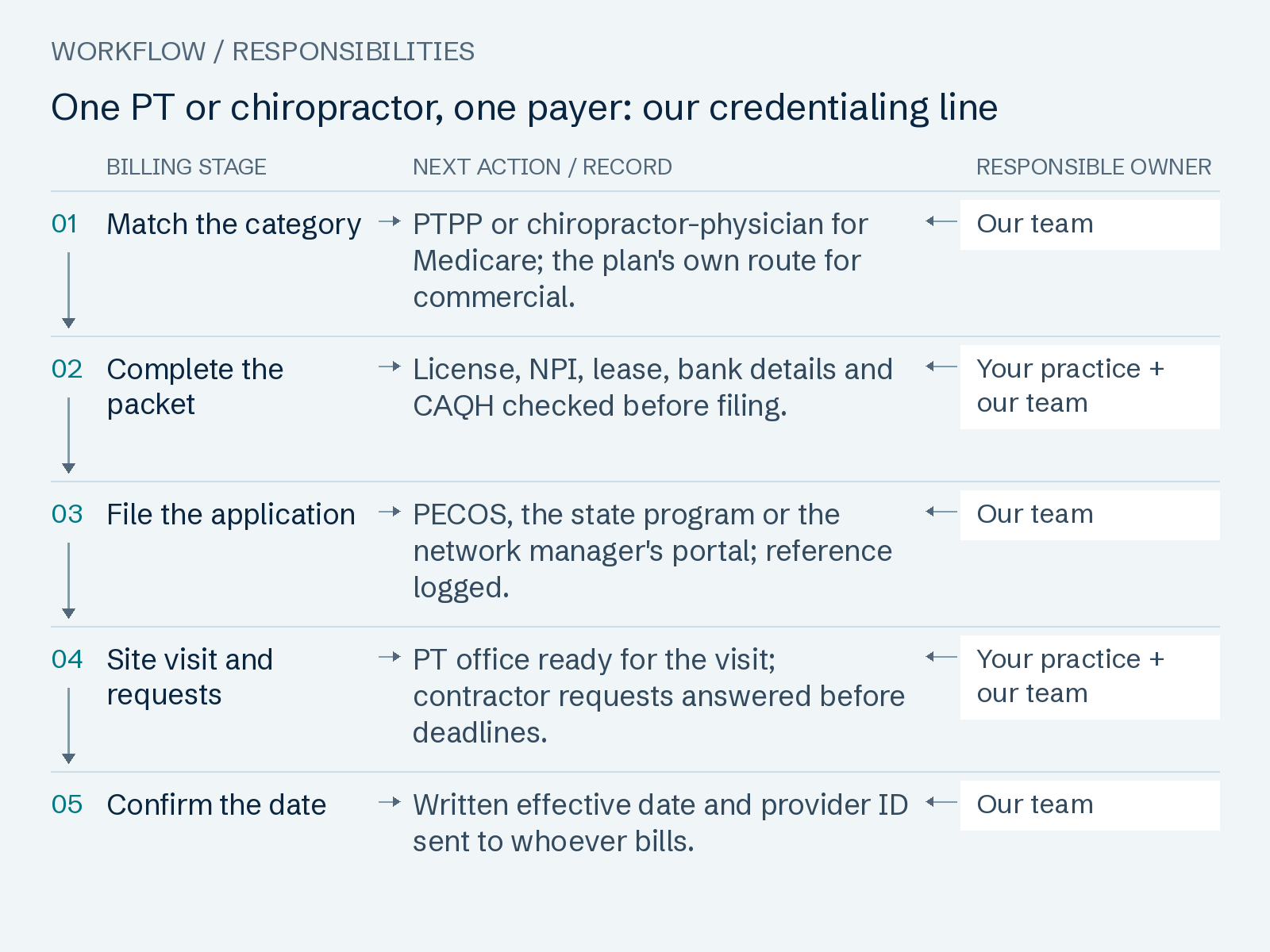
Read the workflow as text
- Match the category — PTPP or chiropractor-physician for Medicare; the plan's own route for commercial. Owner: Our team.
- Complete the packet — License, NPI, lease, bank details and CAQH checked before filing. Owner: Your practice + our team.
- File the application — PECOS, the state program or the network manager's portal; reference logged. Owner: Our team.
- Site visit and requests — PT office ready for the visit; contractor requests answered before deadlines. Owner: Your practice + our team.
- Confirm the date — Written effective date and provider ID sent to whoever bills. Owner: Our team.
Network managers we file through: Optum Physical Health, WholeHealth Networks and others
Many plans do not credential PTs or chiropractors themselves. They hand the work to a network manager, and an application sent to the plan's medical network goes to the wrong organization. We confirm each plan's route at kickoff and file there.
| Plan or network | Who handles PT and chiropractic credentialing | What we do |
|---|---|---|
| UnitedHealthcare | Optum Physical Health, for chiropractors and outpatient therapy providers (physical, occupational, speech), per UnitedHealthcare's join page | File through Optum Physical Health, not UnitedHealthcare's medical network |
| Oxford (UnitedHealthcare) | Some Oxford members must see Oxford participating providers, per the same page | Check Oxford participation for practices that see those members |
| Kaiser Permanente Washington | WholeHealth Networks administers the alternative medicine network; Kaiser's join page sends alternative medicine and chiropractic contract requests there | File chiropractors through WholeHealth Networks in that region |
| Other commercial plans | The plan itself or the network it names | Read the plan's join page before applying |
Timelines and the documents we need from you
CMS holds its Medicare Administrative Contractors to published processing standards in section 10.5 of the Program Integrity Manual, chapter 10. For online (PECOS) applications that need a site visit, development or fingerprinting, as a PT's first private-practice enrollment does, the contractor processes 95% within 50 calendar days of receipt and all within 85. Applications that need none of those are processed 95% within 15 calendar days and all within 50. These are contractor targets, not a promise for one application. Commercial plans and network managers run their own clocks, and we quote each one from its own page.
What we need from your practice
- Each clinician's state license and NPI. CMS makes the NPI the first step of Medicare enrollment.
- Your group NPI and tax ID, if the practice bills as a group.
- For a PT clinic, the lease or deed showing the space is owned, leased or rented by the practice and used only for it.
- Bank details for electronic funds transfer, which Medicare requires at enrollment.
- CAQH access for plans that read a CAQH profile.
- Each clinician's signature on their own application.
CMS tells applicants to answer contractor requests within 30 days, or the application may be rejected. We track every request and send you anything only you can supply, with its due date.
Pricing: $149 per payer
Credentialing for a PT or chiropractor costs $149 per payer for each clinician. Billed only after the payer confirms your effective date; $0 if denied or panel closed; filed within 5 business days of your complete packet. CMS charges individual practitioners no Medicare enrollment application fee, per CMS's enrollment overview.
Billing clients get New-Clinician Enrollment: Clinicians who join while you're a client get enrollment filed with up to 5 payers each (the payer decides), with no per-payer fee. For every fee a credentialing file can carry, see our breakdown of credentialing services pricing, or compare all tiers on the rate card.
Billing from the effective date we confirm
Credentialing ends when the payer confirms an effective date in writing, and that date decides which visits you can bill. For Medicare, the effective date for physicians and physical therapists is the later of the filing date of an application the contractor approves or the date the clinician first furnished services at a new practice location (42 CFR 424.520(d)). Under 424.521, billing can reach back up to 30 days before that date when circumstances prevented enrolling in advance and every requirement was met at the enrolled location. Visits older than that window are not billable to Medicare, so we file before the first Medicare visit whenever we can.
When the date arrives, we send it with the provider ID to whoever runs your billing. From then on each claim must reach the payer within its filing limit, 12 months from the date of service for Medicare; our timely filing limits by payer list the commercial and Medicaid limits too. Each clinician also revalidates Medicare enrollment, generally every 5 years or when CMS asks, and that date goes on the calendar we keep from day one.
To start, send us your clinician list and the payers you want.
Common questions
- How long does chiropractic credentialing take with you?
- For Medicare, CMS holds its contractors to processing 95% of online applications within 15 calendar days when no site visit, development or fingerprinting is needed, and within 50 when it is (Program Integrity Manual, chapter 10, section 10.5). Commercial plans and network managers set their own times, and we report each one every 14 days.
- Can our chiropractors opt out of Medicare instead of enrolling?
- No. The Medicare opt-out law does not define physician to include chiropractors, so they may not opt out and treat Medicare patients under private contract (Benefit Policy Manual, chapter 15, section 40.4). The same section says physical therapists in independent practice cannot opt out either. If you treat Medicare patients, we enroll each clinician.
- Do our PTAs need their own credentialing?
- Not for Medicare: CMS's CMS-855I list names physical therapists in private practice, not assistants, and a PTA works under the general supervision of the enrolled PT. For commercial plans, we check each plan's written requirement before filing anything for an assistant.
- How much does PT credentialing cost?
- $149 per payer for each therapist. Billed only after the payer confirms your effective date; $0 if denied or panel closed; filed within 5 business days of your complete packet. Billing clients get New-Clinician Enrollment: Clinicians who join while you're a client get enrollment filed with up to 5 payers each (the payer decides), with no per-payer fee.
- What do you need from our practice to start credentialing?
- Each clinician's license and NPI, your group NPI and tax ID, bank details for electronic funds transfer, CAQH access and, for a PT clinic, the lease showing exclusive use of the space. You get one missing-item list per clinician, and the filing window in our terms starts when the packet is complete.
- Can you credential a new PT who joins our clinic?
- Yes. We file the new therapist's CMS-855I with reassignment to your group as soon as the license and NPI exist, then each commercial plan. Until Medicare enrollment is approved, that PT's Medicare visits need an enrolled PT providing direct supervision under 42 CFR 410.60(c)(2).
Sources and review
Page revised November 5, 2026 · Review contact: Hyder Shah (inquiries@claimpillar.com). Every source below was retrieved on November 5, 2026. Network routes change, so we reconfirm each plan's route at kickoff.
- CMS Medicare Program Integrity Manual, Chapter 10 (sections 10.2.3.10 and 10.5)
- CMS Medicare Benefit Policy Manual, Chapter 15 (sections 40.4, 230.4 and 240)
- eCFR: 42 CFR 410.60, outpatient physical therapy and therapists in private practice
- eCFR: 42 CFR part 424 subpart P (sections 424.518, 424.520 and 424.521)
- CMS MLN9658742: Medicare Provider Enrollment
- UnitedHealthcare: Join our network (Optum Physical Health for chiropractors and therapy providers)
- Kaiser Permanente Washington: Join our network