96110 developmental screening: per instrument
CPT 96110 is a standardized developmental screen, scored and documented, billed once per instrument. The American Academy of Pediatrics 2026 coding fact sheet reports it at preventive visits and says it may also go with sick or follow-up office visits. Informal surveillance and non-standardized checklists are not separately reportable: they stay inside the evaluation and management (E/M) visit.
Screening vs testing: why 96110 is not 96112
The AAP draws the line by who supplies the answers. A screen records a parent's or caregiver's observations on a validated form, so it never implies a diagnosis. Testing measures what the child can actually do on a standardized psychometric instrument, and that work belongs on 96112 and 96113. If the note shows a parent questionnaire, the claim carries 96110; if it shows a clinician administering items to the child, it does not.
Two screens on one visit
When two standardized screens are completed at one visit, the AAP reports 96110 with 2 units or on two line items, and notes some payers want modifier 59 to show the screens are distinct. In the AAP's own vignette a nurse gives the screen at a five-year well visit, the pediatrician reviews and summarizes it, and the claim carries the preventive visit with modifier 25 plus 96110.
Medicare does not pay for it: the 2026 CMS fee file lists 96110 as a non-covered service (status N) with no national amount, so Medicaid and commercial fee schedules decide what a screen pays. Practices that bill well-child screening alongside sick visits can compare notes with pediatric billing services that handle Medicaid screening claims.
96112 and 96113: developmental test administration
96112 covers the first hour of developmental testing by a physician or other qualified health care professional (QHP), with interpretation and report; 96113 adds each further 30 minutes. The APA Services 2026 testing billing and coding guide says the codes fit when standardized developmental measures assess skills across language, social, cognitive, motor and adaptive areas, and names the Bayley, Battelle, Mullen and Peabody scales as examples. It also places structured autism observation tools and interviews, such as the ADOS-2, CARS-2 and ADI-R, under the developmental testing codes.
The time on 96112/96113 is the total spent administering, scoring, observing, interpreting and making clinical decisions on the battery, and the battery must include a standardized developmental instrument. In the AAP fact sheet's example, testing plus the report took 85 minutes and was billed as 96112 plus 96113.
When 96112 sits inside a psychological evaluation
If the referral question is not developmental but a developmental instrument still answers part of it, APA Services tells the clinician to bill 96112/96113 only for the time on that instrument, put the rest of the battery on the psychological or neuropsychological codes, and append modifier 59 to show the developmental testing was distinct. The clinical interview is outside 96112, so 90791 or 96116/96121 can be reported with it. Interactive feedback is also outside it: when feedback happens, the guide pairs 96112/96113 with 96130/96131, and adds modifier 59 when the interview or feedback falls on the testing date.
The 2026 national Medicare amount (unadjusted) is $125.25 non-facility and $106.88 facility for 96112, and $56.11 and $45.09 for each 96113 unit.
96116 and 96121: neurobehavioral status exam
96116 is a clinician's hands-on check of how the patient thinks and reasons: memory, attention, language, planning and visual-spatial skills. Its time includes the exam with the patient plus scoring what it shows and writing it up. APA Services describes it as a time-based code for the first hour, with add-on 96121 for each additional hour.
96116 and 90791 on the same day
The NCCI Policy Manual for Medicare, 2026, chapter XI bars 96116 and 96121 with the psychiatric diagnostic evaluations 90791 and 90792. It also says 96116/96121 are not reported when only a mini-mental status examination was done, and may go with other psychiatric or E/M services only when a complete neurobehavioral exam was performed. Intake coding and the interview's own limits sit with the 90791 intake evaluation code.
The 2026 national Medicare amount (unadjusted) is $94.19 non-facility for 96116 and $75.49 for each 96121 hour.
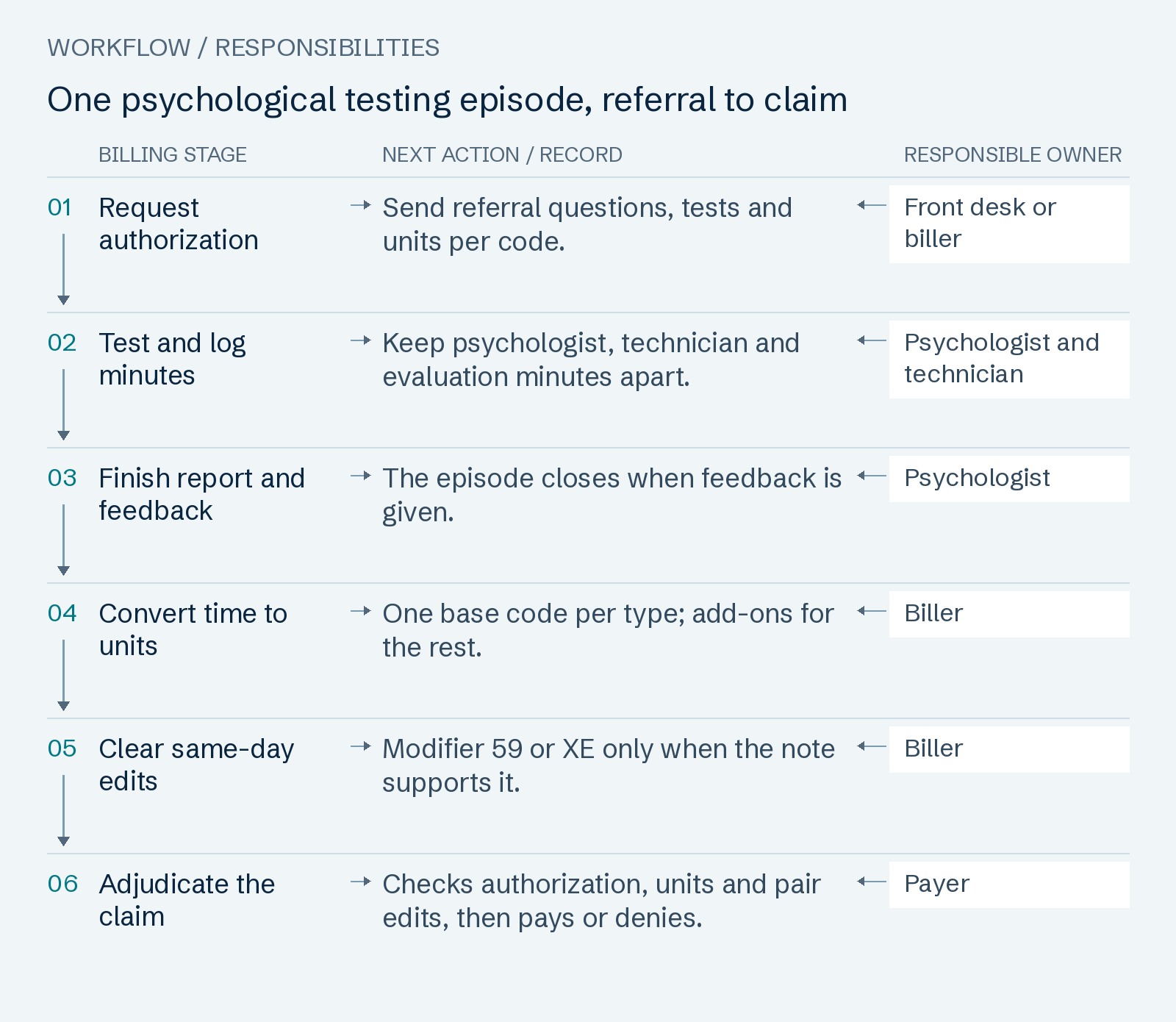
Read the workflow as text
- Request authorization — Send referral questions, tests and units per code. Owner: Front desk or biller.
- Test and log minutes — Keep psychologist, technician and evaluation minutes apart. Owner: Psychologist and technician.
- Finish report and feedback — The episode closes when feedback is given. Owner: Psychologist.
- Convert time to units — One base code per type; add-ons for the rest. Owner: Biller.
- Clear same-day edits — Modifier 59 or XE only when the note supports it. Owner: Biller.
- Adjudicate the claim — Checks authorization, units and pair edits, then pays or denies. Owner: Payer.
96130 CPT code description: testing evaluation services
In plain terms, 96130 is the psychologist's or physician's thinking work on a psychological evaluation, first hour. It covers combining the patient's data, reading the test scores against the clinical picture, settling the diagnosis and plan, writing the report, and the feedback session if one is held. 96131 adds each hour after the first. 96132 and 96133 are the same pair for a neuropsychological evaluation.
Evaluation codes are billed separately from test administration. APA Services notes that the administration codes 96136-96139 may be reported with 96130-96133 on the same or different days, and that a technician's testing is always billed together with the psychologist's evaluation code. Interactive feedback goes on the evaluation codes, not on a therapy code, and the guide says feedback can be given by telehealth or audio only.
96130 or 96132?
The referral question decides. APA Services describes psychological assessment as covering mood and emotional symptoms, mental status, adaptive functioning and behavioral and interpersonal adjustment, which goes on 96130/96131. Neuropsychological assessment measures how a known or possible central nervous system disorder shows up in cognition and behavior, which goes on 96132/96133.
The 2026 national Medicare amount (unadjusted) for 96130 is $123.92 non-facility and $99.53 facility; 96131 is $86.51 and $70.14 per added hour. 96132 is $122.25 and $98.53, and 96133 is $97.86 and $70.48.
96136-96139: test administration by provider or technician
Administration and scoring of two or more tests is billed by who did it. When the psychologist or QHP gives and scores the tests, APA Services reports 96136 for the first 30 minutes and 96137 for each added 30 minutes. When a technician does it, the pair is 96138 and 96139. A single automated test on an electronic platform with an automated result is 96146, billed once even if more than one automated test is given.
For Medicare, 42 CFR 410.32(b)(2)(iii) allows psychological and neuropsychological testing personally furnished by a clinical psychologist or independently practicing psychologist, or furnished under the general supervision of a physician or clinical psychologist (or an NP, CNS, PA, CRNA or nurse-midwife within state scope). WPS article A57481, which covers Iowa, Kansas, Missouri and Nebraska (J5) and Indiana and Michigan (J8), describes technician testing under the clinician's direct supervision, so practices in those states should document the supervising clinician's involvement.
Psychologist and technician on the same day: 59 or XE
An NCCI edit blocks 96136 and 96138 for the same patient on the same date. APA Services resolves it with a modifier on the base code for the second administration, when the documentation supports separate, non-overlapping work:
- Modifier XE when the patient left and came back for a separate encounter that day (the guide's example is a lunch break).
- Modifier 59 when the psychologist started the battery and the technician took over within the same encounter.
- No modifier when the psychologist and technician tested on different dates.
The 2026 national Medicare amount (unadjusted) is $43.76 non-facility for 96136, $37.07 per 96137 unit, $37.74 for 96138, $35.40 per 96139 unit and $2.34 for 96146. CMS lists no facility amount for the technician and automated codes.
Units and time: first hour vs each additional
The table lists every testing code from 96110 to 96139 with who performs it, its time unit and the code it pairs with. Amounts are 2026 national Medicare amounts (unadjusted), non-facility, from the CMS CY 2026 PFS relative value file; actual payment varies by locality, setting and payer.
Multi-day episodes: one base code per service type
APA Services tells psychologists to total the time for each type of service across the whole episode (interview, evaluation, administration, feedback) and bill once, when the report is done and feedback given. The single claim lists base and add-on codes with their dates of service, a base code only for the first unit of each type, and add-on codes for every later unit on the same or different days. Administration time accumulates in 30-minute blocks, and the neurobehavioral exam and evaluation services in 60-minute blocks. In WPS's six states, A57481 adds two rules: a per-hour code needs at least 31 minutes, and all testing time is combined and reported on the last day of service.
Worked example: one full psychological evaluation
Illustrative example, not client data. An adult evaluation runs over two days in an office. Day one: the psychologist gives tests for 60 minutes, then a technician continues for 150 minutes in the same encounter. Across both days the psychologist spends 3 hours integrating results, writing the report and giving feedback.
- Psychologist administration, 60 minutes: 96136 x1 + 96137 x1.
- Technician administration, 150 minutes: 96138 x1 + 96139 x4, with modifier 59 on 96138 because the technician took over in the same encounter.
- Evaluation, 3 hours: 96130 x1 + 96131 x2.
- 2026 national Medicare amounts (unadjusted), non-facility: $123.92 + $173.02 + $43.76 + $37.07 + $37.74 + $141.60 = $557.11, before locality adjustment, deductible and coinsurance.
| Code | What it covers (our words) | Who performs it | Time unit | Pairs with | 2026 national Medicare amount (unadjusted), non-facility |
|---|---|---|---|---|---|
| 96110 | Standardized developmental screen, scored | Clinician or trained staff, clinician reviews | Per instrument | E/M or preventive visit | None published |
| 96112 | Developmental testing, first hour | Physician or QHP | First hour | 96113 | $125.25 |
| 96113 | Developmental testing, added time | Physician or QHP | Each added 30 minutes | Add-on to 96112 | $56.11 |
| 96116 | Neurobehavioral status exam, first hour | Physician or QHP | First hour | 96121 | $94.19 |
| 96121 | Neurobehavioral status exam, added hour | Physician or QHP | Each added hour | Add-on to 96116 | $75.49 |
| 96130 | Psychological evaluation work, first hour | Psychologist, physician or QHP | First hour, once per episode | 96131 | $123.92 |
| 96131 | Psychological evaluation work, added hour | Psychologist, physician or QHP | Each added hour | Add-on to 96130 | $86.51 |
| 96132 | Neuropsychological evaluation work, first hour | Psychologist, physician or QHP | First hour, once per episode | 96133 | $122.25 |
| 96133 | Neuropsychological evaluation work, added hour | Psychologist, physician or QHP | Each added hour | Add-on to 96132 | $97.86 |
| 96136 | Clinician gives and scores tests | Psychologist, physician or QHP | First 30 minutes, once per episode | 96137; billed with 96130-96133 | $43.76 |
| 96137 | Clinician testing, added time | Psychologist, physician or QHP | Each added 30 minutes | Add-on to 96136 | $37.07 |
| 96138 | Technician gives and scores tests | Technician under supervision | First 30 minutes, once per episode | 96139; billed with 96130-96133 | $37.74 |
| 96139 | Technician testing, added time | Technician under supervision | Each added 30 minutes | Add-on to 96138 | $35.40 |
Autism evaluations before ABA: codes and prior auth
An autism evaluation that leads to applied behavior analysis is usually coded from the same families: 90791 for the diagnostic interview, 96112/96113 for standardized developmental and autism observation tools such as the ADOS-2, and 96130-96139 when a broader psychological battery is needed. Which of those lines need approval first depends on the plan.
Louisiana Healthcare Connections, a Louisiana Medicaid plan, is one example. It covers ABA after a comprehensive diagnostic evaluation (CDE) recommends it; the family gives the CDE to the ABA provider they choose, and that provider submits it to request ABA prior authorization. The CDE must include a clinical history with the parent or caregiver, direct observation, a records review, a DSM-5 diagnosis, and the rationale for referring or not referring to ABA. The plan requires no prior approval for the interview and brief assessment codes in a CDE, but does for the testing codes, and asks the evaluator to explain why those added assessments are medically necessary. Its code list does not name 96112 or 96113, so confirm with the plan before billing them in a CDE.
Once the diagnosis is in hand, the ABA claims themselves run on a different code set with their own authorization units. Agencies weighing that side can compare ABA therapy billing support built around authorization tracking.
| Code group in a CDE | Louisiana Healthcare Connections prior approval | What to have ready (our suggestion) |
|---|---|---|
| 90791, 90792 | Not required | Interview note with history and observation |
| 96127 | Not required | Scored brief assessment |
| Office and home E/M visits | Not required | Visit note |
| 96116, 96121 | Required | Why the added assessment is medically necessary |
| 96130-96133 | Required | Medical-necessity explanation (plan rule), plus referral question and planned evaluation hours |
| 96136-96139, 96146 | Required | Medical-necessity explanation (plan rule), plus tests planned and administration units |
Testing denials and documentation
The sources on this page point to four avoidable causes of testing denials: a base code repeated across days, a missing modifier on a same-day pair, time counted twice, or testing a payer reads as non-clinical. The table pairs each with its source and fix.
Prior auth checklist for testing
The BlueCross BlueShield of Tennessee commercial testing authorization form (03/26) shows what a payer reviewer reads. Gather these before you submit:
- Who referred the patient, and the referral questions.
- Why testing is needed now, and how the results will clarify the diagnosis and change treatment.
- Current and prior behavioral health treatment.
- Whether a medical cause could explain the symptoms, with an explanation.
- The diagnosis codes under evaluation and medical comorbidities.
- Each test by full name with its units, at 30 minutes per administration unit.
- Evaluation units by code (96130-96133, 60 minutes per unit) and administration units by code (96136-96139).
- The testing clinician's name, credentials, NPI and tax ID, and a signature.
The same form warns that testing done partly or mainly for educational purposes is not a covered benefit (the form says this can vary by employer account), and APA Services lists educational or vocational testing, self-administered inventories alone and routine screening without clinical justification among the cases that are not medically necessary.
What the testing record must show
APA Services lists the documentation a payer can ask for: the referral question and diagnosis, relevant medical and psychosocial history, sources of information, the procedures given, clinical decision making, interpretation, an integrated summary, the diagnosis, treatment recommendations, the dates, codes and time of each service, and a legible signature. Testing must produce a written report.
Filing clocks keep running while an episode stays open, so check the payer's limit against the first testing date before you hold a claim; the payer timely filing limits list each plan's window. For the session codes that follow an evaluation, see the 90837 cpt code and the wider set of cpt codes for mental health. Practices that want their testing claims billed for them can look at psychology billing services or mental health billing services; if testing claims are already aging, The Free A/R Deadline Map lists every unpaid claim over 90 days by the deadline it faces. Clock starts with your claim-level aging export and signed BAA; above 10 requests in a week, we confirm your date within 1 business day.
| Problem | Why it happens (source) | Fix |
|---|---|---|
| 96130 or 96136 billed on every testing day | Base codes go on once per episode (APA Services) | One base code per service type; add-on units for later time |
| 96138 denied next to 96136 | NCCI pair edit, same patient and date | Modifier 59 or XE when the note shows separate work |
| 96116 billed with 90791 | NCCI bars the pair | Report only the service the note supports |
| Testing time overlaps the 90791 interview | NCCI bars counting the same time twice | Log interview and testing minutes separately |
| Per-hour code under 31 minutes in WPS states | A57481 threshold for per-hour codes | Roll the minutes into the episode total |
| Feedback billed as psychotherapy | Feedback belongs to the evaluation codes (APA Services) | Count feedback time on 96130-96133 |
| 96146 on a Medicare telehealth claim | Not on the CMS 2026 telehealth list | Bill 96146 to Medicare for in-person testing only |
| Testing denied as educational | Plan excludes educational testing (BCBST form) | State the clinical question and treatment impact |
Common questions
- What is CPT code 96110?
- 96110 is a standardized developmental screen, such as a milestone or speech-delay questionnaire, scored and documented. It is billed per instrument, so two screens on one visit are 2 units, and it is usually reported with a preventive or other E/M visit, according to the AAP coding fact sheet.
- What is the difference between 96130 and 96136?
- 96130 is the psychologist's evaluation work (interpreting results, decision making, the report and feedback), counted by the hour. 96136 is giving and scoring the tests yourself, counted in 30-minute blocks; a technician's administration goes on 96138. The APA Services guide says the two families may be billed on the same or different days.
- Who can bill 96112?
- APA Services says developmental testing should be done only by a state-licensed psychologist, physician or behavioral health qualified professional trained in child development and standardized testing. The AAP fact sheet shows pediatricians reporting it too. Each payer's own provider list decides who it pays, so check the plan before scheduling.
- Does psychological testing need prior authorization?
- Often, but it depends on the plan. BlueCross BlueShield of Tennessee uses a commercial authorization form listing units for 96130-96139, and Louisiana Healthcare Connections requires prior approval for 96116, 96121, 96130-96139 and 96146 in an autism evaluation, but not for 90791 or 96127. Check the plan's list before the first testing date.
- Which codes are used for an autism evaluation?
- Most autism evaluations combine 90791 for the diagnostic interview, 96112/96113 for developmental and autism observation tools such as the ADOS-2, and 96130-96139 when a wider psychological battery is needed. APA Services adds modifier 59 when the interview or feedback falls on the same day as developmental testing.
- Can psychological testing be billed by telehealth?
- For Medicare, the CMS list of telehealth services for 2026 includes 96110, 96112, 96113, 96116, 96121 and 96130-96139. 96146 is not on the list. Other payers publish their own telehealth policies.
Sources and review
Page revised November 4, 2026 · Review contact: Hyder Shah (inquiries@claimpillar.com). Every source below was retrieved and checked on November 4, 2026. Medicare amounts are 2026 national Medicare amounts (unadjusted) from our 2026 PFS dataset (CMS RVU26D); actual payment varies by locality, setting and payer.
- APA Services: 2026 Psychological and Neuropsychological Testing Billing and Coding Guide (retrieved 2026-11-04)
- American Academy of Pediatrics: Coding for Standardized Assessment, Screening and Testing fact sheet, 2026 (retrieved 2026-11-04)
- CMS NCCI Policy Manual for Medicare Services 2026, Chapter XI (retrieved 2026-11-04)
- CMS MCD: Billing and Coding: Psychological and Neuropsychological Testing (A57481, WPS J5/J8) (retrieved 2026-11-04)
- eCFR: 42 CFR 410.32, diagnostic tests and supervision (retrieved 2026-11-04)
- BlueCross BlueShield of Tennessee: Psychological/Neuropsychological Testing Authorization Request Form, commercial, 03/26 (retrieved 2026-11-04)
- Louisiana Healthcare Connections: Guidelines for Comprehensive Diagnostic Evaluations for ABA Services, 2025 (retrieved 2026-11-04)
- CMS: List of Telehealth Services, CY 2026 (retrieved 2026-11-04)
- CMS: PFS Relative Value Files, CY 2026 RVU26D