Mental health CPT codes at a glance
The table below is the code sheet for an outpatient mental health practice: each code with our own short description, the time or unit it is counted in, its 2026 national Medicare amount (unadjusted, non-facility) from the CMS CY 2026 physician fee schedule relative value file (RVU26D), and whether it appears on the CMS list of Medicare telehealth services for 2026. Actual payment varies by locality, setting and payer, and facility amounts are lower for most codes. Commercial plans and Medicaid programs publish their own fee schedules.
Every code in the table is on the 2026 telehealth list. 90849, multiple-family group therapy, is the one addition for 2026; the rest are marked "Maintain".
Whose license sets the Medicare amount
The same code pays differently by license. CMS booklet MLN1986542 (March 2026) pays physicians at 100% of the fee schedule amount and clinical psychologists at 100% when they accept assignment. Clinical social workers, marriage and family therapists and mental health counselors must accept assignment and are paid 75% of the clinical psychologist amount. Nurse practitioners are paid 80% of the lesser of the actual charge or 85% of the physician amount. Illustrative calculation, not client data: 90837 at $167.00 × 75% = $125.25 for a counselor, before locality adjustment and the patient's cost sharing.
| Code | What it covers (our words) | Time or unit | 2026 national Medicare amount, non-facility (unadjusted) |
|---|---|---|---|
| 90791 | Intake evaluation, no medical services | Per evaluation | $173.35 |
| 90792 | Intake evaluation with medical services | Per evaluation | $202.08 |
| 90832 | Individual psychotherapy, shortest band | 16–37 minutes | $85.84 |
| 90834 | Individual psychotherapy, middle band | 38–52 minutes | $113.90 |
| 90837 | Individual psychotherapy, longest band | 53 minutes or more | $167.00 |
| 90833 | Therapy add-on to an E/M visit | 16–37 minutes | $81.50 |
| 90836 | Therapy add-on to an E/M visit | 38–52 minutes | $103.21 |
| 90838 | Therapy add-on to an E/M visit | 53 minutes or more | $136.61 |
| 90846 | Family therapy, patient not present | 50-minute session | $105.88 |
| 90847 | Family therapy, patient present | 50-minute session | $109.55 |
| 90849 | Multiple-family group therapy | Per session | $40.42 |
| 90853 | Group psychotherapy | Per session | $30.39 |
| 90839 | Crisis psychotherapy, first hour | First 60 minutes | $160.32 |
| 90840 | Crisis psychotherapy, added time | Each added 30 minutes | $77.16 |
| 90785 | Interactive complexity add-on | Add-on to a primary code | $14.70 |
| 96127 | Brief behavioral screening instrument | Per payer policy | $5.01 |
| 96130 / 96131 | Psychological testing evaluation | First hour / each added hour | $123.92 / $86.51 |
| 96132 / 96133 | Neuropsychological testing evaluation | First hour / each added hour | $122.25 / $97.86 |
| 96136 / 96137 | Test administration by the clinician | First unit / each added unit | $43.76 / $37.07 |
| 96138 / 96139 | Test administration by a technician | First unit / each added unit | $37.74 / $35.40 |
Diagnostic evaluation codes: 90791 and 90792
90791 and 90792 open an episode of care. The 2026 NCCI Policy Manual, chapter XI separates them by medical work: 90791 is the evaluation without medical E/M, and 90792 is the evaluation with medical E/M, so a therapist bills 90791 and a prescriber doing medical work bills 90792. The same chapter says E/M codes such as 99202–99215 are not reported with either evaluation code.
Can 90791 and a therapy code be billed on the same day?
Not for Medicare. Because psychotherapy includes continuing psychiatric evaluation, NCCI chapter XI says 90791 and 90792 are not separately reportable with individual, group, family, crisis or other psychotherapy codes for the same date of service. An intake that runs into a therapy session is billed as the evaluation alone; the first 90834 or 90837 goes on the next visit.
How often can an intake be billed?
Frequency limits come from the payer. WPS, the Medicare contractor for Iowa, Kansas, Missouri and Nebraska (J5) and Indiana and Michigan (J8), says in billing article A57480 (revision effective January 1, 2026) that the evaluation is done once, at the onset of an illness or suspected illness. The same provider may repeat it after an extended break in treatment, which WPS treats as about 6 months, or after an inpatient admission. Commercial plans write their own limits, so check prior intake dates before a returning patient's claim goes out. Documentation and repeat-visit detail sits in the 90791 intake code guide.
Psychotherapy codes by time: 90832, 90834, 90837
Individual psychotherapy is coded by the minutes of therapy delivered, not by the length of the booked slot. Palmetto GBA's psychotherapy guidance for Medicare Jurisdiction M sets the bands: 16 to 37 minutes for 90832, 38 to 52 minutes for 90834, and 53 minutes or longer for 90837. The add-ons 90833, 90836 and 90838 use the same bands. Palmetto counts face-to-face time with the patient, which may include informants, and the patient must be present for all or some of the service.
The 15-minute gap between bands is where most coding disputes start. A standing 50-minute session is a 90834; it becomes a 90837 only when the note shows 53 minutes or more. The documentation side of that choice is set out in 90837 vs 90834. The longest band has its own page on the 90837 CPT code, including payer amounts.
Sessions under 16 minutes
Palmetto states it plainly: do not bill psychotherapy codes for sessions lasting less than 16 minutes. A brief check-in by a prescriber is billed as the E/M visit alone.
Sessions over 90 minutes
The 53-minute band has no upper limit, but payers look harder at long sessions. WPS article A57480 pays a psychotherapy session longer than 90 minutes only when the medical record documents the face-to-face time and supports the medical necessity of the extra time.
Choosing the code, step by step
- Record therapy minutes. Start and stop times, or total psychotherapy minutes, kept apart from any E/M work.
- Match the band. 16–37, 38–52 or 53 or more picks 90832, 90834 or 90837; under 16 minutes, no psychotherapy code.
- Check for an E/M visit. If a prescriber also managed medication, use the add-on in the same band instead of the standalone code.
- Run the same-day pairs. No 90791 or 90792 with therapy on one date; crisis codes stand alone.
- Set the place of service. Office, facility or telehealth POS, which also sets the facility or non-facility amount.
| Psychotherapy minutes | Code without an E/M visit | Add-on with an E/M visit | Example session |
|---|---|---|---|
| Under 16 | None | None | 12-minute check-in |
| 16–37 | 90832 | +90833 | 30-minute session |
| 38–52 | 90834 | +90836 | 50-minute therapy hour |
| 53 or more | 90837 | +90838 | 55-minute session |
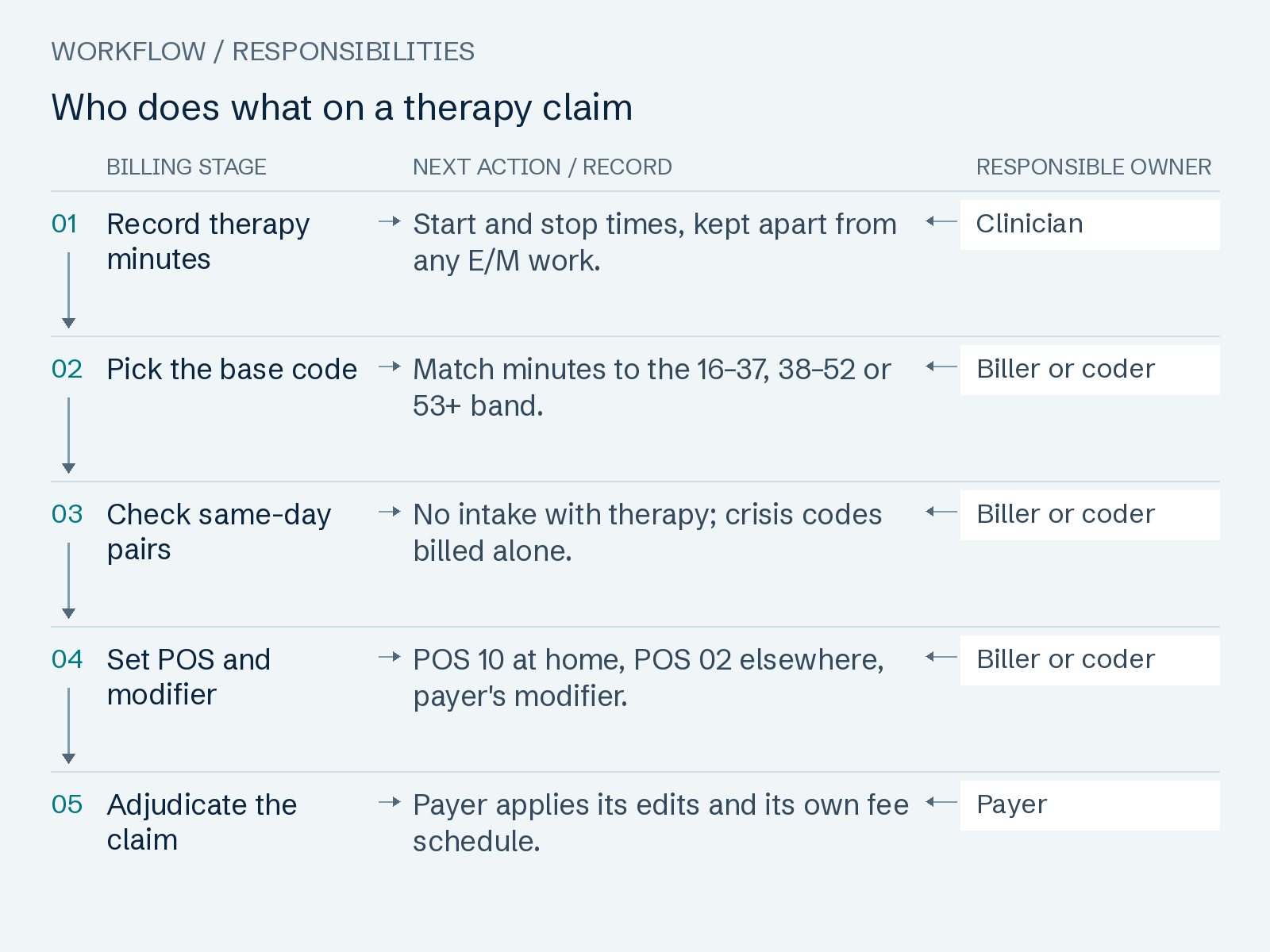
Read the workflow as text
- Record therapy minutes — Start and stop times, kept apart from any E/M work. Owner: Clinician.
- Pick the base code — Match minutes to the 16–37, 38–52 or 53+ band. Owner: Biller or coder.
- Check same-day pairs — No intake with therapy; crisis codes billed alone. Owner: Biller or coder.
- Set POS and modifier — POS 10 at home, POS 02 elsewhere, payer's modifier. Owner: Biller or coder.
- Adjudicate the claim — Payer applies its edits and its own fee schedule. Owner: Payer.
Psychotherapy add-ons with E/M: 90833, 90836, 90838
A psychiatrist, psychiatric nurse practitioner or other prescriber who gives therapy during a medication visit bills the E/M code plus one add-on. Palmetto GBA pays both when the two services are significant and separately identifiable, pays an add-on only when it is reported with its primary service on the same date, and keeps E/M time separate from psychotherapy time.
WPS article A57480 adds three rules for its J5 and J8 states: a separate diagnosis is not required for the E/M and the psychotherapy on the same date; the E/M level is selected by medical decision making, not by time; and prolonged services may not be reported with 90833, 90836 or 90838. How we bill these pairings for psychiatric practices is covered under behavioral health billing.
Add-on pairing chart
The chart adds the two 2026 national Medicare amounts (unadjusted) for common pairings, as an illustration of the claim total before locality adjustment and patient cost sharing. A nurse practitioner's amount is then based on 85% of these physician amounts, per MLN1986542.
| Pairing | Therapy minutes in the note | Non-facility total (2026 national, unadjusted) | Facility total (2026 national, unadjusted) |
|---|---|---|---|
| 99213 + 90833 | 16–37 | $95.19 + $81.50 = $176.69 | $57.45 + $65.80 = $123.25 |
| 99214 + 90836 | 38–52 | $135.61 + $103.21 = $238.82 | $84.50 + $83.17 = $167.67 |
| 99215 + 90838 | 53 or more | $192.39 + $136.61 = $329.00 | $125.59 + $110.22 = $235.81 |
| 90792 + any add-on | Any | Not reported together (NCCI chapter XI) | Not reported together |
Family and group codes: 90846, 90847, 90853
Family psychotherapy has two codes, split by whether the patient is in the room: 90847 with the patient present and 90846 without. Both treat the patient's condition through the family. WPS article A57480 says they are not used when the service is taking a family history or E/M counseling. In the CMS 2026 relative value file, 90846 carries status code R while 90847 carries status A, so check your Medicare contractor's coverage terms before billing 90846 to Medicare.
Family therapy on the same day as individual therapy
NCCI chapter XI says 90832–90838 already include psychotherapy with family members present as informants. Family psychotherapy focused on interactions between the patient and family members may be reported separately with 90832–90838 on the same date only when it is a separate and distinct service during a separate time interval. The note needs two time blocks, not one combined hour. The family therapy codes 90846 and 90847 page goes code by code.
Group therapy: 90853 and 90849
90853 is group psychotherapy, with a 2026 national non-facility amount of $30.39. WPS allows the interactive complexity add-on 90785 with 90853 when medically indicated. 90849, multiple-family group psychotherapy, was added to the CMS telehealth list for 2026 with a national non-facility amount of $40.42.
Crisis, interactive complexity and prolonged services
Crisis codes 90839 and 90840
90839 covers the first 60 minutes and 90840 each added 30 minutes. WPS article A57480 says the crisis codes are reported only by themselves, not with the evaluation or psychotherapy codes it lists, and NCCI chapter XI bars 90791 and 90792 with crisis psychotherapy on the same date. A57480 also notes that HCPCS G0017 and G0018 are for crisis psychotherapy at non-facility places of service other than the office; their 2026 national non-facility amounts are $218.44 and $105.21.
Interactive complexity 90785
90785 is an add-on that never stands alone. NCCI describes interactive services as those for patients who have lost, or have not yet developed, the expressive language skills to explain their symptoms. WPS allows 90785 when at least one listed communication difficulty is present and documented, and bars it with crisis psychotherapy and with an E/M visit that has no psychotherapy. Name the communication factor in the note when the documentation supports it.
Prolonged services after 99354
Searches for 99354 still run high, but the code is gone. NCCI chapter XI records that 99354–99357 were deleted on January 1, 2023; the prolonged E/M codes are now 99417, 99418, G2212 and G0316. In the CMS 2026 relative value file, 99417 is flagged as not used for Medicare payment, while G2212 has a 2026 national non-facility amount of $34.07 and is on the 2026 telehealth list. None of them extend a psychotherapy add-on: WPS bars prolonged services with 90833, 90836 and 90838.
Screening and testing codes (96127, 96130-96139)
Screening and testing sit outside the psychotherapy family. WPS billing article A57481 (revision R4, effective October 31, 2024) points practices to 96110, 96112, 96113 and 96127 for developmental and behavioral screening; 96127 has a 2026 national non-facility amount of $5.01 and no facility amount.
Testing evaluation vs test administration
A testing claim bills two kinds of work. Evaluation codes 96130–96131 (psychological) and 96132–96133 (neuropsychological) carry the clinician's interpretation and report, counted by the hour. Administration codes 96136–96137 (clinician) and 96138–96139 (technician) carry giving and scoring the tests. For WPS states, A57481 requires a minimum of 31 minutes to report any per-hour code, combines testing time from several days onto the last day of service, and treats procedures with no impact on the plan of care as not medically necessary.
Same-day edits on testing claims
NCCI chapter XI requires the diagnostic interview (90791, 90792), testing (96136–96146) and evaluation (96130–96133) to be distinct services when reported on one date, and bars reporting time twice for information already gathered. It also bars these codes for tests reportable as part of an E/M visit and for self-administered tests. Unit counting is worked through in psychological testing CPT codes. Psychology practices that bill testing every week can compare our behavioral health billing.
Telehealth modifiers and POS for mental health claims
For Medicare, the place of service tells the payer where the patient was. The CMS telehealth FAQ (updated October 8, 2026) says to use POS 02 for telehealth provided other than in the patient's home and POS 10 when the patient is at home, and since January 1, 2024 home telehealth claims are paid at the non-facility rate. The same FAQ says the Consolidated Appropriations Act, 2021 permanently removed geographic and place-of-service restrictions for behavioral health telehealth, and that two-way, audio-only technology is permitted for it.
Modifiers differ by setting and payer. CMS's MLN Matters SE22001 tells rural health clinics and FQHCs to use modifier 95 for audio-video mental health visits and FQ or 93 for audio-only visits. Commercial plans and Medicaid programs publish their own telehealth modifier rules, so confirm each payer's policy before the first telehealth claim.
The in-person visit rule for home mental health telehealth
The CMS FAQ dates the in-person requirement to services after December 31, 2027: an in-person visit within 6 months before the first mental health telehealth service at home, then one within 12 months of each telehealth service. Patients who began home mental health telehealth before January 1, 2028 are treated as established and need an in-person visit every 12 months after that date. CMS booklet MLN901705 (December 2025) still states the earlier wording, so confirm the current rule with your contractor before scheduling.
When to hand off mental health coding
The rules above live in different documents: contractor articles, NCCI, the telehealth list and each commercial plan's policy. If minute bands, add-on pairs or telehealth modifiers keep coming back as denials, our mental health billing services match each claim to the note and the payer's rules, and our medical coding service reviews the code choice before submission. Payer setup and claim flow are covered in the guide to mental health insurance billing. Print the code table at the top of this page for your front desk, or ask us about your practice's claims.
| Situation (Medicare unless noted) | Place of service | Modifier | Source |
|---|---|---|---|
| Video session, patient at home | POS 10 | Per the payer's telehealth policy | CMS telehealth FAQ |
| Video session, patient somewhere other than home | POS 02 | Per the payer's telehealth policy | CMS telehealth FAQ |
| Audio-only behavioral session, patient at home | POS 10 | Per the payer's telehealth policy | CMS telehealth FAQ |
| RHC or FQHC mental health visit, audio-video | Clinic billing rules | 95 | MLN Matters SE22001 |
| RHC or FQHC mental health visit, audio-only | Clinic billing rules | FQ or 93 | MLN Matters SE22001 |
Common questions
- What are the most common CPT codes for mental health?
- Outpatient practices bill most often from 90791 (intake), 90832, 90834 and 90837 (individual therapy by minutes), 90846 and 90847 (family therapy) and 90853 (group therapy). Prescribers add 90792 and the E/M add-ons 90833, 90836 and 90838. All are on the CMS 2026 telehealth list.
- What is the CPT code for a therapy intake?
- 90791 for an evaluation without medical services, or 90792 when a prescriber also does medical work. Under the 2026 NCCI manual, neither is reported with a psychotherapy code or an E/M code on the same date. The 2026 national Medicare amounts (unadjusted, non-facility) are $173.35 and $202.08.
- Which mental health codes are time-based?
- Individual psychotherapy and its add-ons (16–37, 38–52 and 53 or more minutes), crisis codes 90839 (first 60 minutes) and 90840 (each added 30 minutes), and the testing codes, which NCCI calls timed procedures. NCCI chapter XI also notes that family codes 90846 and 90847 describe 50 minutes of family psychotherapy. Group codes 90853 and 90849 are not timed: one unit per session, and a practitioner reports one unit per date of service. Intake codes 90791 and 90792 are billed per evaluation.
- What is the CPT code for family therapy without the patient?
- 90846. 90847 is used when the patient is present. WPS article A57480 says neither is used for taking a family history. 90846 carries status code R in the CMS 2026 relative value file, so check your Medicare contractor's coverage terms before billing it.
- Can you bill 90837 and 90847 on the same day?
- Only when they are separate services. NCCI chapter XI allows family psychotherapy with 90832–90838 on the same date when it is separate and distinct and delivered in a separate time interval; the note should show two time blocks.
- Can 90791 and 90837 be billed together?
- Not on the same date for Medicare. NCCI chapter XI says 90791 and 90792 are not separately reportable with individual, group, family or crisis psychotherapy codes for the same date of service.
- How do you bill 90837 by telehealth?
- Bill 90837 when the note shows 53 or more minutes, with POS 10 if the patient was at home or POS 02 if not, per the CMS telehealth FAQ (updated October 8, 2026). Add the telehealth modifier your payer's policy requires.
Sources and review
Page revised November 4, 2026 · Review contact: Hyder Shah (inquiries@claimpillar.com). The workflow checklists are editorial recommendations; payer requirements depend on the program and current policy.
- Palmetto GBA (JM Part B): Psychotherapy Services, retrieved 2026-11-04
- CMS MCD: Billing and Coding: Psychiatry and Psychology Services (A57480, WPS J5/J8, revision effective 01/01/2026), retrieved 2026-11-04
- CMS MCD: Billing and Coding: Psychological and Neuropsychological Testing (A57481, WPS, R4 effective 10/31/2024), retrieved 2026-11-04
- CMS: Medicare NCCI Policy Manual 2026, Chapter XI, retrieved 2026-11-04
- CMS: List of Telehealth Services (CY 2026 final list), retrieved 2026-11-04
- CMS: Telehealth FAQ, updated October 8, 2026 (retrieved 2026-11-04)
- CMS MLN901705: Telehealth & Remote Patient Monitoring (December 2025), retrieved 2026-11-04
- CMS MLN1986542: Medicare & Mental Health Coverage (March 2026), retrieved 2026-11-04
- CMS MLN Matters SE22001: Mental Health Visits via Telecommunications for RHCs and FQHCs, retrieved 2026-11-04
- CMS: PFS Relative Value Files (CY 2026 RVU26D), retrieved 2026-11-04