90847 cpt code: family psychotherapy with the patient
In plain words, 90847 is one family therapy session with the identified patient taking part. The clinician treats that patient's condition by working on how the patient and family members interact. This page uses the code number and our own summary only; the official descriptor belongs to the AMA's CPT code set.
APA Services separates the family codes from individual therapy by focus. The individual codes (90832, 90834, 90837) allow occasional involvement of family members, while the family codes are used when the service focuses on family dynamics or interactions. Medicare's NCCI policy manual, chapter XI (2026) says the same from the billing side: individual psychotherapy already includes family members who join as informants, so a parent sitting in on part of an individual session does not turn it into 90847.
Who counts as family for 90846 and 90847?
Relatives and household caregivers count; professional staff do not. WPS, the Medicare contractor for jurisdictions J5 and J8, states in billing article A57480 that family counseling does not include supervision of, or therapy with, professional caretakers or staff. Novitas LCD L35101 (jurisdictions JH and JL) adds that facility staff are not caregivers under its policy, while caretakers in group-living facilities may be.
90846 cpt code description: family psychotherapy without the patient
90846 is family therapy with family members while the identified patient is absent, for example parents meeting the therapist about their child's treatment plan. The work is still for the patient: Novitas says a patient-absent family session is not routine consultation with staff, and WPS rules out using either family code to take a family history or for E/M counseling.
Medicare treats the two codes differently in one respect. In the CMS CY 2026 PFS relative value file (RVU26D), 90847 has status A (paid separately if covered) and 90846 has status R (restricted coverage: special coverage instructions apply and, if covered, the service is contractor priced). Confirm how your Medicare contractor covers 90846 before you schedule patient-absent sessions.
90846 vs 90847 at a glance
Patient presence decides the code. The table sets the two side by side with the time thresholds and the 2026 national Medicare amount (unadjusted); actual payment varies by locality, setting and payer, and the 90846 figure is indicative because of its status R.
| Check | 90846 | 90847 |
|---|---|---|
| Identified patient in the session | No | Yes, for all or part |
| Descriptor time (NCCI ch. XI) | 50 minutes | 50 minutes |
| Do not report under | Check payer policy | 26 minutes (APA) |
| Medicare units per date (MUE, Oct 1, 2026) | 1 | 1 |
| Add-on codes such as 90785 | Not allowed (APA) | Not allowed (APA) |
| RVU26D status | R: restricted coverage | A: active |
| 2026 national Medicare, non-facility | $105.88 | $109.55 |
| 2026 national Medicare, facility | $99.20 | $102.87 |
| CMS 2026 telehealth list | Maintain | Maintain |
Time rules: 50 minutes and the 26-minute minimum
The NCCI manual says 90846 and 90847 both describe 50 minutes of family psychotherapy. Unlike the individual codes, they have no shorter or longer time bands, and APA Services states that 90847 is not reported for family psychotherapy under 26 minutes. Count only the minutes of family psychotherapy, not scheduling, note writing or a family history taken for an intake.
A longer session is still one unit. Medicare's practitioner Medically Unlikely Edits effective October 1, 2026 allow 1 unit per date of service for 90846, 90847 and 90849. Other payers set their own session caps: under TRICARE regulation 32 CFR 199.4, a covered family or conjoint psychotherapy session is no more than 90 minutes, or up to 180 minutes for crisis intervention.
How many minutes is 90847?
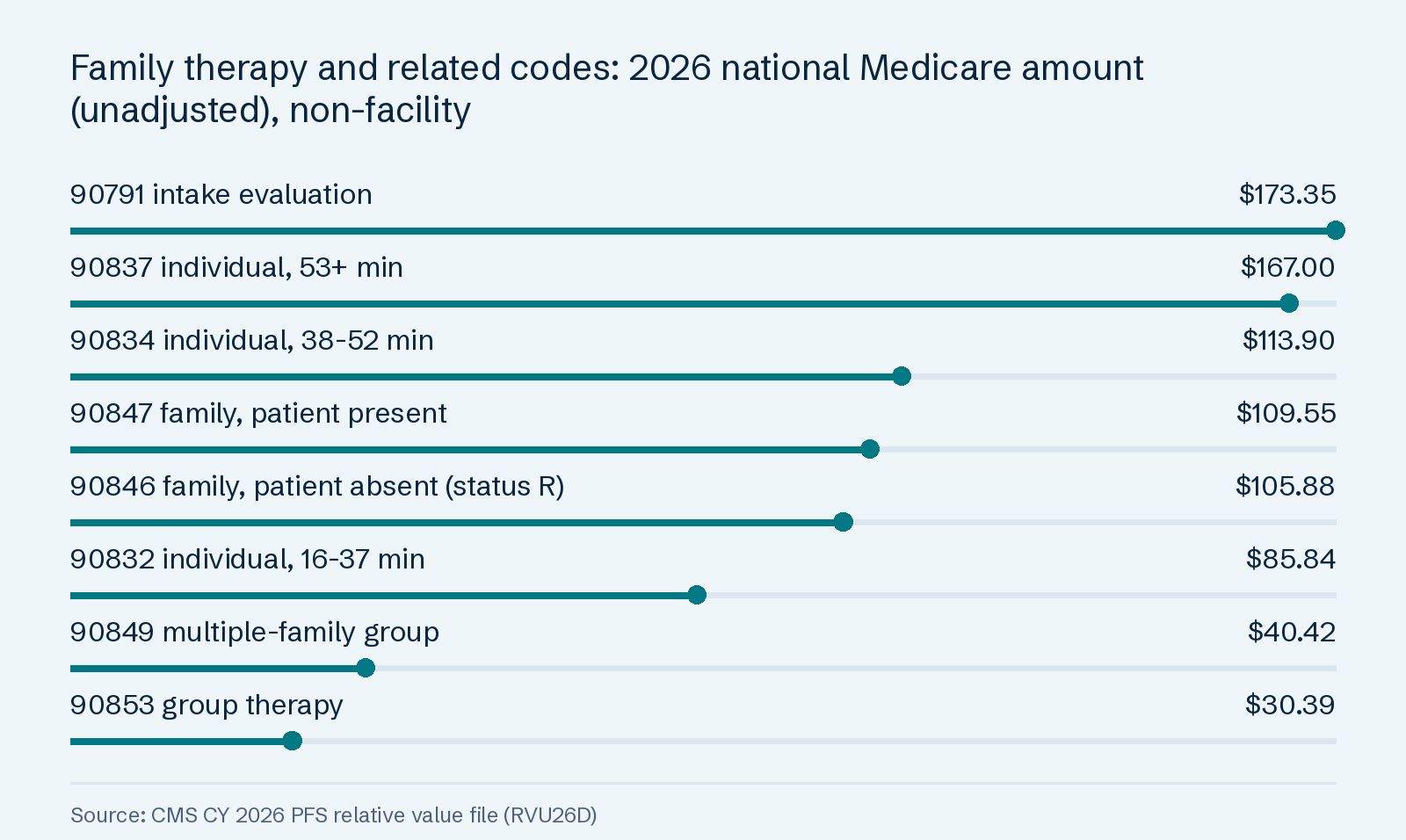
Fifty minutes is the descriptor time, and 26 minutes is the floor APA gives. Record start and stop times in the note so a reviewer can see the session cleared it. For what the family codes pay next to the codes billed around them, the chart shows 2026 national Medicare amounts (unadjusted, non-facility).
CPT code for couples therapy: when insurance pays
Couples sessions are reported with 90847, or 90846 if the identified patient is absent. Whether insurance pays depends on what the session treats, not on who is in the room. Medicare's mental health coverage booklet (MLN1986542, March 2026) covers family psychotherapy with or without the patient present when it is medically reasonable and necessary, with treatment of the patient as the primary purpose. Novitas notes that where both spouses are covered by Medicare, family therapy may be the most effective treatment.
Relationship counseling with no diagnosed condition under treatment is a different service. TRICARE's exclusions in 32 CFR 199.4 list counseling for purposes such as stress management or lifestyle change, and one exception is a certified marriage and family therapist, pastoral counselor or mental health counselor treating a mental disorder.
Couples therapy coverage decision tree
- Is one partner the identified patient with a diagnosed mental disorder? No: the session is relationship counseling. Expect a denial; discuss self-pay with the couple before the first session. Yes: go to step 2.
- Does the session treat that partner's condition through the couple's interaction? Novitas calls family therapy appropriate when intervention in the family's interactions is expected to improve or stabilize the patient's condition. No: bill the individual code if it was individual work, or do not bill. Yes: go to step 3.
- Does the plan cover family or conjoint therapy? Check the member's behavioral health benefit, any prior authorization rule and session caps. For Medicare, also check that the clinician is enrolled. Covered: bill 90847 under the identified patient, or 90846 if the patient sat out the whole session.
Diagnosis rules: the identified patient and Z-codes
Bill the session under one person: the identified patient whose condition the family work treats, with that patient's member ID and diagnosis. Novitas considers family therapy reasonable and necessary only for the beneficiary's mental illness, and says a family member's emotional disturbance that does not affect the patient is not covered on the patient's claim. A relative who needs treatment of their own is a separate patient with a separate record.
Can Z63.0 be the diagnosis on a 90847 claim?
ICD-10-CM code Z63.0 is “Problems in relationship with spouse or partner,” in category Z63, other problems related to the primary support group, including family circumstances (CMS FY 2027 ICD-10-CM code files). The FY 2027 ICD-10-CM Official Guidelines list Z63 among the social determinants of health categories and describe that information as social information rather than medical diagnoses. A payer that covers family therapy only to treat a mental disorder needs the identified patient's mental health diagnosis on the claim. Report Z63.0 or another Z63 code beside it when the record documents the family problem, not in its place.
Billing 90847 with individual sessions
For Medicare, the NCCI manual, chapter XI allows family psychotherapy on the same date as individual psychotherapy (90832 to 90838) only when it is a separate and distinct service in a separate time interval. The note needs two timed blocks, not one total. The same chapter says the intake codes 90791 and 90792 are not separately reportable with family psychotherapy on the same date.
Illustrative example, not client data (2026 national Medicare amounts, unadjusted, non-facility): an individual session billed as 90834, then a separate family session with the patient, bills 90834 and 90847: $113.90 + $109.55 = $223.45. If a parent instead joined part of the individual session, the visit is one 90834 line and the parent counts as an informant.
Same-day rules by payer
Each rule applies only to the payer and region named. All sources were retrieved on November 4, 2026.
| Payer or source | Rule for 90846 and 90847 on the same date | Scope |
|---|---|---|
| Medicare NCCI manual ch. XI (2026) | Individual therapy only in a separate time interval; 90791 and 90792 not separately reportable | Medicare, all states |
| Medicare MUE (Oct 1, 2026) | 1 unit of 90846, 90847 or 90849 per date | Medicare practitioner claims |
| APA Services FAQ | No add-on codes, including 90785, with 90846 or 90847 | CPT usage guidance |
| WPS article A57480 | Family history or E/M counseling is not family psychotherapy | Medicare J5 and J8 |
| TRICARE, 32 CFR 199.4 | Family or conjoint session up to 90 minutes; 180 for crisis | TRICARE |
| Commercial plans and Medicaid | Each plan sets its own same-day policy for 90847 with 90832-90837; check the member's plan before billing both | That plan only |
Telehealth family sessions
Family therapy stays on Medicare telehealth. The CMS list of Medicare telehealth services for calendar year 2026 marks 90846 and 90847 “Maintain” and lists 90849, multiple-family group psychotherapy, as an addition. Medicare's place of service and modifier rules for video and audio-only therapy are the same as for the individual codes, set out in the telehealth section of the 90837 cpt code guide.
Family telehealth outside Medicare
The CMS list binds Medicare only. Commercial plans and state Medicaid programs set their own telehealth terms for family sessions, including whether every family member may join from a different location, so verify the member's plan before the first video session. The telehealth billing guide sets out where telehealth pay differs from in-person pay.
Common 90846 and 90847 denials
Most family therapy denials trace to a same-day edit, the unit limit, a session the payer does not treat as family psychotherapy, or a diagnosis that does not support it. Each row names the cause and the fix.
| Problem | Why it fails | Fix |
|---|---|---|
| 90847 and 90791 on one date | NCCI: intake codes are not separately reportable with family therapy | Bill the evaluation; hold family therapy for another date |
| 90834 and 90847 with one total time | Same-day family therapy needs its own interval | Document two timed blocks, or bill the individual code only |
| Two units of 90847 | Medicare MUE allows 1 unit per date | Bill one unit and document the full time |
| 90785 added to 90847 | Add-on codes do not pair with family codes (APA) | Remove 90785 |
| Patient absent, billed as 90847 | 90847 needs the patient in the session | Rebill as 90846 where the payer covers it |
| Z63.0 as the only diagnosis | Z63 codes record social information, not a mental disorder | Report the identified patient's diagnosis first when the record supports it |
| Staff meeting billed as 90846 | Facility staff are not caregivers (Novitas, WPS) | Bill family codes only for family or group-living caretakers |
| Family session under 26 minutes | Below the 90847 floor (APA) | Do not bill 90847 for it |
Common questions
- What is CPT code 90847?
- 90847 is the CPT code for family psychotherapy with the identified patient present, focused on how the patient and family interact. It describes 50 minutes, is not reported under 26 minutes per APA Services, and Medicare allows one unit per date. Its 2026 national Medicare amount (unadjusted) is $109.55 non-facility.
- What is the difference between 90846 and 90847?
- Patient presence. 90847 is family psychotherapy with the identified patient in the session; 90846 is the same work without the patient. In CMS's 2026 relative value file, 90846 carries status R (restricted coverage, contractor priced if covered), so check your Medicare contractor before billing it.
- Is couples therapy covered by insurance?
- Only when the session treats one partner's diagnosed mental disorder. Couples sessions are billed as 90847 under that partner as the identified patient. Medicare covers family psychotherapy when treating the patient is the primary purpose (MLN1986542); relationship counseling alone, coded only with Z63.0, is usually not covered.
- How many minutes is 90847?
- The NCCI manual gives 50 minutes as the descriptor time for 90846 and 90847, and APA says not to report 90847 under 26 minutes. Medicare's MUE allows 1 unit per date, so a longer session is still one unit.
- Can I bill 90847 and 90837 on the same day?
- For Medicare, yes, when the family session is a separate and distinct service in its own time interval (NCCI chapter XI). Family members who join an individual session as informants are already part of 90837. Commercial plans and Medicaid programs set their own same-day edits, so check the plan's policy.
Sources and review
Page revised November 4, 2026 · Review contact: Hyder Shah (inquiries@claimpillar.com). Every source below was retrieved and checked on November 4, 2026. Medicare amounts are 2026 national Medicare amounts (unadjusted) from our dataset built on the CMS CY 2026 PFS relative value file (RVU26D); actual payment varies by locality, setting and payer. Payer rules apply only to the payer and program named.
- CMS NCCI Policy Manual for Medicare Services, Chapter XI (2026)
- CMS Medicare NCCI Medically Unlikely Edits, practitioner services table effective October 1, 2026
- APA Services: Psychotherapy Services Frequently Asked Questions
- Novitas LCD L35101: Psychiatric Codes
- WPS Billing and Coding Article A57480: Psychiatry and Psychology Services
- CMS MLN1986542: Medicare & Mental Health Coverage (March 2026)
- CMS: List of Medicare Telehealth Services, CY 2026
- CMS: PFS Relative Value Files (CY 2026, RVU26D)
- CMS: ICD-10-CM FY 2027 code descriptions
- CMS: FY 2027 ICD-10-CM Official Guidelines for Coding and Reporting
- eCFR: 32 CFR 199.4, TRICARE basic program benefits