90791 CPT code description
CPT 90791 is the diagnostic intake evaluation without medical services. It pays for an assessment, not for treatment. Novitas Solutions, the Medicare contractor for Jurisdictions H and L, describes this evaluation as a biopsychosocial assessment and the version with medical services as a biopsychosocial and medical assessment. Either one may include discussion with family members or other sources besides the patient (Novitas LCD L35101).
The same LCD treats the diagnostic interview as an initial or periodic evaluation of a patient with a suspected or diagnosed psychiatric illness. It adds that some patients, especially children and older adults, may need more than one visit to complete the initial evaluation. The reason for the assessment must rest on medical necessity and be supported in the record. Once the intake is done, treatment visits move to the psychotherapy codes, chosen by session time; the CPT codes for mental health set out that family.
Is 90791 a timed code?
No. Novitas says the evaluation codes are not timed codes, and that the standard length is generally considered to be between 45 minutes and one hour. Its documentation list still asks for the length of the session, so record how long each intake lasted. The 2026 NCCI Policy Manual, chapter XI calls the individual psychotherapy codes time-based but attaches no time to 90791 or 90792.
Who can bill 90791: psychologists, LCSWs, LPCs, LMFTs
Any licensed clinician whose state scope of practice covers diagnosing and treating mental illness can bill 90791. Novitas limits coverage for non-physician practitioners to the services their state licence authorizes. WPS, the Medicare contractor for Jurisdictions 5 and 8, applies its psychiatry billing rules to physicians and to non-physicians such as clinical psychologists, nurse practitioners, clinical nurse specialists and physician assistants, within their state licence (WPS billing article A57480).
The CMS Medicare & Mental Health Coverage booklet (MLN1986542, March 2026) adds clinical social workers (CSWs), marriage and family therapists (MFTs) and mental health counselors (MHCs) as Medicare clinicians. MFTs and MHCs have been able to enroll and bill Medicare independently since January 1, 2024. The booklet's MHC category includes licensed professional counselors (LPCs) who have at least 2 years or 3,000 hours of post-master's supervised clinical experience in mental health counseling. Each clinician needs their own Medicare enrollment, and commercial plans need their own panel contract, before an intake claim will pay; getting a therapist credentialed with insurance panels comes first.
What Medicare pays each clinician type for 90791
The fee basis depends on who renders the intake. The MLN booklet pays CSWs, MFTs and MHCs at 75% of the PFS amount for clinical psychologists, and nurse practitioners at 85% of the amount a physician gets. Illustrative example, not client data, using the 2026 national Medicare amount (unadjusted), non-facility:
- Psychologist or physician: $173.35
- Nurse practitioner: 85% × $173.35 = $147.35 (rounded)
- CSW, MFT or MHC: 75% × $173.35 = $130.01 (rounded)
Actual payment varies by locality, setting and payer.
90791 vs 90792: the medical-services difference
The 2026 NCCI manual draws the line in one sentence: 90791 is the psychiatric evaluation without medical E&M, and 90792 is the evaluation with medical E&M. That medical work is what decides the code. A psychiatrist, psychiatric nurse practitioner or physician assistant who performs and documents medical evaluation and management work within the intake reports 90792. A psychologist, LCSW, LPC or LMFT reports 90791, because medical evaluation and management sits outside their licence. A prescriber who evaluates without doing medical work may report 90791 as well.
Both codes share the same repeat limits and same-day edits, and both stay on the Medicare telehealth list for 2026. Report one evaluation code per date, never both.
| 90791 | 90792 | |
|---|---|---|
| Plain-English meaning | Intake evaluation without medical services | Intake evaluation with medical services |
| Who can bill | Psychologists, LCSWs, LPCs (MHCs), LMFTs, and prescribers who do no medical work | Clinicians licensed for medical services: psychiatrists, psychiatric NPs, PAs within their licence |
| Required elements (Novitas) | Biopsychosocial assessment; family or other sources may be included | Biopsychosocial and medical assessment, with the E/M part documented |
| Typical payers | Medicare, Medicaid and commercial plans, each with its own repeat limit | Same payers; plans may also allow a new-patient E/M instead |
| Cannot share a date with | Psychotherapy, crisis codes, office E/M 99202-99215, 90792 | Psychotherapy, crisis codes, office E/M 99202-99215, 90791 |
| 2026 national Medicare amount (unadjusted), non-facility | $173.35 | $202.08 |
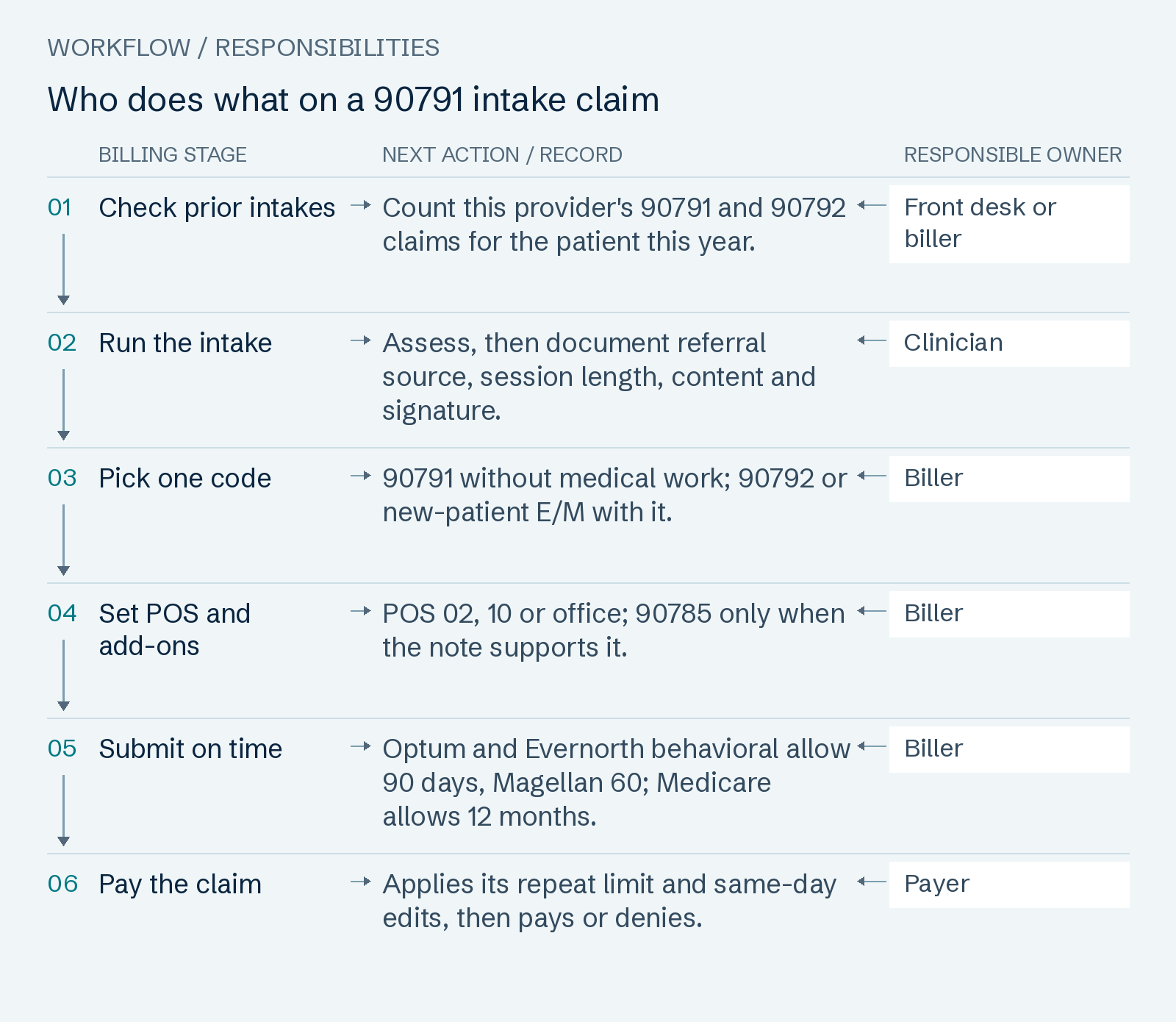
Read the workflow as text
- Check prior intakes — Count this provider's 90791 and 90792 claims for the patient this year. Owner: Front desk or biller.
- Run the intake — Assess, then document referral source, session length, content and signature. Owner: Clinician.
- Pick one code — 90791 without medical work; 90792 or new-patient E/M with it. Owner: Biller.
- Set POS and add-ons — POS 02, 10 or office; 90785 only when the note supports it. Owner: Biller.
- Submit on time — Optum and Evernorth behavioral allow 90 days, Magellan 60; Medicare allows 12 months. Owner: Biller.
- Pay the claim — Applies its repeat limit and same-day edits, then pays or denies. Owner: Payer.
Frequency limits: once per episode, payer by payer
No national rule sets how often 90791 may be billed. NCCI handles same-day bundling only; repeat limits come from the Medicare contractor for your state, the Medicaid program or plan, and each commercial plan. Before you schedule a repeat intake, check how many evaluations this provider has billed for the patient and when the patient was last seen.
WPS: once at onset, then listed repeats
WPS says the evaluation can be conducted once, at the onset of an illness or suspected illness. The same provider may repeat it after an extended break in treatment, which WPS considers to be about 6 months since the patient was last seen or treated for the psychiatric condition. A repeat is also allowed for a psychiatric inpatient admission, a significant change in mental status, an acute or marked mental status change in a patient with an established neurological disorder or dementia, or when a second opinion or diagnostic clarification is needed. WPS adds that an E/M service may be substituted for the initial interview when the E/M elements are met.
Novitas: no more than three a year from one provider
Novitas billing article A57130 says more than three 90791, 90792 or a combination of both should not be reported per year, per beneficiary, by the same provider (Novitas A57130). It also lets a second provider who sees the patient for the first time report its own diagnostic interview. The Novitas LCD names the reasons a repeat is reasonable: a new episode of illness, an inpatient admission or readmission for complications, or a new referral question.
Medicaid and commercial plans
Medicaid managed care plans write their own limits. NH Healthy Families, a New Hampshire Medicaid plan, limits psychiatric evaluation to one session per member per six-month period and denies additional sessions (NH Healthy Families billing tip sheet). Commercial limits sit in each plan's reimbursement policy or your provider contract; we did not find a current commercial policy that publishes one number for every member, so read your contract or ask the plan before booking a repeat.
| Payer and scope | Limit on 90791 and 90792 | Repeat allowed when | Source (retrieved 2026-11-04) |
|---|---|---|---|
| Medicare, WPS J5 (IA, KS, MO, NE) and J8 (IN, MI) | Once, at the onset of an illness or suspected illness | About a 6-month break, psychiatric admission, significant mental status change, second opinion | A57480, revision effective 01/01/2026 |
| Medicare, Novitas JH (AR, CO, LA, MS, NM, OK, TX) and JL (DE, DC, MD, NJ, PA) | No more than three per beneficiary per year, same provider | New episode, admission or readmission, new referral question; a new provider may bill its own | A57130, revision effective 10/01/2026; LCD L35101 |
| Medicaid sample: NH Healthy Families (New Hampshire) | One session per member per six-month period | Additional sessions are denied | NH Healthy Families billing tip sheet (undated) |
| Commercial plans | Set by each plan's policy or your contract | Per the plan policy | Your provider contract or the plan's reimbursement policy |
Same-day rules: no psychotherapy or E/M with 90791
NCCI sets the national same-date edits. Because psychotherapy includes continuing psychiatric evaluation, the 2026 NCCI manual makes 90791 and 90792 not separately reportable with individual, group, family, crisis or other psychotherapy codes on the same date of service. Office E/M codes 99202-99215 are not reported with either evaluation code. So an intake visit bills 90791 alone, and therapy codes such as 90837, the longest psychotherapy time band, start at the next visit.
Testing on the intake date has its own limits. NCCI requires the diagnostic interview and the psychological or neuropsychological testing and evaluation codes (96130-96146) to be distinct services, with no time counted twice, and bars the neurobehavioral status exam codes 96116 and 96121 with 90791 or 90792. The psychological testing codes, 96130 to 96146 and 96110, carry the timing rules for a testing day.
| Code billed with 90791 | Medicare rule | Source and scope |
|---|---|---|
| 90832-90838 psychotherapy | Not separately reportable on the same date | NCCI ch. XI, national |
| 90839, 90840 crisis psychotherapy | Not separately reportable; WPS says crisis codes are reported by themselves | NCCI ch. XI, national; WPS A57480, J5 and J8 |
| 99202-99215 office E/M | Not reported with 90791 or 90792 | NCCI ch. XI, national |
| 90792 | Report one evaluation code, not both | NCCI ch. XI, national |
| 96130-96146 testing | Must be distinct services; no duplicated time | NCCI ch. XI, national |
| 96116, 96121 neurobehavioral status exam | Not reported with 90791 or 90792 | NCCI ch. XI, national |
| 90785 interactive complexity | Allowed when a listed communication factor is documented | WPS A57480, J5 and J8 |
| G0136 activity and nutrition risk assessment | Can be provided with 90791 | MLN1986542, national |
Interactive complexity (90785) with 90791
Interactive complexity, 90785, is an add-on for psychiatric services and can go on the same claim as 90791 when the documentation supports it. NCCI describes interactive services as being for patients who have lost, or have not yet developed, the expressive language to explain their symptoms. WPS allows 90785 with psychiatric procedures when at least one of these factors is present:
- The need to manage maladaptive communication, such as high anxiety, high reactivity, repeated questions or disagreement.
- Caregiver emotions or behavior that interfere with carrying out the treatment plan.
- Evidence or disclosure of a sentinel event and a mandated report to a third party.
- Play equipment, physical devices, an interpreter or a translator used to overcome significant language barriers.
Name the factor and the adaptation in the note: Novitas asks the record to show the adaptations used in the session and the reason for them. WPS bars 90785 with the crisis psychotherapy codes. The add-on's 2026 national Medicare amount (unadjusted) is $14.70 non-facility, so an intake with interactive complexity totals $188.05 nationally before locality and payer adjustments.
Telehealth 90791: POS and modifiers
Medicare covers 90791 by telehealth in 2026. The CMS list of Medicare telehealth services for calendar year 2026 keeps 90791, 90792 and 90785 with the action "Maintain." The MLN mental health booklet says Medicare covers telehealth for behavioral and mental health on a permanent basis, including when the patient is at home, and allows audio-only when a patient cannot use, or does not want, video.
Which place of service to use
The CMS telehealth FAQ (updated October 8, 2026) assigns POS 10 when the patient is at home and POS 02 when the patient is somewhere else, and pays home telehealth at the non-facility rate. A home intake therefore prices at the $173.35 non-facility national amount (unadjusted). For Medicare professional claims, the CMS telehealth booklet (MLN901705) lists the POS codes as the telehealth marker; it ties modifier 95 to physical, occupational and speech therapists employed by hospitals on institutional claims. From January 1, 2027, the telehealth FAQ requires modifier BB when the service runs through a contracted virtual platform and BC when it is furnished incident to another practitioner; neither changes payment. Commercial and Medicaid plans publish their own telehealth modifier rules, so check the plan policy before the first claim.
The in-person visit rule after 2027
The same FAQ cites a statutory in-person visit within 6 months before the first mental health telehealth service, effective after December 31, 2027. CMS reads it as not applying to patients who began home mental health telehealth before January 1, 2028; those patients need at least one in-person visit every 12 months after that date.
90791 reimbursement and documentation checklist
The 2026 national Medicare amount (unadjusted) for 90791 is $173.35 non-facility, such as an office or a home telehealth visit, and $137.28 facility, such as a hospital, from the CMS CY 2026 PFS relative value file. The table sets it beside the codes a practice weighs at intake. Actual payment varies by locality, setting and payer.
Intake documentation checklist that survives audits
Novitas lists the elements every diagnostic evaluation record must hold, in legible form. Work each intake claim in this order:
- Check prior evaluations. Count every 90791 or 90792 this provider billed for the patient in the past year, and the last visit date. In Novitas states a fourth in a year should not be reported; in WPS states a repeat needs a listed reason.
- Pick the code by who did the work. Medical assessment documented by a prescriber: 90792 or a new-patient E/M. Everyone else: 90791.
- Record the Novitas elements. Date, referral source, length of session, content of session, therapeutic techniques and approaches including medications, the patient's ability to follow the treatment plan, and the legible signature of the person who performed it.
- Record the diagnosis and the reason for the assessment. The LCD asks that medical necessity be supported in the record.
- Add 90785 only when the documentation supports it. Name the communication factor and the adaptation.
- Keep therapy off the intake date and set POS 02, POS 10 or the in-person location.
- Submit inside the filing limit. Medicare allows 12 months from the date of service; Optum Behavioral Health and Evernorth Behavioral Health allow 90 days, and Magellan Healthcare 60 days under most provider contracts, from our timely filing dataset, each limit taken from the payer's own manual.
When intake claims keep coming back
Repeat-intake and same-day denials start at scheduling and in the claim template, before anyone codes the visit. Our mental health billing services check each evaluation against the payer's frequency limits before the claim goes out, bill each intake under the rendering clinician's own enrollment, submit new claims once charge data is complete, and work inherited claims nearest their filing deadline first. If intake claims are already aging, The Free A/R Deadline Map lists every unpaid claim over 90 days by the deadline it faces. Clock starts with your claim-level aging export and signed BAA; above 10 requests in a week, we confirm your date within 1 business day.
| Code | Use it when | 2026 national Medicare amount (unadjusted), non-facility | Facility |
|---|---|---|---|
| 90791 | Intake evaluation without medical work | $173.35 | $137.28 |
| 90792 | A prescriber adds documented medical assessment | $202.08 | $159.32 |
| 99204 | A prescriber chooses a new-patient visit, moderate complexity | $177.36 | $116.90 |
| 99205 | Same choice, high complexity | $236.81 | $160.32 |
| 90785 | A listed communication factor complicates the intake | $14.70 | $11.69 |
| 90837 | Therapy starts at a later visit, longest time band | $167.00 | $135.27 |
| 96130 | Testing evaluation follows the interview, first hour | $123.92 | $99.53 |
Common questions
- What is CPT code 90791?
- 90791 is the psychiatric diagnostic evaluation without medical services: the intake assessment a psychologist, social worker, counselor or marriage and family therapist bills before treatment starts. It is not a timed code. Its 2026 national Medicare amount (unadjusted) is $173.35 non-facility and $137.28 facility.
- What is the difference between 90791 and 90792?
- The 2026 NCCI manual defines 90791 as the evaluation without medical E&M and 90792 as the evaluation with it. Clinicians licensed for medical services who do and document that work bill 90792; psychologists, social workers, counselors and MFTs bill 90791. In 2026, 90792 is $202.08 non-facility against $173.35 for 90791.
- How often can 90791 be billed?
- It depends on the payer. WPS (Iowa, Kansas, Missouri, Nebraska, Indiana, Michigan) allows one at onset plus repeats after about a 6-month break, an admission, a significant change or a second opinion. Novitas (Jurisdictions H and L) allows no more than three per patient per year from the same provider. Medicaid and commercial plans set their own limits; NH Healthy Families, for example, allows one per six months.
- Can 90791 be billed with 90837 on the same day?
- No. The 2026 NCCI manual makes 90791 and 90792 not separately reportable with psychotherapy codes on the same date of service, because psychotherapy includes continuing evaluation. Bill the intake alone and start 90837 or another psychotherapy code at the next visit.
- Can an LCSW bill 90792?
- No. 90792 includes medical evaluation and management work, which falls outside a clinical social worker's licence. An LCSW reports 90791 for the intake. Medicare pays CSWs at 75% of the clinical psychologist amount, per the MLN mental health booklet.
- Can 90791 be billed through telehealth?
- Yes, for Medicare in 2026: the CY 2026 telehealth list keeps 90791 with the action "Maintain." Use POS 10 when the patient is at home and POS 02 elsewhere; CMS pays home telehealth at the non-facility rate. Commercial and Medicaid plans publish their own telehealth rules.
Sources and review
Page revised November 4, 2026 · Review contact: Hyder Shah (inquiries@claimpillar.com). Every source below was retrieved and checked on November 4, 2026. Medicare amounts come from our 2026 PFS dataset (CMS RVU26D); filing limits come from our timely filing dataset, built from payer manuals retrieved October 2, 2026.
- CMS NCCI Policy Manual for Medicare Services 2026, Chapter XI (retrieved 2026-11-04)
- CMS MCD: LCD Psychiatric Codes (L35101, Novitas JH/JL) (retrieved 2026-11-04)
- CMS MCD: Billing and Coding: Psychiatric Codes (A57130, Novitas JH/JL) (retrieved 2026-11-04)
- CMS MCD: Billing and Coding: Psychiatry and Psychology Services (A57480, WPS J5/J8) (retrieved 2026-11-04)
- CMS MLN1986542: Medicare & Mental Health Coverage, March 2026 (retrieved 2026-11-04)
- CMS: List of Telehealth Services, CY 2026 (retrieved 2026-11-04)
- CMS: Telehealth FAQ, updated October 8, 2026 (retrieved 2026-11-04)
- CMS MLN901705: Telehealth & Remote Patient Monitoring, December 2025 (retrieved 2026-11-04)
- NH Healthy Families: Psychological Testing and Psychiatric Evaluation Billing Tip Sheet (retrieved 2026-11-04)
- CMS: PFS Relative Value Files, CY 2026 RVU26D