The short answer: time thresholds
Both codes describe one individual psychotherapy session with the patient, billed without an E/M service. The only thing that separates them is time. Palmetto GBA's psychotherapy guidance (published February 23, 2026) attributes the ranges to CPT: 16 to 37 minutes for 90832, 38 to 52 minutes for 90834, and 53 minutes or longer for 90837. The same page tells providers to select the code that most closely matches the actual time spent performing psychotherapy, and not to bill a psychotherapy code for a session under 16 minutes.
Time decision chart
Read the minutes from the note, then follow the row. Only psychotherapy minutes count: Palmetto says time spent on an E/M service is separate from psychotherapy time, and that the patient must be present for all or some of the service, with informants such as a parent allowed to take part.
Why people call 90837 the 60-minute code
The labels "45-minute code" and "60-minute code" are shorthand, and they mislead. Optum Provider Express still lists 90834 as 45 minutes and 90837 as 60+ minutes in its October 2025 record-review article, and the CMS telehealth list uses similar short labels. A clinician who reads "60 minutes" literally undercodes a 55-minute session; one who reads "50-minute hour" as 90837 overcodes it. The billable threshold is the range, so train your staff on 38 and 53, not 45 and 60.
| Psychotherapy minutes in the note | No E/M visit that day | With an E/M visit by the same clinician |
|---|---|---|
| Under 16 | No psychotherapy code | No psychotherapy add-on |
| 16 to 37 | 90832 | E/M code + 90833 |
| 38 to 52 (includes a 45- or 50-minute session) | 90834 | E/M code + 90836 |
| 53 or more (includes a 55- or 60-minute session) | 90837 | E/M code + 90838 |
Side-by-side comparison: time, rate, audit risk
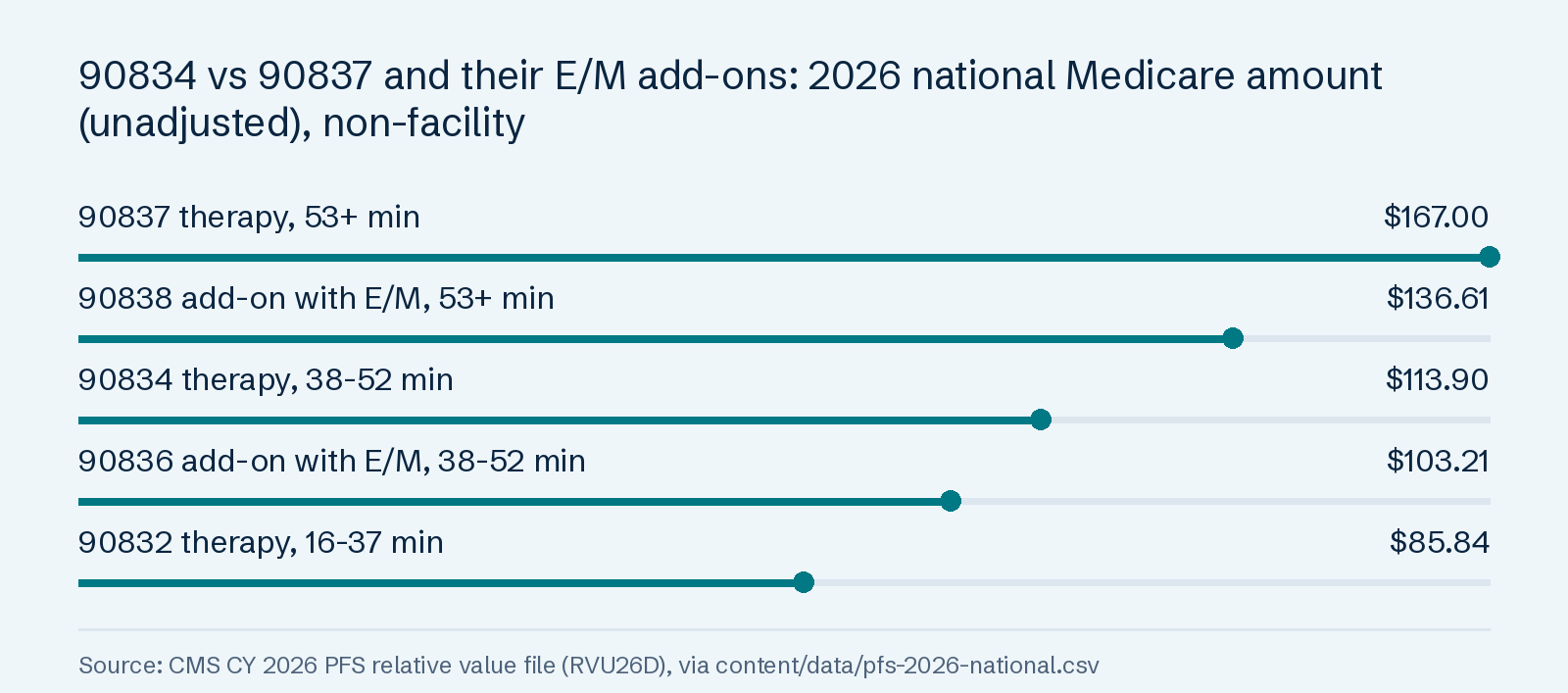
The table puts the two codes next to each other on the points that change a claim. Medicare amounts are 2026 national Medicare amounts (unadjusted) from our dataset built on the CMS CY 2026 PFS relative value file (RVU26D); actual payment varies by locality, setting and payer.
Everything else about the two codes is shared. Both are on the CMS list of Medicare telehealth services for calendar year 2026 with status "Maintain". Both sit in the group of time-based codes billed without E/M that the CMS NCCI policy manual, chapter XI (revised January 1, 2026) names: 90832, 90834 and 90837. Both may be billed by any eligible license, and the license changes what Medicare pays, not which code applies. The full code family, from intake to group therapy, is on our page of cpt codes for mental health, and the single-code detail lives in the 90837 cpt code guide.
| Point of comparison | 90834 | 90837 |
|---|---|---|
| Psychotherapy minutes | 38 to 52 | 53 or more |
| Common session it fits | 45- and 50-minute sessions | 55- and 60-minute sessions |
| Same-day E/M version | E/M code + 90836 | E/M code + 90838 |
| 2026 national Medicare, non-facility | $113.90 | $167.00 |
| 2026 national Medicare, facility | $91.85 | $135.27 |
| Medicare telehealth list, CY 2026 | Yes | Yes |
| Audit exposure | Lower: the mid-length code | Higher: the top of the range, and every claim rests on documented minutes |
Reimbursement gap between 90834 and 90837 by payer type
For Medicare, the 2026 national amount (unadjusted) is $167.00 for 90837 and $113.90 for 90834 in a non-facility setting, a gap of $53.10 per session. In a facility setting the amounts are $135.27 and $91.85, a gap of $43.42. Since January 1, 2024, Medicare has paid telehealth to a patient at home at the non-facility rate, according to the CMS telehealth FAQ (updated October 8, 2026), so a home video session carries the $53.10 gap too.
The gap by license under Medicare
Medicare pays each license a share of the fee-schedule amount. The CMS booklet Medicare & Mental Health Coverage (MLN1986542) says clinical social workers, marriage and family therapists and mental health counselors are paid 75% of the clinical psychologist's PFS amount, and nurse practitioners 85% of the physician amount.
Rate gap example (illustrative calculation, not client data):
- Psychologist or psychiatrist: $167.00 minus $113.90 = $53.10 per session.
- Psychiatric nurse practitioner: 85% of $53.10 = about $45.14 per session.
- LCSW, LMFT, LPC or LMHC: 75% of $53.10 = about $39.83 per session.
These are national figures before the locality adjustment and before the patient's deductible and coinsurance.
Medicaid and commercial plans
Medicaid programs and commercial plans set their own fee schedules and contracted rates for both codes, and the gap differs by state, plan, network and license. We do not print a commercial gap, because no sourced range covers every market. Your own remittances show the real figure: compare the allowed amount on a paid 90834 line with a paid 90837 line from the same plan.
| Payer type | Who sets the 90834 and 90837 amounts | Where to find the gap |
|---|---|---|
| Medicare Part B | CMS Physician Fee Schedule, adjusted by locality; license share per MLN1986542 | PFS amounts: $53.10 national non-facility gap before license share |
| Medicaid (fee-for-service) | Each state's Medicaid fee schedule | The state's published fee schedule |
| Medicaid managed care | Each plan's contract with the practice | The plan contract and paid claims |
| Commercial plans | Each plan's contracted rate, by network and license | The fee schedule attached to your contract, or remittances |
Why payers flag high 90837 use
90837 is the higher-paying code, and its only qualifying fact is a number of minutes. That combination makes it easy to review by data: a clinician whose claims are mostly 90837 stands out against peers, and a reviewer can check each note for the time in seconds.
What a Medicare audit found
HHS-OIG audit A-09-21-03021 reviewed psychotherapy paid by Medicare Part B from March 2020 to February 2021, about $1 billion. For 128 of 216 sampled enrollee days, providers did not meet Medicare requirements, for example because psychotherapy time was not documented. OIG estimated $580 million in improper payments and recommended that CMS implement system edits for psychotherapy services and strengthen provider education.
How insurers limit 90837
Limits come in three forms. First, record reviews: Optum tells clinicians sending records to check signature, credentials and start and stop times, and to confirm the session time matches the code. Second, authorization caps in some Medicaid programs. As an example of one state's rule, West Virginia Medicaid's utilization guidelines for psychological services (KEPRO version 3.2, March 2019) give 10 initial units of 90837 per member per year, each unit 53 or more minutes, with more units only on a medical necessity submission. Other states set their own limits, so check the current version of your state's guidelines. Third, plan-specific policy: each commercial plan can write its own rule, so read the plan's policy before assuming Medicare's rule applies. Check the current version of any state guideline before relying on it.
Documentation that supports 90837
A 90837 claim survives review when the note proves the time and the therapy. Each item below traces to a source on this page: Palmetto, NCCI, Optum, the CMS telehealth rules or the HHS-OIG findings:
- Start and stop times, or a total of psychotherapy minutes, that reach 53.
- Psychotherapy time recorded apart from E/M time; Palmetto asks for the psychotherapy time on its own, not one combined period.
- Who was present: the patient for all or part of the session, plus any informant.
- The therapy delivered and how it relates to the treatment plan, since codes 90832 to 90838 include ongoing assessment and adjustment of the interventions.
- Signature and credentials of the treating clinician.
- Delivery method for telehealth, matching the place of service and any modifier.
Fix the template, not the claim
Most 90837 problems start before billing. A note template with required start and stop fields, a scheduling slot of at least 55 minutes for planned long sessions, and a pre-billing check that compares the minutes with the code catch more errors than appeals do. When a payer denies or downcodes 90837, our denial management guide covers how to sort the reasons and decide which claims to appeal.
Telehealth and add-on considerations
Telehealth does not change the time line between the codes. For Medicare, the CMS telehealth FAQ says to use POS 02 when the patient is not at home and POS 10 when the patient is at home. For an audio-only session with a patient at home who cannot use, or does not consent to, video, 42 CFR 410.78 requires CPT modifier 93, plus modifier FQ for rural health clinics and federally qualified health centers. Commercial plans write their own place-of-service and modifier rules; what your practice can bill by telehealth through 2027 compares them.
Same-day code pairs
These pairings apply the same way to 90834 and 90837, per the NCCI manual, chapter XI:
- Intake (90791 or 90792): not separately reportable with individual psychotherapy on the same date.
- Family therapy (90846 or 90847): reportable with 90834 or 90837 on the same date only as a separate and distinct service in a separate time interval; family members who join as informants are already included.
- E/M visit: swap to the add-on code, 90836 or 90838, reported with the E/M code.
- Interactive complexity (90785): NCCI reports interactive complexity with this add-on, for patients who have lost, or have not yet developed, the expressive language to explain their symptoms; bill it with either code only when the note names the factor.
Crisis psychotherapy is a different service. West Virginia's Medicaid guidelines, for example, say crisis codes 90839 and 90840 cannot be reported in addition to 90832, 90834 or 90837.
What to do when a session runs 50-52 minutes
Bill 90834. Fifty, 51 and 52 minutes all sit inside the 38 to 52 range, and Palmetto tells providers to pick the code that most closely matches the actual psychotherapy time. Rounding 52 up to 53 to reach 90837 is billing time that did not happen.
When the session really ran 53 minutes or more
Bill 90837 and make sure the note shows it. Write the start and stop times, keep any E/M or administrative minutes out of the count, and confirm the patient was present. Minutes spent writing the note after the patient leaves are not face-to-face psychotherapy time.
When sessions cluster at the line
If a clinician's notes keep landing at 52 or 53 minutes, look at the schedule. A 50-minute slot produces 90834 claims; a slot that reliably delivers 53 or more produces 90837 claims. Decide which service the clinic offers and book for it, rather than letting the code drift session by session. Undercoding has a cost too: a 56-minute session billed as 90834 gives up the gap shown above.
If therapy claims keep coming back short-paid, downcoded or with record requests, the pattern sits in the template or the schedule. Our mental health billing services code each session from the minutes in the note and query the clinician when the time is missing, before the claim goes out. To see which unpaid therapy claims are closest to their filing deadline, get my free A/R Deadline Map: The Free A/R Deadline Map (Clock starts with your claim-level aging export and signed BAA; above 10 requests in a week, we confirm your date within 1 business day.).
Common questions
- What is the difference between 90834 and 90837?
- Psychotherapy minutes. 90834 covers 38 to 52 minutes and 90837 covers 53 minutes or more, both without an E/M visit that day (Palmetto GBA). Everything else, including telehealth eligibility and who may bill, is the same.
- Is 90837 paid more than 90834?
- Yes. The 2026 national Medicare amount (unadjusted) is $167.00 for 90837 and $113.90 for 90834 non-facility, a $53.10 gap; actual payment varies by locality, setting and payer. Commercial and Medicaid plans set their own rates, so check your contracts and remittances.
- Can I bill 90837 for a 50-minute session?
- No. A 50-minute session falls inside the 38 to 52 minute range for 90834. 90837 starts at 53 minutes of psychotherapy, and the note should show the start and stop times that reach it.
- Do insurers limit 90837?
- Some do. Medicare pays 90837 when the time and documentation support it, and HHS-OIG has audited psychotherapy claims for missing time. Some Medicaid programs cap authorized units. As one state's example, West Virginia's 2019 guidelines start at 10 units of 90837 per member per year. Commercial plans review records and write their own policies.
- How much does Medicare pay for 90837 compared with 90834?
- In 2026, $167.00 versus $113.90 national non-facility, and $135.27 versus $91.85 facility (unadjusted). LCSWs, LMFTs and mental health counselors receive 75% of the clinical psychologist amount, per CMS MLN1986542.
- Can 90791 and 90837 be billed on the same day?
- Not for Medicare. The NCCI manual says 90791 and 90792 are not separately reportable with individual psychotherapy on the same date, because psychotherapy includes continuing psychiatric evaluation. The same applies to 90834.
- How do I bill 90837 or 90834 by telehealth?
- For Medicare, use the same code and time rule, with POS 10 for a patient at home or POS 02 elsewhere, and modifier 93 for an audio-only session with a patient at home. Commercial plans set their own place-of-service and modifier rules.
Sources and review
Page revised November 4, 2026 · Review contact: Hyder Shah (inquiries@claimpillar.com). Every source below was retrieved and checked on November 4, 2026. Medicare amounts are 2026 national Medicare amounts (unadjusted) from our dataset built on the CMS CY 2026 PFS relative value file (RVU26D); actual payment varies by locality, setting and payer. Payer rules apply only to the payer and program named.
- Palmetto GBA JM Part B: Psychotherapy Services (published 02/23/2026)
- CMS NCCI Policy Manual for Medicare Services, Chapter XI (revised 1/1/2026)
- CMS: PFS Relative Value Files (CY 2026, RVU26D)
- CMS MLN1986542: Medicare & Mental Health Coverage
- CMS: List of Medicare Telehealth Services, CY 2026
- CMS Telehealth FAQ (updated 10/8/2026)
- eCFR: 42 CFR 410.78, Telehealth services
- HHS-OIG A-09-21-03021: Medicare improperly paid providers for some psychotherapy services
- Optum Provider Express: top 3 errors in psychotherapy and E/M records (October 2025)
- KEPRO Utilization Management Guidelines for West Virginia Medicaid, Psychological Services (v3.2, March 2019)