What is denial management in healthcare?
Denial management is the work your practice, or whoever bills for it, does after a payer refuses to pay a claim as billed: find out why, decide whether to correct, appeal or write off the claim, act before that payer's deadline, and change the step that caused the denial so the next claim goes through. It sits inside revenue cycle management services, the larger job of turning each visit into collected cash, and it is the part that decides whether money your clinicians already earned is ever paid.
Deadlines make it urgent. Medicare gives a party 120 days from receipt of the remittance advice or summary notice to request a redetermination, and it presumes receipt 5 days after the notice date (CMS Claims Processing Manual, chapter 29, §310.2). A Medicare claim received more than 12 months after the date of service is denied as untimely, and that denial is not subject to appeal at all (chapter 1, §70.4). Commercial and behavioral health payers set their own clocks; the deadline table below lists four of them alongside Medicare's.
Rejection, denial or underpayment: which one does your practice have?
Three different problems look alike on an aging report, and each has its own fix:
- Rejection: the claim failed front-end or clearinghouse edits and never entered adjudication. Fix the data and resubmit; there is nothing to appeal.
- Denial: the payer adjudicated the claim and will not pay it as billed. You correct it, ask for a reopening or reconsideration, or appeal.
- Underpayment: the payer paid, but less than your contract allows. That is a payment dispute, covered in the last section of this guide.
Who owns denial work in an independent practice?
In a small practice, denial work lands on whoever posts payments unless someone is named to own it. A denial nobody opens still runs down its appeal clock. The rest of this guide sets out a process one person can run, or check, if you hand the work to a billing team.
The denial management process in RCM: 6 steps
The denial management process has six steps, and the order matters: the deadline is set before the fix is chosen, so no claim waits on research it cannot afford.
- Capture every denial the day it posts. Each denied line from the electronic remittance (the 835) or the paper EOB goes into one denial log, with the payer's reason and remark codes, the amount paid (often $0) and the date the remittance arrived. Partial denials count: one denied line on an otherwise paid claim is still a denial.
- Set the deadline. Write that payer's corrected-claim and appeal deadlines next to the claim before anyone works it. Medicare counts its 120 days from receipt of the notice, presumed 5 days after its date, and a Medicare Advantage plan's 60-day reconsideration window uses the same 5-day presumption (42 CFR 422.582).
- Find the cause. Read the reason codes against the claim, the clinical note, the authorization and the eligibility response. Put the cause in one bucket: registration and eligibility, authorization, coding or documentation, clinician enrollment, timely filing, or payer error.
- Choose the route. A data mistake goes back as a corrected claim, or in Medicare as a reopening. A disagreement about coverage, medical necessity or the payer's own error goes to reconsideration or appeal. A balance moves to the patient only with the PR group code, a valid ABN or the payer's rule that allows it.
- Act and follow up. Send the correction or appeal with its supporting records, log the date and the method, and set a follow-up date inside the payer's decision window. A Medicare Administrative Contractor must complete and mail its redetermination within 60 days of receiving the request (chapter 29, §310.4).
- Fix the root cause. Send the cause to the person who controls it: the front desk for eligibility, scheduling for authorizations, the clinician for documentation, credentialing for enrollment. Then check next month's log for the same cause.
Steps 1, 2 and 6 are what separate denial management from simply resubmitting claims. If you hand denial work to a billing team, ask about those three first: where every denial is logged, how each deadline is set, and who hears about the cause.
If a denial goes past the first appeal, Medicare Part A and B claims have five levels: redetermination by the Medicare Administrative Contractor, reconsideration by a Qualified Independent Contractor, a hearing at the Office of Medicare Hearings and Appeals, review by the Medicare Appeals Council, and judicial review in federal district court (CMS: Medicare fee-for-service appeals). To continue past reconsideration, to a hearing and later to federal court, the amount still in dispute must meet a threshold that is recalculated every year (chapter 29, §250).
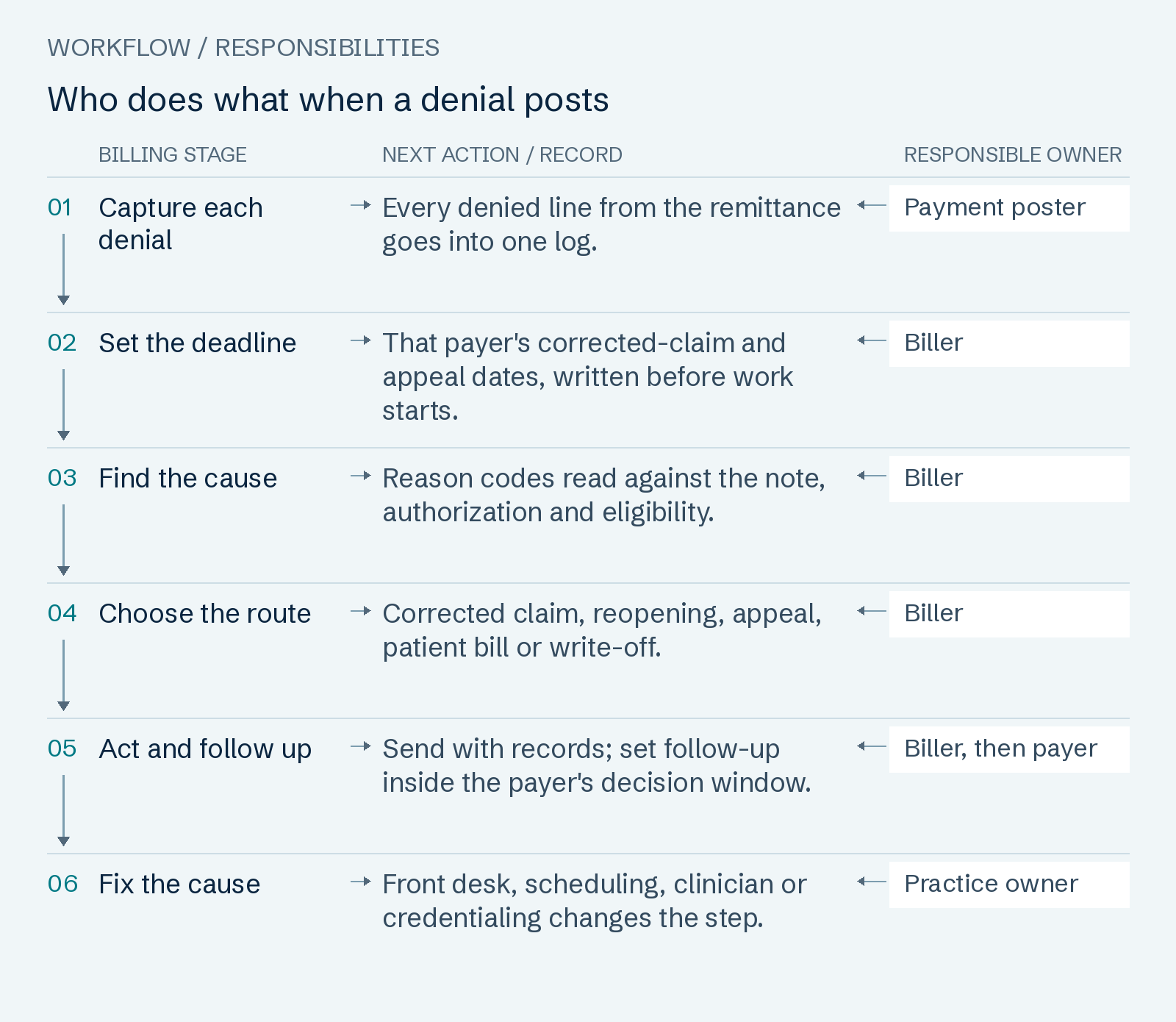
Read the workflow as text
- Capture each denial — Every denied line from the remittance goes into one log. Owner: Payment poster.
- Set the deadline — That payer's corrected-claim and appeal dates, written before work starts. Owner: Biller.
- Find the cause — Reason codes read against the note, authorization and eligibility. Owner: Biller.
- Choose the route — Corrected claim, reopening, appeal, patient bill or write-off. Owner: Biller.
- Act and follow up — Send with records; set follow-up inside the payer's decision window. Owner: Biller, then payer.
- Fix the cause — Front desk, scheduling, clinician or credentialing changes the step. Owner: Practice owner.
Appeal and corrected-claim deadlines by payer
Appeal deadlines differ by payer, by product and sometimes by your contract, so the dates in your denial log should come from each payer's own manual, not from a rule of thumb. The table shows the published windows for Original Medicare, Medicare Advantage and four commercial and behavioral health payers, each as the payer or CMS states it, retrieved November 4, 2026. Where your provider agreement or state law sets a different deadline, that deadline applies.
Two Medicare rules that decide what you can still recover
First, a claim Medicare denies for late filing has no appeal, and if your practice was responsible for the late filing, you may not charge the beneficiary except the deductible and coinsurance that would have applied had Medicare paid (CMS Claims Processing Manual, chapter 1, §70.4). Second, clerical errors are handled as reopenings, not appeals. CMS lists transposed procedure or diagnosis codes, inaccurate data entry, a wrong modifier or date of service, and claims wrongly denied as duplicates among them, and a party may ask for a reopening within 1 year of the initial determination for any reason (chapter 34, §10.4 and §10.6.2). Resubmit with a different date of service only when the medical record shows the correct date.
Keep one deadline list for every payer you bill
The first-claim filing limits behind these appeal windows are in our guide to preventing timely filing denials, and the underlying payer rows, with their sources, download as a timely filing dataset (CSV). Copy the rows for your own payers into your denial log so every deadline in step 2 has a source you can show.
| Payer and product | Corrected claim or reopening | First appeal step | Next step | Where the payer states it |
|---|---|---|---|---|
| Original Medicare (Parts A and B) | Clerical errors go through a reopening, which a party may request within 1 year of the initial determination for any reason | Redetermination: within 120 days of receiving the remittance or notice (receipt presumed 5 days after its date) | Reconsideration by a Qualified Independent Contractor, then a hearing, the Medicare Appeals Council and federal court | CMS Claims Processing Manual, chapters 29 and 34 |
| Medicare Advantage plans (federal rule) | Set by the plan's provider manual and your contract | Reconsideration: within 60 calendar days after receipt of the plan's written determination (receipt presumed 5 days after its date) | The 60-day rule covers a party to the plan's organization determination; a network provider's agreement and the plan's manual can set a different process (Optum's gives network providers 12 months for Medicare Advantage claim decisions) | 42 CFR 422.582 |
| UnitedHealthcare (commercial) | Within your contracted or regulated timely filing limit; a corrected claim is not the way to dispute a payment | Reconsideration: within 12 months of the original claim's EOB or PRA, or as law or your agreement requires | Appeal, inside the same 12 months | 2026 UnitedHealthcare Care Provider Administrative Guide, chapter 10 |
| Optum Behavioral Health (not Medicaid plans) | Corrections or additions within 90 days of Optum's initial receipt of the claim | Reconsideration (step 1) | Appeal (step 2); the two steps together must be submitted within 12 months unless state law or your agreement sets another deadline | Optum Behavioral Health National Provider Network Manual, July 2026 |
| Cigna Healthcare (commercial) | Not set on Cigna's appeals page; follow your agreement | Appeal within 180 calendar days of the initial payment or denial notice, or of the last payment adjustment | Further review as your agreement and the appeals page describe | Cigna Healthcare: appeals and disputes |
| Evernorth Behavioral Health (Cigna) | A timely claim returned at the plan's request for more information: the 90-day filing limit restarts from the date of that request | Appeal in writing within 180 calendar days of the initial payment or denial decision | As your agreement describes | Evernorth Behavioral Health provider administrative guide |
Top denials in therapy, ABA and behavioral health practices
These are the denials that payers' own published rules set up for therapy, ABA and behavioral health claims. They are grouped by practice type, not ranked by how often they happen: none of the payer sources below publishes a frequency count. To reduce claim denials in a therapy practice, check three things before the visit: the authorization, the clinician's enrollment with that payer, and, for Medicare therapy patients, the running total against the KX threshold.
Physical, occupational and speech therapy
For 2026, Medicare's KX threshold is $2,480 for physical therapy and speech-language pathology combined and $2,480 for occupational therapy; claims above it without the KX modifier are denied, and the modifier confirms that the medical record documents medical necessity (CMS: Therapy Services). Add KX only when the documentation supports it. Practices that bill PT, OT and speech can see how our physical therapy billing service tracks that total.
ABA agencies
Optum states that coverage for ABA services usually requires prior authorization, that not all benefit plans cover ABA, and that an authorization is not a guarantee of payment (Optum National Provider Network Manual). Its manual also allows a payment reduction of up to 100% when a network provider fails to obtain a required prior authorization. For an ABA agency, that makes the authorization log as important as the denial log. See how ABA therapy billing handles authorization units and end dates.
Mental and behavioral health practices
Marriage and family therapists and mental health counselors can bill Medicare independently from January 1, 2024, and must enroll in Medicare, with an NPI and a PECOS or CMS-855 application, to be paid (CMS: MFTs and MHCs). Optum and Evernorth both set 90 days from the date of service as their standard filing limit. If your denials cluster on 60-minute psychotherapy claims, check what your notes record against the 90837 CPT code requirements. Our mental health billing service works these claims for therapy groups and solo clinicians.
| Practice type | Denial | What the payer's published rule says | Fix before the next claim |
|---|---|---|---|
| PT, OT and speech (Medicare) | Claim over the KX threshold without the KX modifier | 2026 threshold: $2,480 for PT and speech combined, $2,480 for OT; claims over it without KX are denied | Track each patient's year-to-date therapy amount; add KX only when the documentation supports medical necessity |
| ABA (Optum plans) | No prior authorization | ABA usually requires prior authorization; payment can be reduced up to 100% when a required authorization was not obtained | Request authorization before the first session and log its units and end date |
| ABA (Optum plans) | No ABA benefit on the member's plan | Not all benefit plans provide coverage for ABA services | Verify the ABA benefit itself, not only active coverage, before intake |
| ABA (Optum plans) | Session by a technician without the required certification | Paraprofessionals must be a Registered Behavior Technician, a Board-Certified Autism Technician or a certified ABA technician | Keep each technician's certification on file and current before scheduling them |
| ABA and behavioral health (Optum) | Authorized, then denied anyway | Authorizations are not a guarantee of payment; codes in an authorized range stay subject to medical necessity review | Write each session note to support the code billed, to the payer's documentation protocol |
| Behavioral health (Medicare) | Counselor or marriage and family therapist not enrolled | MFTs and MHCs bill Medicare from January 1, 2024, and must enroll to be paid | Enroll each clinician before scheduling Medicare patients with them |
| Behavioral health (Optum, Evernorth) | Claim filed late | Standard filing limit of 90 days from the date of service, unless state law, your agreement or the plan allows longer | Submit within days of the session, not at month-end |
Working denials within 2 business days: why speed matters
Every deadline in the table runs from a payer's date, not from the day someone in your office opens the denial. Some clocks start before the denial even arrives: Optum's 90-day window for corrections runs from its initial receipt of the claim, so part of it is gone by the time the remittance posts. A denial that waits for a month-end catch-up session can lose a third of its correction window.
What the clock looks like on one claim
Illustrative example, not client data. Optum receives a claim on March 1, and its denial posts on April 10. The 90-day correction window that started March 1 ends on May 30, so 50 days remain when the denial posts. Every week it sits unopened takes 7 of those 50 days, and any records you need from a clinician come out of the same time.
Medicare's 120 days look longer, but a redetermination is only the first of five levels, and the contractor then has up to 60 days to decide. The federal Medicare Advantage reconsideration window is 60 calendar days. Working each denial within 2 business days leaves room to pull records, ask the clinician a question and still file early.
How fast our team works a denial
On Full-Service Billing, we work every denial within 2 business days of the remittance posting it: resubmitted, appealed or returned to you with the fix. From go-live, every new claim goes out within 1 business day of complete charge data, and every denial is worked within 2 business days of posting — or $25 comes off your invoice for each late one. Mon–Fri ET business days by your system's timestamps; worked: resubmitted, appealed or returned with the fix; auto-credited; capped at monthly fee; clearinghouse outages excluded. The credit applies on the terms above. Our denial management services page sets out what that work covers and what stays with your practice.
Tracking denials: a simple log and the 3 metrics that matter
A denial log is one row per denied claim line, kept in a spreadsheet or your practice-management system's worklist. Use the free denial log template in the table: copy its columns into a new sheet and you have the tool that steps 1, 2 and 6 of the process depend on. Every column earns its place by feeding a deadline, a decision or one of the three metrics below.
Metric 1: denial rate by payer
Divide the claims a payer denied by the claims it adjudicated in the same month, and run it for each payer separately. Count each claim once, even when several lines were denied. A practice-wide rate hides the one payer whose rule your front desk keeps missing.
Metric 2: business days from posting to first action
Count the business days between the date a denial posted and the date of its first action in the log, and note the oldest denial with no action. This is the metric that tells you whether denials wait, and waiting is what turns a correctable denial into a write-off.
Metric 3: dollars recovered from worked denials
Add up what payers paid after a correction, reopening or appeal, and divide it by the denied dollars you worked that month. Split it by cause bucket. A cause with high denied dollars and low recovery belongs to step 6: it has to be prevented, because working it after the fact does not pay. We do not publish a benchmark for these three numbers; the useful comparison is your own last three months. For the wider set, see the revenue cycle KPIs your billing report should show.
| Log column | What to enter | Why it matters |
|---|---|---|
| Date posted | The date the remittance with the denial arrived | Starts your internal 2-business-day clock |
| Patient, account and payer claim number | Your account number and the payer's claim number from the remittance | Lets anyone find the claim and quote it to the payer |
| Payer and product | For example Optum commercial, or the Medicare Advantage plan's name | Picks the right row of the deadline table |
| Date of service and rendering clinician | As billed on the claim | Shows enrollment and filing-limit causes clinician by clinician |
| Billed and paid amount | Per denied line | Sizes the recovery and the write-off decision |
| Reason and remark codes | Exactly as printed on the remittance | The payer's stated reason, to read against the record |
| Cause bucket | Eligibility, authorization, coding or documentation, enrollment, timely filing, or payer error | Feeds the root-cause count in step 6 |
| Corrected-claim deadline and appeal deadline | Dates taken from the payer's manual or your agreement | The hard stop for this claim |
| Action and date | Corrected claim, reopening, reconsideration, appeal, patient bill or write-off | Proves when and how you acted |
| Follow-up date and outcome | Paid, partly paid, upheld or still open | Feeds the recovery metric |
| Owner of the fix | Front desk, scheduling, clinician or credentialing | Closes the loop so the cause stops |
When to write off and when to fight
Not every denial is worth an appeal, and some cannot be appealed at all. The decision turns on three questions: is the claim still inside a deadline, is the error yours or the payer's, and does the record support the service as billed? The table sets out the usual call for each situation; your contract and the payer's manual can change it.
Write a write-off policy before you need one
Decide in writing who may approve a denial write-off, up to what amount, and which cause bucket each write-off is recorded under. Keep denial write-offs separate from contractual adjustments, so a report never mixes money the payer was never going to pay with money your practice lost. A write-off recorded with its cause is a step 6 lesson; a write-off recorded as an adjustment disappears.
For Medicare appeals beyond the reconsideration level, the amount in dispute must also meet that year's threshold (chapter 29, §250). Old denials that are still inside a deadline are a different job from new ones: what your practice can still collect on A/R over 90 days sorts them by what is recoverable.
| Situation | Usual decision | Why |
|---|---|---|
| Medicare claim received more than 12 months after the date of service | Write it off; charge the patient only the deductible and coinsurance Medicare would have applied | The late-filing denial is not appealable, and the provider responsible may not charge the beneficiary more |
| The appeal deadline has passed | Write it off unless the payer accepts good cause | Medicare may extend the filing period for good cause shown in writing; other payers by contract |
| Your data was wrong: a transposed code, a wrong modifier, the wrong date of service | Correct it; do not appeal | Medicare handles clerical errors as reopenings; commercial payers take corrected claims inside their limits |
| Medical necessity or coverage denial, and the note supports the service | Appeal with the records | The payer's judgment is what is in dispute, and the record is your evidence |
| No authorization was obtained | Ask the payer whether it reviews late requests; if not, write it off and fix scheduling | The cause sits upstream, and it will repeat on every visit until scheduling changes |
| The balance is the patient's: deductible, coinsurance or a non-covered service | Bill the patient | Only with the PR group code, a valid ABN or the payer's rule that allows it |
Denial management in medical billing vs underpayment recovery
A denial announces itself: the payer refuses the claim and prints a reason. An underpayment does not. The claim pays, nothing appears in the denial log, and the only way to find it is to compare each payment against your contracted rate for that code with that payer. Denial management works the first; underpayment recovery needs your fee schedules and a separate review.
The routes differ too. UnitedHealthcare's administrative guide says a corrected claim should not be used to request a reconsideration of claim payment, and it allows 12 months from the original claim's EOB or PRA for reconsideration and appeal (2026 UnitedHealthcare Care Provider Administrative Guide). Cigna counts its 180 calendar days from the last payment adjustment when an appeal concerns an adjusted payment (Cigna Healthcare: appeals and disputes).
On Full-Service Billing, our 60-Day Underpayment Check covers this: In month 3 we compare every payment from your first 60 days against your contracted rates and appeal each underpaid line. Needs your fee schedules. (Sold separately at $495.)
When should your practice hand off denial work?
Hand it off when denials sit unopened past their first week, when nobody can tell you each open denial's deadline, or when the same cause shows up month after month. Denial work and appeals are part of Full-Service Billing, from 5.0% of insurance payments and 0% of patient payments; Month to month. Leave with 30 days' written notice. No termination fee. You can compare that with running revenue cycle management in-house, or see our denial work for practices with unworked denials.
To start with the denials closest to a deadline, Get my free A/R Deadline Map: A claim-by-claim list of every unpaid insurance claim over 90 days in the aging report you send: payer, amount, the deadline it faces, the denial reason and the next action, sorted by deadline. Clock starts with your claim-level aging export and signed BAA; above 10 requests in a week, we confirm your date within 1 business day.
Common questions
- What is denial management?
- Denial management is the process of getting denied insurance claims paid and preventing the same denials: log each denial, set its deadline, find the cause, correct or appeal it in time, and fix the step that caused it. It is one part of revenue cycle management.
- What is a denial in medical billing?
- A denial is a claim the payer adjudicated and will not pay as billed. It differs from a rejection, which fails front-end or clearinghouse edits and never reaches adjudication, so it is fixed and resubmitted rather than appealed. A denial is corrected, reopened, reconsidered or appealed, depending on its cause.
- What is the denial management process?
- Six steps: capture every denial the day it posts, write that payer's corrected-claim and appeal deadlines next to it, find the cause, choose the route (corrected claim, reopening, appeal, patient bill or write-off), act and follow up inside the payer's decision window, then fix the root cause with whoever controls it.
- How long do I have to appeal a denied claim?
- It depends on the payer and your contract. Medicare allows 120 days from receipt of the notice for a redetermination; the federal Medicare Advantage reconsideration rule allows 60 calendar days, though a network provider's plan contract can set a different process; UnitedHealthcare allows 12 months from the original EOB or PRA; Cigna and Evernorth Behavioral Health allow 180 calendar days; Optum Behavioral Health allows 12 months for its two steps together. See the deadline table.
- What are the most common denials for therapists?
- None of the payer sources in this guide publishes a frequency ranking, so we list the denials their rules set up: Medicare therapy claims over the 2026 KX threshold of $2,480 without the KX modifier, ABA sessions without prior authorization, counselors or marriage and family therapists not enrolled with Medicare, and claims filed past a 90-day limit with Optum or Evernorth. The denial table gives the fix for each.
- Should small practices outsource denial management?
- Outsource it when denials sit unopened, when nobody can name each open denial's deadline, or when the same causes repeat. Our Full-Service Billing includes denial work and appeals from 5.0% of insurance payments, with 0% of patient payments. Month to month. Leave with 30 days' written notice. No termination fee. See pricing by specialty and size.
Sources and review
Page revised November 4, 2026 · Review contact: Hyder Shah (inquiries@claimpillar.com). Every CMS, eCFR and payer source below was retrieved on November 4, 2026. Each payer window applies to the payer and product named in its row, and your agreement or state law can set a different deadline.
- CMS Medicare Claims Processing Manual, Chapter 29: Appeals of Claims Decisions (§250, §310.2, §310.4)
- CMS Medicare Claims Processing Manual, Chapter 1: General Billing Requirements (§70.4)
- CMS Medicare Claims Processing Manual, Chapter 34: Reopening and Revision of Claim Determinations (§10.4, §10.6.2)
- CMS: Medicare fee-for-service appeals (five levels)
- 42 CFR 422.582: Request for a standard reconsideration (Medicare Advantage, eCFR)
- 2026 UnitedHealthcare Care Provider Administrative Guide, Chapter 10: Our claims process
- Optum Behavioral Health: National Provider Network Manual (July 1, 2026)
- Cigna Healthcare: Appeals and disputes
- Evernorth Behavioral Health: Provider administrative guide
- CMS: Therapy Services (CY 2026 KX modifier thresholds)
- CMS: Marriage and family therapists and mental health counselors